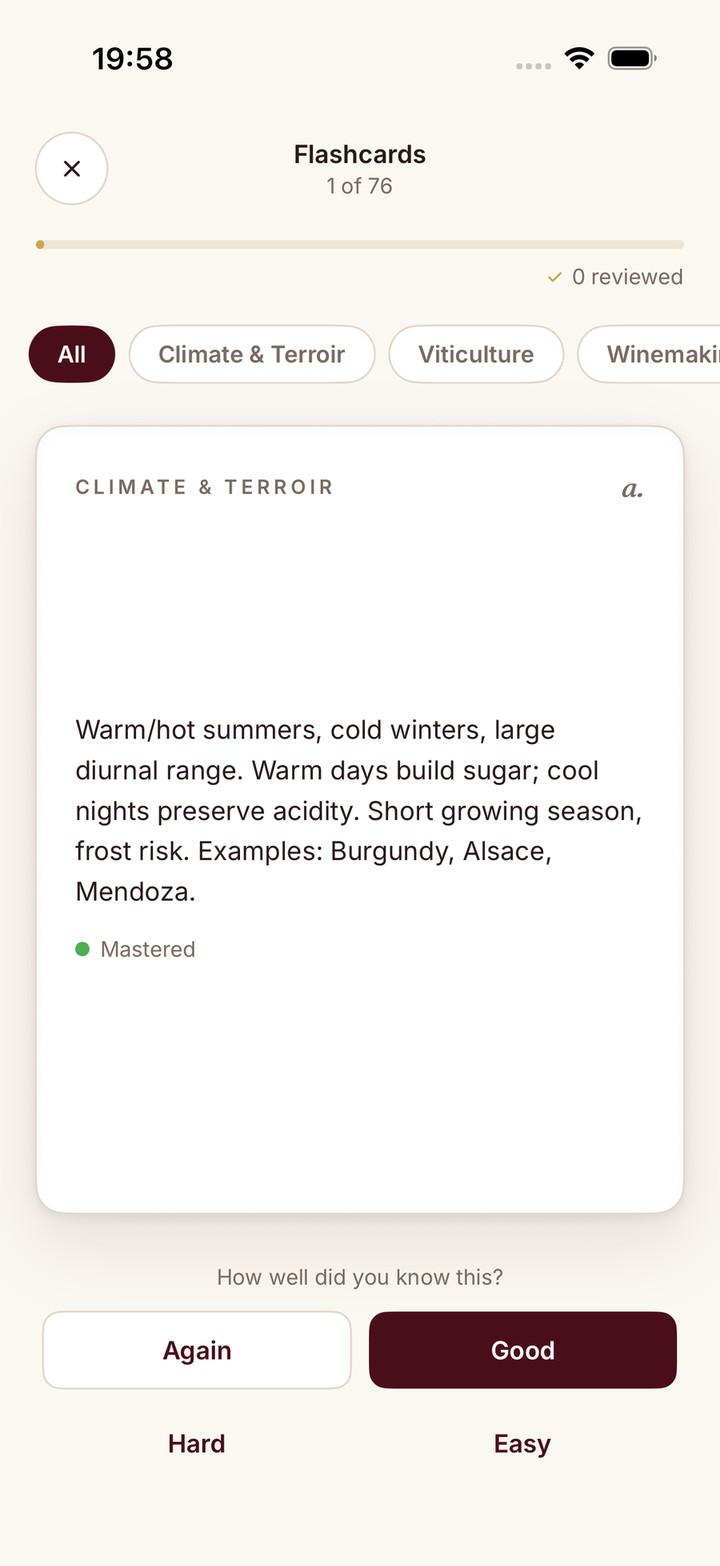
WSET第三級速查表:風土、產區與品質
免費的WSET第三級速查表(繁體中文版)。氣候與風土、葡萄種植與釀造工藝、世界主要葡萄酒產區以及品質評鑑,全部濃縮整理。
氣候類型
氣候概覽
涼爽大陸性氣候——冬季寒冷,夏季溫暖,晝夜溫差大。例如:Burgundy、Alsace。 溫暖大陸性氣候——夏季炎熱,冬季寒冷。例如:Mendoza(海拔調節氣溫)。 海洋性氣候——氣溫溫和,全年降雨,受海洋影響。例如:Bordeaux、Marlborough、Oregon(Willamette Valley)。 地中海氣候——夏季炎熱乾燥,冬季溫和多雨。例如:Southern Rhône、Barossa、Priorat。品酒時運用氣候知識
氣候是評估葡萄酒時應首先使用的分析工具之一。若檢測到高酸度、中等酒精度以及細緻的果味,該酒很可能來自「涼爽氣候」。若檢測到酒體飽滿、高酒精度、成熟深色果味以及中低酸度,則考慮「溫暖氣候」。
「晝夜溫差」對於解釋結合了成熟果味與清爽酸度的葡萄酒特別有用。高海拔大陸性氣候(Mendoza、Etna)能產生這種組合,因為炎熱的白天累積糖分,而寒冷的夜晚保留了蘋果酸。
當題目要求解釋特定產區的葡萄酒風格時,請務必從氣候開始。說明氣候類型,識別關鍵特徵,並將其與您預期的葡萄酒特性連結起來。
土壤對葡萄酒的影響
土壤類型
土壤透過熱量、排水、水分和養分影響葡萄藤。礫石通常排水良好並儲熱;黏土保水且升溫較慢。白堊及部分石灰岩土壤可兼具排水和儲水能力。板岩可儲熱;花崗岩土壤往往肥力較低。火山土隨材料和結構而異。土層深度與結構很重要,地質名稱本身不保證特定風味或酸度。連結土壤與品酒筆記
土壤透過三種主要機制影響葡萄酒:排水(控制葡萄藤水分脅迫)、肥力(控制活力)以及熱特性(影響成熟度)。在考試回答中,請務必說明相關機制。
例如,Haut-Médoc的礫石土壤提供了極佳的排水性(防止積水)並保留熱量(幫助Cabernet Sauvignon成熟)。Burgundy的石灰岩促進了較高的酸度,並產生適度的水分脅迫以限制產量。Mosel的板岩吸收太陽能並輻射回地面,在邊緣涼爽氣候中延長了生長季節。
切勿在未解釋其影響的情況下單純陳述土壤類型。考官尋找的是土壤與葡萄酒之間的「連結」。
葡萄栽培決策
「整枝系統」的選擇旨在適應氣候。灌木型(gobelet)在炎熱乾燥的地中海氣候中很傳統,因為低矮的樹冠能遮蔽果實,避免強烈日曬。VSP(垂直枝條固定)是現代葡萄園進行高效樹冠管理的主流。棚架系統則在炎熱氣候中提供遮蔭。
「產量控制」是最常考的主題之一。產量越低通常與濃縮度相關,但兩者並非線性關係。理想狀態是適度、受控的脅迫,在不損害葡萄藤健康的前提下限制果實大小(提高皮汁比)。
「樹冠管理」(除葉、枝條定位)能改善通風(減少病害),並調節日照以確保成熟均勻。「採收時機」決定了酸度(早期)與糖分/酚類物質(晚期)之間的平衡。
釀造技術
發酵前處理
- 冷浸漬 (Cold soak) - 在不萃取粗糙單寧的情況下提取顏色與果味
- 整串發酵 (Whole-bunch inclusion) - 增加結構感、香料味與清爽度
- 補糖 (Must enrichment/chaptalisation) - 提高潛在酒精濃度
- 帶皮浸漬 (Skin contact,白葡萄酒) - 增強酒體與芳香複雜度
發酵
- 溫度 - 低溫(白葡萄酒:保留芳香)、高溫(紅葡萄酒:促進萃取)
- 容器 - 不鏽鋼桶(中性)、橡木桶(賦予風味與質地)、水泥槽(熱穩定性)
- 酵母 - 商業酵母(穩定可靠)與原生酵母(複雜度高、具風土表現力)
發酵後處理
- 蘋果酸乳酸發酵 (MLF) - 將蘋果酸轉化為乳酸(柔化口感、增加奶油感)
- 酒泥接觸/攪桶 (Lees contact/bâtonnage) - 豐富質地,增添麵包與堅果氣息
- 橡木桶陳年 - 新桶(賦予風味:香草、烘烤味)與舊桶(僅進行溫和的氧化)
- 澄清與過濾 - 用於澄清酒液;過度使用可能會剝奪葡萄酒的個性
法國橡木桶與美國橡木桶
法國橡木桶:紋理細密;帶有細緻的香草、香料、雪松氣息;單寧細膩融合;成本較高。常見於 Burgundy、Bordeaux、Barolo。
美國橡木桶:紋理寬鬆;帶有椰子、蒔蘿、甜香草氣息;單寧較強勁;成本較低。常見於 Rioja 及部分澳洲 Shiraz。
225公升的 Barrique 桶比 500公升的 Puncheon 桶或 2,000公升的 Foudre 桶有更高的橡木接觸面積。新桶賦予的風味最為強烈;使用 3–4 次後,橡木桶通常被視為中性。
法國:Bordeaux
左岸與右岸
左岸 (Médoc、Graves):以 Cabernet Sauvignon 為主,礫石土壤,結構感強且單寧緊實,適合陳年,擁有 1855 Classification。
右岸 (Saint-Émilion、Pomerol):以 Merlot 為主,黏土與石灰岩土壤,口感圓潤柔和,適飲期較早,擁有 Saint-Émilion Classification。
左岸村莊
Margaux - 香氣馥郁、優雅、單寧絲滑。Saint-Julien - 平衡,品質穩定。Pauillac - Médoc 的核心,擁有三座一級酒莊,Cabernet Sauvignon 結構強勁。Saint-Estèphe - 黏土較多,單寧較緊實,風格嚴謹。Pessac-Léognan - 同時生產紅葡萄酒與乾型白葡萄酒,代表酒莊為 Château Haut-Brion。
1855 Classification 將 61 家紅酒酒莊分為五個等級。1855年梅多克分級基本保持不變。木桐酒莊於1973年從二級莊晉升為一級莊。一級酒莊包括:Lafite Rothschild、Latour、Margaux、Haut-Brion、Mouton Rothschild。
右岸與甜型葡萄酒
Saint-Émilion - 產區廣大且多樣,位於石灰岩高原與黏土坡地上。Premier Grand Cru Classé A 為最高等級(歷史上為 Ausone 與 Cheval Blanc)。
Pomerol - 產區小而尊貴,無官方分級。黏土土壤與富含鐵質的底土造就了豐腴、性感的 Merlot。Château Pétrus 與 Le Pin 是最負盛名的酒莊。
Sauternes 與 Barsac - 由 Sémillon、Sauvignon Blanc 與 Muscadelle 釀造的貴腐甜酒。Ciron 河的晨霧促進了貴腐菌生長,濃縮了糖分並增添了杏桃、蜂蜜與柑橘果醬的複雜香氣。
法國:Bourgogne
Côte de Nuits
主要生產 Pinot Noir 紅葡萄酒,是 Burgundy 最偉大紅酒的產地。主要村莊(由北至南):
Gevrey-Chambertin - 擁有最多 Grand Cru 的村莊,結構強勁。Grand Crus:Chambertin、Chambertin-Clos de Bèze。Morey-Saint-Denis - Clos de la Roche、Clos Saint-Denis。Chambolle-Musigny - 優雅、芳香、質地絲滑。Grand Crus:Musigny、Bonnes-Mares。Vougeot - Clos de Vougeot(50 公頃,超過 80 位業主)。Vosne-Romanée - 最負盛名的村莊。Grand Crus:Romanée-Conti、La Tâche、Richebourg。Nuits-Saint-Georges - 無 Grand Crus,但擁有優秀的 Premiers Crus,酒體較緊實。
Côte de Beaune
同時生產紅、白葡萄酒,擁有世界上最偉大的 Chardonnay 葡萄園。Pommard - 紅酒結構緊實。Volnay - 紅酒優雅芳香。
Meursault - 濃郁、帶有奶油與榛果氣息的 Chardonnay。Puligny-Montrachet - 白 Burgundy 的巔峰:優雅、礦物味、濃縮。Grand Crus 包括 Le Montrachet。Chassagne-Montrachet - 風格稍顯豐厚。Corton - Côte de Beaune 唯一的紅酒 Grand Cru;Corton-Charlemagne 則為白酒。
Chablis 與南 Burgundy
Chablis - 位於最北端,在 Kimmeridgian 石灰岩土壤上種植,通常不經橡木桶或輕微過桶。酸度清爽,礦物味純淨。Chablis Grand Cru是一個包含七個climat的法定產區。
Côte Chalonnaise (Mercurey、Givry、Rully、Montagny) - 性價比高的 Pinot Noir 與 Chardonnay。
Mâconnais - 氣候較暖,Chardonnay 風格較豐厚。Pouilly-Fuissé 是頂級產區。
Beaujolais - 在花崗岩土壤上種植 Gamay。10 個特級村莊(如 Morgon、Moulin-à-Vent、Fleurie、Brouilly 等)生產最嚴肅的葡萄酒。
法國:Rhône 河谷
北 Rhône
河谷陡峭,屬大陸性氣候。Syrah 是唯一允許的紅葡萄品種。
Hermitage - 最負盛名,強勁、濃縮,可陳年數十年。Côte-Rôtie - 「烘烤坡」,優雅,有時會與 Viognier 混釀。Condrieu - Viognier 白酒,濃郁芳香。Cornas - 100% Syrah,最為強勁且單寧重。Saint-Joseph - 中等酒體,易飲。Crozes-Hermitage - 產區最大,酒體較輕,性價比高。
南 Rhône
地中海氣候,受密斯托拉風 (Mistral wind) 影響顯著(冷卻、乾燥、預防病害)。葡萄酒通常以 Grenache 為主導進行混釀。
Châteauneuf-du-Pape - 旗艦產區,以 galets roulés(能儲存熱量的鵝卵石)聞名,最多允許使用 13 種葡萄品種。酒體飽滿,帶有香料、乾草本與灌木叢 (garrigue) 的特徵。
Gigondas - 「平民的 Châteauneuf」,結構稍強。Vacqueyras - 風格相似,酒體稍輕。Côtes du Rhône 與 Côtes du Rhône-Villages - 區域級產區,提供極佳的性價比。
義大利
Piedmont
Barolo - 使用 Nebbiolo;最少陳年 38 個月(其中 18 個月在木桶中);Riserva 需 62 個月。風格強勁、單寧重、結構感強。主要村莊:La Morra、Barolo、Serralunga、Castiglione Falletto、Monforte。
Barbaresco - 使用 Nebbiolo;最少陳年 26 個月(其中 9 個月在木桶中);Riserva 需 50 個月。風格較優雅,適飲期較早。主要村莊:Barbaresco、Neive、Treiso。
兩者皆具備高酸度、高單寧、淺石榴紅色,以及焦油、玫瑰、乾櫻桃、松露與甘草的複雜香氣。
Barbera d’Asti / d’Alba - 高酸、低單寧、充滿櫻桃果汁感的紅酒。是 Piedmont 種植最廣的葡萄品種。
Tuscany
Chianti Classico - 最少80% Sangiovese。分為三個等級:Chianti Classico(陳年12個月)、Riserva(陳年24個月)、Gran Selezione(陳年30個月,使用酒莊自種葡萄)。
Brunello di Montalcino是以100%桑嬌維塞釀製、強勁且耐陳年的托斯卡納DOCG。至少在橡木中熟成兩年,並從採收後第五年的1月1日起上市;Riserva從第六年起上市。
Super Tuscans - 誕生於1970年代,在傳統法規之外使用國際品種與法國橡木桶。最初為Vino da Tavola,現在多為IGT Toscana。Bolgheri DOC產區亦涵蓋了這些葡萄酒。
Veneto
Valpolicella - 以Corvina為主,酒體輕盈,帶有櫻桃果味。Amarone della Valpolicella - 採用appassimento風乾葡萄技術,釀造出風味濃郁、酒精度高(14–17% ABV)的葡萄酒。Ripasso - 將Valpolicella葡萄酒在Amarone的果皮上進行二次發酵,結合了兩者的特色。Soave - 以Garganega釀造的白葡萄酒;產自火山岩山坡的Classico等級品質最佳。西班牙
Rioja
子產區:Rioja Alta(氣候較涼爽,海拔較高,風格優雅)、Rioja Alavesa(位於巴斯克地區,石灰岩土壤,香氣馥郁)、Rioja Oriental(氣候較溫暖,酒體較飽滿,常作為混釀使用)。
Tempranillo為主要品種,常與Garnacha、Graciano和Mazuelo混釀。傳統Rioja使用美國橡木桶(帶有椰子、香草味);現代酒莊則多使用法國橡木桶(帶有香料、烘烤味)。
陳年分級:Joven(極少或無橡木桶陳年)、Crianza(1年橡木桶/總共2年)、Reserva(1年橡木桶/總共3年)、Gran Reserva(2年橡木桶/總共5年)。
Ribera del Duero & Priorat
Ribera del Duero - 位於高海拔高原(700–1,000公尺)。極端的大陸性氣候造就了濃郁、強勁的Tempranillo(Tinto Fino)。高海拔在炎熱的日間氣溫下仍能保留酸度。Vega Sicilia和Pingus是該產區的標竿酒莊。
Priorat - 西班牙僅有的兩個DOCa產區之一(另一個是Rioja)。在llicorella(板岩與石英)梯田上種植老藤Garnacha和Cariñena。葡萄酒風味極度濃縮,帶有礦物味、高酒精度與卓越的深度。
德國
Prädikat Levels & VDP
Prädikat等級(按成熟度遞增):Kabinett(最輕盈,通常為半乾型)→ Spätlese(晚收)→ Auslese(精選串選,半甜型)→ Beerenauslese(貴腐菌,甜型)→ Eiswein(冰凍葡萄,甜型)→ Trockenbeerenauslese(乾果粒,極甜)。
VDP分級(私人協會,採用勃根地式階梯):Gutswein(區域級)→ Ortswein(村莊級)→ Erste Lage(Premier Cru)→ Grosse Lage(Grand Cru)。來自Grosse Lage的乾型葡萄酒標示為Grosses Gewächs (GG)。
Key German Regions
Mosel - 極其陡峭的板岩坡地,產出充滿活力、香氣馥郁的Riesling,酸度高,酒精度低(半乾型通常為7–9% ABV)。關鍵村莊:Bernkastel、Piesport、Wehlen、Ürzig。
Rheingau - 沿萊茵河的南向坡地,產出酒體較飽滿的Riesling。同時生產乾型與甜型風格。
Pfalz - 德國最溫暖、陽光最充足的產區之一(受Haardt山脈屏障保護),不過再往南的Baden才是德國整體最溫暖的產區。以Riesling為主,但Pinot Noir(Spätburgunder)、Pinot Blanc和Pinot Gris也生長良好。
Nahe - 多元化的產區,結合了Mosel的優雅與Rheingau的酒體。Franken - 以獨特的bocksbeutel瓶裝,生產乾型、帶有泥土氣息的Silvaner。
新世界產區
California & Oregon
Napa Valley - 美國最負盛名的葡萄酒產區。關鍵子產區:Rutherford(以「Rutherford塵土味」聞名)、Oakville(平衡的Cabernet)、Stags Leap District(優雅、單寧柔和)、Howell Mountain(強勁、單寧重)、Carneros(涼爽多霧:Pinot Noir和Chardonnay)。
Sonoma County - 風格更多元:Russian River Valley(涼爽多霧:出色的Pinot Noir和Chardonnay)、Dry Creek Valley(較溫暖:老藤Zinfandel)、Alexander Valley(濃郁的Cabernet)、Sonoma Coast(山脊上的真正涼爽氣候條件)。
Oregon, Willamette Valley - 涼爽的海洋性氣候,常被與勃根地相比。產出優雅的Pinot Noir,帶有紅櫻桃、泥土氣息與香料味。
South America
Chile - 位於安地斯山脈與太平洋之間的狹長地理環境。Maipo Valley(波爾多風格的Cabernet)、Colchagua(濃郁的Carmenère)、Casablanca(涼爽、受海洋影響的Sauvignon Blanc和Pinot Noir)、Leyda(更涼爽,清爽的Sauvignon Blanc)。
Argentina, Mendoza - 高海拔大陸性氣候(800–1,500公尺)。陽光充足,晝夜溫差大。Luján de Cuyo(傳統Malbec的核心地帶)、Uco Valley(海拔更高,風格更精緻,酸度更明亮)。Salta/Cafayate - 擁有世界上海拔最高的商業葡萄園(高達3,000公尺)。
澳洲
Barossa Valley - 溫暖的地中海氣候,酒體飽滿濃郁的 Shiraz,老藤葡萄具有極高的集中度(部分樹齡超過150年)。Eden Valley - 海拔較高,氣候較涼爽,出產更優雅的 Shiraz 和世界級的乾型 Riesling。Clare Valley - 大陸性氣候,帶有青檸汁般酸度的極乾型 Riesling。
McLaren Vale - 溫暖的海洋性氣候,口感豐腴的 Shiraz,帶有巧克力風味與柔順單寧。Coonawarra - 涼爽的海洋性氣候,紅土土壤,結構感強的 Cabernet,帶有尤加利葉氣息。Margaret River - 海洋性氣候,優雅且風格類似 Bordeaux 的 Cabernet 與 Chardonnay。Hunter Valley - 具有驚人陳年潛力(20年以上)的 Sémillon。Yarra Valley - 涼爽氣候,Burgundy 風格的 Pinot Noir。Tasmania - 涼爽氣候,高酸度的起泡酒、Pinot Noir 與 Chardonnay。
紐西蘭與南非
Marlborough - 紐西蘭最大且最著名的產區。海洋性氣候,日照時間長。濃郁的 Sauvignon Blanc,帶有百香果、醋栗與草本氣息。
Central Otago - 世界最南端的重點葡萄酒產區。大陸性氣候,晝夜溫差極大。集中度高、芳香四溢的 Pinot Noir。Martinborough - 避風且乾燥:優雅的 Burgundy 風格 Pinot Noir。Hawke’s Bay - 紐西蘭最溫暖的主要產區:Bordeaux 風格紅葡萄酒與 Syrah。
Stellenbosch - 南非最重要的紅葡萄酒產區:Cabernet Sauvignon、Bordeaux 混釀與 Syrah。Swartland - 老藤 Chenin Blanc,Rhône 風格紅葡萄酒。Elgin and Walker Bay - 涼爽氣候下的 Pinot Noir 與 Chardonnay。
氣泡酒的釀造
傳統法步驟
- 基酒生產(高酸度、中等酒精度)
- 調配(跨品種、葡萄園、年份進行混釀)
- 加入調配液(糖與酵母)
- 在密封瓶中進行二次發酵(產生二氧化碳)
- 第二次發酵後,死亡酵母細胞逐漸分解(自溶)。長期酒泥接觸可發展麵包、餅乾和布里歐香氣,以及更飽滿、柔滑的質感。 無年份香檳須至少帶酒泥熟成12個月,上市前總熟成至少15個月。年份香檳要求至少三年總熟成,並非必須三年全部帶酒泥。
- 轉瓶(rémuage)- 將沉澱物移至瓶頸
- 除渣(dégorgement)- 排出沉澱物
- 補液(dosage)- 調整甜度
- 上塞、加鐵絲罩並靜置後上市
Champagne 補液甜度等級
Brut Nature - 0–3 g/L 糖分 Extra Brut - 0–6 g/L Brut - 0–12 g/L Extra Dry - 12–17 g/L Dry (Sec) - 17–32 g/L Demi-Sec - 32–50 g/L Doux - 50+ g/L其他氣泡酒方法與產區
槽式法(Charmat/Martinotti/cuve close) — 槽式法在加壓槽中進行第二次發酵。短期酒泥接觸通常保留果香;加壓過濾及裝瓶可保留溶解的二氧化碳。阿斯蒂僅進行一次部分發酵:冷藏葡萄汁以推遲發酵,之後透過降溫與過濾停止發酵以保留葡萄糖分。
轉移法(Transfer method) — 雖然兩種方法的二次發酵都在瓶中進行,但轉移法省去了勞力密集的轉瓶與除渣程序。取而代之的是,酒液在壓力下被轉移到罐中,過濾後再重新裝瓶。
祖傳法(méthode ancestrale/pét-nat) — 單一發酵在尚未完成時便裝瓶,殘餘糖分持續發酵所產生的二氧化碳因此封鎖於瓶內——沒有第二次發酵,不添加調配液,通常也不進行補糖。酒款經常呈混濁狀,氣壓較低,帶有微微的半乾口感,例如Blanquette de Limoux méthode ancestrale與Clairette de Die。
充氣法向已釀好的靜態葡萄酒注入二氧化碳。該步驟產生氣泡,但不產生酒泥或自溶香氣。此法快速且成本低,常用於簡單果香型酒;基酒仍影響最終風格。
Cava — 西班牙採用傳統法釀造的起泡酒,主要使用Macabeo、Parellada與Xarel-lo葡萄品種。需在酒泥上陳釀至少9個月。產區多位於加泰隆尼亞的Penedes。 Xarel-lo帶來酒體、結構以及有助於Cava陳年的泥土與樹脂般特質。Macabeo貢獻清新果味,Parellada增添細緻感、酸度與花香,而Trepat則是僅用於粉紅酒(rosado)的紅葡萄品種。
Franciacorta — 義大利倫巴底產區的高級傳統法起泡酒,主要使用Chardonnay與Pinot Nero。需在酒泥上陳釀至少18個月(年份酒/Millesimato為30個月)。常被拿來與Champagne相提並論。
英國起泡酒 — 涼爽氣候下以傳統法釀造的起泡酒,使用Chardonnay、Pinot Noir與Pinot Meunier葡萄,主要種植於Kent、Sussex與Hampshire的白堊/石灰岩土壤——與Champagne地質相同。天然高酸度與長時間酒泥陳釀,造就近似Champagne的風格,且品質快速提升。
Sekt標籤與來源 — 僅標Sekt的酒可使用其他歐盟國家葡萄釀成的基酒。Deutscher Sekt要求德國葡萄。這兩個術語本身都不保證生產方法;Winzersekt則要求傳統瓶內發酵。
優質氣泡酒的涼爽產區 — 夏多內和黑皮諾是澳洲塔斯馬尼亞、雅拉谷、阿德雷德山區,紐西蘭馬爾堡,以及加州安德森谷和洛斯卡內羅斯優質傳統法氣泡酒的重要葡萄。塔斯馬尼亞的偏南緯度與阿德雷德山區的海拔帶來涼爽;海霧與涼風使加州這些地點降溫。涼爽成熟保留新鮮基酒所需酸度。馬爾堡結合成熟果味與清爽酸度;之後的酒泥熟成可增加麵包與餅乾複雜度。
Port 風格
Ruby 與 Tawny 的區別
Ruby 風格在大型惰性容器中進行還原法陳釀,最大限度減少與氧氣接觸,從而保留新鮮、果味濃郁的年輕特質。酒色保持深紅寶石紫色。風格包括:Ruby、Reserve Ruby、LBV、Crusted 與 Vintage Port。
Tawny 風格在小型橡木桶中進行氧化法陳釀。經過數年甚至數十年,酒色從紅寶石色褪變為琥珀色。風味從新鮮果味演變為乾果、堅果、焦糖、奶油糖果與太妃糖風味。風格包括:Tawny、10/20/30/40年陳年、Colheita。
Vintage Port 是 Ruby 風格的巔峰之作——僅在卓越年份宣告生產,裝瓶時年輕,旨在瓶中陳年20至50年以上。
Sherry 風格
Sherry 概覽
Fino - 在酒花(flor)覆蓋下陳釀,酒色淺,乾型,帶有酵母與杏仁味。Manzanilla - 在酒花覆蓋下陳釀(產自 Sanlúcar),酒體更輕,帶有鹹味。Amontillado - 先經酒花覆蓋再氧化陳釀,琥珀色,堅果味,乾型。Oloroso - 完全氧化陳釀,深色,濃郁,核桃味,乾型。Palo Cortado - 介於 Amontillado 與 Oloroso 之間(罕見)。Pedro Ximénez - 經陽光曝曬的葡萄釀造,極甜,帶有葡萄乾與咖啡味。Solera 系統
Solera 系統是一種分段調配法,旨在確保品質的一致性。橡木桶按層次排列,稱為 criaderas。裝瓶時從最底層(即 solera)抽取酒液。每一層隨後由上一層的酒液補足。每次僅抽取一部分(通常為三分之一或更少),這意味著 solera 系統中始終包含多個年份的酒液調配。酒花(Flor)及其影響
酒花(Flor)是一種 Saccharomyces 酵母薄膜,形成於酒液表面。它需要15–15.5%的酒精度、15–20°C 的溫度以及充足的營養。酒花能保護酒液免受氧化(使其保持淺色與新鮮),消耗殘糖與甘油(使酒液變得極乾且酒體輕盈),並賦予獨特的風味:酵母、麵包麵團、杏仁與洋甘菊。在 Sanlúcar de Barrameda,沿海濕度支持更厚的酒花,賦予 Manzanilla 更輕盈、更具鹹味的特質。品質評估(SAT)
品質等級
有缺陷 (Faulty) - 存在明顯缺陷(如 TCA、揮發酸、氧化)。差 (Poor) - 無缺陷但不平衡或缺乏特質。可接受 (Acceptable) - 純淨、簡單、平衡。良好 (Good) - 平衡感良好,具備一定複雜度,餘味中等。非常良好 (Very good) - 平衡感極佳,複雜度高,餘味悠長。傑出 (Outstanding) - 卓越的複雜度與集中度,餘味非常悠長。
關鍵品質指標:平衡、持久度、濃郁度、複雜度。
如何評估品質
- 檢查缺陷 - 是否有 TCA(霉味)、揮發酸(醋味)、氧化(爛蘋果味)、還原(火柴味)?
- 評估平衡 - 酸度、酒精度、單寧、甜度、酒體與風味是否融合?
- 評估持久度 - 短(<5秒)= 可接受;中等(5–10秒)= 良好;長(10–20秒)= 非常良好;非常長(20秒以上)= 傑出。
- 判斷濃郁度 - 是集中還是稀薄?是奔放還是內斂?
- 評估複雜度 - 有多少種不同的芳香與風味?它們在杯中是否會演變?
- 評定品質並說明理由 - 參考品飲筆記中的具體標準。
主要的因果關聯鏈
- 高海拔 → 晝夜溫差大 → 在保持酸度的同時達到果實成熟 → 清爽且集中。
- 黏土可保水,在乾旱時幫助供水;效果取決於排水和栽培管理。梅洛相對早熟,黏土並不保證成熟度或強勁酒體。
- 新法國橡木桶 → 木紋細緻 → 帶有細膩的香草、雪松與融合的單寧。
- 新美國橡木桶 → 木紋較寬 → 帶有濃郁的椰子、蒔蘿與甜香草味。
- 疏果可幫助負載過高的葡萄藤使剩餘果實成熟。如果原有負載已平衡,減少果串只會降低產量,不一定改善品質;地點和目標風格同樣重要。
- 整串發酵 → 果梗貢獻單寧與芳香化合物 → 增加香料味、清爽感與結構骨架。
- 晚收 → 糖分更高 → 酒精度更高,風味更成熟 → 失去酸度的風險。
- 低溫發酵(白葡萄酒) → 酵母活動緩慢 → 保存揮發性芳香化合物 → 清爽、果味濃郁的葡萄酒。
- 阻斷蘋果酸乳酸發酵 (MLF) → 保留蘋果酸 → 維持清爽、尖銳的酸度(如德國 Riesling、紐西蘭 Sauvignon Blanc)。
- 鼓勵蘋果酸乳酸發酵 (MLF) → 轉化為柔和的乳酸 → 口感更圓潤、奶油感,帶有奶油風味(如經橡木桶的 Chardonnay)。
- 貴腐菌 (Botrytis) → 使葡萄脫水 → 濃縮糖分、酸度與甘油 → 帶來蜂蜜、杏桃的複雜度(如 Sauternes、Tokaji)。
- 二氧化碳浸漬法 → 細胞內發酵 → 單寧極低 → 柔和、果味、帶有糖果氣息(如 Beaujolais Nouveau)。
- 風乾法 (Appassimento) → 水分蒸發 → 糖分濃縮 → 高酒精度、酒體飽滿、乾果風味濃郁(如 Amarone)。
- 酒泥陳釀 → 死酵母細胞釋放蛋白質 → 奶油質地,帶有麵包/堅果風味(如 Muscadet、Champagne)。
- 酒花陳釀 → 酵母薄膜保護免受氧化 → 極乾、輕盈、淺色、帶有酵母/杏仁特質(如 Fino Sherry)。
- 氧化陳釀 → 受控的氧氣接觸 → 酒色變深,發展出堅果/乾果風味(如 Oloroso、Tawny Port)。
- 陡坡 → 陽光照射角度改善 → 在邊緣氣候下能更好地成熟(如 Mosel、Côte-Rôtie)。
- 海洋性氣候 + 礫石 → 排水性抵消降雨 → 適度的水分脅迫 → 集中度高(如 Bordeaux 左岸)。
- 地中海氣候 + Mistral 風 → 冷卻、乾燥 → 減少病害,保持清爽(如 Rhône 南部)。
- 視結構和深度而定,石灰岩土壤可排出多餘水分,同時保留根系可用的水。物理特性影響藤體生長;石灰岩不會直接賦予酒某種風味,也不保證高酸度。
法國:羅亞爾河與阿爾薩斯
羅亞爾河谷
Sèvre et Maine 是 Muscadet 最好的子產區。「Sur lie」表示葡萄酒在裝瓶前一直與酒泥接觸陳釀,這增加了酒體的豐富度、質感以及輕微的氣泡感。
Sancerre 的紅酒與粉紅酒以 Pinot Noir 釀造。Cabernet Franc 則主導 Touraine(Chinon、Bourgueil)的紅酒,而非中央產區。
這些位於 Touraine 與 Anjou-Saumur 的法定產區以 Cabernet Franc 釀造清新、酒體中等的紅葡萄酒,常帶有紅色水果、葉片與石墨氣息。Cabernet Sauvignon 至多僅扮演次要角色。
Quarts de Chaume Grand Cru 在 Layon 河上方陡峭的朝南坡地上,以貴腐 Chenin Blanc 釀造極為濃郁的甜酒,是 Loire 唯一的 Grand Cru 法定產區。Montlouis 與 Vouvray 則是位於更上游的 Touraine 法定產區。
Savennières 釀造結構扎實、耐久存的乾型 Chenin Blanc。其陡峭的朝南片岩坡地地勢高聳、開闊無遮蔽地俯瞰 Loire 河,強風與良好的排水使果實保持健康,貴腐鮮少發生,因此葡萄得以發酵至全乾。往南僅數公里處的 Coteaux du Layon 谷地則會困住秋季的河霧,並在午後陽光下散去,這正是催生甜型 Layon 與 Quarts de Chaume 的經典貴腐中氣候(mesoclimate)。相同的葡萄、相隔僅數公里,風格卻截然相反,原因就在於地塊本身。
儘管名稱如此,Muscadet 與 Muscat 毫無關係,它是以 Melon de Bourgogne(當地簡稱為「Melon」)釀造,這是一種中性、高酸度、非常適合陳釀於酒渣(sur lie)的品種。
阿爾薩斯
傳統上,Alsace Grand Cru 僅允許使用四種「貴族」品種:Riesling、Gewürztraminer、Pinot Gris 和 Muscat。此外,Sylvaner 在 Zotzenberg 產區亦被允許使用。
在 Alsace,Vendange Tardive 意為晚收。這些葡萄酒由過熟的葡萄釀製,風味濃郁,口感從乾型到半乾型或甜型皆有。
SGN 是 Alsace 最甜美的葡萄酒,以個別挑選、感染貴腐(botrytis)的葡萄粒釀成,糖度極高,且僅限四大高貴品種使用。其糖度濃縮程度高於 Vendanges Tardives 一個等級。
Chardonnay 在 Alsace 僅獲准用於 Crémant d’Alsace,也就是本產區的傳統法氣泡酒,其基酒通常以 Pinot Blanc/Auxerrois 為主。它不得用於任何靜態的 Alsace AOC 或 Alsace Grand Cru 葡萄酒,後者幾乎都是單一品種酒,主要為 Riesling、Pinot Gris、Gewurztraminer、Muscat、Sylvaner、Pinot Blanc,紅酒與粉紅酒則使用 Pinot Noir。
標示單一品種的 Alsace 葡萄酒必須是 100% 該指定品種。混釀酒則須標示為 Edelzwicker 或 Gentil(後者要求高貴品種須達最低比例)。
西側的孚日山脈遮蔽了帶來降雨的大西洋氣流,使 Alsace 擁有乾燥、陽光充足的半大陸性氣候(科爾馬是法國最乾燥的城鎮之一)。
Gewürztraminer 是一種粉紅果皮、香氣濃郁的品種,釀成酒體飽滿、酒精濃度高,帶荔枝、玫瑰與香料氣息的白葡萄酒,且酸度明顯偏低,成酒常帶一絲微甜。相較之下,Riesling 則是 Alsace 中酸度較高、風格更內斂的品種。
法國:南部產區
朗格多克-胡西雍與普羅旺斯
位於南隆河的 Tavel 僅能生產粉紅葡萄酒,不得生產紅酒與白酒,主要以 Grenache 與 Cinsault 釀造。相對較長的浸皮時間造就色澤深邃、酒體飽滿、酒精濃度 13-14% 的乾型粉紅酒,與淺色的 Provence 風格截然不同。它是隆河唯一僅產粉紅酒的法定產區,也是法國最著名的一個,但並非唯一:Rosé d’Anjou、Cabernet d’Anjou 與 Rosé des Riceys 同樣是僅產粉紅酒的 AOC。
Picpoul de Pinet 位於 Sète 附近的 Étang de Thau 湖畔,是只產白葡萄酒的法定產區,完全以 Piquepoul Blanc 釀造。這個品種很罕見地能在如此炎熱的地中海環境中保有高天然酸度,而海洋與潟湖的微風調節了熱度,使酸度得以維持到採收,這正是這款酒能與潟湖牡蠣相得益彰的原因。Corbières、Minervois 與 Côtes du Roussillon 則全都以紅葡萄酒為絕對主力。
Côtes du Roussillon 涵蓋全區的紅、白、粉紅葡萄酒,而 Villages 等級僅限紅葡萄酒,且侷限於一組指定村莊的坡地地塊,其中大多位於北部 Agly 河谷一帶。這些地塊坐落於貧瘠的片岩與花崗岩上,Villages 等級同時也有較低的最高產量規定,因此果實更為濃縮,紅葡萄酒也比一般法定產區更飽滿、更深沉。Roussillon 的加烈酒完全不在此列:它們擁有自己的法定產區,如 Rivesaltes、Maury 與 Banyuls。
紅葡萄酒 Bandol 必須含有至少 50% 的 Mourvèdre,多數認真的酒莊使用的比例還更高。Bandol 面向地中海、朝南的梯田圓形劇場地形提供了這個極晚熟品種所需的持續晚季熱能,而成熟的 Mourvèdre 正是 Bandol 深沉色澤、緊密單寧與野味、肉感特質的來源。Grenache 與 Cinsault 是獲准的搭配品種,作用在於柔化與增添香氣,而非定義這款酒。
紅葡萄酒 Bandol 必須在木桶中至少待滿 18 個月,且通常是在大型舊 foudre 中熟成,而非全新的 barrique。在大型中性容器中長時間熟成(élevage)會緩慢地引入氧氣,使 Mourvèdre 緊密的單寧聚合而變得柔和,並讓它還原性、類似農場氣息的硫化物氣味逸散,同時不會添加明顯的新橡木風味。這也是為什麼年輕的 Bandol 在上市時嘗起來仍然嚴肅緊澀,而再多陳放十年會有所回報。
Mourvèdre 萌芽晚、成熟也非常晚,因此需要一個能延續到深秋仍然炎熱的漫長生長季;若在完全成熟前採收,酒會顯得青澀、單寧粗糙且帶植物味。法國只有最溫暖的地塊能提供這樣的條件,其中首推面向地中海、朝南的 Bandol 圓形劇場地形,該處的反射熱與海洋的調節作用讓成熟期得以安全地延伸到秋季。早萌芽與霜害風險描述的是 Grenache 的風險特徵,而非 Mourvèdre 的限制因素。
Carignan 天生酸度高、單寧高且色澤深濃,年輕時可能顯得收斂粗獷,因此會採用二氧化碳或半二氧化碳浸漬法,在萃取色澤的同時大幅減少單寧,並生成明亮清新的紅色果香來提升混釀的表現。它同時生長勢旺盛、產量可以極高,這正是老而低產的灌木藤備受珍視的原因:老根系上的少量收成能完全成熟,帶來過量結果的年輕藤所無法給予的濃縮度。二氧化碳浸漬法無法創造出果實本身不具備的酒精或色澤。
兩者都是憑藉一塊界定明確、條件優異的風土,從較大的法定產區中晉升而成的特級(cru)法定產區,且都僅限紅葡萄酒,並分別比 Corbières 與 Minervois 有更低的最高產量與更長的最低陳年期。較低的產量能濃縮果實中的糖分、色澤與單寧,額外的陳年則讓這些單寧有時間變得柔和,兩者共同支撐了特級名稱所帶來的較高價格。它們是完整的 AOC 而非 IGP,因此以國際品種進行品種標示並不是它們的賣點。
Fitou 由兩塊互不相連的土地組成:一塊是位於 Narbonne 以南沿海潟湖旁、以黏土與石灰岩為主的濱海區,另一塊則是地勢較高、較涼爽、位於片岩上的內陸區,兩者之間隔著 Corbières。兩區釀出的葡萄酒明顯不同,濱海區更成熟、適合較早飲用,內陸區則更緊實、演變更慢,但兩者都以 Carignan 為主,且都只能以紅葡萄酒的形式販售。使這個法定產區與眾不同的是這種分裂的風土,而非任何跨區混釀的規定。
Languedoc AOC 允許的白葡萄品種是地中海品種群,主要為 Grenache Blanc、Bourboulenc、Clairette、Marsanne、Roussanne、Vermentino 與 Piquepoul,Chardonnay 並不在其中;這個法定產區訴求的也是產地而非品種。Pays d’Oc IGP 的設立正是為了讓國際品種與品種標示在整個 Languedoc-Roussillon 各省取得合法地位,這也是本區的 Chardonnay、Merlot 與 Cabernet Sauvignon 進入市場的途徑。IGP 是較寬鬆而非較嚴格的等級:它允許的葡萄品種名單遠比 AOC 廣,產量上限也更高。
Provence 的粉紅葡萄酒採用直接壓榨法:整串黑葡萄直接進入壓榨機,果汁在極短暫的果皮接觸後便被分離,因此只從果皮萃取到微量的花青素,酒色維持極淺,酒體輕盈、果味細緻。若讓果汁與果皮接觸更久:無論是壓榨前浸皮一天以上,或從紅葡萄酒發酵槽中放血(saignée)取汁:都會萃取出多得多的色澤、單寧與風味,形成如 Tavel 那樣更深、更飽滿的粉紅酒風格。在歐盟,靜態粉紅葡萄酒不允許以紅、白酒混調的方式製作,而活性碳澄清屬於矯正性處理,並非一種酒莊風格。
Cinsault 單寧低、色澤淺卻富有香氣,因此能柔化並增添香氣於原本由單寧強勁的 Carignan 與酒精高的 Grenache 主導的混釀之中,而它色淺芬芳的果汁在 Provence 粉紅葡萄酒中尤其可貴。它同時明顯耐旱耐熱,這也是它得以在最炎熱的南部地塊延續下來的原因,但它結果量大,必須先控制產量才能展現品質。青椒香氣來自 Cabernet Franc 等品種中的甲氧基吡嗪,而非 Cinsault。
Roussillon 坐落在由 Pyrenees 山脈與 Corbières 環抱而成的天然圓形劇場地形中,是法國最炎熱乾燥的一隅:雨量極低,乾旱壓力是常態,而且大部分葡萄園位於貧瘠的片岩與花崗岩坡地上。在這樣的土壤上承受水分與養分壓力的葡萄藤結果量小,因此產量低,糖分、色澤與風味都更濃縮,這也是 Roussillon 紅葡萄酒比 Languedoc 平均更飽滿、酒精濃度更高的原因,以及它的老藤 Grenache 何以能支撐本區的加烈酒 vins doux naturels。大西洋的影響是經由 Carcassonne 以西的丘陵缺口進入,抵達的是 Languedoc 西部,而非 Roussillon。
奧地利、匈牙利與希臘
奧地利
Smaragd 是 Codex Wachau 的最高等級,要求最低 12.5% 的天然酒精濃度,且必須為乾型。其背後的機制才是重點:該規章禁止加糖增強,因此此處的酒精濃度直接反映葡萄在園中累積的糖分,這也是為什麼這套階梯衡量的是成熟度而非釀造手法。Steinfeder 的上限為 11.5%,Federspiel 則落在 11.5-12.5% 的區間。這三個名稱屬於 Vinea Wachau 種植者協會,與自 2020 年份起生效的 Wachau DAC 法規並行,而非隸屬其下。Ausbruch 則是 Burgenland 的 Rust 所使用的甜酒名稱,並非 Wachau 的等級。
Weinviertel DAC 僅使用 Grüner Veltliner。帶胡椒感的「Pfefferl」源自 rotundone,它之所以能在 Weinviertel 保留下來,是因為當地偏北的涼爽位置與深厚的黃土(loess)土壤帶來緩慢而適度的成熟:葡萄達到風味成熟度,卻不會累積過多糖分而讓寬廣的熱帶果味蓋過辛香。Riesling 雖然與 Grüner Veltliner 共同出現在多瑙河沿岸的 Kamptal、Kremstal 與 Traisental 等 DAC,但在此並不獲准使用。
Zweigelt 是 Fritz Zweigelt 於 1922 年以 Blaufränkisch × Sankt Laurent 雜交育成的品種,如今是奧地利種植面積最大的黑葡萄品種。這項雜交有其明確目的:它承襲了 Blaufränkisch 的色澤與酸度結構,卻比雙親任一方都更早、更可靠地成熟,因此能在 Sankt Laurent 座果不穩定的奧地利涼爽大陸性產區普遍成功。
在奧地利,Kabinett 是 Qualitätswein 的子類別,位於 Prädikatswein 階梯之外,而該階梯是從 Spätlese 開始的。這項區別並非只是名目上的差異:奧地利的 Kabinett 不得加糖(chaptalisation),酒精濃度也設有上限,因此它被定義為一種清爽、未加糖的乾型至微甜風格,而非含糖量(must weight)階梯上的一個級距。相較之下,在德國 Kabinett 是最低的 Prädikat 等級,因此同一個字在國界兩側代表不同的意義。
Neusiedl 湖水深不超過約 1.8 公尺,四周環繞著大片蘆葦叢,因此葡萄園旁就是一大片極淺的水域。湖水容易增溫、蒸發旺盛,秋夜裡潮濕的空氣凝結成晨霧,為 Botrytis cinerea 提供了感染果粒所需的潮濕清晨。隨後溫暖乾燥的午後則抑制黴菌轉為灰黴,而這正是貴腐所需要的交替循環。結凍得到的是 Eiswein,而持續的乾風或高溫脫水則得到葡萄乾般的果實,而非貴腐果實。
Blaufränkisch 是奧地利最具代表性的優質黑葡萄品種,也是 Mittelburgenland DAC 與 Eisenberg DAC 背後的品種。晚熟正是這種風格的關鍵:它在藤上停留得夠久,足以累積單寧與深色果味,卻仍保有極為突出的蘋果酸酸度,這也是為何它必須仰賴吹抵 Mittelburgenland 的溫暖 Pannonian 氣流才能完全成熟,以及為何較涼爽、富含鐵質的 Eisenberg 會讓同一個品種呈現更纖瘦、更具礦物感的樣貌…
Sankt Laurent 是有紀錄的 Pinot Noir 後代:一株自然生成的 Burgunder 實生苗,另一親本不明:這樣的血緣也顯現在酒杯中:中等單寧與溫和的萃取造就柔順如天鵝絨的質地,以及比 Blaufränkisch 更接近 Burgundy 的酸櫻桃(morello)香氣。這份遺傳同時帶來 Pinot 在葡萄栽培上的難處:開花期敏感、易受晚霜危害、產量偏低且不穩定,使種植面積始終不大,因此它在 Burgenland 北部與 Thermenregion 仍是專門型品種,而非量產葡萄…
Welschriesling 在其他地方釀出的乾型葡萄酒相當中性,卻是 Burgenland 貴腐甜酒的主力,而這兩件事的成因其實相同。它果皮薄,在 Seewinkel 多霧的秋季容易腐化;而它天生的高酸度,正是讓一款殘糖達 150 g/L 以上的葡萄酒喝起來清新而非甜膩的關鍵;它缺乏張揚的品種香氣在此反而是優點,因為這讓蜂蜜與杏桃乾般的貴腐風味得以主導。它的名稱容易誤導,因為這個品種與 Riesling 毫無關係。
匈牙利與希臘
Naoussa PDO 於 1971 年劃定,是一個僅產紅葡萄酒的法定產區,以種植在 Vermio 山東南坡海拔約 150-400 公尺的 100% Xinomavro 釀造。與 Nebbiolo 的比較是結構上的,而這源自此品種的組成:Xinomavro 的花青素含量低,且這些色素並不穩定,因此即使萃取充分的酒也僅呈淺寶石紅,並在數年之內轉為石榴褐色,然而它的果皮富含單寧,果實也保有高酸度(其名稱大致意指「酸黑」)。高單寧加上高酸度,正是這些酒年輕時嚴肅緊澀而又極為長壽的原因…
谷底是 Nemea 最炎熱的部分,日夜溫差的降溫效果也最小。溫暖的夜晚讓葡萄藤在整個成熟期持續呼吸消耗蘋果酸,因此酸度在糖分快速累積的同時流失,果粒也從成熟越過界線走向葡萄乾化。Agiorgitiko 本身的酸度原就只有低到中等,沒有餘裕可以損失,結果便是一款柔軟、果醬般而鬆散的葡萄酒。海拔約 450-650 公尺的山坡中段地塊被視為最佳位置,因為海拔恢復了保存酸度所需的日夜溫差,同時果實仍能成熟;最高處、可達約 900 公尺的地塊則面臨相反的風險,在涼爽年份可能成熟不足、酸度過高,但也能釀出最具結構與辛香感的酒款。單寧強硬並非問題所在,因為 Agiorgitiko 的單寧天生柔順。
Santorini 整個夏季都被 meltemi 這股強勁乾燥的北風掃過,風中夾帶著磨蝕性的沙塵與鹽分,而且此地日照強度極高。把葡萄藤盤繞成籃狀、果串垂掛在環內,等於把葉幕安置在外側作為防風屏障與遮陽傘:果實得以免於風造成的機械傷害與脫水,也被遮蔽而不受直接輻射,因而限制日灼並保住酸度與香氣前驅物質。這套系統的作用與提高產量恰恰相反,Santorini 的產量極低;它也完全排除了機械採收,因為種植者必須伸手進籃內採摘。最後一個選項把幾何關係弄反了:kouloura 使果實保持低矮、貼近地面,而持續的強風本來就讓真菌壓力非常低,因此避免病害並不是採用它的動機。
Vinsanto 是一款風乾葡萄(passito)酒,而非貴腐酒、冰酒或加烈酒。健康的葡萄被採下後攤在陽光下曝曬約兩週,水分蒸發,留下的一切都被濃縮:葡萄汁達到極高的糖度,而關鍵在於酸度也同步濃縮。發酵緩慢進行,並在酵母不堪負荷時自然停止,留下一款酒精濃度低、殘糖極高的葡萄酒。法定產區隨後要求至少兩年的橡木氧化式熟成,許多生產者陳放的時間還長得多,這正是深琥珀色澤與無花果乾、焦糖與咖啡風味的來源。Assyrtiko 極高的酸度則是這款酒嘗起來濃郁而非甜膩的原因。在如此乾燥多風的島嶼上,貴腐幾乎不可能發生。
在大多數品種中,高溫是酸度的敵人,因為葡萄藤會隨溫度上升代謝掉蘋果酸,所以一顆在炎熱地區完全成熟的葡萄進入酒廠時往往糖分充足而酸度極低。Assyrtiko 的特殊之處在於它的酸度絕大部分是酒石酸,而酒石酸不會被葡萄藤呼吸消耗,因此能在高溫與完全成熟之下幾乎原封不動地存留下來。這正是為何同一顆果粒能提供足以達到 13.5-14% 酒精濃度的糖分,卻仍釀出低 pH、緊實、帶柑橘與鹹味的葡萄酒。蘋果酸的選項把機制顛倒了:蘋果酸正是被呼吸作用消耗掉的那種酸,一個以蘋果酸為主的品種絕不可能在這樣的成熟度下保有這麼多酸度…
Furmint 萌芽早但成熟晚,因此果實在十月下旬與十一月仍掛在藤上,而那正是河霧帶來 Botrytis cinerea 的時候。這樣的時序正是穩定的 aszú 收成得以存在的根本原因:一個早熟的品種在貴腐到來之前就已被採收。當受感染的果粒皺縮之後,葡萄汁的甜度極高,而 Furmint 天生極高的酸度正是把成酒撐起來的力量。在殘糖 120 g/L 以上的情況下,一款缺少這道酸度骨幹的 Aszú 會嘗起來鬆散甜膩,也無法陳年,因此在此保住酸度遠比香氣重要。抗腐能力在這裡是負擔而非資產,而混釀中的葡萄香氣則來自少量添加的 Sárga Muskotály。
Eszencia 是在任何壓榨之前,於盛裝手摘 aszú 果粒的桶底聚積起來的糖漿狀自流汁。法規要求糖分至少達 450 g/L,實際上往往更高,如此極端的滲透壓幾乎完全抑制了酵母:發酵會緩慢爬行數年,酒精濃度鮮少超過百分之幾,這也是它在某些市場根本不能以葡萄酒的名義販售的原因。它的產量極小,同時也被用來提升 Aszú 的濃度。Aszú 本身則不同:受貴腐感染的果粒被搗成糊狀後浸泡在乾型基酒或葡萄汁中發酵,殘糖至少達 120 g/L,成酒具有正常的酒精濃度…
Hárslevelű 意為椴樹葉(菩提葉),它比 Furmint 更飽滿、香氣也更外放,釀出濃密且帶香料、花粉與接骨木花氣息的葡萄酒,但酸度的驅動力較弱。這兩個品種是互補而非可以互換的:Furmint 提供高酸度的骨幹,讓一款殘糖 120 g/L 以上的葡萄酒保持清新,而 Hárslevelű 則填滿中段口感並提升香氣。更纖瘦的骨架與更銳利的柑橘酸度正是 Furmint 而非 Hárslevelű 的貢獻;葡萄與橙花的香氣範疇屬於 Sárga Muskotály;而 Hárslevelű 恰恰與中性相反,它的香氣強度正是它被納入混釀的全部理由。
Sárga Muskotály 字面意思是「黃色 Muscat」,是 Muscat Blanc à Petits Grains 在匈牙利的名稱,為 Muscat 家族中品質最優的成員,也正是 Muscat de Beaumes-de-Venise 與 Asti 背後的同一品種。它是 Tokaj 繼 Furmint 與 Hárslevelű 之後的第三大主要品種,且僅以少量比例使用,因為其濃烈的葡萄果香與橙花香氣否則會掩蓋貴腐菌與長時間木桶陳年賦予 Aszú 的蜂蜜與柑橘果醬特質。它同樣容易感染貴腐菌,因此除了香氣之外也能貢獻 aszú 果粒…
Tokaj 位於 Bodrog 河匯入 Tisza 河之處,兩條河在秋季的清晨散發霧氣。這樣的濕度讓真菌得以感染成熟的果串並在其中蔓延;隨之而來溫暖、乾燥、晴朗的午後則抑制其擴散並使果粒脫水,於是糖分、酸度與甘油得以濃縮,風味轉為蜂蜜、杏桃與柑橘果醬。每日循環的兩個階段缺一不可。若沒有清晨的濕度,就完全不會發生感染,葡萄只會在藤上風乾,釀出的是果乾風味的甜酒而非 Aszú;而在持續潮濕的條件下,同一種真菌會轉為灰黴病,整批作物將付諸東流,這正是濕度均勻的海洋性氣候型態毫無助益的原因,也是夏季豪雨造成果皮裂開只會招來錯誤類型腐爛的原因…
葡萄牙
葡萄牙非加烈葡萄酒
Encruzado 是 Dão 的代表性白葡萄品種,得益於本產區的花崗岩土壤與涼爽的山區庇護氣候,能釀出均衡、帶礦物感、質地細膩且耐久存的白葡萄酒。Alvarinho 屬於 Vinho Verde,Antão Vaz 則屬於 Alentejo。
Baga 果皮厚、成熟較晚,天生單寧與酸度皆高,因此 Bairrada 的紅葡萄酒可以緊實且耐久存。其晚熟特性也使其容易受 Bairrada 潮濕的大西洋秋季氣候影響。
Alentejo 是溫暖乾燥、地勢大多平坦的南部產區,出產成熟、酒體飽滿、質地柔和的紅葡萄酒,通常混合 Aragonez、Trincadeira 與 Alicante Bouschet 等本地品種。涼爽帶氣泡白酒的特質則屬於北部的 Vinho Verde。
Tinta Roriz 是 Tempranillo 在 Douro 的名稱,在 Alentejo 則稱為 Aragonez。葡萄牙豐富的本土品種多樣性意味著許多葡萄擁有多個地區性同義名稱,這也是考官常考的內容。
Lisboa 是一個緊貼海洋的狹長產區,決定性的自然因素是風的曝露程度,而非緯度、海拔或法規。位於西側面海一方的葡萄園正處在寒冷、潮濕、帶鹽分的大西洋風的路徑上,這些風壓低氣溫並延緩成熟,因此葡萄酒色淺、酒體輕盈、酸度高、酒精濃度低。在縱貫該產區的數道丘陵之後,東側內陸的 Alenquer、Arruda 與 Torres Vedras 等 DOC 被屏蔽於這股風之外,因而更溫暖也更乾燥,Touriga Nacional、Tinta Roriz 與 Castelão 等黑葡萄品種得以完全成熟,釀出深邃、酒體飽滿、帶香料氣息的紅葡萄酒…
葡萄牙以兩個層級保護葡萄酒。DOC(Denominação de Origem Controlada)屬於 DOP 層級,是較嚴格的一級,明訂劃定範圍、允許的品種、最高產量與陳年規定。Vinho Regional 則是 IGP 層級的酒標用語,涵蓋範圍大得多,允許的品種清單更長,產量上限也更高…
加拿大
尼亞加拉、奧肯那根與冰酒
Icewine 的商業風險不在於採收本身,而在於等待。用於 Icewine 的果實必須從十月一路掛在藤上,直到氣溫達到 −8 °C 或更低,在 Niagara 這可能意味著十二月或一月,而在這段期間,每一次凍融循環都對果粒造成壓力。Vidal 果皮厚實堅韌、與果梗連結牢固,因此果粒既不會在內部冰晶膨脹時裂開,也不會從果串上掉落,而完整的果皮能阻擋在三個月掛果期間足以毀掉整批收成的果串腐爛。糖分並不是區別所在,因為沒有任何品種能單靠成熟達到 35 °Brix;那樣的濃度來自壓榨結凍的果實,讓水分以冰的形式留下。Vidal 也很耐冬寒,但那保護的是葡萄藤本身,而非藤上的果實。
兩種機制共同作用。Coast 山脈與 Cascade 山脈在太平洋氣流抵達內陸之前就把水氣攔下,因此 Okanagan 南部實質上是半沙漠:Osoyoos 一帶年雨量約在 300 毫米上下,相對於北方 Kelowna 的約 400 毫米:並伴隨無雲的天空與經常超過攝氏 30 度的夏季高溫,足以讓黑色 vinifera 品種成熟。同時,靠近北緯 49 度意味著仲夏日照極長,約有 14 小時的直射陽光,因此葡萄藤每天累積的光合作用時數遠多於同溫度的低緯度地塊;代價則是生長季短且結束得很突然。這份乾燥並非沒有代價:從湖泊水系取水的灌溉不可或缺,而乾燥大陸性空氣帶來的巨大日夜溫差,正是成酒得以保有酸度的原因…
Niagara 屬於涼爽的大陸性產區:生長季短且結束得早,而隆冬的低溫足以凍死芽眼並使樹幹裂開。Cabernet Sauvignon 既晚熟又是 Bordeaux 品種中最不耐寒者之一,因此在多數年份它既無法在秋季縮短生長季之前達到完全的酚類成熟,也難以毫髮無傷地熬過嚴冬。Cabernet Franc 在加拿大萌芽與成熟都約早兩週,芽眼與木質部也更耐寒,因此能在可用的生長季內帶來成熟的果實與化開的單寧,並完好地度過冬季,這也是它與 Riesling、Chardonnay 及 Pinot Noir 並列為本區代表性品種的原因…
兩者都是以攝氏零下 8 度或更低溫採收的果實在仍結凍時壓榨,且流出的葡萄汁都必須達到至少 35 Brix,水分則以冰的形式留在壓榨機中。因此兩者都帶有極高的殘糖;差別在於各自的品種為這份糖分帶來了什麼。Riesling 天生酸度更高,香氣走向萊姆、青蘋果與柑橘皮,因此酸度切開甜味,酒喝起來更清新、更線性,其標誌性的煤油氣息則隨瓶陳而發展。Vidal 能達到相當的糖度,但總酸度較低,香氣則屬熱帶與核果的範疇:杏桃、芒果與水蜜桃:因此同樣的甜度嘗起來更豐腴濃厚,酒也普遍較不長壽…
水的熱容量非常高,因此這些深邃的冰川湖盆升溫慢、降溫也慢,而這樣的延遲在一年的兩端都發揮作用。春天,冰冷的湖水使湖畔坡地的萌芽延後,因而落在最嚴重的霜害風險之後,而非正中其間。秋天,整個夏季所吸收的熱量仍在持續釋出,因此第一次具破壞性的霜降來得更晚。兩者合計可增加數週的成熟時間:Riesling 得以掛藤夠久以發展風味並累積糖分,而涼爽的生長季又意味著被呼吸消耗的蘋果酸很少,這正是這些葡萄酒兼具成熟果味與高酸度的原因。請注意,湖泊起的是調節而非加溫的作用,因此並不會把仲夏氣溫提高到足以成熟晚熟黑葡萄品種;而一片會在春天使坡地變暖的水域,只會把萌芽推進霜害期,而不是推出霜害期。
加烈酒:馬德拉、VDN與路斯格蘭
馬德拉
馬德拉酒在裝瓶前已刻意經過多年的加熱陳年與氧化陳年。當它送達消費者手中時,其所經歷的熱度與氧化程度早已遠超開瓶後可能承受的任何影響:因此開瓶後仍能維持穩定數月甚至數年。
這些貴族白葡萄品種對應著一套甜度階梯:Sercial 最乾、風格最為緊實;Verdelho 為中乾型;Bual 為中甜型;而 Malmsey(Malvasia)則是最甜、質地最為濃厚黏稠的品種。
estufagem 是將酒液在不鏽鋼槽中加熱至約攝氏 50 度,日常等級 Madeira 至少維持三個月;canteiro 則是讓橡木桶在溫暖的閣樓中緩慢陳年數年,用於高階酒款。
天然甜葡萄酒與路斯格蘭麝香
Rutherglen Muscat 擁有四級分級,基於 solera 風格調配酒的濃度、複雜度和平均年齡的增加。
VDN 是透過 mutage(中止發酵)工藝釀造的:在發酵過程中加入中性葡萄烈酒殺死酵母,同時保留大量葡萄糖分,從而產生酒精濃度至少 15% 的天然甜葡萄酒。
這款產自南 Rhône 的 VDN 以 Muscat Blanc à Petits Grains 為基礎,並採用還原法釀造以保護其花香與葡萄香氣,成就一款色澤淺淡、新鮮芳香、且適合年輕時飲用的甜葡萄酒。