WSET Study Guide: Every Level, Every Tool
Find the right WSET level and the tools to pass it: study guides, mock exams, cheatsheets, and flashcards for Levels 1 to 4, plus a method that actually works.
Start with the right level
The fastest way to waste money on WSET is to enrol at the wrong rung. The table routes you; the sections below expand each level with the tools to pass it.
| You are | Start at |
|---|---|
| Completely new to wine, want a taster day | Level 1 |
| A curious drinker or hospitality professional | Level 2 |
| Experienced, comfortable with structured theory and tasting | Level 3 |
| A Level 3 holder heading for the top of the ladder | Level 4 Diploma |
Still unsure what the ladder even is? What is WSET covers the system, and how long each level takes puts hours against every rung.
WSET Level 1: the one-day foundation
Level 1 covers the main types and styles of wine, a first set of grape varieties, how to store and serve wine, and the basics of pairing it with food. The exam is 30 multiple choice questions in 45 minutes with a 70% pass mark, and most candidates clear it after a single taught day. Prepare with the Level 1 mock exam, the Level 1 cheatsheet, and the Level 1 flashcards, then go deeper with the Level 1 study guide.
WSET Level 2: the popular entry point
Level 2 is where the world map arrives: eight principal grape varieties, the regions that define them, label terms, winemaking, sparkling and fortified wines, and food pairing principles. The exam is 50 multiple choice questions in 60 minutes with a 55% pass mark, and tasting is taught but not examined. Drill with the Level 2 mock exam, topic quizzes, the cheatsheet, and flashcards; the Level 2 study guide and exam guide cover the rest.
WSET Level 3: where it gets serious
Level 3 shifts from what to why: viticulture and winemaking as cause and effect, the world’s regions in real depth, and tasting assessed formally with the Systematic Approach. The theory paper combines 50 multiple choice questions with short written answers at a 55% pass mark, and a separate blind tasting paper covers two wines. Train with the Level 3 mock exam, theory questions, the cheatsheet, and flashcards, guided by the Level 3 study guide and study plan.
WSET Level 4: the Diploma
The Diploma is a postgraduate-style programme of six units, D1 to D6: wine production, wine business, wines of the world, sparkling wines, fortified wines, and an independent research assignment. It requires Level 3 in Wines to enrol, expects around 500 study hours, and typically runs 18 months to 3 years. Support the long haul with the Level 4 mock exam, cheatsheet, and flashcards, plus the Level 4 study guide and the full Diploma guide. Beyond it lies only the Master of Wine.
The method that works
Every level rewards the same three-part method, and every part has a free tool behind it.
- Structured recall. Reading feels like learning; retrieval is learning. After each topic, close the book and answer questions on it. Wrong answers are the syllabus telling you where to look next.
- Spaced repetition. Facts decay on a curve, and reviewing just before the drop is what makes them stick. The flashcards schedule this automatically, the Anki decks do it offline, and the spaced repetition study guide explains the mechanics.
- Mock exams under real conditions. Timed, closed book, full length. One early as a diagnostic, one mid-revision, one in the final week. The mock test hub has a paper for every level.
Wrap the three in a calendar with the study planner, and the recommended study hours in how long WSET takes become a realistic budget rather than a hope.
Every free tool in one place
- Mock exams for all four levels, in the real format
- Cheatsheets that compress each syllabus onto a page
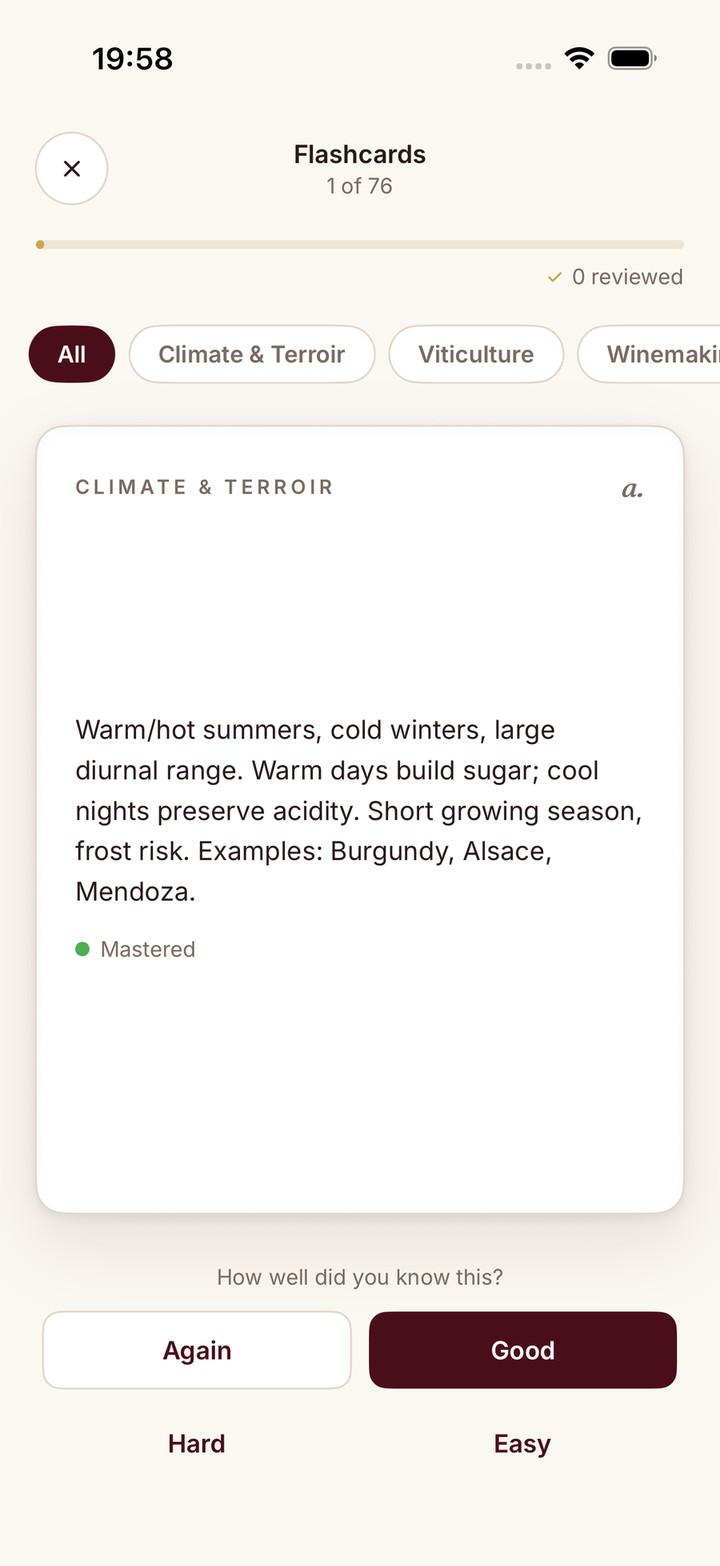
- Flashcards with spaced repetition built in
- Study planner and exam-day checklist as printable downloads
- Deciding between rungs: Level 1 vs Level 2, Level 2 vs Level 3, Level 3 vs Level 4
- Weighing the spend: WSET costs, pass rates, and is WSET worth it
- Recommended reading beyond the course pack: best WSET study materials and best WSET books
And if the floor of a restaurant is the actual goal, compare the ladder against the sommelier route before committing.
Common questions
Level 2 for most people. It assumes no prior qualification, covers the grape varieties and regions that make everything else make sense, and its exam is multiple choice only. Choose Level 1 if you want a gentle single-day introduction, and consider starting at Level 3 only if you already have strong, structured wine knowledge.
Levels 1 to 3 have no formal prerequisites, so you can enter the ladder wherever fits your knowledge. The Diploma is different: it requires WSET Level 3 in Wines before you can enrol. In practice most Level 3 candidates have done Level 2 first, because the exam assumes that foundation even though nobody checks for the certificate.
Three habits cover it: active recall instead of rereading, spaced repetition so reviews land just before you forget, and timed mock exams so the format holds no surprises. Read a topic once, then test yourself on it repeatedly. Candidates who only reread the study book consistently overestimate how much they know until the first mock corrects them.
No. Sommo is independent of WSET, and course providers supply the official study packs when you enrol. Sommo's mock exams, flashcards, and cheatsheets are original materials aligned to the published specifications, built for the practice and self-testing layer that official course books do not provide. Use both: the official text to learn, these tools to test.
WSET recommends about 6 study hours for Level 1, 28 for Level 2, 84 for Level 3, and around 500 for the Diploma, which typically spans 18 months to 3 years. In calendar terms alongside a job, expect a weekend, one to two months, three to six months, and about two years respectively. Hours vary by provider and starting knowledge.