WSET Pass Rates: The Real Numbers for Every Level
WSET pass rates by level: providers report 70-85% at Level 2 and 50-60% at Level 3. What WSET does and does not publish, why Level 3 drops, how to pass.
Before committing to a course fee and weeks of study, most people want one number: what percentage of candidates pass? For WSET the honest answer is four different numbers, two of which are ranges and one of which does not exist. Here is what can actually be said, level by level, and what moves you to the right side of it.
The headline numbers
| Level | Indicative global pass rate | Exam format | Pass mark |
|---|---|---|---|
| Level 1 | Not published; near-universal among prepared candidates | 30 multiple choice, 45 minutes, closed book | 70% (21 of 30) |
| Level 2 | 70-85% (provider reported) | 50 multiple choice, 60 minutes, closed book | 55% (28 of 50) |
| Level 3 | 50-60% (industry estimates) | Theory (multiple choice plus short written answers) and a blind tasting paper | 55% on each paper, both must pass |
| Level 4 Diploma | Not published | Six units: exams, essays, and a research assignment | Varies by unit |
A note on sourcing, because it matters: WSET publishes candidate numbers in its annual reviews, not pass rates, at any level. Every figure above comes from what Approved Programme Providers report about their own cohorts and from consistent industry estimates, which is why they are ranges, not decimals. Any site quoting an exact percentage, including the “roughly 70% global” figure that circulates, is quoting either a single school’s cohort or another site repeating it.
WSET Level 1: no published rate, and that is the story
WSET does not publish a Level 1 figure, and the numbers circulating online are either cross-qualification averages or single-provider cohorts, so treat them as marketing rather than data. What is known is the design intent: the syllabus is small, the course is taught before the exam, and candidates who attend and revise pass. The catch is the pass mark of 70%, the highest of the wine awards, which leaves room for only nine wrong answers out of 30. Careless misreads cost more here than anywhere else. The WSET Level 1 pass rate breakdown covers who actually fails, and the free WSET Level 1 mock exam shows the real format.
WSET Level 2: 70% to 85%, provider reported
Most Approved Programme Providers report Level 2 pass rates between 70% and 85%, which means roughly one candidate in four does not pass first time. Failures cluster around three habits: confusing grapes with wines and regions (Garganega, Soave, Veneto), skipping the sparkling and fortified chapters because they feel niche, and revising by rereading rather than testing. The pass mark drops to 55%, or 28 of 50, but the volume of material rises sharply. The WSET Level 2 pass rate breakdown maps exactly where marks are lost, and the free WSET Level 2 mock exam is the fastest way to find out where you stand.
WSET Level 3: 50% to 60%, the cliff edge
Industry estimates place the Level 3 pass rate between 50% and 60%. Some well-established providers report closer to 65%, others fall below 50%, so around half of all candidates do not pass on the first attempt. The drop has a structural cause: two separately assessed papers, theory and blind tasting, each with a 55% pass mark, and both must be passed. The tasting paper fails more people than anything else, because the SAT format has to be internalised through repetition, followed by weak written-answer technique on the theory paper. The WSET Level 3 pass rate breakdown explains both failure modes, and the free WSET Level 3 mock exam benchmarks the theory paper.
WSET Diploma: no honest single figure
WSET publishes no Diploma pass rate, and the qualification’s shape means no single number would be honest. Six units are assessed separately over two to three years, through exams, essays and a research assignment, and a candidate can fail one unit, resit it, and still complete the Diploma. Per-unit results therefore tell a different story from completion rates, and neither is published in citable form. What is certain is the scale: upwards of 500 hours of study, and written and tasting assessment at a depth Level 3 only gestures at. The WSET Diploma guide covers the structure, and the free WSET Diploma mock exam samples the question style.
What a Diploma pass rate would have to measure
The current official Diploma qualification page defines six mandatory units and about 500 total study hours, normally completed over 18 months to three years. D1 and D2 are open-response exams, D3 combines theory with a 12-wine blind tasting, D4 and D5 combine written and three-wine tasting papers, and D6 is a 3,000-word independent research assignment.
That creates three different questions which websites often collapse into one unsupported percentage:
| Question | What it would measure | Why it is not the same |
|---|---|---|
| Unit pass rate | Attempts passed for D1, D2, D3, D4, D5 or D6 | Units differ greatly in format and weight |
| First-attempt qualification rate | Candidates passing all six without a resit | A single failed unit makes the whole candidate count as a failure |
| Eventual completion rate | Entrants who ultimately earn DipWSET | Includes resits, deferrals and candidates who stop studying |
WSET publishes the mark bands, not those global rates. An overall Diploma result of 55% to 64% is a Pass, 65% to 74% a Pass with Merit, and 75% or above a Pass with Distinction, subject to the unit and component rules in the current specification. Those thresholds tell you how work is graded. They do not reveal what percentage of the worldwide cohort achieves each result.
When a provider advertises a pass rate, ask for the unit, date range, cohort size, whether resits are included and whether the denominator is exam attempts or people. Without those five details, the number cannot help you estimate your own odds.
The practical readiness measure is unit-specific. Use a timed Diploma mock for open-response recall, practise blind flights at the exact D3, D4 or D5 scale, and keep D6 research moving before exam revision consumes the calendar. The Level 4 study guide maps the six-unit workload.
What actually moves your pass probability
The pass rate describes the whole population of candidates. Three habits reliably move you out of the failing part of it.
Practice testing under real conditions. Recognition is not recall. Sitting full-length, timed papers before exam day is the single strongest predictor of passing, and it also builds the pacing that stops you leaving questions blank. The free mock test library covers every level at the real length and timing, and the Level 2 past papers guide explains what official practice material exists and what to use instead.
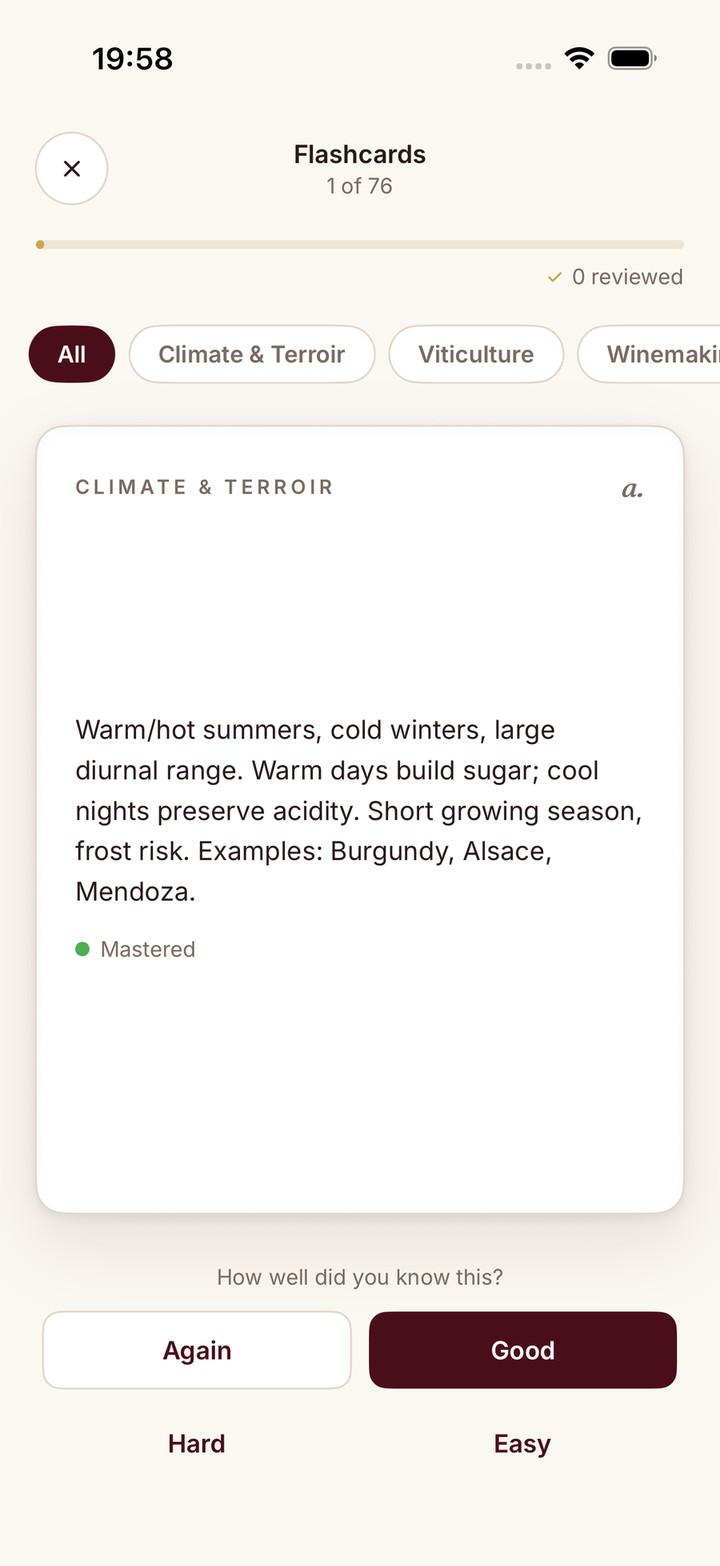
Spaced repetition for the memory load. Grapes, regions, appellations and production methods are volume problems, and rereading does not solve volume. Reviewing material at increasing intervals, right before you would forget it, does. The WSET flashcards run on exactly that system, and the study guide hub shows how to structure the weeks around it. If you are still planning the timeline, how long WSET takes sets realistic hours per level.
Written-answer and SAT practice at Level 3. From Level 3 the exam stops rewarding recognition entirely. Short written answers need command-word technique practised against the clock, and the tasting paper needs dozens of structured SAT notes, not a handful. Drill the format with the SAT tasting quiz, and use the free WSET study planner to schedule tasting practice alongside theory instead of leaving it to the final fortnight.
Knowing the odds is half the decision; the other half is the spend. The WSET cost breakdown covers what every level actually costs, and is WSET worth it weighs the two together.
Common questions
There is no official global figure: WSET's annual reporting covers candidate numbers, not pass rates. A figure of roughly 70% circulates across wine-school sites, but it is unofficial and heavily weighted by the easier Level 1 and Level 2 exams. The more useful numbers are per level: providers typically report 70% to 85% at Level 2, while Level 3 estimates sit between 50% and 60%.
WSET does not publish granular pass rates by level, but most Approved Programme Providers report Level 2 rates between 70% and 85%, depending on the cohort and quality of teaching. Roughly one candidate in four does not pass on the first attempt. The pass mark is 55%, which means 28 correct answers out of 50.
Industry estimates from Approved Programme Providers consistently place the Level 3 pass rate between 50% and 60%. Some well-established providers report closer to 65%, while others fall below 50%. Both papers, theory and tasting, must be passed at 55% each, and the tasting paper is the single biggest reason candidates fail.
WSET does not publish a Diploma pass rate, and no honest single figure exists. The Diploma is six separately assessed units completed over two to three years, and a candidate can fail a unit, resit it, and still finish. Per-unit results and overall completion tell different stories, and neither is published in a form you can cite.
Level 1 passes at 70%, which is 21 correct out of 30 and the highest bar of the wine awards. Level 2 passes at 55%, or 28 out of 50. Level 3 requires 55% on each of its two papers, theory and tasting, and both must be passed. Diploma requirements vary by unit.