WSET Diploma D1 Cheatsheet: Wine Production
A free WSET Diploma D1 cheatsheet: 13 tables from climate metrics and disease to oak, sulfur dioxide chemistry, closures and faults, with mechanisms explained.
D1 is the mechanism unit. Marks come from explaining why an option was chosen and what it cost, not from naming the option, so every table below pairs a decision with the effect it produces and the trade off that comes with it. Use it alongside the D1 mock test and the rest of the Diploma unit hub; if the underlying vocabulary is shaky, the Level 3 cheat sheet is the faster place to start.
The Vineyard: Soil, Water, and Climate Metrics
Soil matters through four levers, and an answer that names a soil without naming the lever earns nothing: water holding capacity (texture, depth, organic matter), drainage, nutrient supply and cation exchange capacity, and thermal behaviour (dark or stony soils absorb and re-radiate heat, pale soils reflect light into the canopy). Soil pH adds a fifth constraint, since high active lime blocks iron uptake and causes chlorosis, which is a rootstock decision rather than a fertiliser one.
Vine water status, not rainfall, is what shapes the wine. Mild deficit after fruit set restricts cell expansion, so berries stay small, the skin to juice ratio rises, and anthocyanins, tannins, and flavour compounds concentrate; the vine signals that deficit through abscisic acid, which slows shoot growth and moves assimilates toward the bunches. Severe deficit closes stomata, halts photosynthesis, and strands the fruit unripe. Growers measure vine water potential with a pressure chamber rather than reading the soil, and manage it through regulated deficit irrigation, partial rootzone drying, cover crops, mulching, or rootstock choice.
| Metric | What it actually measures | Blind spot to flag in an answer |
|---|---|---|
| Growing degree days (Winkler) | Heat summed above a base of 10 degrees Celsius across the growing season | Ignores diurnal range, sunshine hours, and whether the heat arrives early or during ripening |
| Mean growing season temperature | Average of the monthly means over the seven month growing season | Compresses extremes; two sites with the same mean can differ in heat spikes |
| Huglin index | Heat above 10 degrees Celsius weighted for maximum temperature and day length | Rewards long summer days, so it flatters high latitude sites |
| Diurnal range | Difference between day and night temperature | Explains acid retention, says nothing about total heat or ripening capacity |
| Continentality | Gap between warmest and coolest month means | Predicts frost and season length, not ripening potential |
| Sunshine hours and solar radiation | Energy available for photosynthesis and for skin phenolics | Can be decoupled from temperature in cool maritime sites |
| Growing season rainfall and timing | Water supply, disease pressure, harvest risk | Annual totals hide the distribution that actually matters |
Vine Physiology and Phenology
The vine’s yearly cycle is a sequence of risk windows, and each one has a distinct failure mode. Bud fruitfulness for next year is set during this year’s growing season, so a shaded or stressed canopy costs two vintages, not one.
| Stage | What is happening | Principal risk |
|---|---|---|
| Dormancy | Carbohydrate reserves stored in trunk and roots; chilling requirement accumulates | Winter freeze injury; insufficient chilling in warm regions gives uneven budburst |
| Budburst | Buds swell and shoots emerge | Spring frost, which is why late pruning is used to delay it |
| Shoot and inflorescence growth | Shoots elongate on stored reserves until leaves take over | Wind damage, downy mildew on soft tissue |
| Flowering and fruit set | Self pollination and berry formation | Cold, rain, or wind gives coulure (flowers fail to set) and millerandage (uneven berry size) |
| Berry formation | Cell division then expansion; malic and tartaric acid accumulate | Hail, water stress, excessive vigour |
| Veraison | Growth switches to ripening; berries soften and colour | The point after which severe stress can no longer be recovered |
| Ripening | Sugar imported through the phloem, malic acid respired, anthocyanins and tannins develop, methoxypyrazines degrade with light | Sunburn, rain dilution, botrytis, sugar ripeness outrunning phenolic ripeness |
| Harvest to leaf fall | Reserves rebuilt for the following season | Early frost cutting the replenishment short |
Vineyard Hazards, Pests, and Disease
Frost comes in two forms and the response differs: radiation frost on still, clear nights can be fought with wind machines, helicopters, sprinklers, or heaters because there is warmer air aloft to mix down, whereas advective frost carried in on a cold air mass defeats all of them. Hail is insurable, not preventable at scale. Sunburn is a canopy question. Smoke taint is a chemistry question, because the volatile phenols bind to sugars as glycosides that survive fermentation and hydrolyse later, so a wine can taste clean at bottling and taste of ash a year on.
| Problem | Organism and type | Conditions that favour it | Control |
|---|---|---|---|
| Downy mildew | Plasmopara viticola, an oomycete | Warm rain and free water on green tissue | Copper compounds, systemic fungicides, open canopy, drainage |
| Powdery mildew | Erysiphe necator, a fungus | Humid but dry, shaded and crowded canopies | Elemental sulfur, leaf removal, shoot thinning, resistant plantings |
| Grey rot | Botrytis cinerea | Persistent damp on damaged or unripe fruit | Open fruit zone, loose clustered clones, botryticides, careful harvest |
| Noble rot | The same fungus, benign outcome | Humid mornings, warm dry afternoons, ripe intact fruit | Deliberately encouraged; harvested in successive passes |
| Esca and Eutypa dieback | Complexes of wood colonizing fungi | Infection of pruning wounds, especially in wet weather | No cure; wound protection, later pruning, sap flow pruning, trunk renewal |
| Flavescence doree | Phytoplasma, insect vectored | Presence of the leafhopper vector | Notifiable in the EU; vector treatment, uprooting, hot water treated planting material |
| Pierce’s disease | Xylella fastidiosa, a bacterium | Sharpshooter vectors, mild winters | Vector control and removal; no cure for the vine |
| Fanleaf and leafroll viruses | Nepovirus and closterovirus | Nematode vectors (fanleaf) and mealybugs or scale (leafroll) | Certified virus tested planting material, vector and soil management |
| Phylloxera | Daktulosphaira vitifoliae, a root aphid | Any soil that is not predominantly sand | Grafting onto resistant rootstock; quarantine |
| Nematodes and moths | Root feeding nematodes; European grapevine moth | Sandy soils (nematodes), warm dry summers | Tolerant rootstocks, pheromone confusion, integrated pest management |
Rootstocks and Phylloxera
Phylloxera is native to eastern North America and reached Europe in the second half of the nineteenth century, where it destroyed vineyards on a scale that reset the industry: it feeds on the roots of Vitis vinifera, which has no resistance, and the durable answer was grafting vinifera scions onto American species roots. Chile has never had it, and it does not establish in pure sand, which is why ungrafted vines survive at Colares and on Santorini. Rootstock choice is now a site engineering decision, not just a phylloxera insurance policy.
| Species or cross | Lime tolerance | Drought tolerance | Vigor | Typical use |
|---|---|---|---|---|
| Vitis riparia | Low | Low, shallow rooting | Low, hastens ripening | Cool, damp, fertile sites needing devigoration |
| Vitis rupestris | Moderate | High, deep rooting | High | Dry sites; parent of drought tolerant crosses |
| Vitis berlandieri | Very high | Good | Moderate to high | Rarely used alone (roots poorly from cuttings); parent for limestone crosses |
| Berlandieri x rupestris (110R, 140Ru, 1103P) | High | High | High | Hot, dry, calcareous sites |
| Berlandieri x riparia (SO4, 5BB, 420A) | Good | Moderate | Low to moderate | Balanced or fertile calcareous sites; 420A for devigoration |
| Berlandieri x vinifera (41B) | Highest | Moderate | Moderate | Chalk with very high active lime |
| Riparia x rupestris (3309C, 101-14) | Low | Low to moderate | Low to moderate | Cooler sites with reliable moisture |
| Vitis champinii (Ramsey) | Moderate | High | Very high | Sandy, nematode infested soils |
| Vinifera x rupestris (AXR1) | n/a | n/a | High | A cautionary tale: its vinifera parentage let phylloxera break through in California |
Canopy Management, Trellising, and Yield
Vine balance is the goal, expressed as the ratio of leaf area to crop weight, or in the field as the ratio of harvested crop to winter pruning weight. Too much vegetative growth and the shoot tips outcompete the bunches for assimilates while the canopy shades the fruit; too little and the vine cannot ripen what it carries. High vigour sites are fixed by devigoration (cover crops, lower vigour rootstock, no irrigation) or by dividing the canopy, not by hedging harder, since summer topping simply provokes laterals.
| System | Pruning and shape | Suits | Effect on fruit |
|---|---|---|---|
| Gobelet / bush vine | Head trained, spur pruned, free standing | Hot, dry, windy Mediterranean sites | Canopy shades fruit; low yield; hand work only |
| Guyot (single or double) | Head trained, cane pruned, vertical shoot positioning | Cool climates with variable bud fruitfulness at the base | Even exposure; replacement cane avoids unfruitful basal buds |
| Cordon de Royat and similar | Cordon trained, spur pruned, vertical shoot positioning | Varieties with fruitful basal buds | Quick to prune, mechanisable, consistent bud numbers |
| Pergola / tendone | High overhead canopy | Hot regions and humid sites needing airflow beneath | Shades fruit and workers; high yields; poor exposure unless managed |
| Divided canopies (lyre, Geneva Double Curtain, Scott Henry) | Two fruiting zones | High vigour, fertile sites with adequate water | Spreads the leaf area, restores exposure without cutting yield |
| Minimal or mechanical pruning | Little or no winter pruning | Warm, high volume regions | Many small bunches, self regulating yields, lowest cost |
Yield is controlled most reliably at pruning, because the bud count fixes the potential crop before the vine spends anything on it. A green harvest at veraison is a corrective tool: the vine can compensate by swelling the berries left behind, which partly cancels the intended concentration. Appellation yield ceilings in hectolitres per hectare are a legal constraint, not a quality guarantee, and low yield only helps up to the point where vine balance breaks.
Harvest date is the last viticultural decision and the first winemaking one. Sugar (measured as Brix, Baume, or Oechsle), total acidity, and pH are the numbers; tannin ripeness, seed colour, skin extractability, aroma precursors, and the state of any botrytis are the judgements. Hand picking allows selection, whole bunches, and successive passes; machine picking is faster and can work at night, which preserves aromatics, but it delivers detached berries with juice already flowing, which rules out whole bunch pressing and carbonic maceration.
Can you explain the mechanism, not just name it? Find out in 30 questions.
Take the D1 Mock TestThe Winery Before Fermentation
Fruit arrives warm, oxidising, and full of decisions. Chilling on reception, inert gas, dry ice, and an early sulfur dioxide addition protect aroma; hyperoxidation does the opposite on purpose, deliberately oxidising a white must so the oxidisable phenols polymerise and drop out, leaving a wine that is more stable later. Sorting runs from a vibrating table through optical sorters that reject by colour, size, and shape, to density sorting in a flotation bath.
Must adjustments are legally constrained and regionally revealing. Enrichment (chaptalisation with sucrose or with rectified concentrated grape must) raises potential alcohol in cool regions and is banned in warm ones; acidification with tartaric acid is standard in warm regions and restricted in cool ones. Tartaric is chosen because it is the strongest grape acid and, unlike malic acid (converted during malolactic conversion) or citric acid (metabolised by lactic acid bacteria into acetic acid and diacetyl), it is not consumed by wine microbes. Deacidification uses calcium carbonate or potassium bicarbonate. Pectolytic enzymes aid settling, extraction, and pressing yield.
| Fraction | How it is obtained | Composition | Typical use |
|---|---|---|---|
| Free run juice or wine | Drains without pressure | Lowest phenolics and solids, highest acidity | The backbone of delicate whites and of fine reds |
| Early press (in Champagne, the cuvee) | Low pressure, first stage | Clean, fine, well balanced | Blended with free run for the top wine |
| Later press (in Champagne, the taille) | Higher pressure, later stage | More phenolics, potassium, colour, higher pH | Kept separate; used for early drinking or lesser cuvees |
| Hard press | Highest pressure, final stage | Bitter, coarse, high pH, high solids | Usually distilled or sold off |
| Red press wine | Pressing the pomace after fermentation | High in tannin, colour, and dry extract | Blended back by taste to add structure |
Whole bunch pressing of white grapes gives the lowest phenolic must of all, because the stems act as drainage channels through the mass of fruit, so the juice runs off quickly at low pressure with minimal skin contact. The costs are press capacity and cycle time.
Fermentation
Alcoholic fermentation runs through glycolysis: glucose to pyruvate, pyruvate decarboxylated to acetaldehyde, acetaldehyde reduced to ethanol by alcohol dehydrogenase, with carbon dioxide, glycerol, and a great deal of heat as the other outputs. Knowing the acetaldehyde step explains why a struggling ferment smells of bruised apple and why acetaldehyde later binds so much of the sulfur dioxide added to the wine.
Yeast choice is a risk decision. Cultured Saccharomyces cerevisiae strains are selected for alcohol and temperature tolerance, low hydrogen sulfide production, thiol release, or foam behaviour, and give a fast, reproducible ferment. An ambient ferment runs as a succession, with non Saccharomyces genera dominating the early phase and adding aromatic complexity and glycerol before Saccharomyces takes over; the price is slower, less predictable kinetics and greater exposure to volatile acidity and stuck fermentation.
Nutrition is the other half of that question. Yeast assimilable nitrogen (ammonium plus free amino nitrogen) drives cell population and fermentation rate: too little gives sluggish ferments and hydrogen sulfide, too much gives a violent ferment, excess heat, fusel alcohols, and elevated volatile acidity. Diammonium phosphate is the fast correction and organic nitrogen preparations the gentler one, both best split across the ferment. Yeast also need a little oxygen early for sterol synthesis, which is why an aerative pump over in the first days is protective rather than damaging.
| Vessel | Thermal behaviour | Oxygen ingress | Flavour contribution | Why it gets chosen |
|---|---|---|---|---|
| Stainless steel | Low inertia; precise jacket control | None unless deliberately added | None | Aromatic whites, control, hygiene, scale |
| Oak barrel (225 to 300 L) | Low inertia, small volume, stable cellar needed | Meaningful and continuous | High if new, minimal when neutral | Barrel fermented whites, small red lots |
| Large oak vat or foudre | High inertia | Slow | Low, mostly textural | Traditional reds, long elevage without oak flavour |
| Concrete, lined or unlined | Very high inertia, damped peaks | Slight if unlined, none if lined | None | Reds wanting stability without wood; concrete eggs for lees suspension |
| Amphora or qvevri | Moderate, buried vessels very stable | Slight through the clay unless sealed | None | Skin fermented whites and minimal intervention styles |
Stuck fermentation is a Diploma favourite because the causes are diagnostic: nitrogen deficiency, temperature too high or too low, very high initial sugar, excessive alcohol, toxic medium chain fatty acids, low oxygen early, competition or killer factor from wild flora, or an SO2 addition at the wrong moment. Restarting means acclimatising a robust restart culture into a small volume, adding nutrients, adjusting temperature, and blending the stuck wine in progressively. The real danger is not the delay but the window it opens for acetic acid bacteria and Brettanomyces in a wine with residual sugar and a shrinking sulfur dioxide reserve.
Red Winemaking and Extraction
Anthocyanins are water soluble and come out early; tannins are more alcohol soluble and extract as the ferment progresses, with seed tannin arriving late and harsh. That is the whole logic of extraction management: extract colour early and gently, decide how much seed tannin to accept, and then let time in contact with alcohol polymerise what you have taken into softer, more stable pigment tannin complexes.
| Technique | Mechanism | What it favours |
|---|---|---|
| Cold soak | Pre fermentation aqueous maceration under CO2 or SO2 | Color and primary fruit with little tannin; spoilage risk if too long or too warm |
| Punch down (pigeage) | Cap plunged into the juice | Gentle to firm depending on frequency; suits whole bunch and delicate varieties |
| Pump over (remontage) | Juice pumped over the cap, with or without air | Moderate extraction; aerative version supports yeast health and colour stabilisation |
| Rack and return (delestage) | Vat fully drained then returned over the cap | Strong extraction with aeration; seeds can be removed while the vat is empty |
| Rotary fermenter | Mechanically rotated tank | Fast, powerful extraction; easy to overshoot |
| Submerged cap | Cap held under the juice by a grid | Slow, continuous, gentle; traditional in large wooden vats |
| Extended post fermentation maceration | Weeks on skins after dryness | Polymerization of tannin with anthocyanin; softer, more stable structure |
| Whole bunch or stem inclusion | Stems retained in the vat | Adds stem tannin, aromatic lift, potassium (which raises pH); absorbs some colour and alcohol |
| Carbonic maceration | Whole berries under an added CO2 blanket | Intracellular fermentation; malic degraded, kirsch and confected esters, almost no tannin |
| Semi carbonic maceration | Whole bunches, no added gas; crushed base berries ferment and blanket the rest | The Beaujolais default; a spectrum rather than a single technique |
| Thermovinification and flash detente | Heating the must before or instead of skin fermentation | Color and fruit without tannin; deactivates laccase in botrytis affected fruit |
Malolactic Conversion
Oenococcus oeni converts sharp diprotic L-malic acid into softer monoprotic L-lactic acid, releasing carbon dioxide. Titratable acidity falls, pH typically rises by around 0.1 to 0.3, texture softens, and the wine gains microbial stability because the malic acid that a stray bacterium might have fermented in bottle has already gone. Diacetyl, the buttery compound, is an intermediate: how much survives depends on the strain, on oxygen, on lees contact (yeast metabolize diacetyl back down), and on when SO2 is added.
Encouraging it means warmth in the region of 18 to 22 degrees Celsius, low free SO2, lees contact, and usually inoculation. Blocking it, which is the choice for aromatic whites and for many cool climate sparkling base wines, means free SO2, chilling, racking off the gross lees early to remove the bacterial population, lysozyme, and a sterile filtration before bottling. The risks of an uncontrolled conversion are volatile acidity, biogenic amines, ropiness, and mousiness, particularly at higher pH.
Maturation
| Variable | Options | Result |
|---|---|---|
| Species | Quercus petraea (European sessile, tight grain), Quercus robur (European pedunculate, wider grain, higher ellagitannin), Quercus alba (American white oak) | Petraea gives aroma with restrained tannin; robur gives more tannin; alba gives high whiskey lactone (coconut, dill) and can be sawn rather than split |
| Forest and grain | Tight grain from slow grown trees versus wide grain | Tight grain extracts more slowly and more subtly |
| Seasoning | Air dried outdoors for two to three years versus kiln dried in weeks | Rain leaches bitter ellagitannins and fungi degrade harsh precursors, so air dried wood gives a smoother extract at a higher cost |
| Toast | Light, medium, heavy | Heat converts lignin to vanillin, guaiacol, and eugenol, and hemicellulose to furfural (caramel, toast); heavy toast adds smoke and char while reducing lactone and oak tannin |
| Size | 225 L barrique, 228 L piece, 300 L hogshead, 500 L puncheon or demi muid, 2,000 L and larger foudre or botte | Smaller vessels have more surface area per litre, so oak character and oxygen transfer are faster |
| Age | New, second and third fill, neutral after roughly four fills | New oak gives flavour and tannin; neutral oak gives only slow oxygen exchange and texture |
| Alternatives | Staves, chips, or powder in tank | Oak flavour without the oxygen transfer, at a fraction of the cost |
Lees are the second lever. Gross lees carry solids and can turn reductive; fine lees, kept deliberately, consume oxygen and release mannoproteins during autolysis, adding palate weight, binding harsh tannin, and improving protein and tartrate stability, which reduces the bentonite and cold treatment needed later. Batonnage suspends them, accelerating the effect and introducing a little oxygen.
Oxygen management runs through everything. Topping up (ouillage), racking frequency, headspace inert gas, vessel choice, and the number of pump transfers together set a cumulative exposure that either polymerises tannin, stabilises colour through ethyl bridged pigments, and builds complexity, or tips into oxidation. Micro oxygenation applies the same principle in tank at a controlled dose per litre per month; developed for very tannic reds, it softens texture and fixes colour, but over dosing invites oxidation and hands Brettanomyces the conditions it likes.
Stabilization, Fining, and Filtration
Three instabilities are worth separating. Tartrate instability is cosmetic: potassium bitartrate crystals form in a cold bottle and consumers mistake them for glass. It is treated by cold stabilisation near freezing, by the contact process seeded with cream of tartar, by electrodialysis or ion exchange, or by inhibitors such as metatartaric acid (temporary), carboxymethylcellulose (which requires a protein stable wine first), and mannoproteins. Protein instability is a white and rose problem, diagnosed with a heat test and fixed with bentonite. Microbial instability is the dangerous one, handled with molecular SO2, sterile filtration, sorbate plus SO2 in sweet wines, or dimethyl dicarbonate at bottling.
| Fining agent | Removes | Notes |
|---|---|---|
| Bentonite | Heat unstable grape proteins | Negatively charged clay binds proteins that are positively charged at wine pH; strips some aroma and generates heavy lees |
| Gelatin | Harsh and bitter tannin | Effective but easy to overfine, which can leave a white protein unstable |
| Isinglass | Haze and dullness in white wine | Very gentle, gives brightness; not vegan |
| Egg white albumen | Coarse tannin in red wine | Traditional polishing fining for fine reds; not vegan |
| Casein | Oxidised and browning phenolics | Used on whites to lift colour; not vegan |
| PVPP | Bitter, browning prone low weight phenols | Synthetic, filtered out afterward, very targeted |
| Activated carbon | Colour and off odours | Blunt instrument; strips aroma along with the fault |
| Copper sulfate | Hydrogen sulfide and simple mercaptans | Does not touch disulfides, which can revert to mercaptans in bottle; residual copper is regulated |
| Pea or potato protein | Tannin and phenolics | The vegan replacement for gelatin and casein |
Filtration is either depth (diatomaceous earth, sheets), which traps particles within a matrix, or surface (membrane cartridges, cross flow), which excludes by pore size. A sterile membrane filtration removes yeast and bacteria and is the only reliable way to bottle a wine with residual sugar without sorbate. The argument against heavy filtration is loss of colloids and texture, which is why many fine red producers bottle unfined and unfiltered and accept the sediment.
Sulfur Dioxide Chemistry
Total SO2 is free plus bound. Bound SO2 is combined with acetaldehyde, pyruvic acid, ketoglutaric acid, anthocyanins, and sugars, and it is largely inert. Free SO2 sits in a pH dependent equilibrium between molecular SO2, the bisulfite ion, and sulfite; only the molecular fraction is meaningfully antimicrobial, and it is also the fraction that scavenges the hydrogen peroxide and quinones produced when phenols oxidize. The practical target for microbial protection is commonly around 0.8 mg/L molecular SO2, and what that costs in free SO2 depends entirely on pH.
| Wine pH | Share of free SO2 present as molecular SO2 | Free SO2 needed for roughly 0.8 mg/L molecular |
|---|---|---|
| 3.0 | About 6 percent | About 13 mg/L |
| 3.2 | About 4 percent | About 20 mg/L |
| 3.4 | About 2.5 percent | About 32 mg/L |
| 3.6 | About 1.6 percent | About 50 mg/L |
| 3.8 | About 1.0 percent | About 79 mg/L |
That table explains a large part of D1. A high pH red is microbiologically fragile because the SO2 addition needed to protect it approaches the legal ceiling and the sensory threshold at the same time. EU limits sit at 150 mg/L total for dry red and 200 mg/L for dry white and rose, with higher ceilings for sweet wines and lower ones under organic certification. SO2 also inhibits the grape’s own polyphenol oxidase, though laccase from botrytis affected fruit is far more resistant, which is why heating the must is used on rotten fruit.
Packaging and Closures
The bottling line is where a year of careful oxygen management is most easily undone. What matters is total package oxygen: dissolved oxygen picked up during filtration and filling, plus the oxygen trapped in the headspace, plus whatever the closure transmits over time. Green or amber glass protects against light strike, in which riboflavin drives the degradation of methionine into foul smelling sulfur compounds; clear glass under retail lighting does not.
| Closure | Oxygen transmission | Main risk | Typical fit |
|---|---|---|---|
| Natural cork | Low on average, highly variable bottle to bottle | TCA taint and bottle variation | Long ageing fine wine where tradition carries value |
| Technical cork with supercritical CO2 treatment | Consistent and selectable by grade | Cost; no romance | Producers who want a predictable ageing curve |
| Agglomerated cork | Moderate, short service life | Not suitable for extended ageing | Early drinking wine |
| Synthetic | Historically the highest, now graded | Oxidation over time, aroma scalping | Early drinking wine and large formats |
| Screwcap, tin or Saran lined | The lowest available | Reduction if the wine goes in reductive | Aromatic whites; the norm in Australia and New Zealand |
| Screwcap, Saranex lined | Slightly higher than tin | Less protection over long storage | Wines wanting a little more oxygen ingress |
| Glass stopper with elastomer seal | Very low | Cost and line compatibility | Premium presentation without taint risk |
| Crown cap | Very low | Perception, not performance | Sparkling wine under tirage; some still wines |
Alternative formats trade shelf life for carbon footprint and convenience. Bag in box and kegs remove headspace oxygen entirely but have limited life once the barrier film is breached; cans require an internal liner, because aluminium in contact with wine at low pH can generate hydrogen sulfide, and both SO2 and chloride levels have to be managed carefully.
Wine Faults
| Fault | Compound | Cause | Behavior worth knowing |
|---|---|---|---|
| Cork taint | 2,4,6-trichloroanisole | Fungal methylation of chlorophenols in cork, cellar timber, packaging, or barrels | Perceptible at a few nanograms per litre; below that threshold it suppresses fruit, so the wine reads as dull rather than faulty |
| Brettanomyces | 4-ethylphenol and 4-ethylguaiacol | Yeast converting grape hydroxycinnamic acids during maturation | Favoured by higher pH, low molecular SO2, warm cellars, residual sugar, and old porous barrels |
| Volatile acidity | Acetic acid and ethyl acetate | Acetic acid bacteria with oxygen; stressed or stuck ferments | Ethyl acetate has the lower threshold; small amounts of VA can lift aroma, which is why it is a fault of degree |
| Oxidation | Acetaldehyde, later sotolon | Cumulative oxygen, poor topping, failed closure | Irreversible; whites brown and flatten before reds show it |
| Reduction | Hydrogen sulfide, methanethiol, dimethyl sulfide, disulfides | Low YAN, very clean juice, low oxygen, low permeability closures | Copper removes thiols but not disulfides, which can revert in bottle |
| Light strike | Methanethiol and dimethyl disulfide | Riboflavin driven degradation of methionine under light | Clear glass in bright retail lighting; solved by green or amber glass and cartons |
| Geosmin | Geosmin | Molds on damaged fruit, often with botrytis | An extremely low threshold earthy, beetroot character that sorting cannot always remove |
| Mousiness | Tetrahydropyridines | Brettanomyces and lactic acid bacteria at high pH with low SO2 | Invisible on the nose and only perceived retronasally, often after a delay |
| Refermentation | Carbon dioxide and haze | Residual sugar plus viable yeast without sterile filtration or sorbate | A packaging and stabilisation failure rather than a winemaking one |
| Smoke taint | Volatile phenols and their glycoside precursors | Wildfire smoke exposure in the vineyard | Bound precursors hydrolyse in bottle and in the mouth, so the fault can grow after bottling |
Study This With Sommo
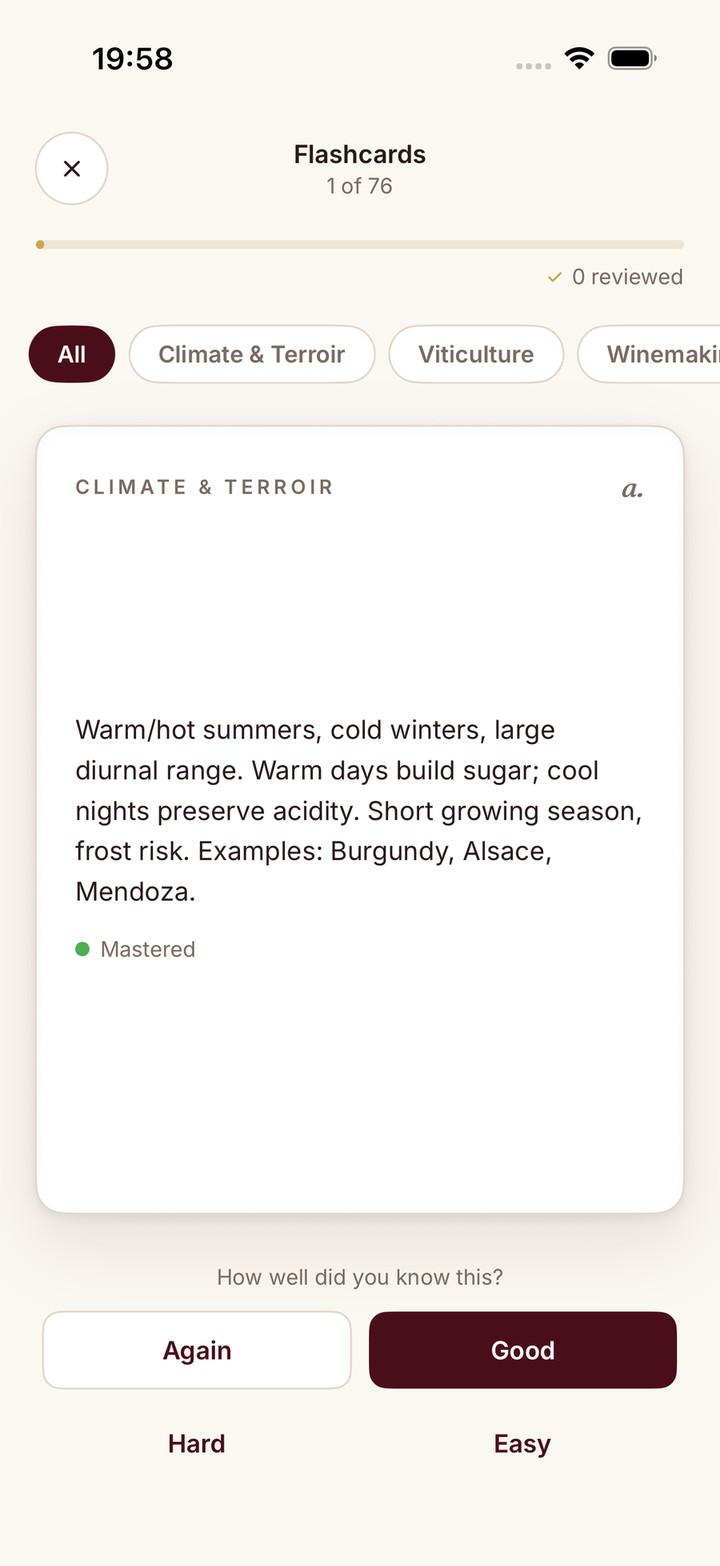
Tables get you recall; D1 is graded on explanation. Sommo turns this page into spaced repetition flashcards and typed answer drills that grade the mechanism you wrote, not the keyword you remembered, so you find out which chains you can actually explain before an examiner does. Try the full Diploma mock test next, then download Sommo free and keep the vineyard and winery material warm between study blocks.