WSET Level 3 Tasting Exam Guide: Timing, SAT and Practice
Prepare for the WSET Level 3 tasting exam: official format, a 30-minute timing plan, SAT note anatomy, common mark losses and a four-week practice schedule.
What the Official Exam Requires
The current WSET Level 3 specification describes a blind tasting of two still wines in 30 minutes. Candidates must accurately describe each wine and draw conclusions from those observations. The tasting examination requires 55% to pass. Sommo is independent of WSET; the practice schedules and example reasoning on this page are study advice, not official marking guidance.
That wording is liberating. You are not playing a bottle identification game. A perfect grape guess cannot repair missing palate structure, and a wrong region guess cannot damage a note when you never write it. Your task is to complete the Level 3 SAT tasting sheet accurately and support the conclusions.
A 30-Minute Timing Plan
| Time | Task | What must be on the page |
|---|---|---|
| 0:00 to 1:00 | Orient and taste both wines once | Decide which wine to start with; notice the broad structural contrast |
| 1:00 to 3:00 | Wine one appearance and nose | Every required appearance field, nose condition, intensity, development and aroma groups |
| 3:00 to 9:00 | Wine one palate | Sweetness, acidity, tannin where relevant, alcohol, body, intensity, flavour and finish |
| 9:00 to 14:00 | Wine one conclusions | Quality level with evidence; readiness for drinking with reasons |
| 14:00 to 26:00 | Repeat for wine two | A complete second SAT note, not a longer first note |
| 26:00 to 30:00 | Audit | Fill blanks, align nose and palate, check both conclusions |
The split is deliberately unforgiving. If wine one consumes 18 minutes, wine two becomes a rushed half answer. Practise moving on when the allocated time ends.
Anatomy of a Mark-Earning Note
Appearance: Fast and Literal
Appearance is observable and should take about a minute. Record clarity, intensity and colour using the SAT terms. Do not spend valuable time debating poetic shades. Tilt the glass against a white background, make the best calibrated call and move on.
Nose: Condition, Intensity, Development, Aromas
Start with condition. A clean wine can then be assessed for intensity and development. Group aroma evidence rather than producing a shopping list:
- Primary fruit, floral, herbaceous or spice notes
- Secondary notes from fermentation and maturation, where present
- Tertiary development from bottle ageing or deliberate oxidation
Use specific descriptors only when you can defend them. Three coherent aroma groups are more useful than ten guesses.
Palate: Structure Before Flavour
Call sweetness, acidity, tannin, alcohol, body and flavour intensity before chasing flavour detail. Structure anchors the rest of the note. Distinguish tannin level from tannin nature: how much grip exists is not the same question as whether it feels ripe, fine, coarse or green.
Nose and palate should tell the same story unless you can explain the difference. A wine described as youthful and citrus led on the nose should not suddenly become tertiary and dried fruit dominated on the palate without evidence.
Quality: Use Evidence, Not Prestige
Quality is a conclusion from what is in the glass. A practical check uses balance, length, intensity and complexity:
- Balance: Do acid, alcohol, tannin, fruit and sugar sit in proportion?
- Length: Do desirable flavours persist after swallowing or spitting?
- Intensity: Are the aromas and flavours clear and concentrated?
- Complexity: Are there multiple integrated aroma or flavour dimensions?
Name the evidence that supports the level you choose. Do not award outstanding because the wine seems expensive, old or familiar.
Readiness: Separate Now from Next
Development describes the wine today. Readiness recommends what to do with it. A youthful wine is not automatically too young, and a developing wine is not automatically ready to drink. Support the call with structure and fruit:
- Firm tannin, high acidity and concentrated youthful fruit may support further ageing.
- Balanced structure, open flavours and sufficient concentration may mean drink now with potential.
- Fading fruit and drying structure point towards drink now or past its best.
A Sample Reasoning Chain
Imagine a dry red with medium-plus acidity, high ripe tannin, full body, pronounced black fruit, cedar, spice and a long finish. A weak conclusion says: “very good, can age”. A stronger conclusion connects the marks:
Very good quality: concentrated fruit, balanced high tannin and acidity, integrated oak and a long finish provide intensity, structure and complexity. It can be drunk now, but the fruit concentration and firm ripe structure support further bottle development.
The point is not to memorise that sentence. It is to make every conclusion traceable to observations already written above it.
Common Ways to Lose Marks
- Trying to identify the wine. It steals time from assessed fields.
- Leaving a structural field blank. An imperfect call can earn marks; a blank cannot.
- Writing aromas without grouping or development logic. More nouns do not equal more accuracy.
- Calling quality without support. State the evidence from balance, length, intensity and complexity.
- Confusing development with readiness. One describes; the other recommends.
- Spending too long on wine one. Both notes need conclusions.
- Practising untimed. The exam tests the method under pressure, not only palate sensitivity.
A Four-Week Practice Schedule
Week 1: Calibration
Use four benchmark wines with clearly different structures. Complete one wine at a time on the interactive SAT sheet, then compare calls with your educator or tasting group. Focus on acid, tannin, alcohol and body.
The tasting calibration workshop gives you a session structure and an error log for those disagreements. Record your first observations before discussion and ask an educator about persistent differences instead of treating a group vote as a mark scheme.
Week 2: Conclusions
Taste two contrasting pairs without a clock. Write quality and readiness conclusions first from your own notes, then challenge every adjective: which observation earns it? Use the SAT topic quiz to reinforce the terminology.
Week 3: Timed Flights
Complete three two-wine flights in 30 minutes. Use contrasting wines so structure is easier to calibrate: light versus full, young versus developed, unoaked versus oaked. Review missing fields before debating exact levels.
Week 4: Exam Simulation
Complete three fresh flights under strict conditions with no labels, phone or discussion. Use the same glassware, water and neutral lighting each time. You are ready when all three are complete inside 30 minutes and the conclusions follow from the notes.
Pair this practical schedule with the Level 3 study plan, theory questions and mock test so tasting practice does not displace theory.
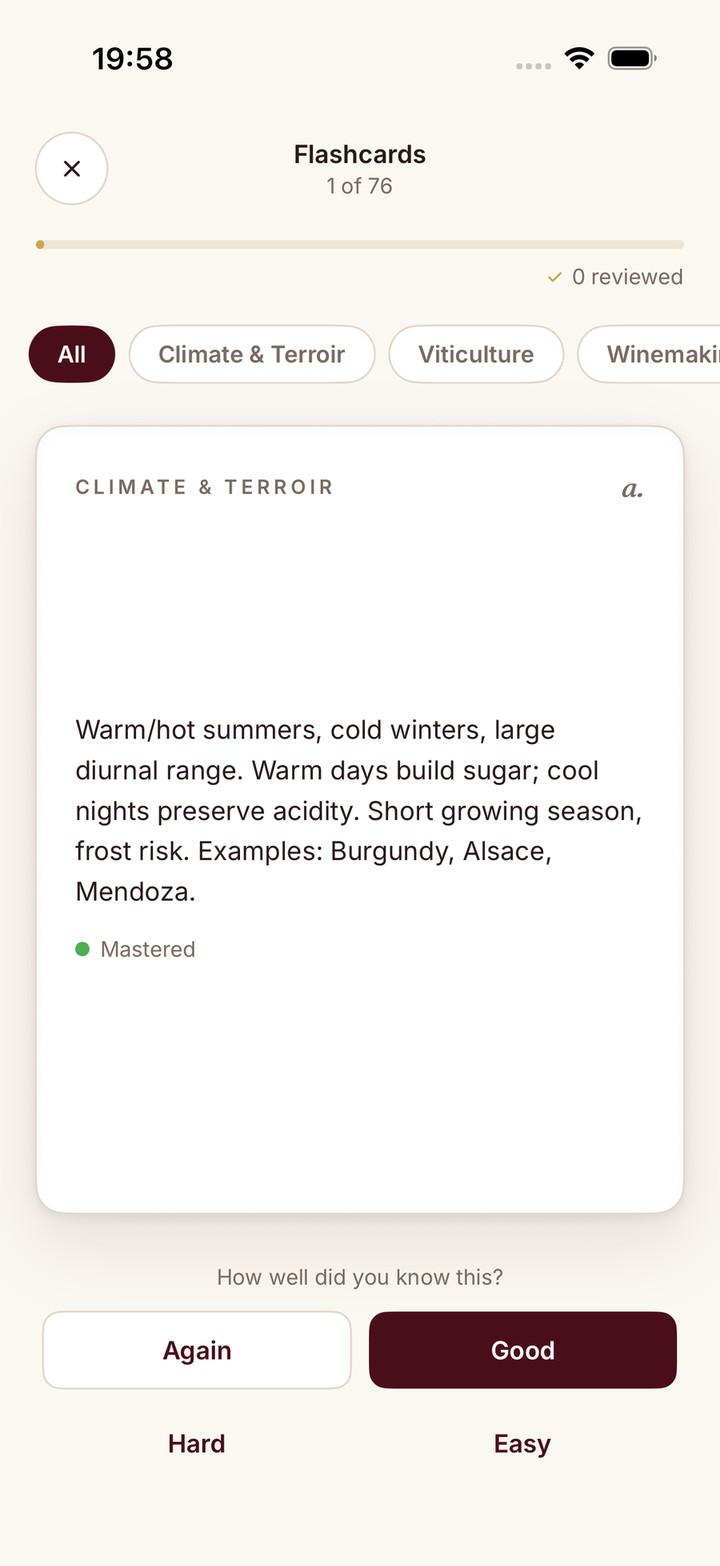
Practise with Sommo
Use Sommo’s blind tasting tools and structured journal to repeat the same sequence until it becomes familiar: observe, calibrate, conclude, review. Download Sommo to keep the observations together. Use small samples and spit during study sessions.