WSET Level 3 Study Guide: Award in Wines
In-depth WSET Level 3 study guide covering winemaking, terroir, quality assessment, and all major wine regions. Free cheatsheet and 50-question mock test.
- Qualification
- Award in Wines
- Study Time
- ~84 hours
- Exam Format
- MCQs + Short Answer + Tasting
- Pass Mark
- 55%
Understand
Keep the core ideas close, then follow the connections between grapes, places and styles.
View CheatsheetRecall
Cover the answer, retrieve it from memory, and revisit anything that needs another look.
Study FlashcardsPractise
Put your knowledge to work and use the explanations to plan your next study session.
Take the Mock TestWhat Is WSET Level 3?
WSET Level 3 is a rigorous intermediate-to-advanced qualification that shifts from describing wine to explaining it. Every tasting note and quality judgement must be traced through cause-and-effect chains linking vineyard, climate, soil, viticulture, and winemaking to the wine in the glass. The exam has a theory paper (50 MCQs + short-answer questions, 2 hours) and a tasting paper (2 wines, 30 minutes). Both must be passed separately at 55%.
WSET specifies a minimum of 84 hours of study. The syllabus covers the principal wine-producing regions, viticulture, winemaking, sparkling and fortified wines. Check the official Level 3 qualification page and specification with your provider for your current course requirements.
Your Level 3 Study Route
Give theory and tasting their own weekly practice time. For theory, build a cause-and-effect explanation, then use the command-verb guide and written-answer exercises to answer the exact question. For tasting, use the calibration workshop to compare your observations with informed feedback before moving into timed exam practice.
Sommo’s online multiple-choice tests are independent knowledge drills. They do not simulate the whole Level 3 qualification or assess your written answers and tasting. Your official study pack and Approved Programme Provider remain authoritative, and a practice score is not a prediction of an official result.
The SAT at Level 3
Level 3 adds quality assessment to the SAT framework. After describing appearance, nose, and palate, you must justify a quality judgement using four criteria:
- Balance: structural components (acidity, tannin, alcohol, sweetness, body) in harmony
- Length: persistence of desirable flavours after tasting; there is no stopwatch threshold that automatically makes a wine outstanding
- Intensity: concentration of flavour and expressiveness of aromatics
- Complexity: diversity and layering of aromas and flavours
Quality scale: Faulty → Poor → Acceptable → Good → Very good → Outstanding
Climate, Soil & Terroir
Climate types and their effects
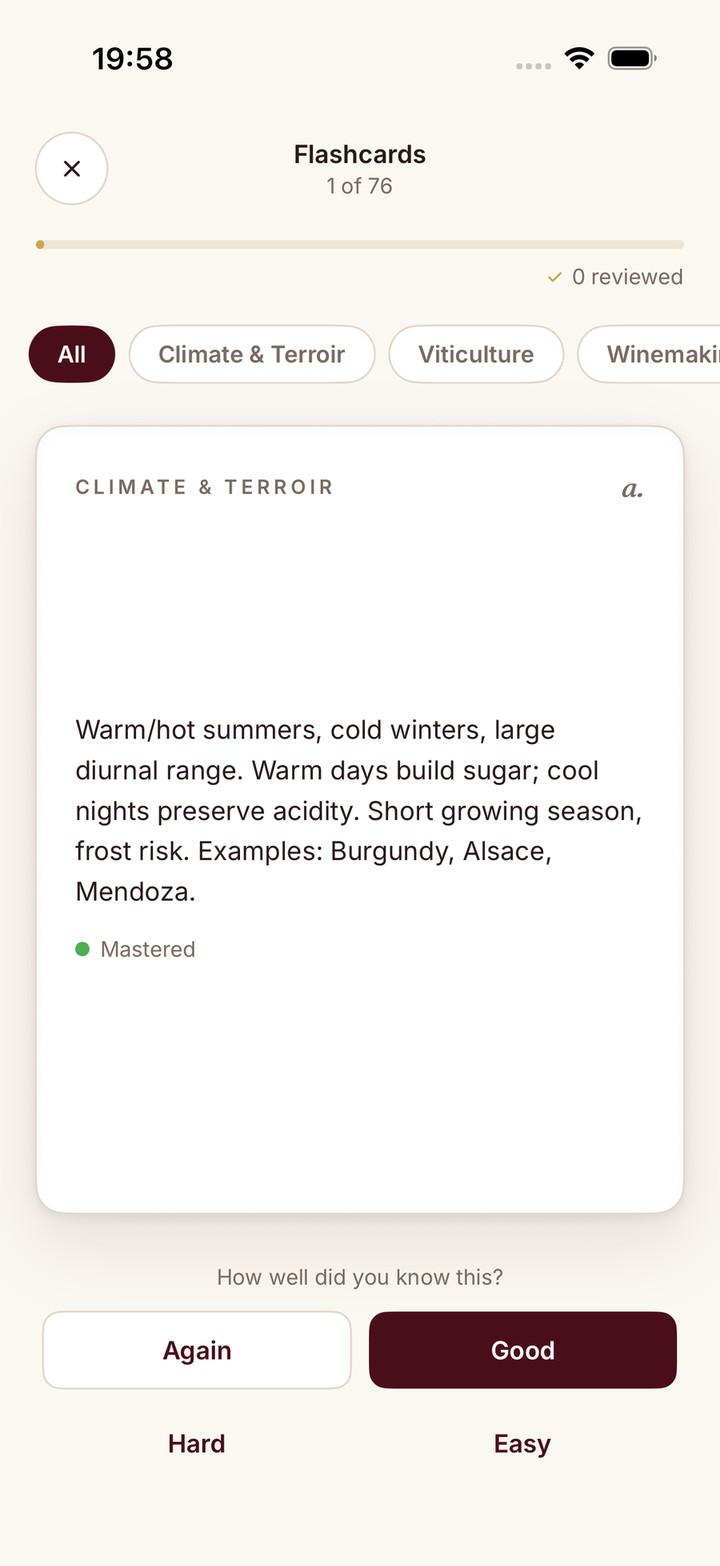
Continental: warm/hot summers, cold winters, large diurnal range. Warm days build sugar; cool nights preserve acidity. Short growing season, frost risk. Examples: Burgundy, Alsace, Mendoza (high altitude).
Maritime: moderated by water, warm summers, mild winters, year-round rainfall. Slow, steady ripening; rot pressure in wet years. Examples: Bordeaux, Marlborough, Willamette Valley.
Mediterranean: hot dry summers, mild wet winters. Full ripeness reliable; challenge is preserving acidity. Producers pick early, plant at altitude, or choose acid-retaining varieties. Examples: Southern Rhone, Barossa Valley, Priorat.
Key soil types
- Gravel: free-draining, heat-retaining. Bordeaux Left Bank.
- Clay: water-retentive, rich and powerful wines. Pomerol, Saint-Emilion.
- Limestone/Chalk: good drainage, promotes acidity. Burgundy, Champagne, Loire.
- Slate: heat-retaining on steep slopes, aromatic intensity. Mosel.
- Volcanic: mineral-rich, well-drained. Mount Etna, Santorini.
- Granite: low fertility, excellent drainage, elegant wines. Beaujolais crus, Northern Rhone.
- Sand: free-draining, phylloxera-resistant. Lighter, fragrant wines.
Viticulture & Winemaking
Viticulture decisions
- Canopy management: leaf removal improves airflow, reduces rot, increases sun exposure. Excessive removal causes sunburn in hot climates.
- Yield control: lower yields = more concentrated wines. Managed through pruning, green harvesting, vine density.
- Organic/biodynamic: no synthetic pesticides. Biodynamic adds Steiner preparations timed to lunar calendar. More labour, higher disease risk.
- Harvest timing: sugar ripeness vs. phenolic ripeness. Warm climates may reach high sugar before tannins mature, leading to higher alcohol.
Winemaking techniques
Pre-fermentation:
- Cold soaking, extracts colour and fruit without harsh seed tannin (classic for Pinot Noir)
- Whole-bunch, stems add structure, spice, freshness (Burgundy, Rhone)
- Skin contact for whites, brief enhances aromatics; extended creates orange wines
Fermentation:
- Stainless steel (preserves fruit) vs. oak (adds flavour, micro-oxidation) vs. concrete (neutral)
- Cool fermentation for aromatic whites; warm for red extraction
- Indigenous yeasts for complexity vs. cultured yeasts for reliability
Post-fermentation:
- MLF, standard for reds, optional for whites. Adds creaminess, softens acidity.
- Lees contact/batonnage, body, texture, bready/nutty flavours
- Oak ageing, new oak (strong flavour), old oak (gentle oxidation). French vs. American oak.
Major Wine Regions
France
- Bordeaux: Left Bank (Cabernet Sauvignon, gravel, tannic, 1855 Classification), Right Bank (Merlot, clay/limestone), Sauternes (botrytised Semillon)
- Burgundy: Regional → Village → Premier Cru → Grand Cru. Cote de Nuits (Pinot Noir), Cote de Beaune (Chardonnay), Chablis
- Rhone: North: single-varietal Syrah (Hermitage, Cote-Rotie), Viognier (Condrieu). South: Grenache blends (Chateauneuf-du-Pape)
- Loire: Sancerre (Sauvignon Blanc), Vouvray (Chenin Blanc), Chinon (Cabernet Franc), Muscadet
- Alsace: Riesling, Gewurztraminer, Pinot Gris, Muscat. 51 Grand Cru vineyards.
Italy and Spain
Italy:
- Piedmont: Barolo (38 months ageing, 18 in wood), Barbaresco (26 months, 9 in wood). Barbera, Dolcetto.
- Tuscany: Chianti Classico (80%+ Sangiovese, three tiers), Brunello di Montalcino (100% Sangiovese, 5 years ageing), Super Tuscans (IGT).
- Veneto: Valpolicella, Amarone (dried grapes, appassimento), Ripasso, Soave (Garganega).
Spain:
- Rioja: Joven, Crianza (1yr oak + 1yr bottle), Reserva (1yr oak + 2yr bottle), Gran Reserva (2yr oak + 3yr bottle). Sub-regions: Alta, Alavesa, Oriental.
- Ribera del Duero: powerful Tempranillo (Tinto Fino). Priorat: Garnacha/Carinena on llicorella slate. Jerez: Sherry. Rias Baixas: Albarino.
Germany and New World
Germany:
- Pradikat system + VDP vineyard hierarchy (Gutswein → Ortswein → Erste Lage → Grosse Lage)
- Mosel (steep slate, racy Riesling), Rheingau (fuller Riesling), Pfalz (warmest, diverse)
New World:
- California: Napa Valley Cabernet (sub-AVAs: Rutherford, Oakville, Stags Leap). Sonoma (Russian River Pinot Noir, Dry Creek Zinfandel).
- Oregon: Willamette Valley Pinot Noir
- Chile: Maipo (Cabernet), Colchagua (Carmenere), Casablanca/Leyda (cool whites)
- Argentina: Mendoza high-altitude Malbec (800-1,500m), Uco Valley
- Australia: Barossa (Shiraz), Eden/Clare Valley (Riesling), Margaret River (Cabernet, Chardonnay), Hunter Valley (Semillon)
- New Zealand: Marlborough (Sauvignon Blanc), Central Otago/Martinborough (Pinot Noir), Hawke’s Bay (Bordeaux blends)
- South Africa: Stellenbosch (Cabernet), Swartland (Chenin Blanc, Rhone reds), Elgin/Walker Bay (cool-climate Pinot Noir)
Sparkling & Fortified
Sparkling wine production
Traditional method (Champagne, Cava, Cremant, Franciacorta, English sparkling):
- Base wine → 2. Assemblage → 3. Liqueur de tirage → 4. Second fermentation in bottle → 5. Lees ageing (autolysis adds bread and biscuit aromas) → 6. Riddling → 7. Disgorgement → 8. Dosage → 9. Corking
- Blanc de Blancs (white grapes, usually Chardonnay in Champagne), Blanc de Noirs (black grapes), Rose (blending or skin contact)
- Cava: Macabeo/Parellada/Xarel-lo, 9 months lees minimum
- Prosecco: Charmat method, Glera grape, fresh/fruity/floral
Port and Sherry
Port: fermentation arrested by grape spirit at ~half sugar fermented. 19-22% ABV.
- Ruby styles: Ruby, Ruby Reserve, LBV (single vintage, 4-6yr), Vintage Port (exceptional years, decades of bottle age)
- Tawny styles: oxidative ageing in pipes. 10/20/30/40 Year Old (average age). Colheita (single vintage, 7yr+ barrel)
Sherry: Palomino base wine, fortified, then classified:
- Biological (15% ABV): Fino, Manzanilla (under flor yeast)
- Oxidative (17% ABV): Oloroso (no flor, walnut, toffee)
- Both: Amontillado (starts under flor, then oxidative), Palo Cortado
- Solera system: fractional blending for consistency
Exam Strategy
Theory paper (2 hours):
- MCQs: eliminate wrong options, watch for qualifying words (always/never/typically/may)
- Short-answer: State the point → Explain cause-and-effect → Support with specific examples
- Allocate time proportionally to marks per question
Tasting paper (30 minutes, 2 wines):
- Work through the full SAT systematically, do not skip sections
- Quality assessment must explicitly reference balance, length, intensity, complexity
- A well-supported “wrong” variety guess with excellent notes scores better than a correct guess with poor notes
Study habits:
- Build cause-and-effect chains for every region
- Taste 2-3 wines per week using the full Level 3 SAT
- Study maps, placing appellations geographically helps connect climate, soil, and style
- Use Sommo’s adaptive daily practice to target your weakest topics with AI-selected questions
- Check your AI study plan weekly for an updated readiness score and personalised focus areas
- Take the mock test under timed conditions to identify weak areas
The Level 3 study-pack guide turns the current specification, provider-issued book, maps, tasting list and timed practice into one eight-week system without reproducing copyrighted course material.