WSET Level 2 Past Papers: Free Exam Questions with Answers
WSET does not release past papers. Use the closest legal equivalent: free Level 2 exam questions with answers, plus a timed 50-question mock in the real format.
Why real past papers do not exist
WSET treats its exam papers as confidential assessment material. Papers are collected at the end of every sitting, questions rotate through a shared bank used across thousands of course providers worldwide, and releasing even one old paper would compromise live exams. That is why no legitimate site offers a genuine “WSET Level 2 past paper PDF”, and why anything claiming to be one deserves suspicion: it is either invented material dressed up with a logo or an actual breach of copyright.
What WSET does publish is the specification: the learning outcomes, the exam format, and the pass mark. That document is the honest foundation for practice, and it is exactly what the questions below and the full Level 2 mock exam are written against.
How the real exam is structured
| Element | Detail |
|---|---|
| Questions | 50 multiple choice |
| Time | 60 minutes |
| Pass mark | 55% (28 correct answers) |
| Merit | 70% and above |
| Distinction | 85% and above |
| Marking | One mark per question, no negative marking |
| Materials | Closed book, no notes |
Tasting is taught on the Level 2 course but not examined, so the paper is pure theory: grape varieties, regions, label terms, winemaking, sparkling and fortified wines, and food pairing principles. The Level 2 exam guide walks through the question styles and marking in detail, and the Level 2 pass rate post covers how often candidates clear 55%.
Ten sample questions with answers
These are original questions written to Level 2 difficulty. Cover the answers, work through all ten, then check yourself.
1. Which grape variety makes the red wines of Beaujolais?
A) Pinot Noir B) Gamay C) Syrah D) Merlot
Answer: B. Gamay gives Beaujolais its light body, low tannin, and fresh red-fruit character.
2. Chablis is made from which grape variety?
A) Sauvignon Blanc B) Pinot Gris C) Chardonnay D) Riesling
Answer: C. Chablis is Chardonnay from a cool climate, typically dry, high in acidity, and unoaked.
3. What does the term Trocken indicate on a German wine label?
A) The wine is sweet B) The wine is dry C) The wine is sparkling D) The wine is oak aged
Answer: B. Trocken is the German label term for a dry style.
4. Which region is best known for Sauvignon Blanc with intense gooseberry and passion fruit flavours?
A) Marlborough B) Barossa Valley C) Tuscany D) Mosel
Answer: A. Marlborough in New Zealand made this pungent, high-acid style famous.
5. Barolo is made from which grape variety?
A) Sangiovese B) Barbera C) Corvina D) Nebbiolo
Answer: D. Nebbiolo gives Barolo its high tannin, high acidity, and capacity to age.
6. In the traditional method of sparkling winemaking, the bubbles are created by:
A) Injecting carbon dioxide B) A second fermentation in the bottle C) Fermenting at high temperature D) Adding sugar at bottling
Answer: B. The second alcoholic fermentation happens in the sealed bottle, trapping the carbon dioxide it produces.
7. What does Reserva indicate on a bottle of red Rioja?
A) A single-vineyard wine B) A sweet style C) Minimum ageing requirements in oak and bottle have been met D) The grapes were hand harvested
Answer: C. Reserva is a legally defined ageing category, not a statement about vineyard, sweetness, or harvest method.
8. A squeeze of lemon over a dish will generally make an accompanying wine taste:
A) More acidic and harsher B) Less acidic and fruitier C) More tannic D) Sweeter than it is, then bitter
Answer: B. Acidity in food softens the perception of acidity in wine, making it taste rounder and fruitier.
9. Which of these is a fortified wine?
A) Champagne B) Chianti C) Port D) Chablis
Answer: C. Port is fortified by adding grape spirit during fermentation, which stops the yeast and leaves residual sugar.
10. The sweetness of Sauternes comes principally from:
A) Grape spirit added during fermentation B) Sugar added after fermentation C) Grapes dried indoors after harvest D) Grapes concentrated by noble rot
Answer: D. Botrytis cinerea, noble rot, shrivels the grapes on the vine and concentrates their sugars and flavours.
Scoring 8 or more from cold is a good sign. Anything less just tells you where to point your revision, which is what practice is for.
How to use practice papers properly
A practice paper is a diagnostic instrument, not a revision method. Used well, the loop looks like this:
- Sit a full paper cold, early. Take the interactive Level 2 mock exam before serious revision starts. The score does not matter; the per-topic breakdown does.
- Drill the gaps by topic. The Level 2 topic quizzes let you hammer one area at a time, whether that is Burgundy, label terms, or winemaking.
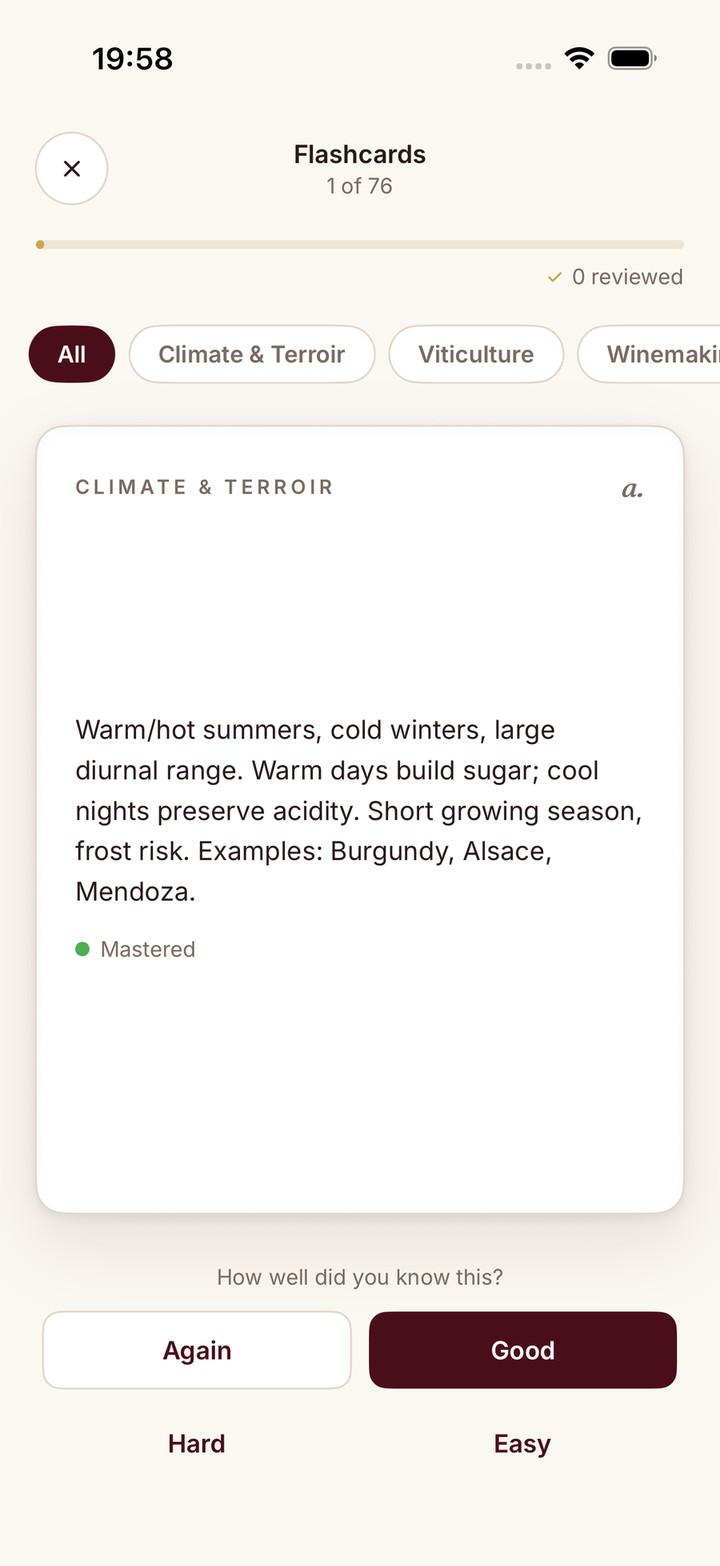
- Convert misses into flashcards. Every fact you got wrong goes into rotation with the Level 2 flashcards, which use spaced repetition so the fact comes back just before you forget it.
- Repeat under timed conditions. A second and third full mock, spaced through your revision, measures real progress. Sixty minutes for 50 questions is comfortable, but only if you practise the rhythm.
- Never memorise the questions. If you can predict the answer from the wording rather than the wine knowledge, the paper has stopped measuring anything. Rotate fresh questions instead of rereading old ones.
The Level 2 study plan sequences all of this over four weeks, and the study planner turns it into a printable schedule.
Printable revision sheets
For offline revision, the printable Level 2 cheatsheet PDFs condense the syllabus onto sheets you can mark up by hand, and the online Level 2 cheatsheet mirrors the same content with links into each topic. Pair either with the flashcards for recall and the mock for exam rehearsal, and you have covered the three things a past paper would have given you: format familiarity, topic coverage, and a score you can trust. Browse all WSET mock tests if you are also eyeing Level 3.
Common questions
No. WSET keeps all examination papers confidential and reuses questions across sittings, so genuine papers are never released. Sites offering past paper PDFs are selling either invented questions or copyrighted material. The legitimate route is the official specification, which describes the exam, plus original practice questions written to that specification, like the free mock exam here.
No. Every question on this page and in the mock exam is original, written to match the published Level 2 specification in topic coverage, difficulty, and format. Nothing is copied from a live paper. That matters: practising on legitimate questions trains the same knowledge without the risk of studying from material that misrepresents the real exam.
Three full timed papers is a sensible minimum. Sit one early as a diagnostic, one mid-revision to measure progress, and one in the final week to rehearse pacing. Between papers, drill your weak topics with targeted quizzes and flashcards rather than repeating full mocks, because repeating too soon just tests your memory of the questions.
The pass mark is 55%, but aim to score 70% or higher on a full timed mock you have not seen before. That margin absorbs exam-day nerves, unfamiliar wording, and the odd topic you missed. If you are scoring in the 50s, identify which topics are leaking marks and drill those before sitting another full paper.
No. There is no negative marking. Every question carries one mark, a wrong answer scores zero, and a blank answer also scores zero, so never leave a question unanswered. Eliminate the options you know are wrong and choose the most plausible of what remains. Guessing from two options gives you a coin-flip on a mark you would otherwise forfeit.