WSET Level 2 Exam Guide: Format, Questions, and Marking
What the WSET Level 2 exam is like: 50 multiple choice questions in 60 minutes, a 55% pass mark, grade bands, worked examples, and a 4-week revision plan.
The format at a glance
| Element | Detail |
|---|---|
| Questions | 50 multiple choice, four options each |
| Time | 60 minutes |
| Pass | 55% (28 correct) |
| Pass with merit | 70% (35 correct) |
| Pass with distinction | 85% (43 correct) |
| Marking | One mark per question, no negative marking |
| Materials allowed | None: closed book |
| Tasting | Taught on the course, not examined |
Sixty minutes for 50 questions is just over a minute each, and most candidates finish with time to spare. The constraint is knowledge, not speed, which is good news: it means structured revision is the whole game.
What the questions feel like
Level 2 questions come in two broad styles. The first is straight recall:
Which of these regions is best known for Pinot Noir?
A) Barossa Valley B) Central Otago C) Rioja D) Mendoza
Answer: B. The other three are famous for Shiraz, Tempranillo, and Malbec respectively. Distractors are usually real regions attached to the wrong grape, so vague familiarity is not enough.
The second style asks you to apply a principle:
A customer wants a dry white with high acidity and no oak flavour. Which is the best recommendation?
A) Sauternes B) Chablis C) An oaked Chardonnay from California D) Tawny Port
Answer: B. You are not recalling a fact but combining three: Chablis is dry, high in acid, and typically unoaked.
Label terms get the same treatment:
Which statement about a wine labelled Brut is correct?
A) It is a sweet fortified wine B) It is a dry style of sparkling wine C) It must come from Champagne D) It has been aged in oak
Answer: B. Brut describes sweetness level, not origin or ageing, and it appears on sparkling wines from many countries.
Ten more worked questions, with answers and explanations, are on the Level 2 sample questions page, and the interactive mock exam runs the full 50-question format against the clock.
How the exam is marked
Every question is worth one mark, wrong and blank answers both score zero, and there is no penalty for guessing, so answer everything. Papers are marked through WSET’s centralised process rather than at your course provider’s discretion, and WSET issues the results back through the provider. The grade bands (pass, merit, distinction) appear on your certificate, but the qualification itself is identical at every band.
What the syllabus weighs
The paper samples across the whole specification, so selective revision is the classic way to fail. Roughly, the emphasis falls like this:
| Syllabus area | Presence in the paper |
|---|---|
| Grape varieties and the styles they produce | The largest share, anchored on eight principal varieties |
| Regions and their labelling terms | Close behind, and often fused with variety questions |
| Winemaking and factors affecting style | A solid block |
| Sparkling and fortified wines | A smaller but dependable set |
| Food and wine pairing principles | A handful of questions |
The official specification, free to download from WSET, sets out the learning outcomes behind this in full. The Level 2 cheatsheet compresses all of it onto one page, and the topic quizzes let you test each area in isolation.
Exam-day logistics
Bring photo ID matching your registration name, arrive early, and expect phones and notes to be surrendered before the paper starts. In-person sittings use a paper answer sheet; remotely invigilated online exams, where your provider offers them, add a room scan and strict software rules, so test your setup in advance. The exam-day checklist covers the full run-through, including the things people actually forget.
The classic mistakes
For the diagnosis and repair loop behind this summary, read eight fixable WSET Level 2 exam mistakes. It separates knowledge gaps from misreads, confusion pairs and correct guesses that only looked secure.
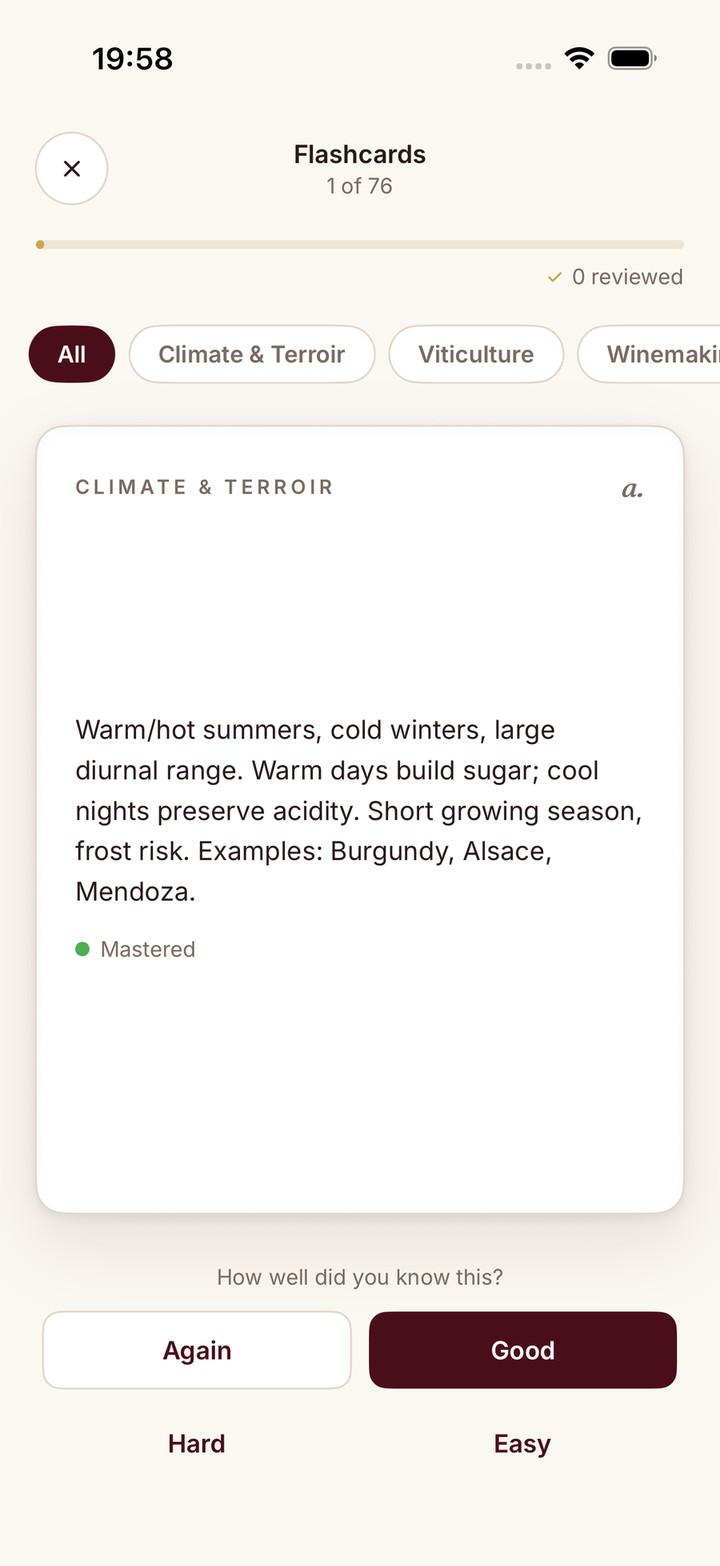
- Skipping label terms. Trocken, Brut, Reserva, and their relatives are pure memorisation, and they reliably appear. Experience with wine does not teach them; flashcards do.
- Learning varieties without their regions. The exam loves the join: not “what is Gamay” but “where is Gamay the grape”.
- Ignoring sparkling and fortified chapters. Smaller topics, guaranteed marks, frequently sacrificed.
- Misreading negative stems. “Which of these is NOT…” catches people sprinting. Slow down on any question containing “not” or “except”.
- Leaving blanks. With no negative marking, an educated guess is always worth more than an empty box.
- Never sitting a timed paper. The first time you experience 50 questions against a clock should not be the day it counts.
A four-week revision outline
| Week | Focus |
|---|---|
| 1 | Sit the mock exam cold as a diagnostic. Revise grape varieties and factors affecting style |
| 2 | European regions and label terms, drilled with topic quizzes |
| 3 | Southern hemisphere regions, sparkling, fortified, food pairing. Start daily flashcards |
| 4 | Second and third timed mocks, review every wrong answer, skim the cheatsheet daily |
The full Level 2 study plan expands this into day-by-day sessions, and the printable study planner turns it into a schedule you can pin above your desk. Wondering how Level 2 compares to what comes next? See Level 2 vs Level 3 and the wider study guide hub.
Common questions
It is a fair exam with a forgiving pass mark. You need 28 of 50 questions correct, the questions test recognition and understanding rather than obscure trivia, and most candidates who complete the recommended study hours pass. The people who struggle are usually those who relied on wine experience alone and skipped the label terms and lesser-known regions.
No. The course teaches the Level 2 Systematic Approach to Tasting and you will taste wines in class or with course samples, but the qualification is awarded on the multiple choice theory paper alone. Tasting is first formally examined at Level 3, where a blind tasting paper on two wines sits alongside the theory exam.
You can resit the exam through your course provider without repeating the course. There is a resit fee, set by the provider, and you book the next available exam date. Before rebooking, diagnose what went wrong with a full timed mock, because a resit with the same preparation tends to produce the same result.
Many course providers offer a remotely invigilated online exam as well as in-person paper sittings, but availability varies by provider and country. The format, question count, time limit, and pass mark are the same either way. Check the technical requirements carefully if you choose the online option, as invigilation software has strict rules.
Results come back through your course provider, usually within several weeks of the exam, though exact timing varies by provider, country, and exam format. Certificates and pins follow after results are confirmed. If you are planning to start Level 3 immediately, book with your intended provider early rather than waiting for the paperwork to arrive.
The qualification is the same either way, and most employers only ask whether you hold it. Distinction is a nice signal of thoroughness on a CV, and clearing 85% suggests you are ready to move to Level 3 quickly. But nobody should delay booking Level 3 purely to chase a better grade band at Level 2.