01
Wine
Roast chicken
Buttery skin and savory juices meet the wine's texture and acidity in the middle, the most reliable Sunday pairing there is. The wine with chicken guide has the variations.
- From
- Burgundy
- Also
- Sonoma County
Roast chicken is the best Chardonnay food pairing, but the right bottle changes with the plate. A guide to what to eat with oaked and unoaked Chardonnay.
Buttery skin and savory juices meet the wine's texture and acidity in the middle, the most reliable Sunday pairing there is. The wine with chicken guide has the variations.
Sweet shellfish and a gently oaked bottle trade richness for richness, with enough acidity to keep the butter moving.
Steely, unoaked Chablis grew on fossil oyster shell and mirrors the brine exactly. See the wine with oysters guide for the full raw bar.
Roast chicken is the best pairing for Chardonnay, and a bottle of white Burgundy makes the case in one mouthful. Buttery skin, savory roasting juices and a wine built on texture and orchard fruit meet in the middle, with just enough acidity to reset the palate between bites. The wider truth about Chardonnay is that the grape itself is close to neutral, so the useful question is never whether Chardonnay pairs with a dish. It is which Chardonnay.
Chardonnay has no tannin, almost no aromatic signature of its own and no residual sugar in the dry styles that make up most of what you will buy. Everything you taste comes from two variables: where it grew and what the winemaker did with it.
Climate sets the acidity and the body. Cool sites such as Chablis give lean, high-acid wines that taste of green apple, lemon and wet stone. Warm sites give lower acidity, a fuller body and flavors that run from peach to pineapple and mango.
Winemaking sets the texture. Malolactic conversion turns sharp malic acid into softer lactic acid and creates the buttery note people either love or avoid. Oak barrels add vanilla, toast and baking spice. Stirring the wine on its spent yeast lees adds a creamy, bready weight. Stainless steel does none of that and leaves the fruit bare.
So the pairing rule is simple. Match weight with weight, then match the cooking method to the winemaking. Lemon, brine and raw fish want an unoaked, high-acid bottle. Butter, cream, roasting and char want the barrel-aged version, because toast in the glass and browning on the plate are the same flavor family.
| Dish | Why it works | Style of Chardonnay to reach for |
|---|---|---|
| Roast chicken | Buttery bird, creamy-textured wine, the most reliable Sunday match | Village white Burgundy |
| Lobster and crab in butter | Sweet shellfish and gentle oak trade richness for richness | Barrel-aged, Meursault in style |
| Oysters | Steely, unoaked Chardonnay mirrors the shell and the brine | Chablis, no oak at all |
| Salmon | Texture and gentle toast echo the char, acidity handles the oil | Lightly oaked, mid-weight |
| Creamy pasta | Enough body for the sauce, enough acid for the third forkful | Unoaked or lightly oaked |
| Pork loin with apple | Orchard fruit does the job apple sauce does | Unoaked Macon or Italian |
| Turkey | Weight for the dark meat, freshness for everything else | Ripe, medium oak |
| Mushroom risotto and mushrooms | Creamy rice, creamy wine, and acidity keeping both honest | Mature white Burgundy |
| Comte and hard Alpine cheese | An Alpine marriage of nut and cream | Aged, barrel-fermented |
| Brie and Camembert | Soft orchard fruit in quiet agreement with the paste | Unoaked, or Blanc de Blancs |
| Fried chicken | Bubbles and batter, the fizz cuts the fry every time | Blanc de Blancs Champagne |
| White pizza with four cheeses | No tomato acidity to fight, so texture leads | Unoaked, high acid |
| Butternut squash and pumpkin ravioli | Sweet roasted squash meets vanilla and spice from the barrel | Ripe, barrel-fermented |
| Fish and chips | The surprise: bone-dry Chablis slices grease better than beer | Chablis, cold and unoaked |
Morels are a special case because their nutty, smoky depth needs more than generic fruity Chardonnay. When they are cooked with butter or cream, choose a textured white Burgundy in the Meursault, Saint-Aubin, Rully or good Mâcon spectrum. Lees and restrained oak echo the mushroom while acidity cuts the sauce.
For morels with roast chicken, keep the wine fresh enough for the bird: a Puligny-Montrachet style or another cool-climate, lightly oaked Chardonnay. For a cream-heavy fricassée, move towards Meursault-like breadth. If the recipe uses Vin Jaune, pour the Jura wine instead, since its walnut and oxidative character is the direct bridge.
Avoid overt vanilla, high alcohol and sweet tropical fruit. The full mushroom pairing guide matches morels alongside porcini, chanterelles and truffle, and Pinot Gris versus Chardonnay explains the alternative when the dish includes gentle spice.
Burgundy makes the case twice over. In the north, Chablis grows on soils full of fossil oyster shell, and a glass beside a dozen oysters is one of wine’s tidiest circles. Further south in the Cote de Beaune, the wines gain barrel and lees weight and turn toward poulet de Bresse with cream, gougeres and river fish in butter.
California’s cooler coastal sites, Sonoma County above all, built their reputation on riper, rounder Chardonnay, and the local table answered with Dungeness crab, roast chicken and cedar-planked salmon. The extra fruit weight needs a dish with fat in it, so butter and browning are your friends.
Margaret River in Western Australia sits between the two, taut but textured, and it is poured with grilled marron, snapper and abalone straight off the coast. The pattern repeats everywhere Chardonnay grows: the leaner the region, the rawer and simpler the plate can be.
Unoaked styles show best at 8 to 10 degrees Celsius (46 to 50 Fahrenheit). Oaked and barrel-aged bottles want 10 to 13 degrees (50 to 55 Fahrenheit), because fridge-cold mutes exactly the texture you paid for. Use a standard white wine glass for lean styles and a slightly wider bowl for rich ones. Serious young white Burgundy improves with fifteen minutes in a decanter, and nothing else needs it.
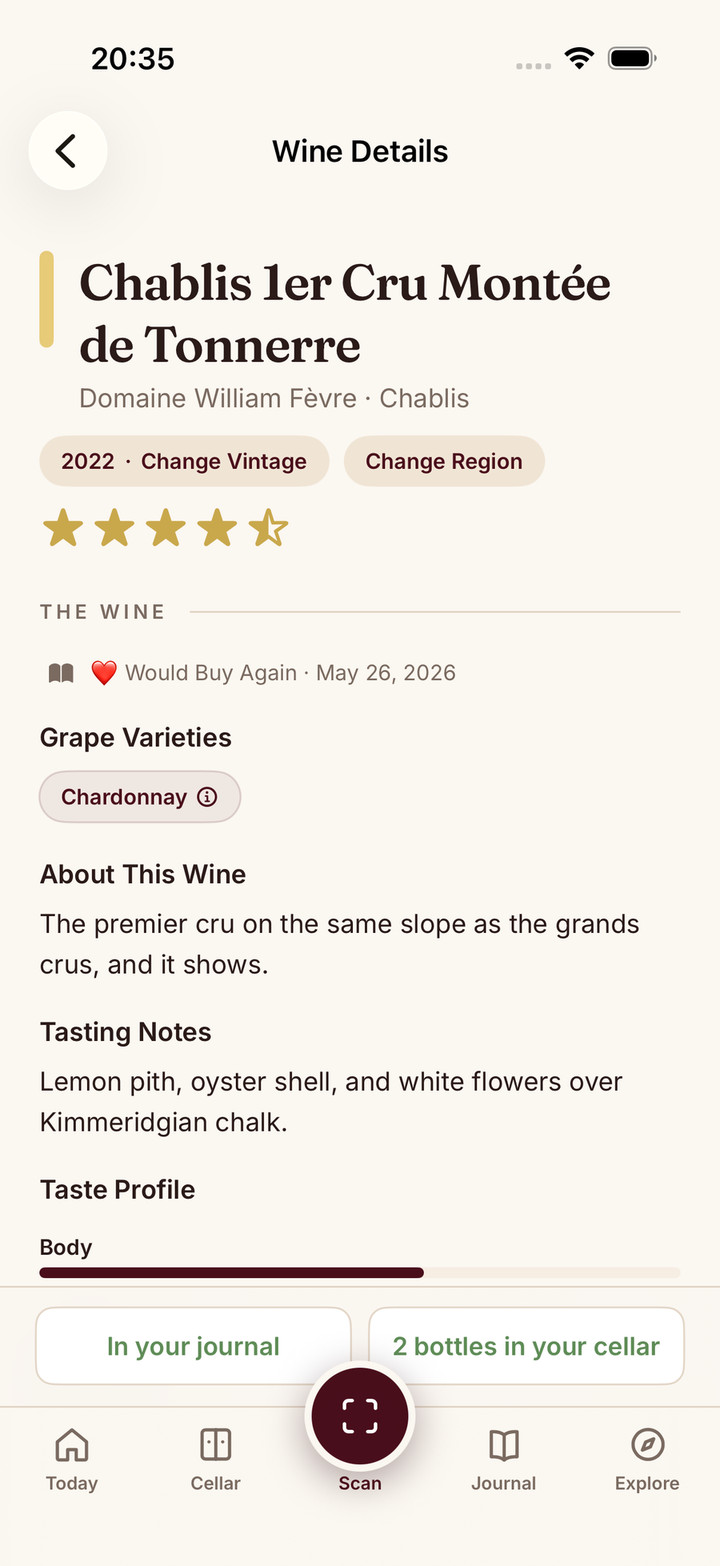
The hardest part of a Chardonnay pairing is knowing which kind you are holding, and the label rarely tells you. Sommo reads the bottle, works out how much oak, lees and ripeness are in play, and matches that to what is on your plate tonight. Download Sommo free and stop guessing at the wine shop.
Sommo reads your cellar, checks how each bottle tastes right now, and picks the wine that fits the meal. Built by a sommelier-trained model.
 Or point your camera here