Bordeaux Wine Tours: Guide to France's Top Region
Plan your Bordeaux wine tour with our guide to Left Bank chateaux, Right Bank estates, Sauternes, and tips for visiting this iconic region.
Highlights
- The 1855 Classification chateaux, including First Growths like Lafite Rothschild and Margaux
- The UNESCO World Heritage city of Bordeaux with La Cite du Vin wine museum
- Saint-Emilion's medieval village with underground limestone cellars and exceptional Merlot-based wines
- Over 7,000 chateaux and wine producers across 60 appellations
Top Wineries & Wine Bars
Chateau Margaux
A First Growth estate producing one of Bordeaux's most elegant and perfumed Cabernet-dominant wines
$$$$Chateau Figeac
A Saint-Emilion Premier Grand Cru Classe known for its unique blend with significant Cabernet Franc and Sauvignon
$$$$Chateau Lynch-Bages
A beloved Fifth Growth Pauillac over-performing its classification, known for generous, approachable wines
$$$Chateau Smith Haut Lafitte
A revitalized Pessac-Leognan estate producing outstanding red and white wines, with a luxury spa
$$$Chateau Pavie
A Premier Grand Cru Classe A Saint-Emilion with powerful, concentrated wines from limestone slopes
$$$$Chateau Pape Clement
One of Bordeaux's oldest estates, dating to 1306, producing rich Pessac-Leognan reds and whites
$$$Areas to Explore
Medoc & Haut-Medoc
The Left Bank's legendary strip of gravel terroir, home to the greatest classified Cabernet Sauvignon chateaux.
Saint-Emilion
A charming medieval village on the Right Bank producing opulent, Merlot-dominant wines from limestone and clay.
Pomerol
A tiny, prestigious appellation producing rich Merlot-based wines, including the legendary Petrus.
Pessac-Leognan
The closest wine region to Bordeaux city, producing exceptional reds and some of Bordeaux's finest dry whites.
Sauternes & Barsac
The world's greatest sweet wine region, where noble rot transforms Semillon into golden, honeyed nectar.
Planning Tips
- Start with a visit to La Cite du Vin in Bordeaux city for an excellent introduction to the region's wines and history.
- Most chateaux require advance appointments; book at least one to two weeks ahead, especially for classified growths.
- Consider joining a guided minibus tour to the Medoc or Saint-Emilion if you prefer not to drive on narrow country roads.
- Visit both Left Bank and Right Bank to appreciate the contrast between Cabernet and Merlot-dominant styles.
- Do not skip the sweet wines of Sauternes; a visit to Chateau d'Yquem's village is a truly memorable experience.
Budget Guide
- Budget: Explore cooperative cellars and smaller family chateaux with low or free tasting fees, stay in Bordeaux city hostels or budget hotels, and eat at local bistros. Around $100-$150 per person per day.
- Mid-Range: Join organized half-day tours to Saint-Emilion or the Medoc, stay at a comfortable city hotel or countryside gite, and enjoy meals at wine bar restaurants. Plan for $200-$350 per person per day.
- Luxury: Arrange private visits to First Growth estates, stay at Les Sources de Caudalie or Chateau Cordeillan-Bages, and dine at Michelin-starred restaurants like Le Gabriel. Budget $600 or more per person per day.
Bordeaux: The Benchmark of Fine Wine
Bordeaux is not merely a wine region. It is the reference point against which much of the wine world measures itself. For centuries, the chateaux of Bordeaux have produced wines of extraordinary elegance, complexity, and longevity, establishing a classification and trading system that remains the template for fine wine globally. A visit to Bordeaux is a pilgrimage into the history, culture, and craft that define winemaking at its highest level.
The region stretches across roughly 280,000 acres of vineyard, making it one of the largest appellations of fine wine in France. The Gironde estuary and its two tributaries, the Garonne and the Dordogne, divide the landscape into the Left Bank, Right Bank, and Entre-Deux-Mers, each with distinct soils, grape preferences, and winemaking philosophies.
Understanding Bordeaux’s Geography
The Left Bank
The Left Bank, south and west of the Gironde and Garonne, is home to Bordeaux’s most famous communes: Margaux, Saint-Julien, Pauillac, Saint-Estephe, Pessac-Leognan, and Graves. The gravelly soils here are ideally suited to Cabernet Sauvignon, which forms the backbone of Left Bank blends. These wines are typically structured, tannic in youth, and capable of extraordinary aging.
Pauillac alone contains three of the five First Growths from the 1855 Classification: Chateau Lafite Rothschild, Chateau Mouton Rothschild, and Chateau Latour. The concentration of prestige in this small commune is unmatched anywhere in the wine world.
Margaux produces wines often described as the most perfumed and elegant of Bordeaux. Chateau Margaux itself, with its neoclassical facade, is one of the most photographed wine estates on earth. Saint-Julien is arguably the most consistent commune, with estates like Chateau Leoville Las Cases and Chateau Ducru-Beaucaillou producing wines that rival the First Growths at lower prices.
The Right Bank
Across the Dordogne, the Right Bank tells a different story. The clay and limestone soils favor Merlot, producing wines that are generally rounder, more approachable in youth, and often more fruit-driven than their Left Bank counterparts. The two great appellations here are Saint-Emilion and Pomerol.
Saint-Emilion is one of the most visually stunning wine towns in the world, a UNESCO World Heritage site of medieval streets, limestone cellars, and a monolithic church carved into the rock. The appellation’s own classification system, updated roughly every decade, includes estates like Chateau Ausone and Chateau Cheval Blanc at the summit.
Pomerol, despite being Bordeaux’s smallest major appellation, produces some of its most expensive wines. Chateau Petrus, the most celebrated estate in Pomerol, is planted almost entirely to Merlot on a unique plateau of blue clay. A visit here (if you can arrange one) is an intimate, almost spiritual experience in contrast to the grandeur of the Left Bank chateaux.
Sauternes and Barsac
South of Bordeaux, the communes of Sauternes and Barsac produce the world’s greatest sweet wines. Morning mists from the Ciron river create conditions for Botrytis cinerea, the “noble rot” that concentrates sugars and flavors in Semillon, Sauvignon Blanc, and Muscadelle grapes. Chateau d’Yquem, the sole Premier Cru Superieur in the 1855 Classification, is the benchmark, producing wines of almost infinite complexity and longevity.
Entre-Deux-Mers
Between the two rivers lies Entre-Deux-Mers, Bordeaux’s largest and most diverse sub-region. While not home to classified growths, this area produces excellent value wines, particularly crisp, aromatic dry whites from Sauvignon Blanc and Semillon. It also serves as a pleasant base for exploring both banks.
Planning Your Bordeaux Wine Tour
When to Visit
June through September offers the best weather, with long sunny days ideal for vineyard visits. September brings the excitement of harvest. April and May are lovely, with fewer crowds and mild temperatures. The annual Bordeaux Wine Festival (Fete le Vin), held in even-numbered years along the city’s riverfront, is a spectacular event featuring tastings from hundreds of producers.
The City of Bordeaux
The city itself has undergone a remarkable renaissance. The riverfront, once a neglected industrial zone, is now a UNESCO World Heritage site with elegant 18th-century facades, excellent restaurants, and the stunning Cite du Vin, a wine museum and cultural center that opened in 2016. The building’s futuristic design houses interactive exhibits covering global wine culture, and the panoramic tasting room on the top floor offers views across the city with a glass of wine included in admission.
Spend at least a full day exploring the city before heading to the vineyards. The Chartrons district, historically the wine merchants’ quarter, is now home to antique shops, wine bars, and galleries. Bar a Vin, the wine bar operated by the Bordeaux Wine Council in the city center, offers an affordable and educational introduction to the region’s wines.
Getting to the Vineyards
The Medoc communes (Margaux, Saint-Julien, Pauillac, Saint-Estephe) lie north of the city along the D2 road, often called the Route des Chateaux. This drive is spectacular, with famous estates appearing one after another along the route. The journey from Bordeaux to Pauillac takes about an hour.
Saint-Emilion is 40 minutes east of the city and is easily reached by train as well as car. The town is compact and walkable, with numerous tasting rooms in its medieval center.
Visiting the Chateaux
The Classified Growths
Visiting a First Growth is a memorable experience but requires advance planning. Chateau Margaux, Chateau Lafite Rothschild, and Chateau Mouton Rothschild all accept visitors by appointment. Mouton Rothschild’s museum of wine-themed art, featuring works by Picasso, Warhol, and Chagall, is exceptional. Expect tour fees ranging from 30 to 100 euros, often including a tasting of the estate’s second wine and sometimes the grand vin.
Chateau Lynch-Bages in Pauillac has invested heavily in visitor facilities and offers one of the most polished tasting experiences on the Left Bank. Chateau Pichon Baron, with its fairy-tale turrets reflected in a manicured lake, combines architectural drama with excellent wine.
Accessible and Welcoming Estates
Not all Bordeaux chateaux require weeks of advance planning or deep pockets. Chateau Prieure-Lichine in Margaux has long been one of the most welcoming estates in the Medoc, with daily tours and tastings. Chateau Siran, also in Margaux, offers an excellent experience at moderate prices.
In Saint-Emilion, Chateau Franc Mayne and Chateau de Pressac provide warm hospitality and the chance to taste wines from this prestigious appellation without the stratospheric prices of the top crus.
Garagiste Estates
Bordeaux’s garagiste movement, which emerged in the 1990s, produced tiny-production wines from the Right Bank that challenged the established order. While the initial controversy has settled, estates like Chateau Valandraud and Chateau La Mondotte continue to produce compelling wines and offer intimate visiting experiences.
Food and Wine in Bordeaux
Regional Specialties
Bordeaux cuisine is rich, hearty, and perfectly suited to its wines. Entrecote bordelaise, ribeye steak with a shallot and red wine sauce, is the quintessential pairing with Left Bank Cabernet-Merlot blends. Lamprey a la bordelaise, lamprey eel cooked in red wine, is a traditional delicacy that has become increasingly rare. Canele, the small caramelized pastries flavored with rum and vanilla, are the region’s signature sweet.
Where to Eat
Le Pressoir d’Argent at the Grand Hotel Bordeaux, helmed by Gordon Ramsay’s team, offers Michelin-starred cuisine with a wine list that showcases the best of the region. For something more casual, Le Petit Commerce in the city center serves excellent seafood from the Atlantic coast. In Saint-Emilion, L’Envers du Decor is a wine bar and bistro on the main square that offers a well-priced selection of local wines by the glass alongside hearty regional cooking.
Practical Considerations
Tasting Etiquette
Bordeaux chateaux tend to be more formal than New World tasting rooms. Dress neatly, arrive on time for your appointment, and be prepared to listen before you taste. Many visits include a tour of the chai (barrel room) and an explanation of the estate’s history and winemaking philosophy. Questions are welcomed but interrupting your guide is not.
Language
While many chateau staff speak English, especially at larger estates, a few words of French go a long way. Learning basic wine vocabulary in French (“degustation” for tasting, “chai” for cellar, “vignoble” for vineyard, “millesime” for vintage) demonstrates respect and often results in a warmer welcome.
Buying Wine
Prices at the chateau are not always lower than retail, particularly for classified growths whose pricing is controlled through the negociant system. However, buying at the estate ensures provenance and sometimes grants access to wines not available elsewhere. Shipping internationally is possible through most estates, though it can be expensive for small quantities.
Budget
A Bordeaux wine tour can be done at various price points. Budget-conscious visitors can enjoy excellent wines from Cru Bourgeois estates on the Left Bank and satellite appellations of Saint-Emilion for under 20 euros a bottle, with tasting fees as low as 10 euros. At the other end, a First Growth tasting experience followed by dinner at a Michelin-starred restaurant can easily exceed 500 euros per person.
Enhance Your Bordeaux Experience with Sommo
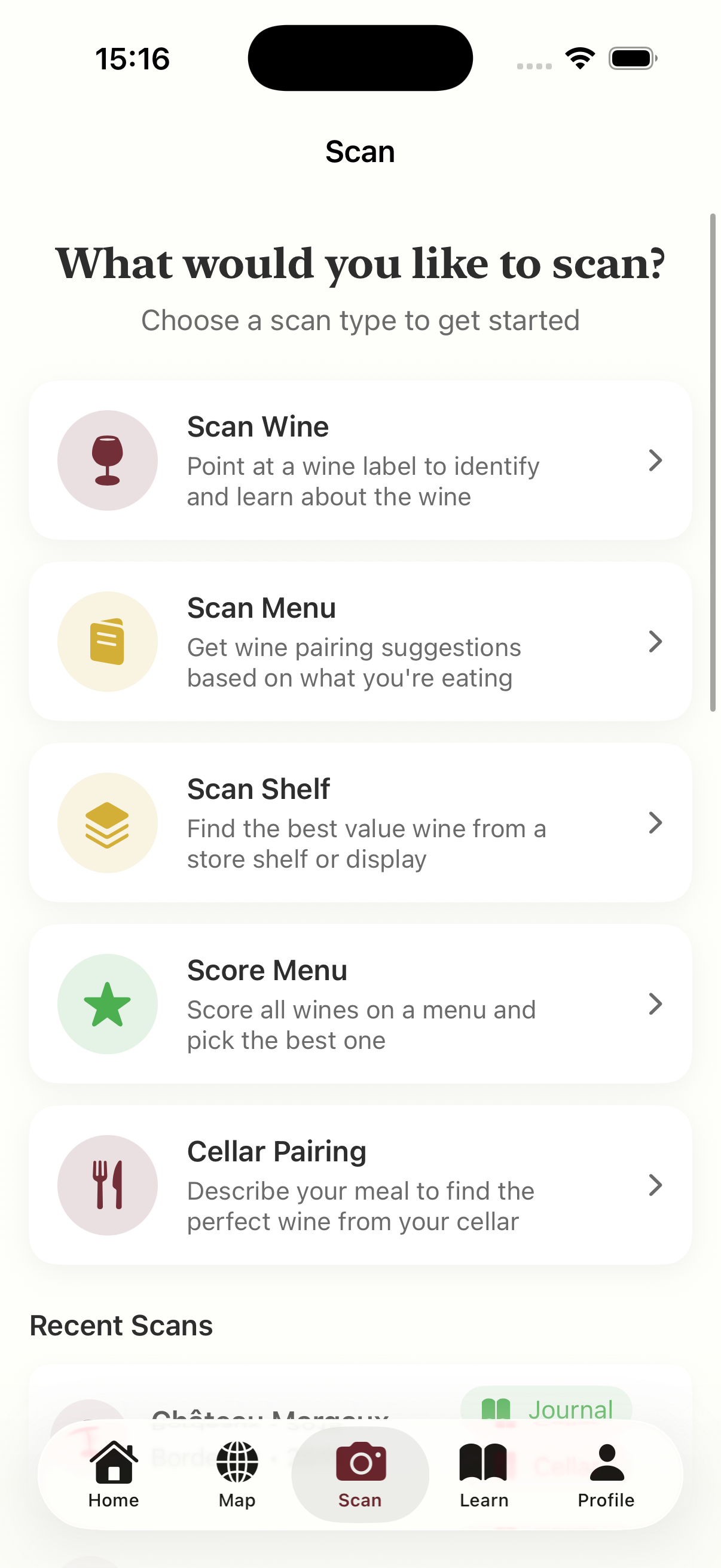
Bordeaux’s complex classification systems, appellations, and centuries of history can be overwhelming even for experienced wine lovers. The Sommo app cuts through the complexity by giving you instant access to detailed information about any wine you encounter. Scan the label of a classified growth to understand its place in the hierarchy, or identify the grape blend in a Right Bank cuvee. Your personal wine journal captures every tasting, building a comprehensive record of your Bordeaux journey that you can reference when buying wines back home. The learning modules provide essential context on Cabernet Sauvignon, Merlot, and the Bordeaux classification system, ensuring you arrive at each chateau with the knowledge to fully appreciate what you are tasting. With Sommo, Bordeaux becomes not just a trip but a transformative wine education.
Plan your wine trip
Map the regions you visit, journal tastings on the go, and relive every glass.