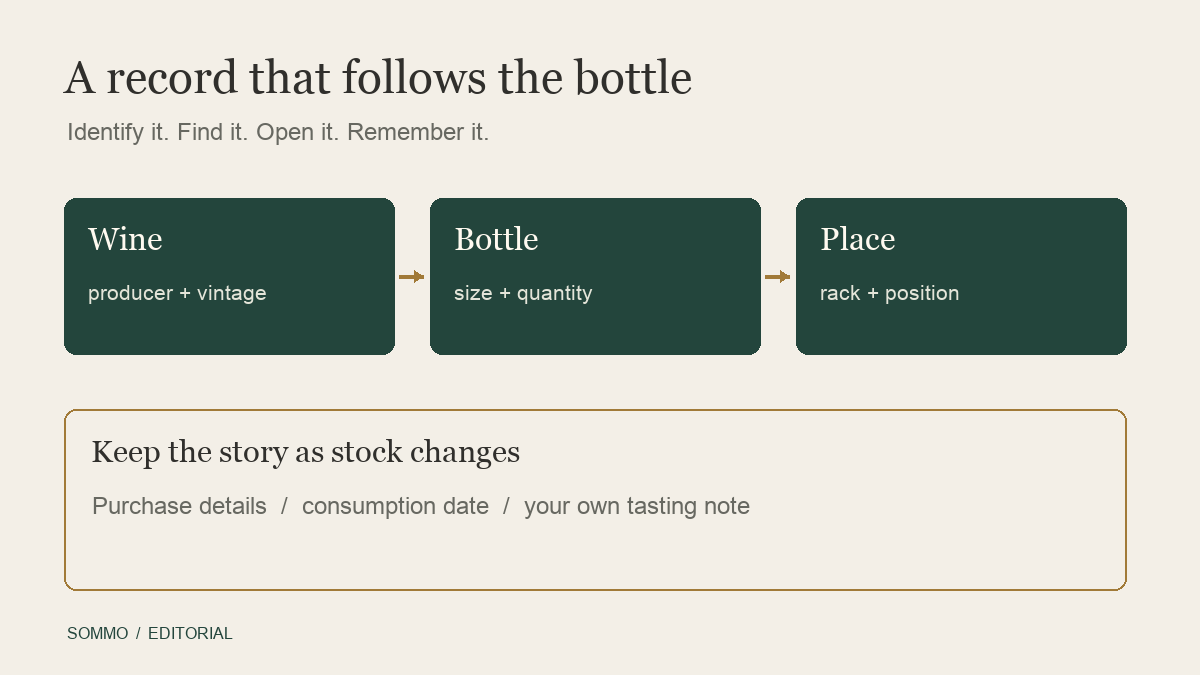
Export CellarTracker before changing apps, keep the original files untouched, and test a small selection before moving the full collection. The important question is what reaches the destination correctly: wine identity, bottle size, quantity, location, history and note privacy.
The steps below follow official export and import guidance checked on 5 October 2026. They give you a way to inspect a transfer; they do not assume that any two products preserve the same fields.
1. Decide what you are taking
List the records you want to keep: bottles in stock, pending purchases, consumed history, your tasting notes, private notes and purchase details. Photos, attachments and critic reviews need their own check. Being visible in the old app does not mean an item appears in its collection CSV.
If the real problem is finding bottles, changing your location names may help more than changing software. The app versus spreadsheet guide helps you weigh the maintenance work before starting.
2. Export the right CellarTracker views
Use the full desktop website. CellarTracker’s export instructions say the export control is not available in its mobile app or mobile website.
Open My Cellar, select the view, then use Export to choose columns and a format. For location and bin, choose Individual Bottles. This gives each bottle its own row. The ordinary Wines view summarises wines and does not include those fields in its standard export dialog.
Export purchase records and wider wine history from their relevant views as well. The official instructions also document separate note, pending-purchase and consumed-bottle exports. Use the current help for the required record type, rather than assuming one download is your entire account.
3. Keep originals and a working copy
Save exports in a dated folder, such as wine-backup-2026-10-08. Keep one untouched copy and make a separate file for renaming columns or correcting entries. Add a short note listing the view, filters and selected columns.
Open the working file as a table. Check that vintage remains a year, bottle size has a unit, and currencies remain identifiable. Preserve identifiers as text where needed so spreadsheet software does not strip leading zeroes. Keep personal notes out of any file you intend to share publicly.
4. Build a five-record test
This fictional example exposes more transfer problems than five identical bottles:
| Record | Identity and size | State | What to verify |
|---|---|---|---|
| A | Rioja 2018, 750 ml, two bottles | In stock | One in the home rack and one offsite remain separately located |
| B | Riesling 2023, 750 ml, one bottle | In stock | A private purchase note stays private |
| C | Red blend 2019, 1,500 ml, one bottle | In stock | The magnum is not matched to a standard bottle |
| D | Rosé 2024, 750 ml, one bottle | Pending | It does not become available stock |
| E | Pinot Noir 2015, 750 ml, one bottle | Consumed | Its dated note remains history, not a new bottle |
The expected totals are four bottles in stock, one pending and one consumed record. There are five wine identities but six bottle records across those states. Counting rows alone will not tell you whether a transfer is correct.
5. Match the destination’s format and privacy rules
Read the destination’s current instructions before uploading. Check accepted formats, required columns, matching review and whether importing adds records or updates existing ones.
For example, InVintory’s import guide says imports add bottles rather than merge with records already entered. Test in an empty collection or resolve existing entries first to avoid duplicates.
Its CellarTracker transfer instructions document a separate Community Reviews option. Dated tasting notes brought through that option become public reviews. The mobile options initially start on; web options initially start off. Read the actual labels and turn that option off if you do not want those notes published. Private bottle notes and public tasting reviews are different records.
Oeni documents a different boundary: Excel import uses its template and wine matching, while its insurance export describes PDF. Neither statement establishes a universal round trip between formats.
6. Inspect the test before expanding
For each record, compare the source file, the matched destination wine and the resulting bottle entry. Verify vintage, cuvée, size, quantity, location, state, purchase currency and note visibility. Check that an unmatched wine was not silently substituted.
Try one ordinary change: move a bottle, record its consumption and find the associated note. Then export the small destination collection and inspect what you can recover. InVintory’s export help distinguishes bottle and label groupings and requires a separate export for past bottles, illustrating why the return file also needs review.
7. Reconcile the full move
Transfer the remaining records only when the small test is satisfactory. Compare totals by state and location, investigate duplicate identities, and keep a list of unsupported fields or attachments retained separately. Record new purchases and openings consistently during the move so two changing inventories do not drift apart.
Use the inventory template as a simple reconciliation sheet. A successful switch gives you a record you can maintain and back up, with any losses understood before the old workflow is retired.
If the transfer exposes a feature you cannot afford to lose, reconsider the destination using the CellarTracker stay-or-switch checklist. Keeping a dependable stock record is more valuable than completing a move for its own sake.
For a separate tasting record, try Sommo’s wine journal with one wine you have tasted. Free journal-history access covers 30 days; access to older entries and cellar inventory requires Premium. Start with that small action while keeping your collection backup intact.