Tasting Note Wizard — Taste Like a Professional
Taste like a professional.
A guided four-step form following the Systematic Approach to Tasting (SAT). Record appearance, nose, palate, and conclusions, then get AI feedback on your observations.
Available on all journal entries
What You Get
Professional Framework
Follow the same SAT methodology used by WSET students and professional tasters worldwide.
AI Feedback
After submitting your notes, AI compares your observations against the wine's known profile and tells you what you nailed.
Alignment Scoring
Get a percentage score showing how closely your tasting matched the wine's established characteristics.
How It Works
Create an Advanced Entry
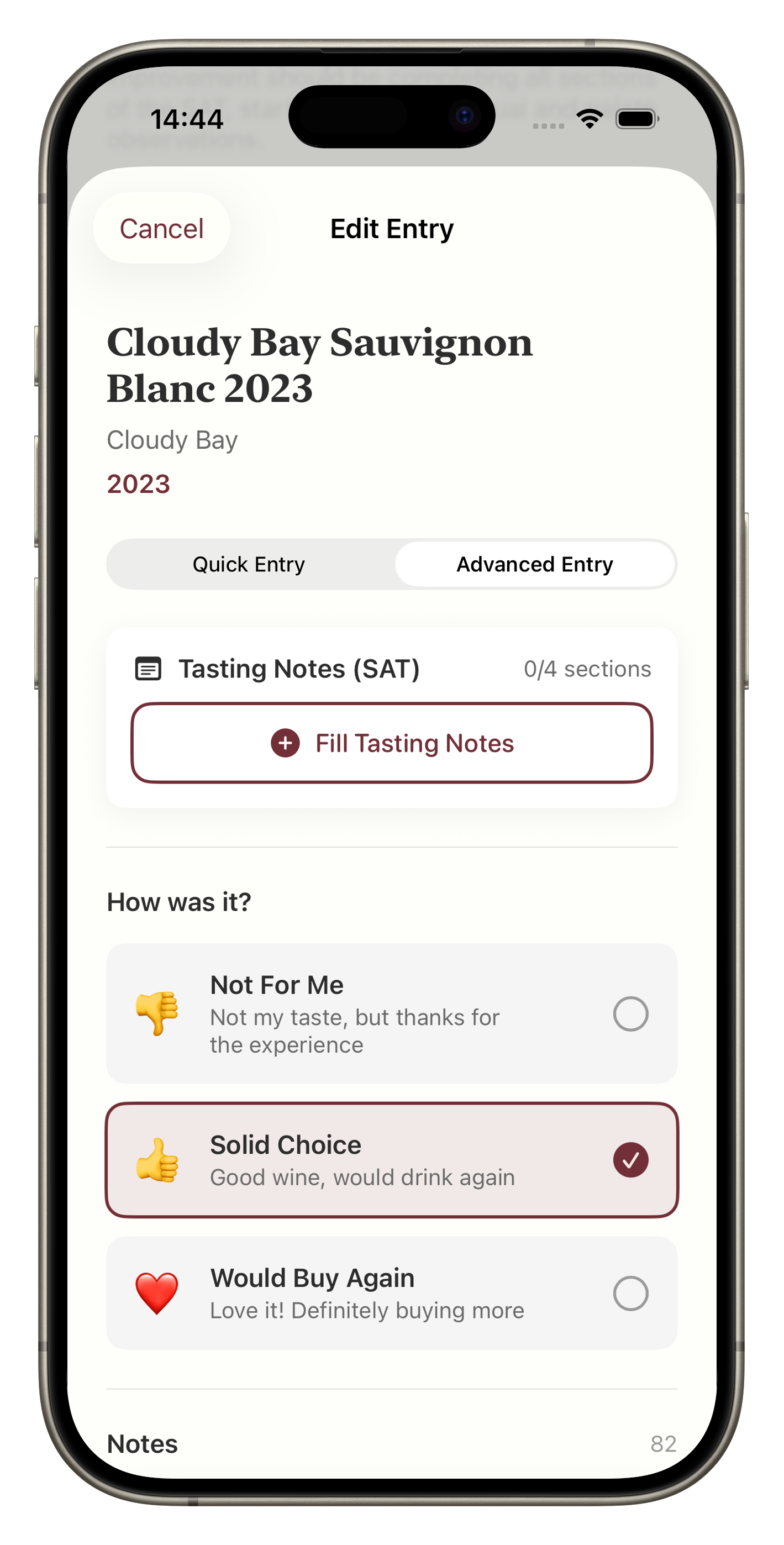
Choose Advanced Entry from the journal to open the SAT wizard.
Walk through each step
Record appearance, nose aromas, palate structure, and your quality conclusion.
Get AI feedback
Submit your notes and receive detailed feedback with an alignment score.
Beyond “I Liked It”
Most people describe wine in one of two ways: “It’s good” or “I don’t like it.” But wine has hundreds of identifiable characteristics, and learning to spot them is what separates casual drinking from genuine appreciation.
The Tasting Note Wizard gives you the framework to notice more, describe it accurately, and track your improvement over time.
The Four Steps
1. Appearance
Start by looking at the wine. The wizard asks you to assess:
- Clarity — Is it clear or hazy?
- Intensity — How deep is the colour?
- Colour — What shade? Lemon, gold, ruby, garnet?
Appearance tells you more than you’d think. A deep garnet Cabernet Sauvignon from Napa Valley looks different from a pale ruby Pinot Noir from Burgundy. Colour intensity can hint at age, grape variety, and winemaking style.
2. Nose
Swirl, sniff, and record what you detect. The wizard breaks aromas into three categories:
- Primary — Fruit, floral, and herbal aromas from the grape itself
- Secondary — Aromas from fermentation and winemaking (butter, bread, vanilla)
- Tertiary — Developed aromas from ageing (leather, tobacco, earth)
Select from predefined options or add your own. Over time, you’ll start recognising patterns. That blackcurrant note in every Bordeaux blend. The petrol hint in aged Riesling.
3. Palate
Take a sip and evaluate the wine’s structure:
- Sweetness — Dry, off-dry, medium, or sweet
- Acidity — Low to high
- Tannin — Low to high (red wines)
- Body — Light, medium, or full
- Flavour intensity — How pronounced are the flavours?
- Flavours — What do you taste?
- Finish — How long do the flavours linger?
This is where calibration happens. A wine that feels “medium” in body today might feel “full” next month as your reference points sharpen.
4. Conclusions
Wrap up with your assessment of quality (from acceptable to outstanding) and readiness (too young, suitable for drinking, or past its peak). This step forces you to make a judgment, which is the most valuable part of learning to taste.
AI Feedback and Alignment
After submitting your notes, Sommo’s AI compares your observations against the wine’s known profile. If you described a Malbec from Mendoza as light-bodied with high acidity, the AI will gently point out that this grape and region typically produce full-bodied wines with moderate acidity.
The alignment score — a percentage — tracks how closely your tasting matched the wine’s established characteristics. Watch it climb over weeks of practice.
Pairs Perfectly with WSET Prep
If you’re studying for WSET Level 2 or Level 3, the SAT wizard is your practice ground. The exam requires structured tasting under time pressure. Using the wizard regularly builds the muscle memory you need to perform on exam day.
Combine it with Sommo’s WSET Exam Prep for a complete study toolkit.
Frequently Asked Questions
The SAT is a structured method used by WSET students and wine professionals to evaluate wine. It covers four areas: appearance (clarity, intensity, colour), nose (condition, intensity, aromas), palate (sweetness, acidity, tannin, body, flavours, finish), and conclusions (quality and readiness).
No. Each step offers selectable options with clear labels. You pick what you observe rather than writing from scratch. The wizard teaches you the vocabulary as you use it.
After submitting your notes, the AI compares your observations against the wine's known flavour profile. It highlights what you identified correctly and points out characteristics you might have missed.
A percentage showing how closely your tasting matched the wine's established characteristics. A higher score means your palate is well-calibrated. Track it over time to see your improvement.