WSET Level 3 is where wine education gets serious. Level 2 emphasises breadth and recognition. Level 3 asks you to explain why a wine tastes the way it does, connect production choices to style, quality and price, and demonstrate structured tasting under exam conditions.
The jump in difficulty catches many candidates off guard. Here is what the official evidence can tell you, where candidates lose marks, and how to judge whether you are ready.
The Honest Answer on Pass Rates
WSET does not publish a global pass rate for Level 3. Percentages repeated by course providers and study sites usually describe one school’s cohort, an unidentified period or all qualification levels combined. None can support a worldwide claim.
The defensible numbers are the assessment thresholds in the current WSET Level 3 specification: candidates must meet the 55% requirements across the theory components and achieve 55% across the two-wine tasting assessment. WSET’s 2026 exam preparation guidance also confirms four short written answers, 50 multiple-choice questions, two hours for theory and 30 minutes for the blind tasting.
That does not make the qualification easy. It makes a universal failure claim unnecessary. Your most useful comparison is against fresh, timed work under the same constraints.
What the Exam Involves
Level 3 has two separately assessed papers, and you must pass both to receive the qualification.
| Component | Details |
|---|---|
| Theory paper | 50 multiple choice + short written answers |
| Tasting paper | Two wines assessed using the SAT (Systematic Approach to Tasting) |
| Duration | Theory: 2 hours. Tasting: 30 minutes |
| Pass requirement | 55% thresholds across the required theory and tasting components |
| Merit | Aggregate 65% to 79% |
| Distinction | Aggregate 80% or above, with no individual paper below 65% |
The theory paper is split into two sections. Section one is multiple choice (similar to Level 2 but harder). Section two requires short written answers where you must construct coherent arguments about wine styles, winemaking decisions, and regional characteristics.
The tasting paper requires you to analyse two wines using the WSET Systematic Approach to Tasting and write structured notes covering appearance, nose, palate, and conclusions.
For a full topic-by-topic breakdown of the syllabus, see the WSET Level 3 study guide.
Where Candidates Lose Marks
The SAT Tasting Paper
Many people can taste wine and describe what they notice, but the SAT demands a specific, structured format. Examiners are looking for:
- Precise vocabulary from the WSET lexicon (not “fruity” but “medium-plus intensity, red fruit: cherry, cranberry”)
- Logical conclusions that follow from your tasting notes (a wine with high acidity, moderate alcohol, and light body should lead you toward a cool-climate conclusion)
- Consistency between your appearance, nose, palate, and quality assessment
Candidates who taste casually throughout the course and then try to adopt the structured format in the exam almost always struggle. The SAT is a skill that requires repetition to internalise.
Practise the 30 minutes as a repeatable sequence and support every quality and readiness conclusion from observations already on the page.
Weak Essay Technique in the Theory Paper
The short-answer section is not asking for everything you know. It is asking for a focused, well-structured response to a specific question. Candidates who write long, unfocused answers that circle around the question without addressing it directly lose marks even when they clearly understand the topic.
Common mistakes include listing facts without linking them to the question, missing the command word (explain, describe, discuss each require different approaches), and running out of time on later questions because too long was spent on earlier ones.
Insufficient Regional Depth
Level 2 requires you to know key facts about major wine regions. Level 3 expects you to understand the why behind those facts. It is not enough to know that Barolo is made from Nebbiolo in Piedmont. You need to understand why the Langhe hills provide suitable conditions, how the region’s classification system works, and what distinguishes Barolo from Barbaresco in style and regulation.
Candidates who study regions as a list of facts rather than interconnected systems of climate, soil, grape, and regulation tend to struggle with the theory paper.
How to Beat the Odds
Use a Readiness Test, Not a Rumoured Rate
Book the exam when you can do all three of these consistently:
- Score at least 65% on three fresh, timed mock tests, leaving a buffer above the official threshold.
- Complete four short written answers in two hours, addressing every command verb and allocating time by available marks.
- Complete two blind SAT tasting notes in 30 minutes, with quality and readiness conclusions supported by observations.
One good attempt is not evidence. Repeat the test across different regions and wine styles, then use the study plan to target whatever still breaks under time.
Start Tasting Structured, Early
Begin using the SAT format from the very first tasting in your course. Do not wait until revision period. You need dozens of structured tastings before the exam, not a handful. Practise with wines you do not know, writing full SAT notes under timed conditions (roughly fifteen minutes per wine). The free blind tasting trainer is a useful drill between real bottles.
Build a Study Plan Around Weak Areas
After your first month of study, identify which regions and topics feel shaky. Dedicate extra time to those areas rather than revisiting topics you already know well. Adaptive study, where you focus on gaps rather than strengths, is far more efficient than reading the textbook cover to cover.
A structured study plan helps you stay on track and avoid last-minute cramming.
Use Spaced Repetition for Theory
The sheer volume of regional detail in Level 3 (grape varieties, appellations, classification systems, climate data) makes brute-force memorisation impractical. Spaced repetition, where you review material at increasing intervals based on how well you know it, is the most efficient way to retain this volume of information.
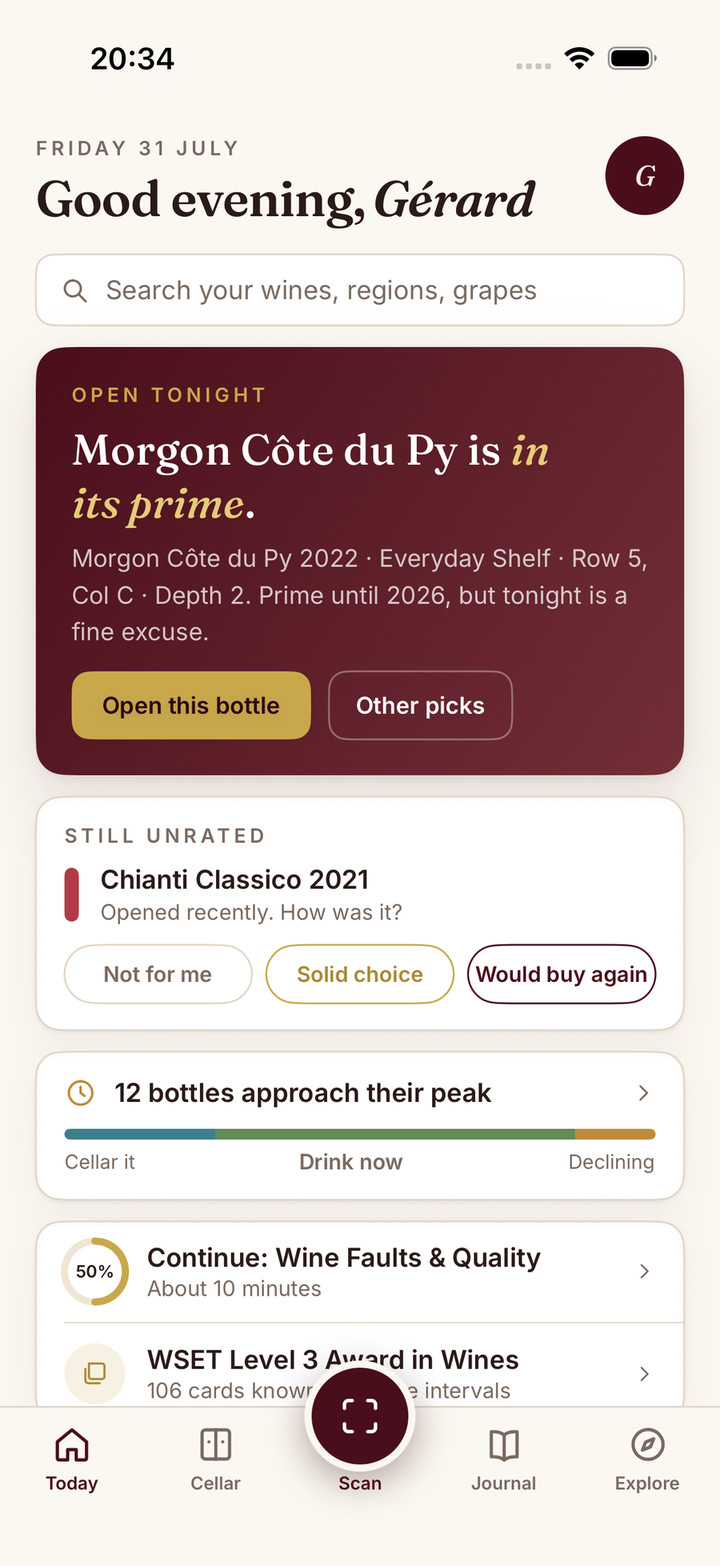
Sommo includes WSET Level 3 flashcard decks with built-in spaced repetition, along with quizzes and a free WSET Level 3 mock exam that target your weak areas. It is particularly useful for drilling appellation-level detail and grape-region associations that appear repeatedly in the exam.
Practise Written Answers
Write answers to practice questions supplied by your approved provider under timed conditions. WSET does not release past papers. Review the answer against provider feedback or the stated mark allocation, focusing on whether you addressed the command word, built complete cause-and-effect links and used enough specific evidence.
Form a Study Group
Tasting with others forces you to articulate your reasoning and exposes you to different interpretations. If a study partner describes a wine as “medium body with high acidity” and you assessed it as “full body with medium acidity,” that disagreement is more valuable than any textbook exercise. It sharpens your palate and your confidence in the SAT format.
What Happens If You Fail
If you fail one paper but pass the other, you only need to retake the failed paper. This is important because it means a tasting failure does not require you to resit the theory, and vice versa. Contact your course provider to arrange a resit at the next available exam session.
Use the time between your result and the resit to focus on the paper you failed. If it was tasting, practise complete timed SAT notes. If it was theory, ask your provider what feedback or examination enquiry options are available and rebuild the weak learning outcomes before attempting another full paper.
The Bottom Line
There is no official global pass rate to turn into a prediction. Level 3 still demands serious, sustained effort: WSET allocates 84 qualification hours, theory includes both multiple-choice and short written work, and tasting is a separately passed unit. Attendance alone is not preparation for those constraints.
But the candidates who fail are rarely the ones who lacked intelligence or passion. They are the ones who underestimated the step up from Level 2, neglected the SAT, or left regional study too late. Respect the workload, start early, practise the skills the exam actually tests, and you will give yourself the best possible chance.
Ready to start preparing? Try our WSET mock tests to benchmark your knowledge, then use Sommo’s WSET flashcards, quizzes, and adaptive practice tools to target your weak areas through spaced repetition. Download Sommo and start drilling Level 3 content today.