If you’ve decided to get serious about wine education, the Wine & Spirit Education Trust (WSET) is the gold standard. With programmes offered in over 70 countries and recognised across the global wine and hospitality industries, WSET qualifications carry genuine weight.
But here’s the question that trips up most newcomers: should you start with Level 1, or skip straight to Level 2?
The answer depends on your experience, your goals, and how much time and money you’re willing to invest. This guide breaks down everything you need to know about both levels so you can make the right call.
What Is WSET?
The Wine & Spirit Education Trust is a London-based organisation that has been running wine and spirits education since 1969. Their qualification framework runs from Level 1 (introductory) through to Level 4 (the Diploma, which is roughly equivalent to the first year of a Master of Wine). Each level builds on the last, introducing more depth, more regions, and more rigorous tasting methodology.
WSET qualifications are recognised by employers across hospitality, retail, distribution, and wine journalism. They’re also increasingly popular with enthusiasts who simply want structured knowledge rather than a career change.
WSET Level 1: The Foundations
What You’ll Learn
Level 1 is titled “Award in Wines” and covers the absolute basics. The syllabus includes:
- The main types and styles of wine (still, sparkling, fortified)
- Common grape varieties and their characteristics
- How to store and serve wine correctly
- Basic food and wine pairing principles
- How to describe wine using the WSET Level 1 Systematic Approach to Tasting (SAT)
Think of Level 1 as a structured introduction. If you’ve never thought critically about what’s in your glass, this is where you start building that vocabulary and framework.
Format and Duration
Level 1 is typically delivered in a single day, usually around six hours of teaching followed by the exam. Some providers spread it across two evenings or offer it online with a proctored exam.
The exam itself is a 30-question multiple choice paper. You need 70% to pass, which means getting 21 out of 30 correct. There is no tasting component in the exam.
Cost
Prices vary by provider and location, but Level 1 typically costs between £150 and £250 in the UK. This usually includes study materials, tuition, tasting wines, and the exam fee.
Who Is It For?
Level 1 is designed for complete beginners. If you’ve never studied wine formally, if you’re entering the hospitality industry, or if you simply want a gentle, low-pressure introduction, Level 1 is a sensible starting point.
It’s also a good option if you’re unsure whether you want to commit to further study. One day and a modest investment gives you a taste of structured wine education without a major commitment.
WSET Level 2: The Step Up
What You’ll Learn
Level 2 is titled “Award in Wines” as well, but the depth is significantly greater. The syllabus covers:
- The factors influencing the style and quality of wine (climate, soil, winemaking decisions)
- Major grape varieties in detail: Chardonnay, Sauvignon Blanc, Pinot Grigio, Riesling, Gewürztraminer, Viognier, Cabernet Sauvignon, Merlot, Pinot Noir, Syrah/Shiraz, Grenache, Tempranillo, Nebbiolo, Sangiovese, Gamay, and more
- Key wine regions of the world and their signature styles
- Sparkling, sweet, and fortified wines in more depth
- The WSET Level 2 Systematic Approach to Tasting
- Labelling and classification systems
Level 2 doesn’t just teach you what grapes taste like; it teaches you why they taste that way based on where they’re grown and how they’re made. You’ll finish with a genuinely useful mental map of the wine world.
Format and Duration
Level 2 is a much bigger commitment. Classroom courses typically run over 8 to 12 weeks, with one session per week. Intensive formats compress this into three to five consecutive days. Online options are also available, with self-paced study over several weeks leading up to a proctored exam.
The exam is a 50-question multiple choice paper. You need 55% to pass, which means 28 out of 50 correct. There is no tasting component in the exam, though tasting is a core part of the coursework.
Cost
Level 2 typically costs between £400 and £700 in the UK, depending on the provider and format. This includes study materials, tuition, tasting wines, and the exam fee. London providers tend to sit at the higher end.
Who Is It For?
Level 2 is designed for anyone who already has a basic understanding of wine and wants to build a solid, structured knowledge base. It’s the most popular WSET qualification and serves both industry professionals and serious enthusiasts.
If you already know the difference between Sauvignon Blanc and Chardonnay, if you can identify a few grape varieties by taste, or if you regularly read about wine regions, Level 2 is probably your starting point.
Head-to-Head Comparison
| Feature | WSET Level 1 | WSET Level 2 |
|---|---|---|
| Duration | 1 day (6 hours) | 8 to 12 weeks |
| Exam format | 30-question MCQ | 50-question MCQ |
| Pass mark | 70% (21/30) | 55% (28/50) |
| Tasting in exam | No | No |
| Tasting in course | Yes (limited) | Yes (extensive) |
| Grape varieties | Overview of main types | 20+ varieties in depth |
| Regions covered | Minimal | Comprehensive world tour |
| Typical UK cost | £150 to £250 | £400 to £700 |
| Study commitment | Minimal prep needed | Significant self-study required |
| Career recognition | Entry-level | Industry standard |
| Prerequisite | None | None (L1 recommended, not required) |
Pass Rates and Difficulty
WSET publishes annual candidate performance reports. Both levels have high pass rates, reflecting the fact that most candidates who complete the coursework and revision are well prepared.
Level 1 is intentionally accessible. The single-day format, shorter exam, and foundational content mean that most candidates pass comfortably with reasonable attention during the course.
Level 2 requires genuine study. The breadth of content, covering dozens of grape varieties, regions, and winemaking concepts, means you’ll need to revise consistently over the course duration. The lower pass mark (55% vs 70%) reflects the greater difficulty of the material, not lower standards.
The tasting practice matters too. While neither exam has a tasting component, developing your palate during the course helps you understand and remember the theory. Tasting Marlborough Sauvignon Blanc while learning about its characteristics makes the knowledge stick in a way that reading alone cannot.
Can You Skip Level 1?
Yes. WSET Level 1 is not a prerequisite for Level 2. You can enrol directly in Level 2 with no prior qualifications.
This is an important point, because it changes the decision from “which should I do first?” to “do I need Level 1 at all?”
For many people, the answer is no. If you have any of the following, you can almost certainly skip Level 1:
- Existing wine knowledge: you already know basic grape varieties, can distinguish red from white wine styles, and understand that climate affects flavour
- Hospitality experience: you’ve worked with wine in any professional capacity
- Self-study background: you’ve read wine books, taken informal courses, or spent time exploring wine regions through travel or tasting
- Confidence with tasting: you can describe what you’re drinking in basic terms (fruity, dry, acidic, tannic)
Level 1 covers ground that many wine-curious people have already covered informally. Paying £200 to confirm what you already know is not the best use of your budget.
When Level 1 Makes Sense
There are genuine reasons to start with Level 1:
You’re a Complete Beginner
If you’ve never thought about wine beyond “I like red” or “I prefer dry,” Level 1 gives you the vocabulary and framework to start. The Systematic Approach to Tasting alone is worth learning in a structured environment.
You Want a Low-Risk Test
Not sure if formal wine education is for you? Level 1 costs less, takes one day, and gives you a clear sense of whether you enjoy structured study. If you love it, Level 2 is the natural next step. If not, you’ve lost a day rather than three months.
You’re Entering Hospitality
If you’re starting a career in restaurants, hotels, or wine retail, Level 1 on your CV shows initiative even if the knowledge itself is basic. Some employers specifically look for it as a minimum qualification.
You Want the Confidence Boost
There’s genuine value in walking into a structured course, learning from an expert, tasting wines with guidance, and walking out with a qualification. For some people, that confidence boost is what unlocks their enthusiasm for deeper study.
Three Scenarios
Scenario 1: The Curious Hobbyist
Profile: You drink wine regularly, have some favourite regions and grapes, and want to understand wine better for personal enjoyment. No career ambitions in wine.
Recommendation: Skip Level 1, go straight to Level 2. You already have the baseline knowledge that Level 1 provides. Level 2 will transform your understanding of why wines taste the way they do and give you a framework for exploring new regions and styles with confidence.
Scenario 2: The Hospitality Professional
Profile: You work in a restaurant, hotel, or wine shop. Your employer values qualifications, and you want to build credibility and knowledge for your career.
Recommendation: Start with Level 2 if you have any wine experience from your role. If you’re brand new to both hospitality and wine, Level 1 is a reasonable starting point, but don’t linger there. The real career value begins at Level 2, and Level 3 is where you start to stand out.
Scenario 3: The Informal Wine Lover
Profile: You enjoy wine but haven’t studied it formally. You read the odd article, pick up bottles that look interesting, and want to learn more without committing to a long course.
Recommendation: Level 1 is a perfect fit. One day, modest cost, and you’ll come away with a tasting framework and enough vocabulary to engage more deeply with wine. If it sparks something, Level 2 awaits.
What Comes After?
Both levels feed into WSET Level 3 (Award in Wines), which is a significant step up in depth and rigour. Level 3 introduces the full Systematic Approach to Tasting, includes a tasting exam alongside theory, and covers regions and styles in granular detail. It typically takes three to six months and costs £500 to £900.
Beyond that, Level 4 (the Diploma) is a multi-year commitment and the highest qualification WSET offers. It’s the gateway to the Master of Wine programme for those who want to reach the very top.
The key point: wherever you start, each level builds logically on the last. Starting with Level 1 doesn’t slow you down if you progress quickly, and starting with Level 2 doesn’t leave gaps if you have the baseline knowledge.
How to Prepare for Either Level
For Level 1
Minimal preparation is needed. If you want to arrive feeling confident:
- Taste a few different grape varieties side by side (a Sauvignon Blanc vs a Chardonnay, a Pinot Noir vs a Cabernet Sauvignon)
- Read the study materials your provider sends in advance
- Familiarise yourself with the WSET tasting grid
For Level 2
Level 2 requires consistent study throughout the course:
- Read each chapter before the relevant class
- Create flashcards for grape varieties, regions, and key terms
- Taste as widely as possible during the course, focusing on the grape varieties in the syllabus
- Use practice questions to test your recall
- Review your notes weekly rather than cramming before the exam
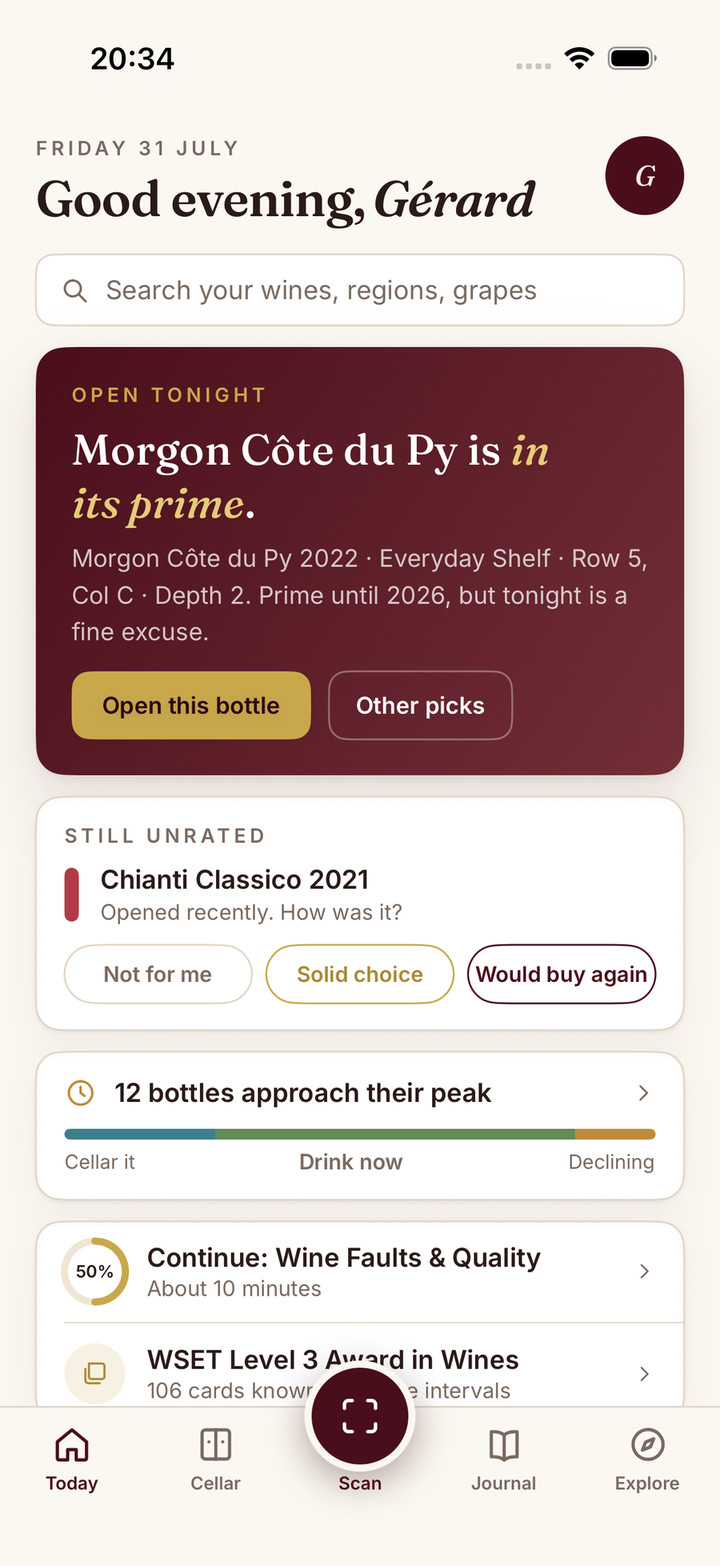
The WSET exam prep tools in Sommo include flashcards with spaced repetition, practice quizzes, and mock exams designed specifically for Level 2 preparation. Spaced repetition is particularly effective for the volume of factual content Level 2 requires.
Quick Decision Framework
Ask yourself these three questions:
1. Can you name five grape varieties and describe how they typically taste?
Yes: consider skipping to Level 2. No: Level 1 is your starting point.
2. What’s your goal?
Career in wine or hospitality: start with Level 2 (or Level 1 if you’re a total beginner, then progress quickly). Personal enrichment: either level works; match it to your current knowledge.
3. What’s your budget and time?
Tight on both: Level 1 gives you a qualification in one day for under £250. Ready to invest: Level 2 delivers far more value for the additional cost and time.
The Bottom Line
WSET Level 1 is a solid, well-structured introduction to wine that serves complete beginners and anyone testing the waters of formal wine education. WSET Level 2 is where the real depth begins, delivering the kind of knowledge that changes how you taste, buy, and talk about wine.
If you have any existing wine knowledge, skip Level 1 and go straight to Level 2. If you’re genuinely starting from zero, Level 1 is a gentle and worthwhile first step.
Either way, the most important thing is to start. Structured wine education, at any level, accelerates your understanding in ways that casual drinking simply cannot match.
Start Studying with Sommo
Whichever WSET level you choose, Sommo helps you prepare. Our WSET exam prep tools include flashcards with SM-2 spaced repetition, practice quizzes, mock exams, and AI-generated study plans tailored to your weak areas. Track your progress, review wrong answers, and build the confidence you need to pass.
Download Sommo free and start your WSET revision today.