Before paying for a wine course, most people want a number: what percentage of candidates pass WSET Level 1? That number is the one thing nobody can honestly give you, and understanding why tells you more about the exam than a statistic would.
The Honest Answer About the Number
WSET does not publish pass rates broken down by level in a form you can cite with any confidence. The figures circulating online come from two places, and neither is what people assume.
The first is a cross qualification average, blending a one day course with a multi year Diploma into one percentage that describes neither. The second is a provider quoting its own cohort: one school, one year, often only the candidates who finished the course, presented as marketing.
So this post will not invent one. What can be said with confidence is what the exam is and who tends to fail it.
What the Exam Actually Is
Level 1 Award in Wines is assessed by one closed book paper: 30 multiple choice questions in 45 minutes, with no tasting component in the assessment (your course day includes tasting, but it is not marked).
The pass mark is 70 percent, or 21 correct out of 30. That is the highest pass mark of the wine awards, since Level 2 and Level 3 both pass at 55 percent. You can get nine wrong, and that is it.
The syllabus behind those 30 questions is deliberately narrow: the main wine styles, the principal grape varieties, storage and service, and the basic principles of food pairing. It is a body of material you can genuinely finish.
Why the Pass Rate Is High, and What That Does Not Mean
Level 1 is designed to be passed. The syllabus is small, the course is taught before the exam, the questions test recall rather than analysis, and there is no second paper to fail. Every provider will tell you most of their candidates pass, and they are almost certainly right. Here is what that does not mean.
It does not mean the exam is a formality. A 70 percent pass mark on 30 questions leaves very little room for the two or three careless misreadings most people make on any multiple choice paper. At Level 2, three sloppy answers are noise. At Level 1, they are a third of your margin.
It does not mean you can walk in cold. A high pass rate measures the preparation of the people sitting the exam as much as the difficulty of the questions.
It does not tell you anything about Level 2 or Level 3. The step up is real, and our Level 2 pass rate breakdown and Level 3 pass rate breakdown cover where the difficulty actually arrives.
How the Four Levels Compare
| Level | Exam format | Pass mark | Typical study time | Relative difficulty |
|---|---|---|---|---|
| Level 1 Award in Wines | 30 multiple choice, 45 minutes, closed book | 70% (21 of 30) | Around 6 hours plus the course day | Passable by anyone who attends and revises |
| Level 2 Award in Wines | 50 multiple choice, 60 minutes, closed book | 55% (28 of 50) | Around 28 hours | A step up in volume, not in analysis |
| Level 3 Award in Wines | Multiple choice and short written answers, plus a blind tasting paper | 55% on each paper, both must pass | Around 84 hours | Hard: writing technique and calibrated tasting |
| Level 4 Diploma | Six units: exams, essays, research assignment | Varies by unit | 500+ hours over 2 to 3 years | Expert level, measured in years |
Notice that the pass mark falls as the levels get harder: the questions climb faster than the threshold does.
Who Actually Fails Level 1
Failures cluster into recognizable profiles.
The confident drinker. Twenty years of enjoying wine, assumes the syllabus is common sense, skims the study guide. Level 1 asks about specific service temperatures, storage conditions and pairing principles, and enthusiasm does not cover them.
The candidate who did not attend. Some providers offer an exam only or self directed route. Passing that way is possible, but it removes the most reliable predictor of success: sitting through the taught material with someone there to answer questions.
The fast reader. Level 1 uses negatively phrased questions (“which of the following is NOT …”). Read at speed and you answer the question you expected rather than the one printed. Two of those plus one genuine gap, and the margin is gone.
The candidate sitting in a second language. Wine vocabulary is specialized, and a closed book paper under time pressure in a non native language is harder. Ask your provider what language support exists before exam day, not after.
Notice what is missing: people who lack talent for wine. Nobody fails Level 1 for an unrefined palate, because the palate is not assessed.
How Much Study Is Realistic
The usual guidance is around six hours alongside the taught course, and that is enough if the hours are spent well. Across a week it is under an hour a day (the printable WSET study planner lays it out).
Spend most of it on active recall. Cover the page and list the styles, the grapes, the service temperatures from memory. Rereading builds a comfortable familiarity that collapses the moment a question asks you to produce the answer yourself.
A workable shape: read the study guide once, run a practice quiz, revisit only what the quiz exposed, then sit a full timed paper. The free Level 1 wine basics quiz and the tools on the Level 1 hub are built for that loop.
Should You Skip Level 1 and Start at Level 2?
Level 1 is not a prerequisite, and plenty of people go straight in. Start at Level 2 if you know the major grape varieties and their styles, can explain the difference between tannin and acidity, and have a sense of how food changes a wine. It will still be work, but it will not be foreign.
Start at Level 1 if wine is genuinely new, if a hospitality role specifies it, or if a gentle on ramp keeps you engaged. The certificate does not expire, so nothing is wasted. Our Level 1 vs Level 2 comparison works through the decision properly.
Going straight to Level 2? The free Level 2 mock exam shows the real format, the Level 2 cheatsheet condenses the syllabus, the Level 2 flashcards handle memorization, and topic drills on grape varieties and sparkling wines close the common gaps.
How to Be Certain You Will Pass
Remove the uncertainty rather than estimating it.
- Attend the whole course. The highest value hours you will spend.
- Read the study guide once, properly. Not skimmed on the train.
- Take a timed practice paper. Thirty questions, 45 minutes, no notes.
- Score above 85 percent twice. Not 71 percent once. Margin is the point.
- Answer every question. There is no penalty for a wrong answer, so a blank is a guaranteed zero.
- Slow down on negative wording. Underline the NOT.
Do those six things and the pass rate stops mattering, because you are no longer in the population it describes. Everything you need is free on the WSET hub, including the mock test library and the cheatsheets for every level.
Explore with Sommo
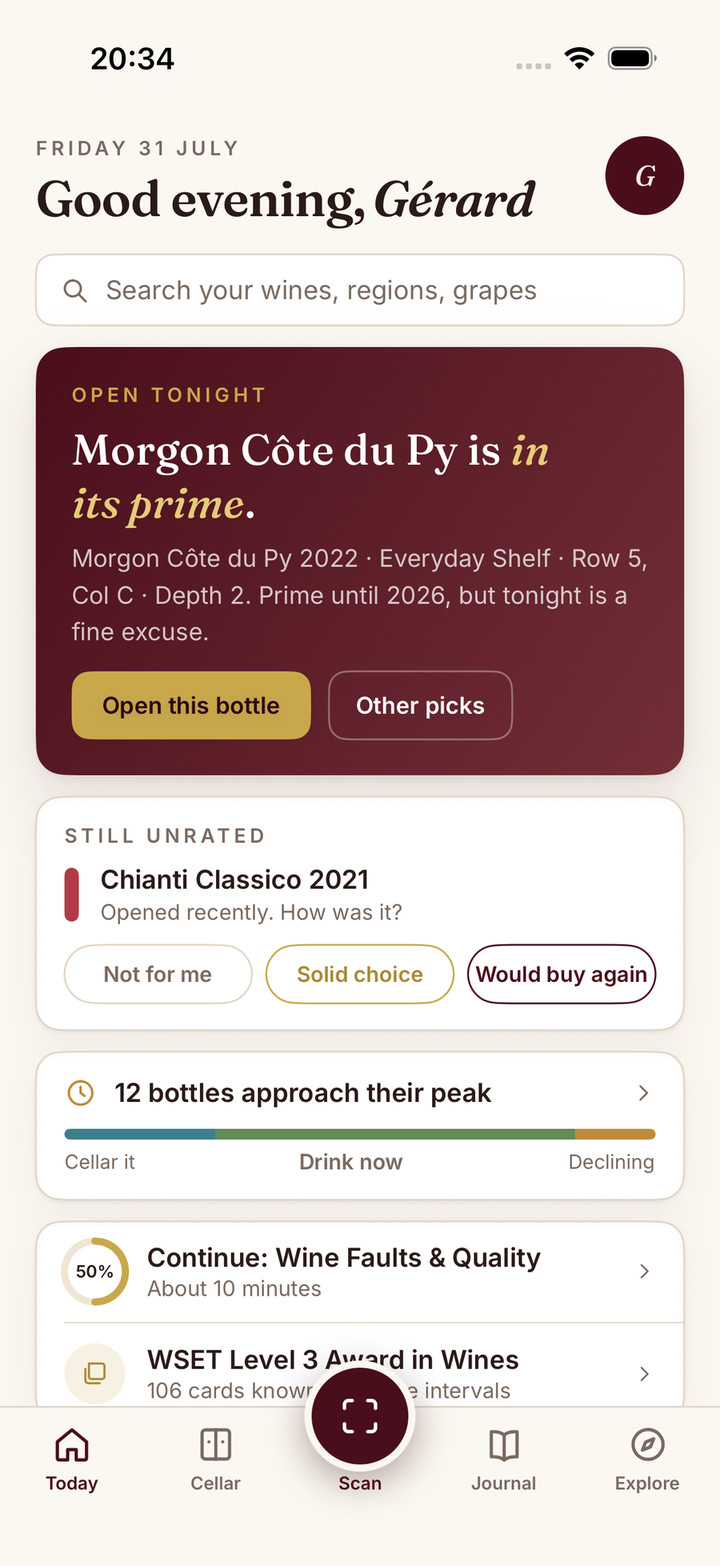
Sommo turns those six hours of revision into something you can do on a phone: spaced repetition flashcards for the grapes and styles, timed mock exams in the real format, adaptive practice that returns to whatever you get wrong, and a wine journal that ties the syllabus to bottles you drink. It carries through to Level 2 and Level 3 when you are ready. Download Sommo and start free.