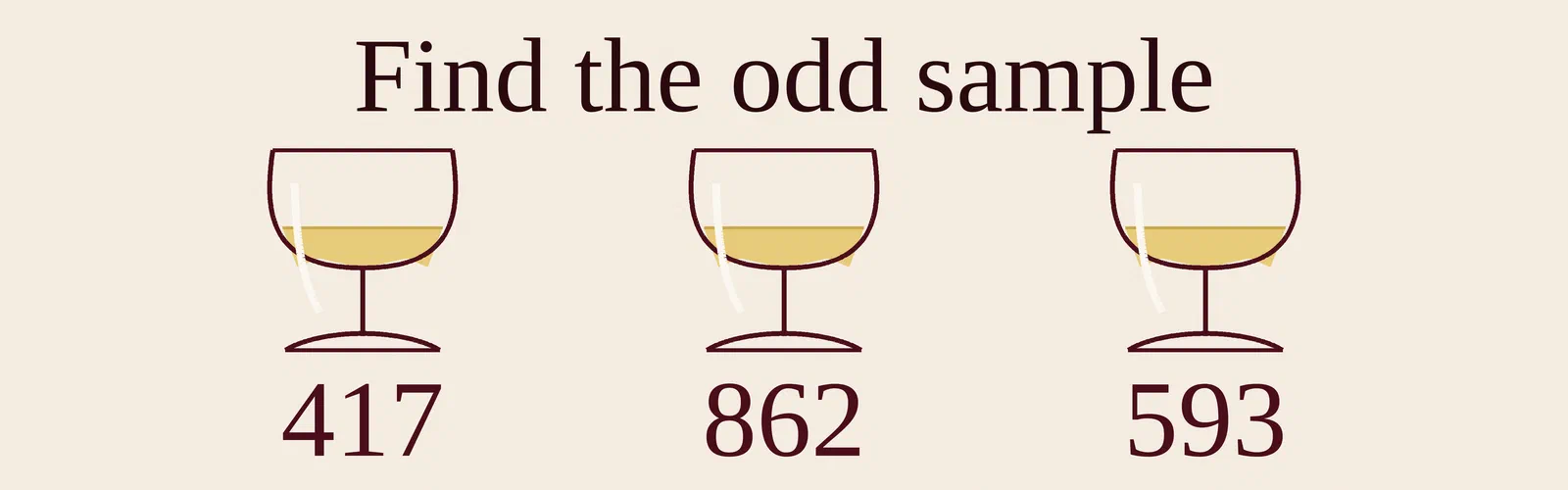
You pour two wines, taste them side by side and decide one seems brighter. Then you see the labels and wonder how much the story influenced the answer. A triangle test asks a narrower question: can you pick the different sample from three coded glasses, when two contain the same wine? It does not ask which wine is better.
At home, this is a useful exercise in careful observation. It needs a helper, a hidden answer key and a willingness to write down a guess before talking. One correct answer is a modest result, not proof of a remarkable palate or a claim about everyone else’s experience.
Decide what you are comparing
Choose two wines, called A and B on the helper’s private sheet. Write the question before pouring: “Can I distinguish these two bottles under the same serving conditions?” is manageable. “Does expensive wine taste better?” combines discrimination, price and preference into a question this exercise cannot answer.
Two commercial wines differ in more than a single feature. Even if they have different vintages, a correct response cannot establish that vintage caused the difference. Bottle condition and other production differences may also matter. If you compare a treatment, define it in advance and keep the remaining handling as similar as possible.
The Australian Wine Research Institute’s triangle method, checked on 16 October 2026, describes three differently coded samples, two of the same wine, followed by an odd-sample choice. Its possible serving orders are AAB, ABA, BAA, BBA, BAB and ABB. The sheet below is our own home exercise, not a reproduction of AWRI’s forms or significance tables.
Let the helper build the set
The person tasting should not watch preparation or know the order. The helper keeps the key out of sight, conceals bottles and avoids hints through conversation or placement.
- Use three matching, clean, odour-free glasses. Give each a different, unrelated three-digit code.
- Choose one of the six orders at random, for example by drawing one folded order slip from six identical slips. For a group, distribute all six orders as evenly as possible, then shuffle the allocations.
- Pour equal small samples sufficient for assessment, from the same source bottle for both matching samples. These are sample sizes, not drinking targets.
- Match temperature, pouring time and time in the glass. Serve together, in the recorded left-to-right order. Avoid food, perfume or distracting discussion during the assessment.
- Ask the taster to choose exactly one odd code, even if unsure, and record confidence separately. Collect the response before revealing anything.
Provide water and a spittoon, allow anyone to opt out, and arrange transport without driving after drinking. There is no need to finish a glass or keep repeating sets to make the evening worthwhile. For the wider hosting arrangements, see the wine tasting party guide.
The helper’s key and the taster’s sheet
Copy these into separate notes. Codes must conceal identity, not carry clues such as the bottle’s vintage or price. Use fresh codes if you run another set.
| Helper only | Fill before serving |
|---|---|
| Question; session date | ______ |
| A identity; B identity | ______ |
| Random order selected | ______ |
| Left code → wine | ______ |
| Middle code → wine | ______ |
| Right code → wine | ______ |
| Odd code; service conditions | ______ |
| Taster response | Fill before reveal |
|---|---|
| Taster; session/set | ______ |
| Codes left to right | ______ |
| One odd code chosen | ______ |
| Confidence: low / medium / high | ______ |
| Observation behind choice | ______ |
| After reveal: correct / incorrect | ______ |
Taste in order, return to samples if useful, then commit to one code. An observation such as “the middle sample seems more acidic” explains the choice; it does not need elaborate tasting vocabulary. Our tasting-notes guide helps describe what you notice without seeing the label first.
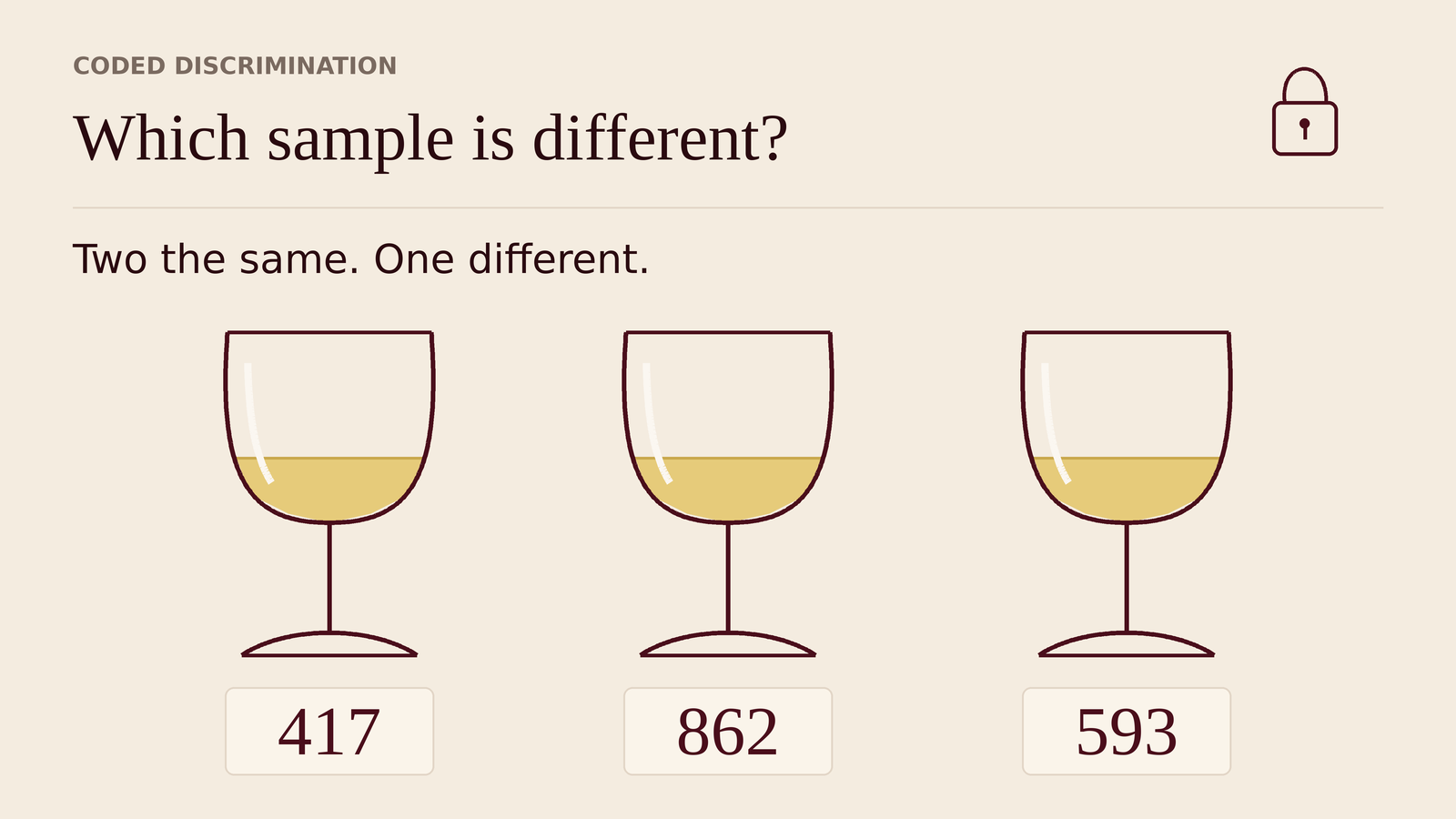
Synthetic worked example, not tasting data: the helper draws ABA and assigns 417=A, 862=B, 593=A. The taster chooses 862 with low confidence, writing “slightly sharper finish”. That is one correct response. The codes and answer are internally consistent; nothing was tasted to produce this example.
What the answer does and does not mean
With one odd sample among three, a random forced choice has a one-in-three chance of being correct. A single correct choice can therefore happen by guessing. Confidence is useful context, but high confidence does not change whether the code matched the key.
A wrong answer does not prove that the wines are identical. A correct answer does not tell you which wine you prefer. Ask about liking in a separate exercise after collecting the discrimination responses, and label it separately. Do not convert “I picked B” into “B is better” or “the oak caused it”.
Repeated responses from the same person are not independent tasters. Learning, fatigue and remembered clues can affect later choices. Do not turn six rounds by one guest into a six-person panel, or choose when to stop only after a pleasing run of answers. A group conclusion needs a planned analysis suited to its design, not an improvised score threshold.
AWRI’s sensory programme account describes screened, qualified assessors for difference testing and separate consumer work on liking. That is useful context for the limits of a casual home session. This article has had a desk check of coding and allocation, not a pilot tasting or review by a sensory-method specialist.
For a distinct repeatability check, a helper can later present a hidden duplicate of the same wine under fresh codes and compare the descriptive notes. This asks how consistently you describe a sample. It is not a triangle set: an all-identical trio has no correct odd sample and should never be scored as one.
After the reveal, Sommo’s structured tasting notes can help record observations, while wine sharing supports the social side of a tasting. Keep the triangle codes, hidden key and correct/incorrect responses on your separate sheet. Sommo is not a native triangle-test randomiser or significance engine.