Most people write wine tasting notes the wrong way. They reach for poetic adjectives, copy phrases from the back label, and end up with something that reads well but tells them nothing useful three months later. That is not a tasting note. That is a sentence.
A real tasting note is a structured record that lets you compare bottles, track your palate, and recognise patterns over time. It does not need to be eloquent. It needs to be precise. This guide walks through the framework used by professional tasters and wine students worldwide (the Systematic Approach to Tasting, or SAT, developed by the WSET), explains the vocabulary that actually matters, and shows you how to start writing notes that train your palate while you drink.
Why Tasting Notes Matter
A tasting note has three purposes.
The first is recognition. You will drink wines that you love and forget completely within a week. A note lets you find the bottle again, identify why it worked, and replicate the experience. Without notes, every bottle starts from zero.
The second is calibration. The act of writing a note forces you to taste deliberately. Most casual drinkers move from sniff to sip to next conversation in under five seconds. A note slows you down, asks you to articulate what you smell and taste, and pulls flavours out of the wine that you would otherwise miss.
The third is pattern recognition. After 30 notes, you will start to see clusters. You may notice that you consistently rate wines with high acidity higher than wines with low acidity. You may notice that you prefer Pinot Noir from cool vintages over warm ones. These patterns are invisible to you in real time and obvious in a journal. They are what build a sophisticated palate.
The Systematic Approach (SAT)
The WSET’s Systematic Approach to Tasting is the dominant framework used in serious wine education. It splits a tasting note into four sections: Appearance, Nose, Palate, and Conclusions. Each section asks specific questions in a fixed order. The discipline is the point. By always asking the same questions in the same order, you build muscle memory for tasting, and your notes become directly comparable across wines.
Here is what each section covers, and how to actually write it. If you prefer to practise on paper first, the WSET Level 2 tasting sheet follows this exact structure.
Appearance
This is the easiest section and the one most people skip. Do not skip it. The colour of a wine tells you something about its age, its grape variety, and sometimes its winemaking.
You are recording two things: intensity (how deep the colour is, from pale to deep) and colour (the specific hue).
For white wines:
- Pale: very light, almost water-coloured. Often youth, often a neutral grape.
- Medium: pale gold or pale lemon. Standard for most whites.
- Deep: rich gold or amber. Often age, often oak, sometimes botrytis or skin contact.
Specific colours for whites: lemon-green (youthful Sauvignon Blanc), lemon (most whites), gold (oaked Chardonnay or aged Riesling), amber (orange wines, aged dessert wines).
For red wines:
- Pale: light ruby, almost translucent. Often Pinot Noir, Beaujolais, or aged reds.
- Medium: standard red intensity. Most reds.
- Deep: opaque, hard to see through. Often young, often warm-climate or thick-skinned grapes.
Specific colours for reds: purple (youthful, often Syrah or Malbec), ruby (most young reds), garnet (some bottle age), tawny (significant age, or fortified wine).
How to write it: “Pale lemon” or “Medium ruby” is enough. Two words. Move on.
Nose
This is where most people get stuck. The wine is in front of you, you swirl it, you smell, and you have no idea what to say. The trick is to focus on categories before specifics.
Ask three questions, in order.
- Intensity: Is the smell light, medium, or pronounced?
- Fruit category: Red fruit (cherry, raspberry, strawberry)? Black fruit (blackberry, blackcurrant, plum)? Citrus (lemon, lime, grapefruit)? Stone fruit (peach, apricot)? Tropical (pineapple, mango, passionfruit)?
- Other categories: Floral (rose, violet, blossom)? Herbal (mint, eucalyptus, fennel)? Spice (pepper, clove, cinnamon)? Earthy (forest floor, mushroom, leather)? Oak (vanilla, coconut, cedar, smoke)?
You do not need to nail every aroma. You need to identify the dominant category and a few specifics. A perfectly useful note might read: “Medium-plus intensity nose, dominant red fruit (cherry, raspberry), some floral lift (violet), subtle earthy undertone.”
Two tips that help.
Swirl deliberately. Aromas in wine are volatile compounds. Agitating the wine releases them. Swirl for five to ten seconds before sniffing. Sniff twice: a quick short sniff to catch the top notes, then a longer deeper sniff to get the rest.
Trust your first impression. The wine’s most honest aromas appear in the first ten seconds. The longer you stare at the glass searching for descriptors, the more you start inventing.
Palate
This is the meatiest section. You are recording structural elements alongside flavour.
Structural elements (these are objective measurements, not preferences):
- Sweetness: Bone dry, dry, off-dry, medium, sweet, very sweet. Most table wines are dry. If you taste any residual sugar, note it.
- Acidity: Low, medium-, medium, medium+, high. The mouth-watering sensation on the sides of your tongue.
- Tannin (reds only): Low, medium-, medium, medium+, high. The drying, slightly bitter sensation on your gums and the roof of your mouth. Tannins come from grape skins and oak.
- Alcohol: Low (under 11 percent), medium (11 to 13.5), high (13.5 to 14.5), very high (over 14.5). Often perceived as warmth or weight.
- Body: Light, medium, full. The overall weight and texture of the wine in your mouth. Body is the result of alcohol, sugar, and extract working together.
Then flavour:
- Same categories as the nose, but you may notice different specifics. Wines often smell of one thing and taste of another. A wine that smells of red cherry might taste of dark plum.
- Length (or finish): How long the flavours linger after you swallow. Short, medium, long, very long. A great wine has a long finish that evolves rather than fades. A simple wine disappears in two seconds.
How to write it: “Dry, high acidity, medium tannin, medium alcohol, medium body. Black fruit (blackberry, plum) with savoury herb notes. Long finish.”
Conclusions
This is where the note becomes actionable.
- Quality: Faulty, poor, acceptable, good, very good, outstanding. Be honest. Most wines are good. A few are very good. Outstanding is genuinely rare.
- Readiness: Drink now, can age, must age. Most wines under $25 are drink now.
- Comments: One or two sentences capturing what made this wine memorable, or not. This is the only freeform part.
A Worked Example
To make the framework concrete, here is a real tasting note for a 2021 Morgon Côte du Py from a fictional but typical Beaujolais producer.
Appearance: Medium ruby, slightly translucent at the rim.
Nose: Medium-plus intensity. Dominant red and dark cherry, raspberry, hint of violet, some forest floor and crushed stone in the background.
Palate: Dry, medium-plus acidity, medium tannin (fine-grained), medium alcohol, medium body. Flavours match the nose: cherry, raspberry, with savoury earth notes adding complexity. Long finish, lingering minerality.
Conclusions: Very good. Drink now or hold three to five years. Excellent value for the price; the kind of Gamay that complicates the Burgundy comparison.
That note is structured, precise, and useful. You can read it six months later and remember the wine. You can compare it directly to another Cru Beaujolais. You can share it with a friend who knows the framework and they will understand exactly what you tasted.
The Vocabulary That Matters
Wine vocabulary often gets mocked, and some of the mockery is fair. “Notes of fresh-cut grass with a hint of old leather and the suggestion of a summer afternoon in 1987” is comedy. But a core vocabulary of about 50 terms covers 95 percent of useful tasting notes. Here are the categories worth learning.
Red fruit: cherry, raspberry, strawberry, redcurrant, cranberry, pomegranate.
Black fruit: blackberry, blackcurrant (cassis), plum, blueberry, mulberry.
Citrus: lemon, lime, grapefruit, orange peel.
Stone fruit: peach, apricot, nectarine.
Tropical fruit: pineapple, mango, passionfruit, lychee.
Floral: rose, violet, jasmine, elderflower, orange blossom.
Herbal: mint, eucalyptus, dill, fennel, bay leaf, sage, thyme.
Spice: black pepper, white pepper, clove, cinnamon, nutmeg, anise.
Oak-derived: vanilla, coconut, cedar, smoke, toast, baking spice.
Earthy and savoury: forest floor, mushroom, truffle, leather, tobacco, wet stone, graphite.
Faults (worth knowing): corked (musty cardboard), oxidised (sherry-like in non-sherry wines), reduced (struck match, rotten egg), Brettanomyces (barnyard, bandages).
For a deeper vocabulary list, see our wine vocabulary guide and the full wine glossary.
Common Mistakes
Three mistakes show up in nearly every beginner’s notes.
Reaching for flavours that are not there. If you cannot smell pineapple, do not write pineapple. The honest answer “I cannot identify the specific aromas, but the wine is fruit-forward with medium intensity” is more useful than a fabricated list.
Confusing taste with quality. A wine you do not personally enjoy can still be very good. A wine you love can still be poor. Try to separate the structural assessment from the personal verdict. Both belong in the note, but they are different judgements.
Writing for an audience. Your tasting notes are for you. Nobody is reading them. The temptation to write elegant prose is the enemy of useful data. Aim for boring and precise. Eloquence comes later, after the framework is automatic.
How Often to Take Notes
Not every glass needs a note. The expectation that you will deliberately taste through every bottle on a Friday night is unrealistic, and it can suck the pleasure out of casual drinking.
A reasonable rule: take a proper note on bottles you have never had before, on bottles that surprise you (good or bad), and on bottles you are likely to want to remember. For everything else, a one-line note (“Solid, would buy again, paired with pasta”) is plenty.
The Digital Tasting Note Advantage
Paper notebooks work, especially with a printable SAT tasting grid to keep the structure in front of you, but digital notes have one major advantage: they are searchable, sortable, and comparable. After 50 entries, you can filter your notes by grape, region, price, or food pairing and see patterns that would take hours to find on paper.
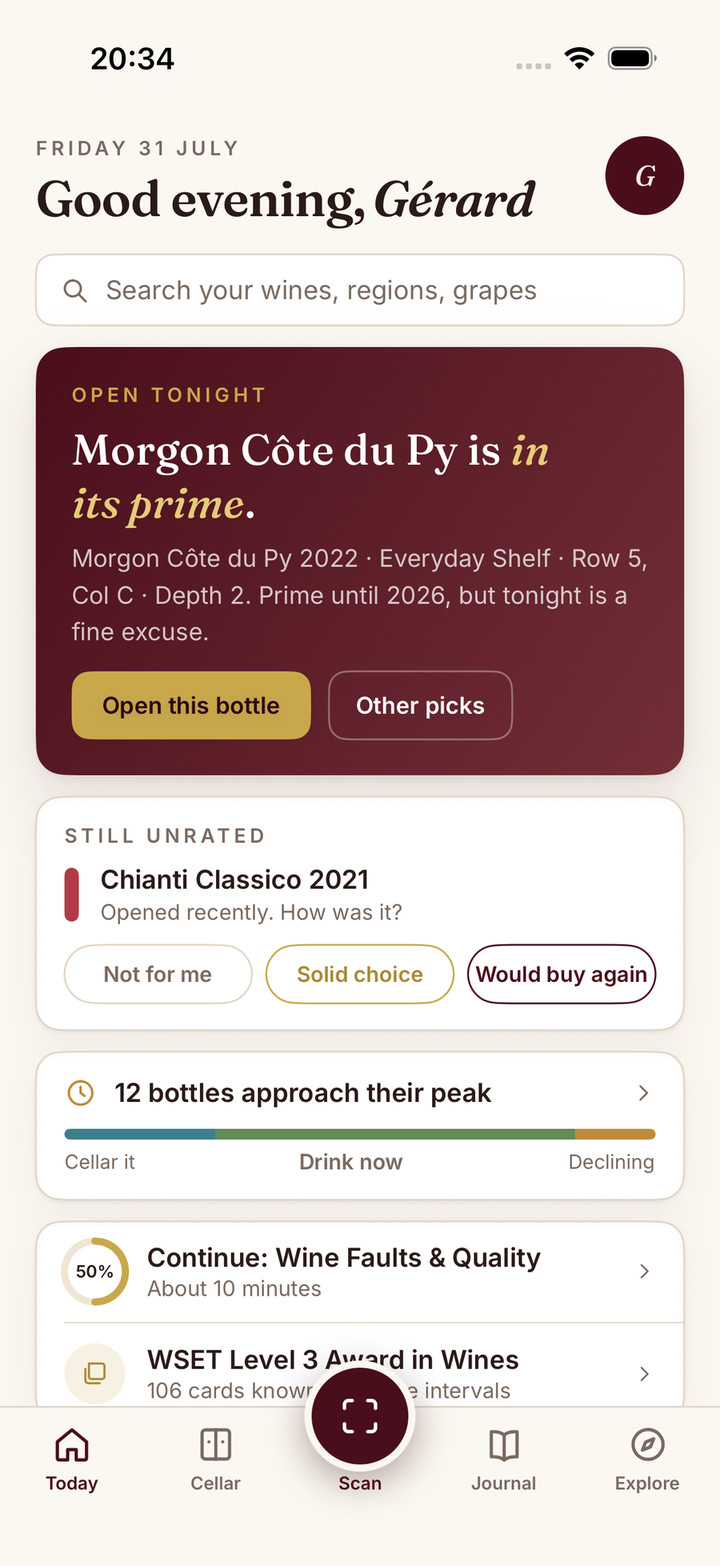
Sommo’s tasting note feature is structured around the SAT framework, with guided prompts for each section. The Tasting Note Wizard walks you through Appearance, Nose, Palate, and Conclusions, suggesting common descriptors at each stage so you do not freeze. When you save the note, the AI cross-references your description against the wine’s official characteristics and gives you an alignment score, helping you calibrate your perception against the broader consensus. Over time, this calibration is what builds confidence.
For more on the tasting framework, see our 5S method guide and How to Taste Wine Like a Sommelier.
Explore with Sommo
The single fastest way to develop your palate is to take structured tasting notes, consistently, for three months. Most people will not do this on paper. Digital tools make the friction low enough that the habit actually sticks. Sommo gives you the SAT framework, the prompts, the alignment scoring, and a long-term record that builds your wine memory automatically.
Download Sommo free and start your first proper tasting note tonight.