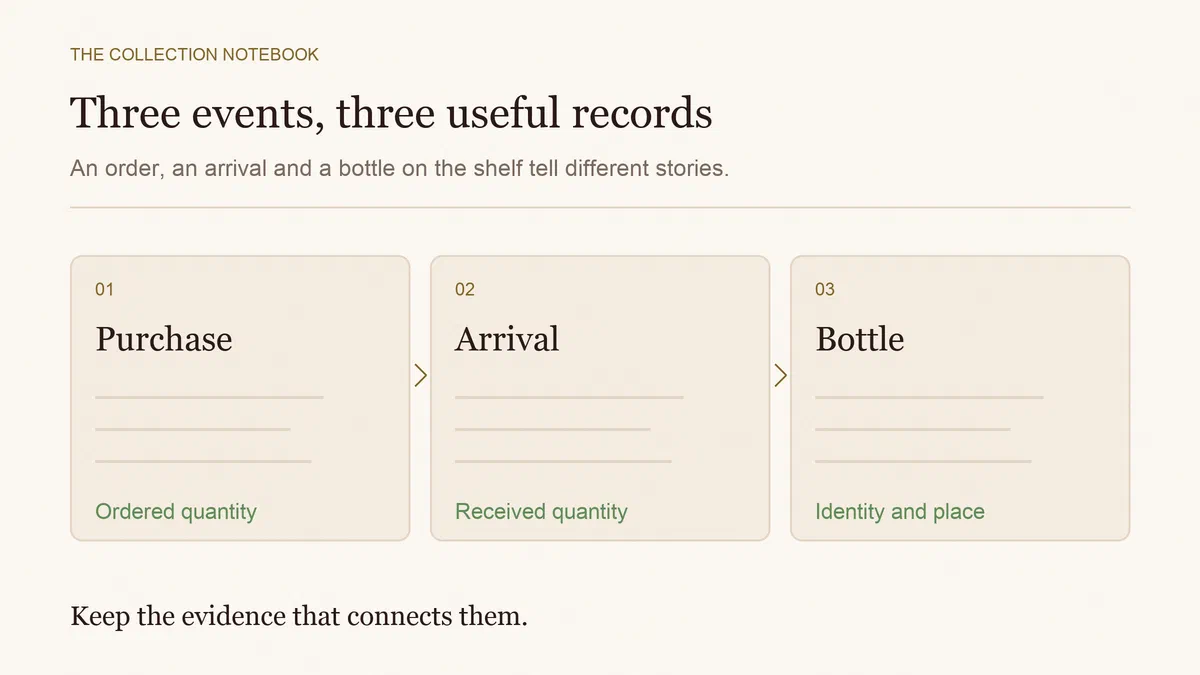
Cash spent during a year, the purchase cost of bottles still in your cellar and their estimated market value answer different questions. Choose the question before adding prices. Otherwise a perfectly plausible total can give you the wrong answer.
For budgeting, follow payments and refunds. For remaining purchase cost, follow the particular bottles still owned. For a market estimate, keep a separately dated source and valuation basis. None of these totals automatically represents the amount an insurer would accept; our insurance documentation guide explains how to prepare the supporting records.
Define the period and the price basis
Write a short rule above your spending ledger: for example, “payments made from 1 January to 31 December, including delivery and tax, less refunds received in that period”. Use receipts or account records to establish the dates. State how you treat deposits and purchases still awaiting delivery.
You may instead want the cost of wine acquired during the period. That is a useful measure too, but it differs from cash flow if you paid before delivery or received a refund later. Keep sales proceeds separate unless the question specifically asks for net cash spent after sales.
Consistency matters more than choosing the most impressive total. If you include shipping for one purchase and omit it for another, label the difference rather than presenting a uniform figure.
A worked example with one wine and two prices
These are fictional purchases. The collector starts the year with none of this wine and tracks which physical bottles leave.
| Event | Cash paid | Effect on physical stock |
|---|---|---|
| January: six bottles at £20 each | £120 | Six received |
| March: four more at £25 each | £100 | Four received |
| During the year: four January bottles drunk and one gifted | £0 | Five removed |
| June: two bottles received as gifts | £0 | Two added, recorded separately |
| September: six other bottles paid for but not yet delivered | £180 | None added to available stock |
Cash paid is £400. The received purchases cost £220, and £180 relates to the undelivered order. At this point, seven physical bottles remain: one January bottle, four March bottles and two gifts.
The remaining paid bottles have a purchase cost of £120: one at £20 plus four at £25. The gifts added no cash outlay for this collector. Their donor’s purchase price is unknown; that does not establish a zero market value.
If you estimate the current market value of the seven bottles, document that calculation separately. Do not substitute £120 or £400 simply because those figures are already available.
Why an app’s total may differ
InVintory’s documentation, checked on 10 October 2026, distinguishes Spend from Total Purchase Value. Its Spend includes priced bottles later removed, while Total Purchase Value covers remaining bottles. Pending deliveries do not enter those figures until received. Therefore its Spend is not necessarily the same as a bank-based cash ledger that includes an already-paid undelivered order.
CellarTracker’s purchase guidance also explains a difference between summing individual bottle costs and applying historical average prices to wine totals. That page is dated November 2020; check current report definitions before using a figure for a financial decision.
Read the definition and the filters attached to any total. Unknown prices omitted by a report are missing information, rather than proof that those bottles were free. Report the known subtotal alongside the number of unpriced bottles.
Preserve purchase lots and original currencies
The example works because the collector knows which bottles cost £20 and which cost £25. An aggregate count cannot reconstruct that distinction after the fact. If the physical lots are indistinguishable, choose and document an allocation method rather than claiming exact individual costs.
Keep original currencies. A £100 purchase and a €60 purchase cannot become a £160 total without conversion. If you choose a reporting currency, record the exchange-rate source, date and method; use the same method throughout. Keep the original amount so the calculation can be checked later.
Sommo’s Premium cellar stores current quantities, purchase-price metadata and currency. Repeated additions of the same wine merge, rather than preserving independent purchase lots or a complete annual transaction history. If all seven held bottles share one entry priced at £25, multiplying that price by the quantity gives £175. That differs from the £120 historical cost of the five remaining purchased bottles and applies a purchase price to the two gifts. Keep lot costs and gift status in the separate ledger.
Decide which number to use
Use cash spending to review a budget, remaining purchase cost to understand what paid stock is still held, and a sourced market estimate for a separate valuation discussion. Our cellar app versus spreadsheet guide can help you maintain the current inventory alongside its financial record.
Download Sommo to organise the bottles you own, with a separate ledger for the money and history behind them.