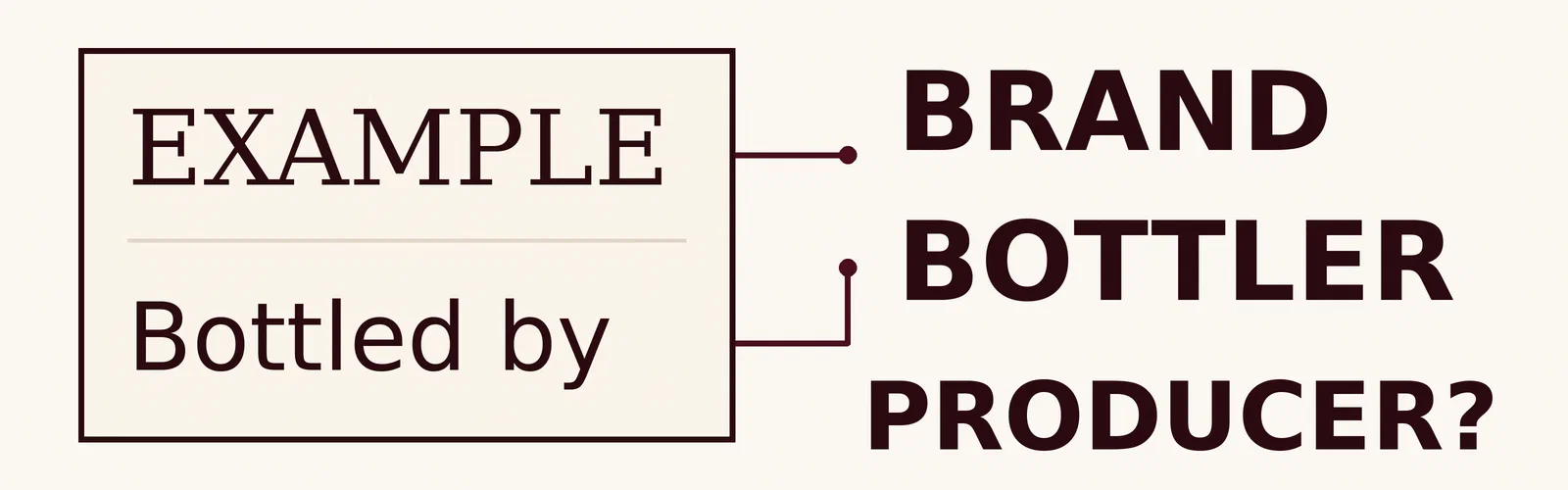
The largest name on a bottle may be its brand. A smaller business name may identify the bottler, importer or another responsible business. Read the words beside each name before deciding what that business did. “Imported by” does not, by itself, tell you who grew the grapes or made the wine.
Turn the bottle around and copy the complete statement, including “by”, “for” and the address. Then separate three things: the literal wording, the role that wording supports, and what remains unknown. Several roles can belong to one business, but a familiar name is not evidence that they do.
Our general wine-label guide covers vintage, grape and region. This guide looks more closely at the people and businesses named on the bottle, using specific US and British guidance checked on 16 October 2026. The wording examples below are reading exercises, not a review of a label’s compliance.
Begin with the role, not the reputation
A useful working vocabulary distinguishes the brand under which the wine is sold, a grower who grows grapes, a producer whose stated activity needs interpreting in context, a bottler who puts wine into bottles, and an importer involved in bringing it into a market. A retailer sells it to you. These roles may overlap; they are not a ranking of quality.
For a US example, TTB’s Anatomy of a Wine Label describes a brand as the name used to market a wine or line of wines. Treat the prominent name as an identifier to record, then look for more specific role statements elsewhere on the bottle. Do not turn “marketed as” into “grown and made by”.
What US statements support
The following narrow readings come from TTB’s name-and-address guidance, updated 12 January 2026. They concern the described US labelling context, not every bottle worldwide.
| Wording | Supported reading |
|---|---|
| Bottled by, on American wine | Names the bottler; does not establish the grape grower. |
| Imported by, on imported wine | Identifies the importer or responsible importing party, not necessarily the producer. |
| Produced by, on American wine | A defined activity: fermenting at least 75% of the wine, or specified class/type-changing or sparkling-wine operations. |
| Vinted by, on American wine | Defined cellar treatment; does not establish grape growing. |
TTB’s own illustrative example names Lighthouse Vintners in Kingston, New York, with both production and bottling wording. The guidance distinguishes optional production wording from the required bottler statement. That is a regulator’s example, not a bottle we have examined or a recommendation of a commercial wine. The term used for a foreign producer on a US imported label is subject to the country-of-origin requirements described in that guidance.
Two original text-label exercises
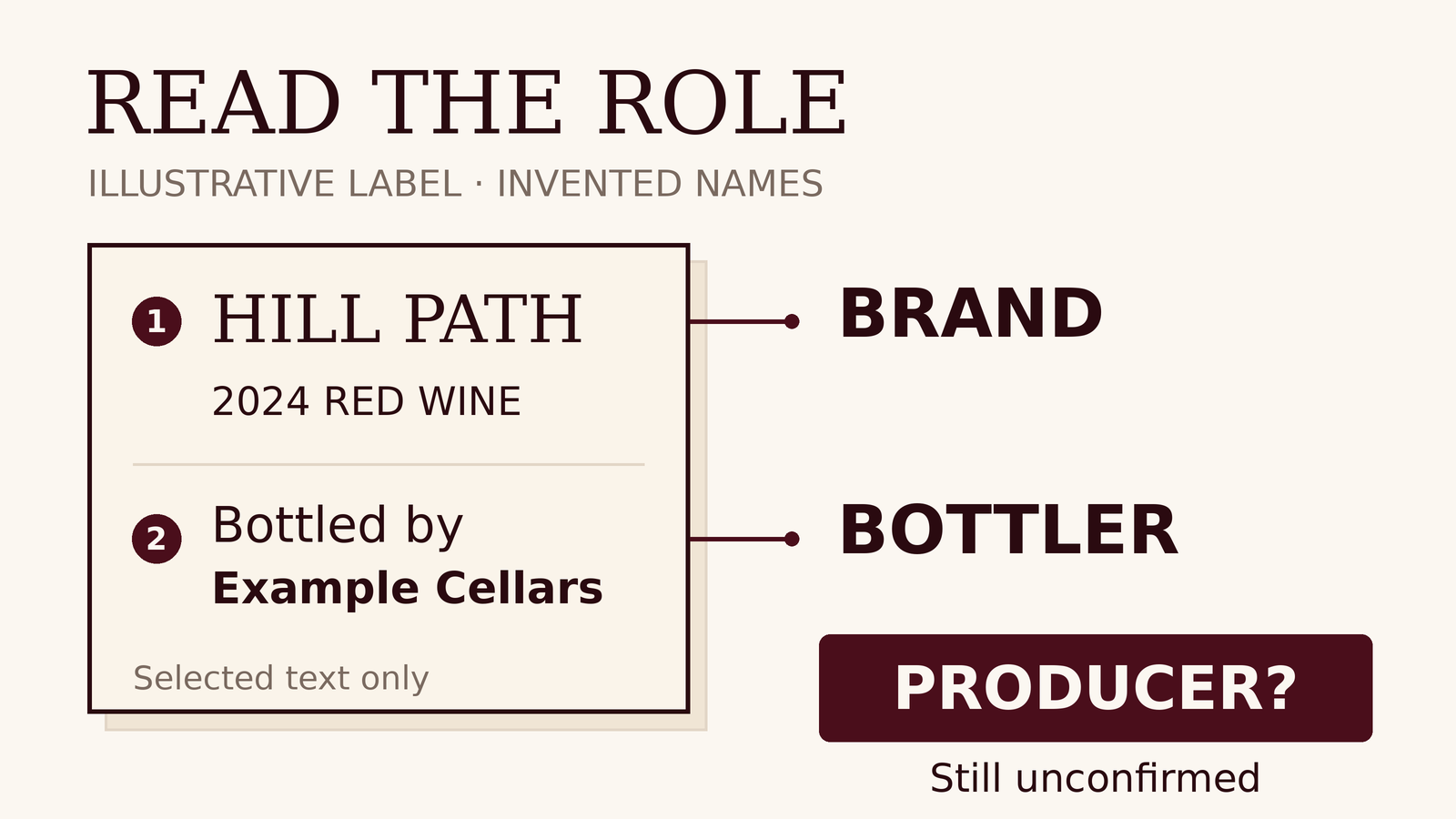
These are illustrative schematics with invented business names, not photographs, commercial bottles or complete compliant label designs. Their purpose is to show where an inference should stop.
SCHEMATIC A: American wine, selected text only

HILL PATH                    [1] Brand
2024 Red Wine
Bottled by Example Cellars   [2] Stated bottler
Example City, California

Unknown from this text: grower and fermenting producer.
SCHEMATIC B: wine imported into the US, selected text only

ORCHARD WINDOW               [1] Brand
Wine of France
Imported by Example Imports [2] Stated importing business
Example City, New York

Unknown from this text: grower, producer and bottler.
In A, adding a supposed producer from an internet discussion would create a new claim without evidence. In B, saving Example Imports as the winery would confuse the route to market with production. Record the importer’s name in its own role and leave the producer unconfirmed.
An address in England needs a different reading
GOV.UK’s importing-wine guidance, updated 19 September 2025, says wine imported into England must name and give the address of a business based in the UK, Channel Islands or Isle of Man that takes responsibility for marketing it. The words “importer” or “imported by” are not required. That address alone therefore does not identify the producer or necessarily the importer.
For wine imported directly into Scotland or Wales, the guidance requires the importer’s address prefixed with “importer” or “imported by”. It also explains movement between these markets. Do not extend the England reading to all UK imports, or apply the US table to a bottle simply because the wording looks familiar. Follow the relevant guidance when the route and market matter.
For a reader’s record, the practical consequence is small: an unqualified business address stays “business named on label; precise role unconfirmed” until further evidence identifies it. A missing production story is a question you can ask, rather than a puzzle you must solve by guessing.
A worksheet for the bottle in your hand
| Field | Your entry |
|---|---|
| Brand, cuvée, vintage and format | ___ |
| Market; relevant source and check date | ___ |
| Exact business statement and address | ___ |
| Role supported by that wording | ___ |
| Grower, producer or bottler still unknown | ___ |
| Evidence file or label photograph | ___ |
| Question, recipient and reply date | ___ |
Completed synthetic example: Schematic B; illustrative US-market import; wording “Imported by Example Imports”; supported role importing business; producer unknown; evidence this schematic; question for the importing business: “Who produced this exact cuvée and vintage?” No reply has been obtained. This is a desk exercise in tracing evidence, not physical bottle verification.
Route the question to the business best placed to answer it. Ask the retailer to confirm the exact product and current stock label, the importer about the wine it represents, and the producer, once established, about growing and production. Include the vintage, format, lot code if visible and a clear photograph. Distinguish a reply about this bottle from general brand history.
Use the wine glossary when an unfamiliar term interrupts the reading. In your wine journal, retain literal label wording and the source of any later clarification. A Sommo scan can help identify a wine, but check the result against the actual bottle. It cannot turn an importer into a producer or establish the bottle’s chain of custody.