The wines you reach for repeatedly are not random. They reflect how you taste, how you eat, what kind of intensity you can handle, and even what you grew up around. Wine professionals have spent decades trying to map these patterns, and the result is a surprisingly coherent picture: there are roughly seven or eight wine personality types, each defined by a cluster of preferences that hang together.
This guide is for anyone who has ever looked at their wine fridge and noticed that they keep buying the same kinds of bottles. We will break down the main personality profiles, explain the science of why your palate gravitates where it does, and offer a path for each type to expand their range without abandoning what they love.
The Science Behind Taste Preferences
Before we get to the profiles, a quick word on what is actually going on.
Taste preferences come from three sources working in combination. The first is biological. You are born with a certain number of taste buds (between 2,000 and 10,000), a certain sensitivity to specific compounds (the most famous example: roughly a quarter of people are “supertasters” who experience bitterness more intensely), and a certain tolerance for tannin and acid. These traits are hardwired and they do not change much across your life.
The second is cultural. The food you grew up eating trains your palate to expect certain flavour profiles. People raised on rich Italian food often gravitate to bold, structured reds. People raised in coastal cultures often prefer crisp, mineral whites. None of this is destiny, but it shapes the starting point.
The third is exposure. Palates evolve with experience. A wine that tastes too tannic at 21 can become a favourite at 30 because you have built up tolerance and learned what to focus on. This is the part that wine learning actually changes. The first two are background. The third is what you grow.
The Eight Wine Personality Types
These profiles are based on the dominant clusters you see in wine drinkers. Most people are a primary type with a secondary tendency. Read each one and see which two feel closest, or take the free wine quiz and let it place you.
1. The Bold Red Drinker
You like big, structured reds: Cabernet Sauvignon, Malbec, Shiraz, Napa Zinfandel. You want a wine you can taste through a steak. You probably find lighter reds “watery” and Pinot Noir underwhelming. Sparkling wine is fine but you do not seek it out.
What it says about your palate: You are tolerant of tannin and you read texture as a pleasure rather than a problem. You probably enjoy strong coffee, dark chocolate, and well-seasoned food. You are likely not a supertaster.
What to explore next: Stay in the bold zone but widen the geography. Try Aglianico from Campania, Cahors Malbec from France (the original Malbec home), Priorat blends, or aged Brunello di Montalcino. All of them deliver structure, but with more complexity than the standard Napa Cab. If you want a stretch, try a serious Northern Rhône Syrah like Côte-Rôtie. You will find familiar muscle but with savoury, peppery, olive notes that complicate the picture.
2. The Crisp White Drinker
Sauvignon Blanc, Pinot Grigio, Albariño, dry Riesling. You want freshness, brightness, and zero residual sugar. You probably find oaked Chardonnay heavy and you avoid Chardonnay altogether at restaurants for this reason. Rosé is fine if it is dry and pale.
What it says about your palate: You are acid-loving, which is one of the most reliable markers in wine. You probably enjoy citrus, vinegar-dressed salads, and Asian food. You may dislike very sweet desserts.
What to explore next: Move toward whites with more texture but still high acidity. Try a Chablis (unoaked Chardonnay from cool Burgundy), a Hunter Valley Semillon from Australia, a top-tier Grüner Veltliner from Wachau, or an aged Riesling from the Mosel. You will discover that some wines can be both crisp and complex, with weight that comes from age and minerality rather than from oak.
3. The Pinot Noir Loyalist
You drink Pinot Noir, and very little else. You can taste the difference between Oregon and Burgundy. You probably read about wine more than the average drinker, and you are willing to spend a bit more per bottle because you have learned that good Pinot is expensive. You may also enjoy Champagne, Beaujolais, and elegant Italian reds.
What it says about your palate: You prioritise finesse over power, you are sensitive to texture, and you probably have a more developed palate than average. You read aromatics carefully and you value transparency in winemaking.
What to explore next: Beaujolais Cru wines are the obvious adjacent category. Then move to Nebbiolo from Alto Piemonte (lighter than Barolo, similarly fragrant), Etna Rosso from Sicily, Trousseau from Jura, and old-vine Mencía from Bierzo. All four are Pinot-adjacent in style and texture without being Pinot.
4. The Champagne Enthusiast
You drink sparkling more than most. Real Champagne when the budget allows, good Crémant or Cava when it does not. You have opinions about brut versus extra brut. You probably also enjoy crisp whites and you find big reds tiring.
What it says about your palate: You love acidity and you love texture (those tiny bubbles are a textural sensation as much as a flavour one). You are probably social, since sparkling wine is the most occasion-driven category. You may also be celebration-oriented in your food choices.
What to explore next: Move beyond Champagne to other traditional-method sparkling: Franciacorta from Lombardy, top-tier English sparkling from Sussex or Kent, Cap Classique from South Africa, and grower Champagnes (small-production Champagne from individual growers rather than the big houses). You will find that the traditional method produces remarkable wines outside Champagne, often at half the price.
5. The Natural Wine Adventurer
You drink whatever the natural wine shop pours you. Pét-nat in summer, skin-contact whites with dinner, glou-glou reds with everything. You probably read the back label for sulphite levels and you can name three or four producers off the top of your head. You may be sceptical of conventional wine altogether.
What it says about your palate: You enjoy funk, you have a high tolerance for volatile acidity, and you value process over polish. You are probably also interested in fermentation more broadly (sourdough, kombucha, kimchi).
What to explore next: Try the more polished side of natural wine: producers who work organically or biodynamically but make wines that are technically pristine. Domaine Tempier in Bandol, Domaine Leflaive in Burgundy, Pingus in Ribera del Duero, or the more refined Beaujolais of Jean Foillard. These wines bridge the natural and classical worlds and may reset some assumptions about what “natural” has to taste like.
6. The Sweet Wine Lover
You like Moscato, Riesling Spätlese, Port, ice wine, or anything with noticeable residual sugar. You may be quietly self-conscious about this because wine culture tends to look down on sweet wines. You should not be. Sweet wine has been the prestige category for most of wine history.
What it says about your palate: You enjoy fruit-forward, generous flavours. You may be sensitive to bitterness (a marker of supertasting). You probably enjoy desserts and you may find very dry wines harsh.
What to explore next: Move up the quality ladder rather than across the style. The best sweet wines in the world are stunning: Sauternes from Bordeaux, Tokaji Aszú from Hungary, German Beerenauslese Riesling, Rutherglen Muscat from Australia, and aged Madeira. Try one bottle at the serious end of each category and you will discover that “sweet wine” can mean profound, age-worthy complexity rather than simple sugar.
7. The Rosé Devotee
Rosé all year, not just summer. You probably prefer the pale Provence style, and you have a few favourite producers. You may also enjoy crisp whites and light reds when rosé is not available.
What it says about your palate: You like wines that sit in the middle: enough flavour to be interesting, enough freshness to drink across a long meal, no heaviness. You are probably food-oriented and you may have a slight preference for shared, casual meals over formal ones.
What to explore next: Explore the world’s rosé traditions beyond Provence. Tavel from the southern Rhône (deeper colour, more weight). Spanish Garnacha rosado from Navarra. Italian Cerasuolo d’Abruzzo from Montepulciano. Bandol rosé (from the same region as Domaine Tempier mentioned above), one of the few age-worthy rosés in the world. Then move into very light reds served chilled: Beaujolais, Frappato, or Loire Cabernet Franc. The boundary between deep rosé and light red is thinner than people realise.
8. The Curious Explorer
You do not have a type. You buy by mood, by occasion, by what the shop recommends. You may have favourite producers but no favourite grape. You are open to almost anything.
What it says about your palate: You are still calibrating, and that is the most useful place to be. Curiosity, more than knowledge, is the trait that builds a sophisticated palate over time.
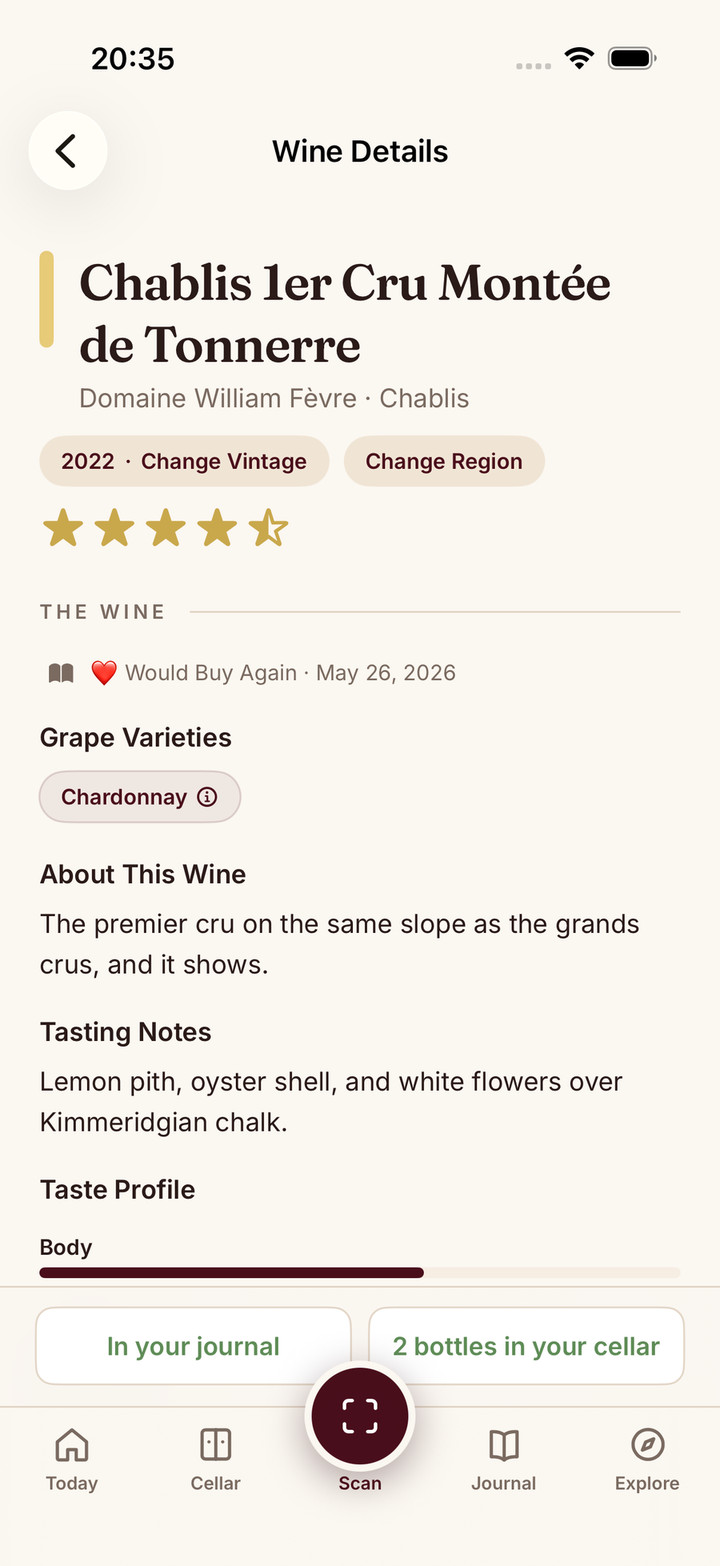
What to explore next: Stay curious, but start tracking. The biggest weakness of the explorer profile is that without a record, the patterns never emerge. Keep a wine journal (paper or in Sommo) and note three things for each bottle: did you love it, did you hate it, and what was the food. When you are ready for more structure, learn how to write wine tasting notes properly. After 30 entries, you will start to see the shape of your palate emerge.
Why Knowing Your Type Matters
The point of identifying your wine personality is not to box yourself in. It is to give you a starting point for expansion. People who try to “learn wine” by drinking through famous regions without a personal anchor usually end up confused and disengaged. People who start with what they love, then stretch carefully into adjacent territory, build genuine expertise.
The most useful question in wine is not “what is the best wine?” It is “what is the best wine for someone with my preferences, at my budget, for this occasion?” That is a personal question, and it requires self-knowledge.
The Wine Character Analysis Feature
This is exactly what we built Sommo’s Wine Character Analysis feature to do. Once you have logged three or more wines in your journal, the AI analyses your tasting notes, ratings, and chosen wines to produce a personality profile that is more nuanced than the eight types above. It might tell you that you are an “Acid-driven explorer with a soft spot for chillable reds and an undeveloped tolerance for tannin.” That kind of specificity is what unlocks better recommendations.
The profile updates as you add more wines, so it tracks the evolution of your palate over time. A drinker who starts as a Bold Red type and gradually moves toward Pinot Noir will see that arc reflected in their analysis after a few months of journalling.
How Palates Change
A final point worth making: nobody’s palate stays still. Most people follow a rough arc.
- Early years: Sweet, fruity, low-tannin wines. Moscato, off-dry Riesling, light reds.
- Middle years: Bigger, bolder wines. Cabernet, Malbec, oaked Chardonnay. The “I want to taste it” phase.
- Later years: A return to elegance. Pinot Noir, Burgundy, mineral whites, Champagne. The “subtlety over volume” phase.
This arc is not universal, but it shows up often enough that wine professionals jokingly call it the journey “from grape juice to Burgundy.” Where you are on the arc tells you something about what is next, and what will probably still be there in five years.
The Bold Red Drinker who is bored with Napa Cab is often three months away from falling in love with Bordeaux. The Crisp White Drinker who has hit a ceiling on Sauvignon Blanc is often a few bottles away from loving Chablis. Knowing the arc lets you skip the dead ends.
Explore with Sommo
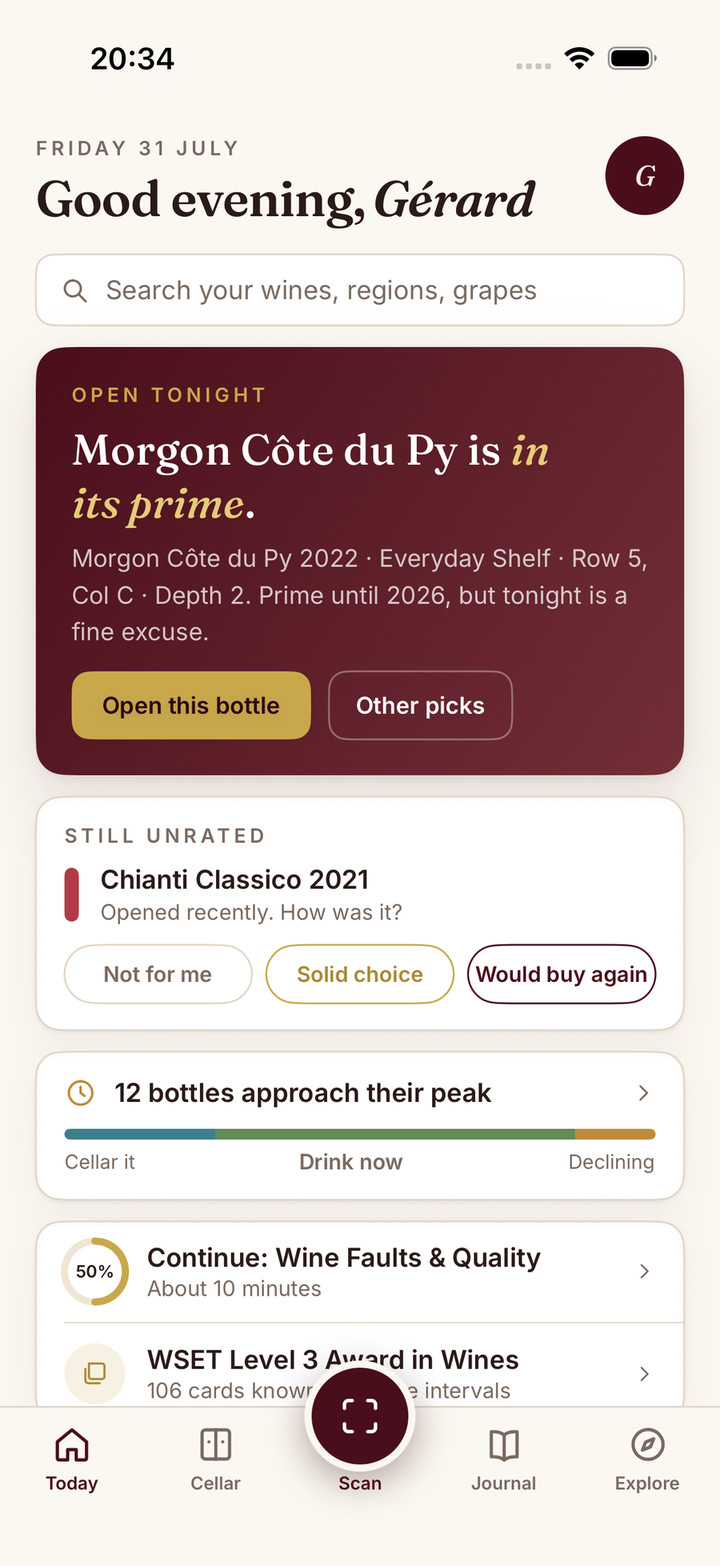
The fastest way to understand your wine personality is to track it. Sommo’s journal records every wine you drink with structured tasting prompts that train your palate while you log. The Wine Character Analysis turns those entries into a personal profile that updates as you grow. Over time, you build a record of your taste that is more useful than any general guide, because it is yours.
Download Sommo free and find out what your bottles say about you.