A dark wine fridge calls for a calm sequence: check that people are safe, keep the door closed, record the last known normal condition and compare your real alternatives before moving bottles. There is no universal number of powerless hours after which a collection is either ruined or guaranteed unharmed.
The practical decision depends on the cabinet, its surroundings, the conditions actually observed and the risks of moving the wine. This guide is an incident record and decision aid for an existing collection. Use your appliance’s instructions and qualified help for faults; the log cannot diagnose electrical problems or certify bottle condition.
Start with people and the appliance
If there is flooding, smoke, a burning smell, damaged wiring or another electrical hazard, keep clear and contact the appropriate emergency service or qualified professional. Do not touch wet equipment, dismantle panels, improvise a supply or repeatedly reset protection devices to make the fridge run. Bottles can wait while a safety problem is addressed.
Find the exact model’s manual and the supplier’s outage information from a safe place. Establish whether there is a reported wider outage or an appliance fault without attempting electrical repairs. Record a restoration estimate as an estimate with its source and time; it is not a guarantee.
Keep the cabinet door shut while deciding what to do. Repeatedly opening it to feel a bottle gives you a poor temperature history and changes the conditions you are trying to protect. Use an existing external readout or logger if available. Do not open the door just to manufacture a missing measurement.
Separate times, readings and unknowns
Write down the last time you actually saw normal operation and when you discovered the problem. Those are different events. If the cabinet was normal at 08:00 and dark at 13:00, the outage did not necessarily begin at either time.
Record the setpoint separately from a measured cabinet reading. A remembered setting of 12°C does not establish that the cabinet stayed at 12°C. Note the source and location of each reading: cabinet display, independent air sensor or room thermometer. Cabinet air, room air and the wine inside a bottle are different measurements.
Blank incident log:
| Record | Details to fill in |
|---|---|
| Model, serial and manual version | ___ |
| Last confirmed normal; evidence | ___ |
| Discovery time; actual observation | ___ |
| Setpoint; cabinet reading and source | ___ |
| Room reading; instrument and location | ___ |
| Alarm or maximum reading; time | ___ |
| Outage estimate; source and time | ___ |
| Action, bottle groups and locations | ___ |
| Recovery readings; service reference | ___ |
Write “unknown” when you do not have evidence. A neat filled table is less useful than an honest one.
A decision card for moving or waiting
Read each step in order. A cooler-sounding place is not automatically a better place for the wine.
| Question | Next action |
|---|---|
| Is there a hazard? | Keep clear; obtain the appropriate professional help. |
| Is the situation safe to observe? | Keep the door closed; record available readings and information. |
| Is an alternative demonstrably more suitable? | Compare actual conditions, capacity, access and transport before a move. |
| Is the advantage unclear or handling risky? | Avoid a rushed transfer; seek advice and reassess as information changes. |
| Is a move justified and practical? | Prepare divided cartons and destinations first; count and record each group. |
| Has power returned? | Follow this model’s recovery guidance; document readings and unresolved faults. |
Compare a working suitable cabinet or confirmed professional storage with leaving the collection where it is. Ask about availability before packing. Consider hot corridors, stairs, fragile bottles, transport time and whether the destination can hold everything securely. The collection-moving guide covers packing and reconciliation; the storage guide helps assess the destination.
What a real manual can tell you
For the Miele KWT 4584 E, the current UK manual, printed page 44, describes a power-failure indication when an interruption has allowed the temperature to rise too high. Acknowledging it with OK displays the warmest recorded temperature for about one minute before returning to the current reading. The manual says to remedy the cause. Photograph or note the readings while available.
That is a model-specific example, checked on 16 October 2026 against the manual linked from Miele’s product page. Another cabinet may store no maximum or use a different sequence. A maximum alone also cannot tell you how long the wine experienced that condition.
The same manual’s printed page 7 prohibits operating this appliance in areas exposed to moisture. Check installation restrictions before proposing a temporary appliance location. Do not move or reconnect a heavy cabinet in haste.
A timeline with the gaps left in
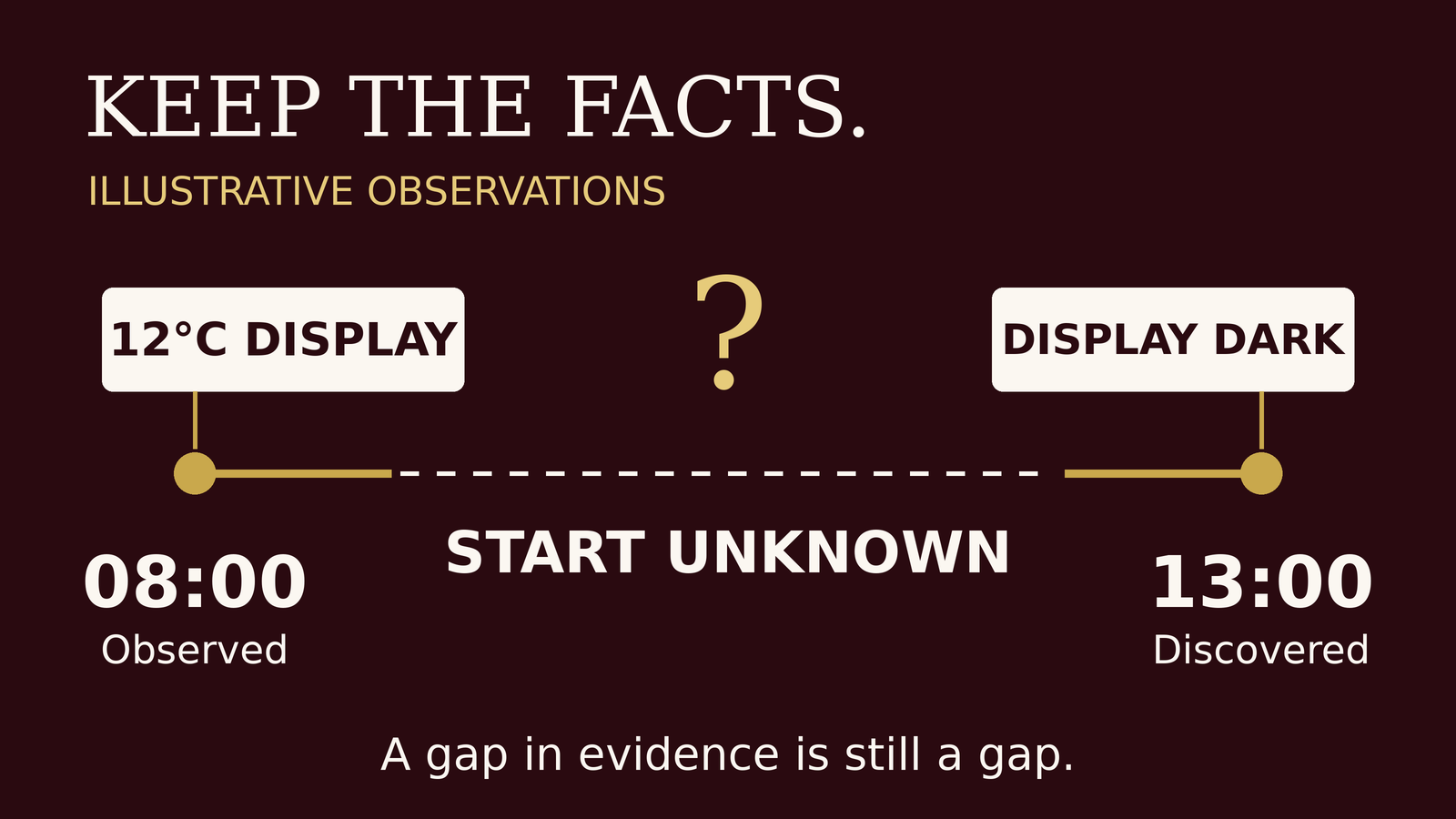
Synthetic desk example, not a measured outage: at 08:00 an owner recorded a cabinet display of 12°C. At 13:00 they discovered a dark display; a room thermometer read 23°C. Outage start and current cabinet temperature were unknown. At 13:15 a provider estimated restoration at 15:00. A neighbour’s spare cabinet was unavailable, so no transfer was arranged. Power returned at 14:20; the owner then followed their own manual and recorded recovery observations.
The interval between the two observations is five hours. It is not five hours at 23°C, and it does not establish an internal warming curve. The example demonstrates record keeping only. It offers no verdict about the bottles.
Close the incident properly
After restoration, follow the model’s restart guidance and check whether normal operation returns. Preserve alarm details and seek qualified service for persistent faults. Retain dated photographs of leaks or closure changes and the observation history; wine insurance documentation explains useful records without assuming any particular policy covers the incident.
Once the immediate problem is resolved, the maintenance checklist can help organise follow-up care. In Sommo’s cellar, update actual rack positions and relevant bottle notes after any transfer. Keep sensor data and service paperwork with the incident file: Sommo’s collection record does not measure cabinet conditions, control the appliance or certify damage.