A garage can have plenty of room for a wine fridge and still be the wrong place for it. The decision depends on the exact appliance instructions and the conditions in that particular space throughout the year.
Put a wine fridge there only when its manufacturer permits the location and the site meets its temperature, moisture, ventilation and electrical requirements. If the manual rules out the conditions, a climate-class label does not reverse that restriction. If either the instructions or the annual conditions are unknown, the answer is still unresolved.
Our wine fridge buying guide covers the broader purchase. This guide is a conservative check of location suitability, not installation approval.
Start with the exact model, not the brand
Find the full model code, market version and rating plate. Download the matching current manual from the manufacturer and record its document number or revision. A retailer’s “garage suitable” description, a similar model’s manual or an owner’s experience is not enough to resolve a conflict with those instructions.
Check three different temperatures:
- Ambient operating range: the air around the appliance in which it is designed to work.
- Internal setting range: the temperatures you can select inside the cabinet.
- Actual cabinet temperature: what is happening around the stored wine.
A cabinet setting of 12°C says nothing by itself about whether the fridge can maintain it in a cold garage. Likewise, an appliance that can cool in warm weather does not necessarily have a documented heating or winter function.
A current model shows the distinction
We checked the UK Miele KWT 4584 E product page and its linked documents on 16 October 2026. The product page lists climate class SN-T.
Its operating manual, M.-Nr. 12 546 900/05, gives two consequential instructions:
- Printed page 7 says not to operate the unit in areas exposed to moisture, giving a garage or utility room as examples.
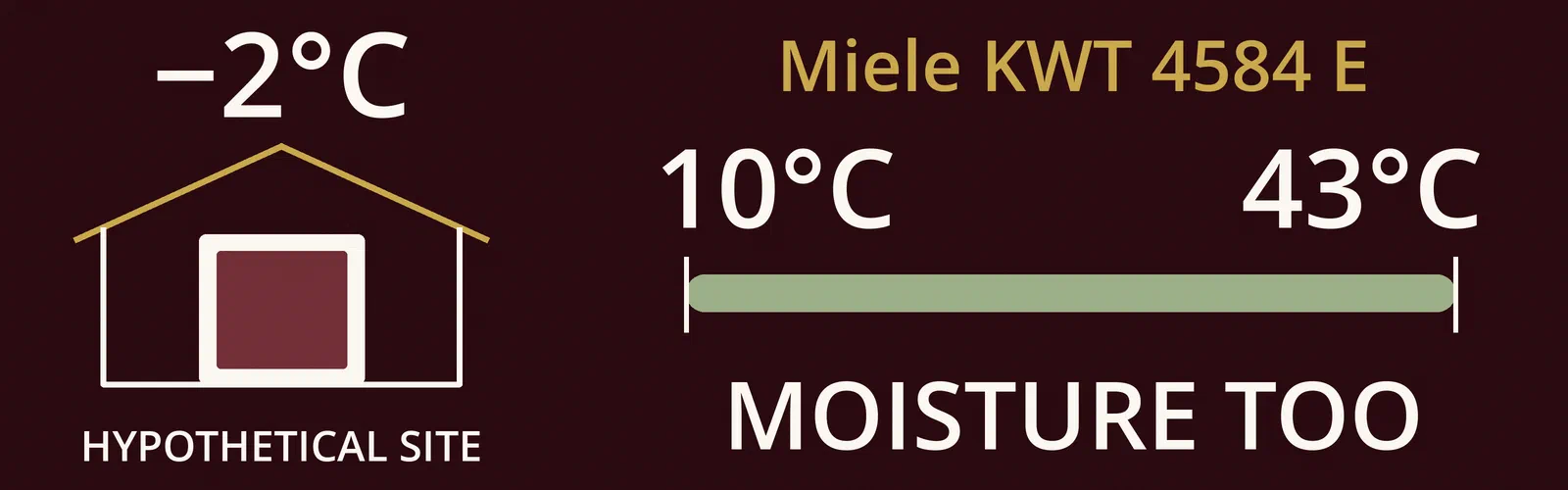
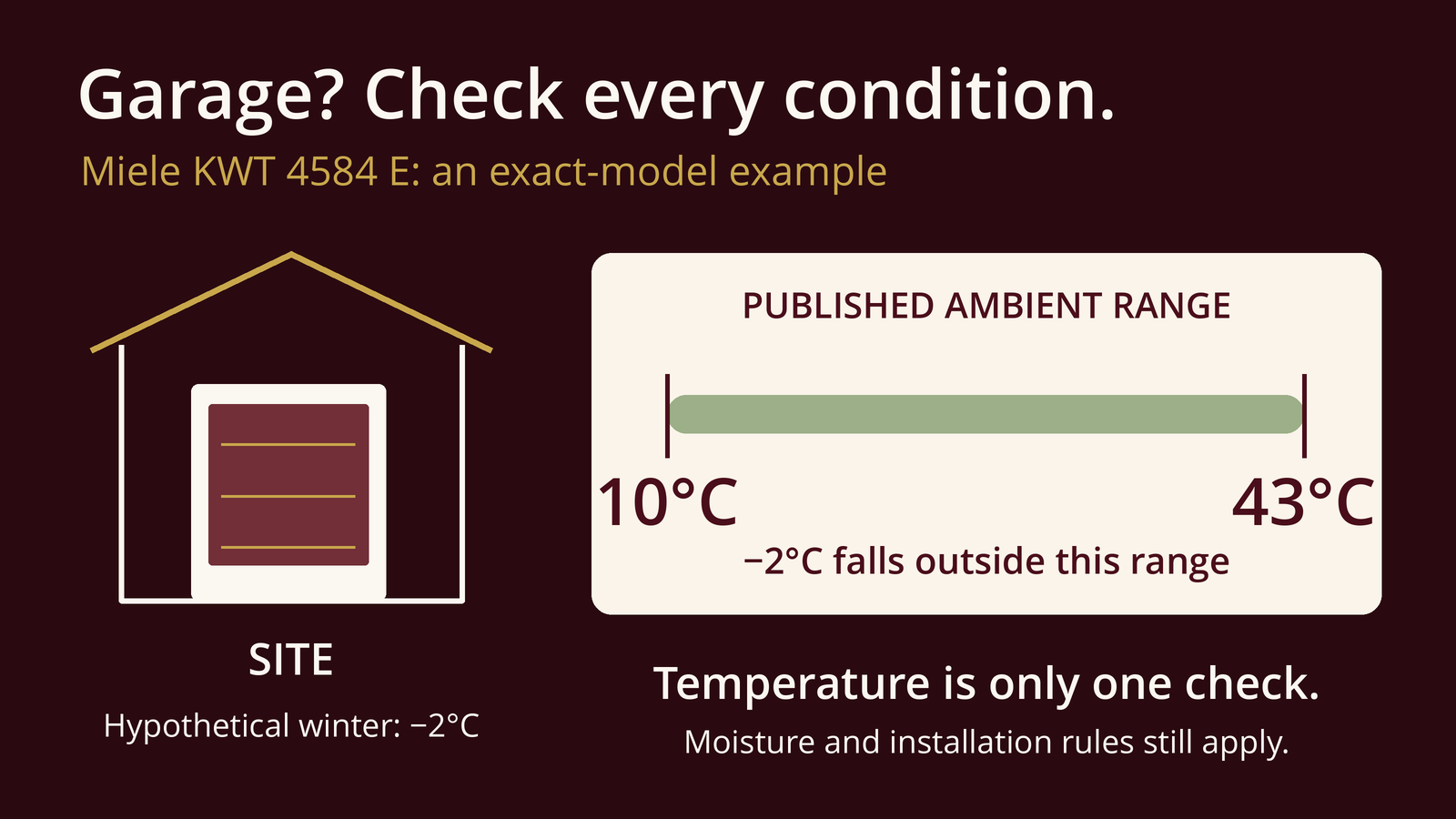
- Printed page 49 lists SN-T as 10 to 43°C ambient and explains that low ambient temperatures can leave it unable to maintain the required internal temperature in some circumstances.
The linked product fiche separately lists a minimum ambient of 10°C, maximum of 43°C and no winter setting.
These facts do not establish permission for a particular garage. A damp garage fails the moisture condition even if its thermometer reads 15°C. A dry space below 10°C fails the ambient check. For an unusually dry converted space whose status is unclear, ask Miele about the exact site before buying or moving this model there.
Measure the site across the seasons
A reading taken on delivery day is not an annual range. Gather recorded minimum and maximum temperatures at the intended appliance location through winter and summer, including unusual cold spells and hot days. Keep dates and the measurement method. Outdoor weather reports do not directly measure the air beside the cabinet.
If you have only a week of readings, write “one week”, not “year-round”. Existing records may help, but a changed garage door, insulation, heating pattern or roof can make older measurements less representative.
Look for moisture exposure as a separate question: water ingress, condensation, a damp floor or walls, and conditions when a wet vehicle is parked inside. Do not turn an absence of obvious damp on one visit into a guarantee. Keep the appliance out of use while a safety-relevant conflict or uncertainty is being resolved.
Two desk scenarios, with clear statuses
The following are hypothetical examples applying the published Miele documents. No site was measured and no appliance was installed or tested.
| Check | A: dry converted garage room | B: damp detached garage |
|---|---|---|
| Assumed annual ambient record | 12 to 30°C | Minus 2 to 40°C |
| Temperature comparison | Supported: inside published range | Outside: winter below 10°C |
| Moisture / site permission | Described as dry; manufacturer confirmation absent | Moisture exposure described; conflicts with manual |
| Other installation evidence | Plate match, ventilation and electrics not yet checked | Irrelevant to resolving the existing conflicts |
| Overall decision | Unresolved. Temperature alone passes; do not assume permission | Outside the stated conditions. Choose another permitted location |
“Supported” describes a particular evidenced check, not an overall certification. In scenario A, the next step is to resolve site permission and the remaining installation requirements. In scenario B, a heater beside the cabinet or an improvised enclosure is not a substitute for manufacturer instructions.
Copy the location decision card
Use this before ordering, then update it with the actual rating plate on arrival.
| Field | Your evidence |
|---|---|
| Exact model / market / rating plate | ______ |
| Manual revision and relevant pages | ______ |
| Permitted location / restrictions | ______ |
| Ambient minimum and maximum allowed | ______ |
| Recorded site minimum and maximum / period | ______ |
| Documented heating or winter function / limits | ______ |
| Moisture exposure and ventilation check | ______ |
| Electrical / floor / access requirements checked by | ______ |
| Remaining question; manufacturer response reference | ______ |
| Status: supported, unresolved or outside | ______ |
Only mark the overall plan supported when every relevant requirement has evidence. Keep uncertainties visible rather than averaging a failed safety condition against several successful checks.
Ventilation and electrics are part of the decision
Use the exact manual’s clearance dimensions and airflow instructions. Do not copy a generic gap from another cabinet or box a freestanding unit into furniture. Check that doors open as required and that the floor and access route suit the appliance.
Follow the manufacturer’s power-supply requirements. Ask a qualified electrician to assess an unsuitable or uncertain garage supply; this article cannot verify wiring, sockets or electrical protection. Do not modify the appliance, bypass controls, add an improvised heater or use adapters to make an unsuitable location appear workable.
If the garage cannot satisfy the requirements, choose a suitable indoor location or investigate another exact model with documented permission for your conditions. Compare its full manual and actual plate again; “winter function” on a sales page is not blanket permission for freezing or damp conditions.
Before relocating bottles, plan the move of your collection and review the basics of wine storage. Physical suitability comes first. We have not obtained manufacturer or specialist approval for either scenario, and this desk check cannot replace it.