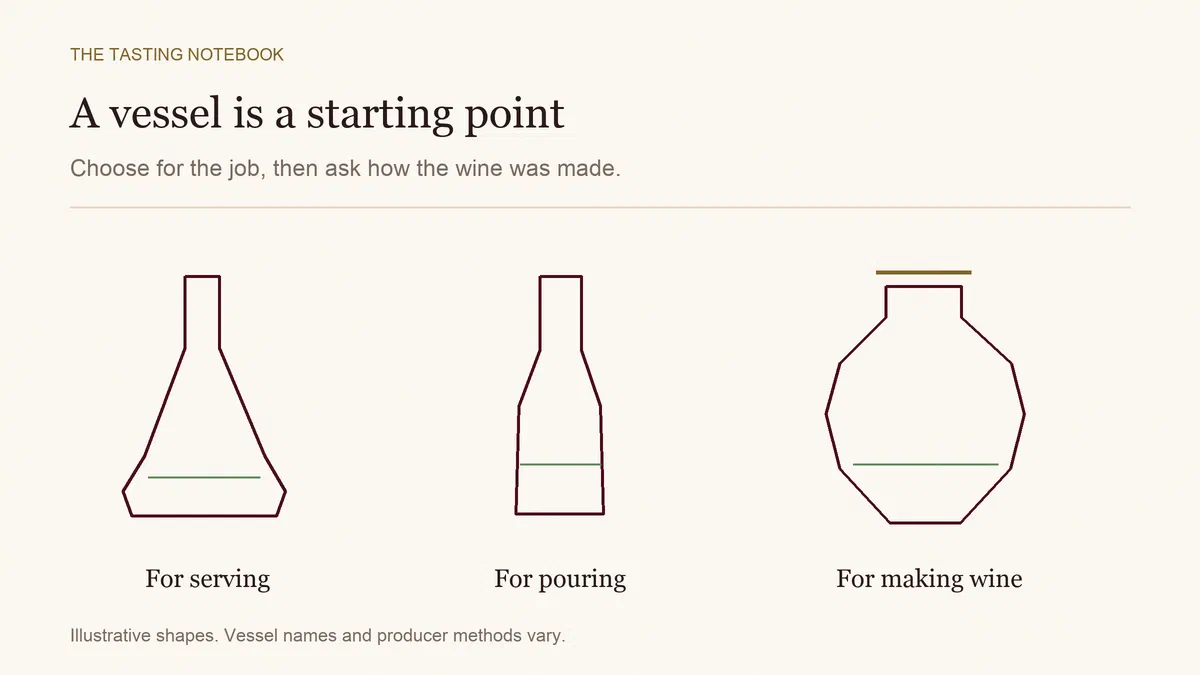
Choose a carafe or decanter by what you want to do with the wine, not by the name on the box. For serving, look for a comfortable pour and manageable capacity. For aeration, consider the wine’s exposed surface. For separating sediment, controlled pouring matters more than a dramatic shape.
The names overlap. A vessel sold as a carafe can expose wine to air, and a decanter can simply serve it. Neither word guarantees that the wine needs aeration or that sediment will disappear.
Three jobs, three useful priorities
| Your purpose | Useful vessel qualities | What the vessel cannot do alone |
|---|---|---|
| Serve at the table | Stable base, comfortable grip, reliable lip, suitable volume | Keep every wine at its ideal temperature indefinitely |
| Expose a wine to air | Space above the pour and a suitable liquid surface | Guarantee a better taste or one universal waiting time |
| Leave sediment behind | Easy filling and controlled pouring, with wine visible | Filter sediment already poured into it |
Frank Family Vineyards’ glassware guide, checked on 10 October 2026, discusses wider bases for aeration and stresses filling, pouring and cleaning. Those are practical selection criteria. They are not a reason to decant every bottle.
For the technique and whether a particular wine needs it, use our decanting guide. Here, the decision is which vessel makes the intended job easy.
Shape matters at the level you actually pour
A broad base can spread a modest volume into a shallower layer. But a photograph of an empty decanter does not tell you the surface area when it holds your wine. A narrow waist or a very full vessel may change that relationship.
Think about your usual serving amount. A vessel for a few glasses need not accommodate a magnum; one for a magnum should have usable room beyond its quoted brim capacity. Filling to the neck leaves little working space and may make an awkward vessel harder to lift.
A decorative curve can be pleasant on the table and difficult in the sink. Before buying, picture the complete sequence: filling it, carrying it, pouring the final glass, rinsing it and drying the inside. A vessel that demands a special balancing act is a poor match for hurried dinners.
At the dinner table
Suppose you are serving a young red and an older red that has visible sediment. You have a slim, easy-pouring carafe and a broad-bottomed decanter.
The young red may be a candidate for the broader vessel if tasting suggests it needs air. That remains a decision about the wine. The older bottle may suit gentle separation into the vessel you can control most easily, followed by prompt attention to how it is showing. Age alone does not make the broad decanter the right destination.
Pouring the older bottle’s sediment into the slim carafe and then transferring it into the broad one has not separated anything. It has merely moved the deposit twice. The label on the vessel cannot rescue the method.
If you only need to serve a fresh wine in a convenient container, the slim carafe may already do the job. There is no need to create an aeration ritual to justify using it.
Temperature, cleanliness and a good pour
A large exposed vessel can make keeping wine cool less convenient. Plan the serving conditions, especially for whites, rather than leaving the vessel on a warm table and blaming the wine for losing freshness. Our serving-temperature guide helps with that separate decision.
Follow the maker’s cleaning instructions. Check for smells, residue and trapped rinse water before use, and make sure you can dry the vessel. Avoid assuming every ornate glass shape is dishwasher-safe or compatible with the same cleaning tools.
Try the pour with water when the vessel is new. Is the weight comfortable? Does the lip drip? Can you see where the last portion is going? These mundane questions tell you more about suitability than a claim that one shape improves every red wine.
Keep a useful observation, not an invented experiment
If you compare the wine before and after pouring, note the time, approximate serving temperature and what changed. “Fruit became easier to notice after twenty minutes” is more useful than “the decanter improved it”. The latter assigns a cause you have not isolated: temperature, time and the glass may also have changed.
Keep both observations in the same tasting record. They are stages of one bottle, not evidence that you tasted two independent wines. The tasting-journal template gives you a simple structure.
You can save that real serving observation in Sommo, alongside the wine and your reaction. Free journal history covers the last 30 days; Premium gives access to the full history.