How to Build Your First Wine Collection
You don't need a cellar or a trust fund to start collecting wine. Here's a practical guide to building a collection you'll actually enjoy.
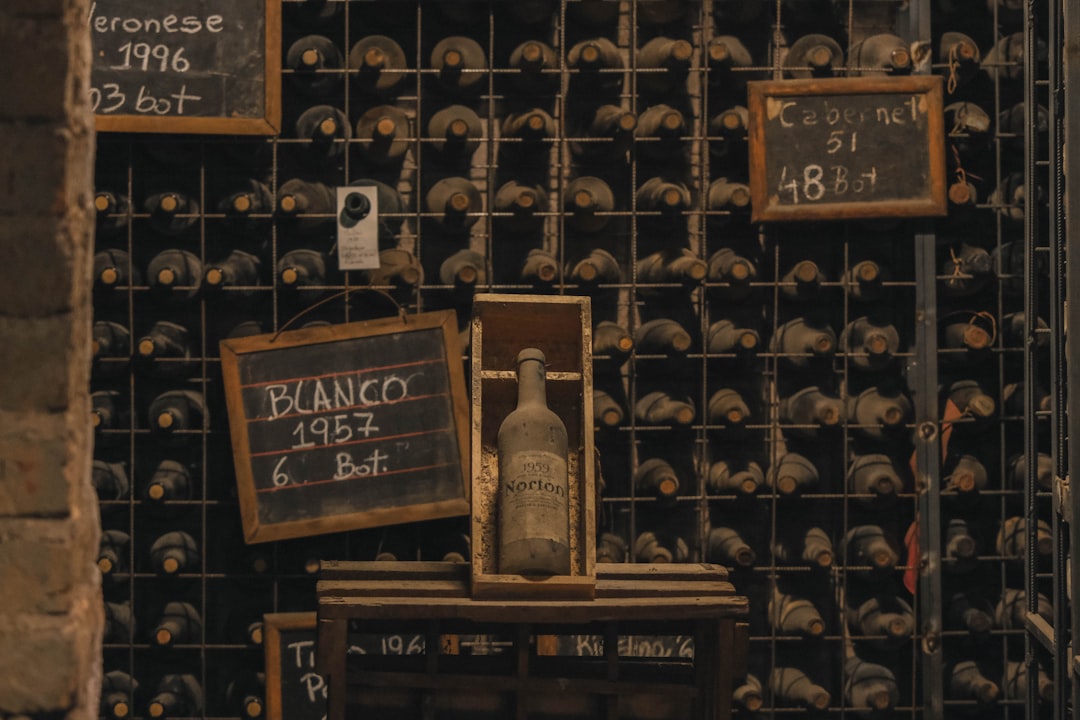
There’s a moment in every wine lover’s journey where you stop buying wine one bottle at a time and start thinking bigger. Maybe you found a wine you loved and wished you’d bought a case. Maybe you opened something special for dinner and realized it would’ve been even better with a few more years in the bottle. Whatever the trigger, the itch to collect is real.
The good news: you don’t need a climate-controlled underground vault or a six-figure budget. You just need a plan, some restraint, and a decent spot to store bottles. Here’s how to start.
Why Collect Wine at All?
Before you start buying, it’s worth asking yourself what you actually want from a collection. There are a few honest reasons:
- Aging potential. Some wines genuinely improve with time. A $25 Barolo that’s tight and tannic today might be silky and complex in five years.
- Convenience. Having a curated stash means you always have something good to open, whether it’s a Tuesday night pasta or an unexpected celebration.
- Learning. Buying multiples of the same wine and opening them over months or years teaches you more about wine development than any textbook.
- Saving money. Buying by the case often comes with a 10-20% discount. Over time, that adds up.
If your reason is “investment,” I’d gently steer you toward index funds instead. Wine as a financial asset is a game for professionals with deep pockets and warehouse-grade storage.
Storage Basics: The Non-Negotiable Rules
Wine is surprisingly forgiving, but there are a few conditions that will ruin bottles fast:
| Factor | Ideal | Danger Zone |
|---|---|---|
| Temperature | 12-14°C (54-57°F), consistent | Above 24°C or big swings |
| Humidity | 60-70% | Below 50% (corks dry out) |
| Light | Dark | Direct sunlight or fluorescent |
| Vibration | None | Next to the washing machine |
| Position | On its side (cork wines) | Upright for months |
The enemy isn’t any single factor. It’s heat and fluctuation. A consistently cool closet beats a garage that swings between 10°C in winter and 35°C in summer.
Affordable Storage Solutions
You don’t need to renovate your house. Here are your realistic options, ranked by budget:
Under $50: The Interior Closet. A closet on an interior wall (not against an exterior wall that heats up) in the coolest part of your home works fine for wines you’ll drink within 1-2 years. Add a simple wine rack and you’re set.
$200-500: A Wine Fridge. This is the sweet spot for most collectors. A 28-46 bottle thermoelectric wine fridge maintains a steady temperature, doesn’t vibrate much, and fits in a corner. It’s the single best investment for a home collection.
$500+: Dual-Zone Wine Fridge. If you want to store reds and whites at different serving temperatures, a dual-zone unit gives you that flexibility. But honestly, a single-zone set to 13°C works for everything.
How Many Bottles to Start With
Start with 12-24 bottles. That’s it. A dozen bottles gives you enough variety without overwhelming your space or budget. You can always grow later, but starting small forces you to be intentional about what you buy.
A good rule of thumb: buy at a rate slightly faster than you drink. If you open two bottles a week, aim to buy three. Your collection grows naturally without becoming a hoarding problem.
What to Buy First: The Starter Framework
Here’s a practical split for your first 12 bottles:
6 bottles “drink now” (under $15 each):
- 2 versatile whites (Albariño, Grüner Veltliner, or Vermentino)
- 2 everyday reds (Côtes du Rhône, Malbec, or Montepulciano d’Abruzzo)
- 1 rosé (Provence or Spanish Garnacha rosado)
- 1 sparkling (Crémant de Loire or Cava)
4 bottles “short-term aging” (under $25 each):
- 1 Cru Beaujolais (Morgon or Fleurie, drink in 1-3 years)
- 1 Chianti Classico Riserva (drink in 2-4 years)
- 1 white Burgundy or quality Chardonnay (drink in 1-3 years)
- 1 Riesling Kabinett or Spätlese (drink in 2-5 years)
2 bottles “long-term” ($30-50 each):
- 1 Barolo, Brunello, or quality Bordeaux (hold 5+ years)
- 1 age-worthy Riesling or Chenin Blanc from the Loire (hold 3-7 years)
This gives you something for every occasion while teaching you how different wines evolve.
Budget Allocation Strategy
The biggest mistake new collectors make is spending too much on “special” bottles and having nothing good to drink on a regular night. Flip that thinking:
- 60% of your budget on everyday wines ($10-20 range)
- 30% on mid-range wines worth short-term aging ($20-40)
- 10% on splurge bottles for long-term cellaring ($40+)
At a $100/month budget, that’s $60 on solid daily drinkers, $30 on something interesting to age for a bit, and $10 saved toward an occasional special bottle. In a year, you’ll have a well-rounded collection of 60-80 bottles without ever feeling the financial pinch.
Tracking Your Collection
A collection without tracking is just a pile of bottles you’ll forget about. And forgetting about wine is how you end up opening a bottle three years past its prime – or worse, never opening it at all.
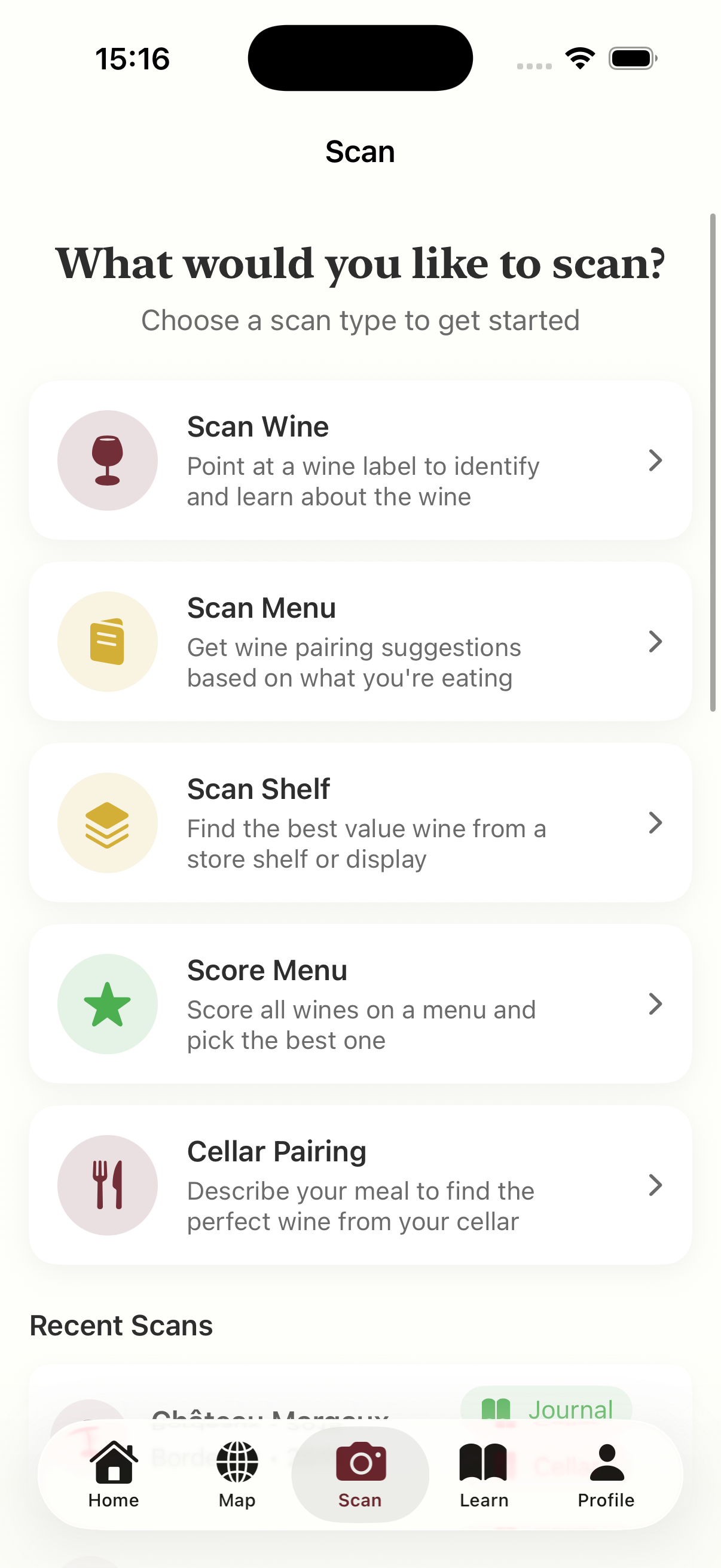
At minimum, track what you bought, when, what you paid, and when you plan to drink it. Sommo’s wine journal makes this effortless. Scan the label when you buy, add it to your journal, and you’ve got a running record of your collection with tasting notes for everything you’ve opened. It’s the difference between guessing what’s in your wine fridge and actually knowing.
Common Collection Mistakes
Buying what you think you should like, not what you actually like. If you don’t enjoy Bordeaux, don’t buy Bordeaux just because collectors are “supposed to” have it.
Not drinking your wine. Wine is for drinking. If you haven’t opened a bottle in your collection for six months, something’s wrong. The best collection is one that’s in constant rotation.
Ignoring drinking windows. That $12 Sauvignon Blanc is not going to improve with age. Drink it within a year. Not everything needs to be cellared.
Buying too many of one wine. Unless you’ve tasted it and loved it, don’t buy a full case of anything. Start with one or two bottles, and if you’re sure, go back for more.
Skipping affordable regions. Portugal, Spain, southern France, and southern Italy offer extraordinary value. While everyone else fights over Napa Cabernet, you can drink like royalty on a budget from these regions.
The Long Game
Building a wine collection is a slow, rewarding process. Start small, store properly, track what you have, and most importantly, drink the wine. A collection isn’t a museum. It’s a living, rotating library of things you love.
Open that bottle you’ve been saving. Buy a replacement. Try something new. That’s the whole game.
Ready to start tracking your collection? Download Sommo and use the wine journal to log every bottle – scan the label, add tasting notes, and never lose track of what you’re drinking.
Liked this read? Try the app.
Scan any wine label with AI, build your tasting journal, and learn wine your way.