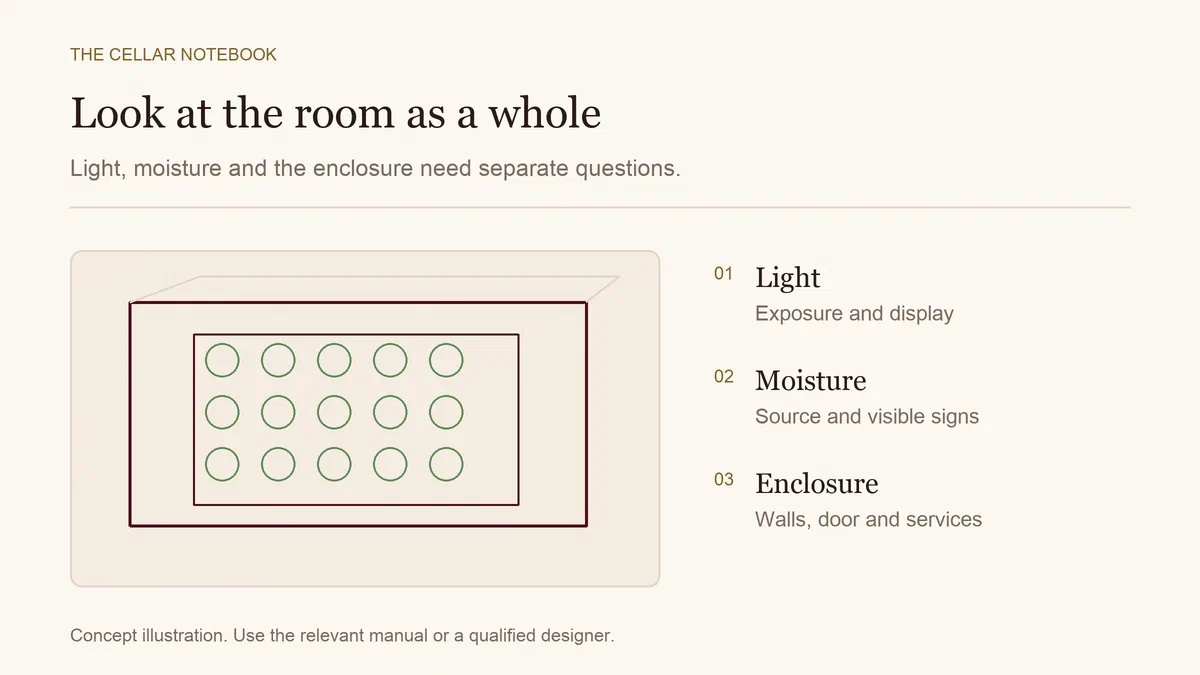
Start by finding the moisture source, then assess the room, packaging and wine as separate problems. Mould on a cellar wall needs attention even when the bottles look sound. A damaged label needs documenting even when the room has dried. Neither observation, by itself, tells you how the wine inside tastes or whether it is suitable to drink.
The useful first outcome is a small evidence record: where the problem appears, what is wet, when it changes and which bottles are affected. That gives a building specialist or appliance engineer something more precise than “my cellar smells musty”.
Locate the problem before changing the room
Photograph the affected area without brushing or scraping it. Note whether the growth is on a wall, wooden rack, cardboard case, label, door seal or appliance interior. Record recent leaks, heavy rain, cooling faults and changes in how the room is used.
The US Environmental Protection Agency’s moisture guidance explains why cleaning alone often fails: the water problem also needs resolving. Condensation is a useful clue, not a diagnosis of its cause.
| Observation | Useful next check | What it does not establish |
|---|---|---|
| A patch grows after rain | Give the timing and photographs to a building specialist | That the wine is corked |
| Water collects on a cold surface | Record room conditions and ask about condensation and the enclosure | That opening a window will solve it |
| Several labels or cases are damp | Map their shelf positions and inspect the surrounding area | That every bottle has the same condition |
| Growth appears inside a wine fridge | Consult the model’s care instructions and service provider | That a household cleaner is suitable |
If you have a separate temperature and humidity meter, record its location and readings over several observations. One reading in the middle of the room may miss a damp corner. Write down when the door was opened or the cooling system stopped, rather than treating every change as a new fault.
Keep building advice distinct from wine-storage targets
A humidity range for storing wine is not permission to leave walls or packaging wet. Conversely, a general household humidity recommendation is not a complete design specification for a cooled wine room. The building, its surrounding spaces and the cooling system need to work together.
Our wine-storage guide covers the broader conditions. For persistent damp, ask a competent professional to assess the actual moisture source and room construction. Avoid adding a humidifier, turning the cooling much colder or introducing outside air simply because one number looks wrong.
The EPA’s cleanup guidance makes the scale and circumstances relevant. Seek experienced help for substantial water damage, suspected contaminated ventilation or contaminated water. Its guidance treats growth over about 10 square feet, roughly 0.9 square metres, as a reason to consult its more extensive remediation guidance. Health concerns also warrant advice before cleanup.
Preserve bottle information before dealing with damaged packaging
Once access is appropriate, photograph the front and back labels, closure and case markings. Link each image to a location and bottle description. Separate observed facts, such as “label detached at lower edge”, from conclusions, such as “wine spoiled”.
For ordinary packaging, the cleanup method depends on the material. EPA notes that porous items can be difficult to remediate fully. Its hard-surface advice should not be transferred automatically to paper labels, wooden shelves or a wine fridge’s components. For valuable bottles or original cases, ask the relevant conservation or wine specialist before attempting restoration.
Keep bottles affected by contaminated water or a compromised closure out of your serving plans pending appropriate advice. Opening and tasting is not a way to investigate flood contamination.
A simple example: one damp corner, three records
Imagine a twelve-bottle case beneath a pipe. The cardboard is damp, two labels have visible damage and moisture appears on the pipe again the next morning.
Create a room record for the pipe and recurring moisture, a packaging record for the case, and individual observations for the two bottles. If the collection must move, record the destination and quantities. Do not mark twelve wines as faulty because the case was wet, or mark them all sound because ten labels look normal.
The cellar inventory template helps keep identity and location consistent. Photographs and building reports can stay in a separate folder referenced from the list.
Assess the wine on its own evidence
Musty aromas in wine deserve a separate investigation. The Australian Wine Research Institute describes several compounds that can produce earthy or mouldy aromas; cork-related taint is more specific than visible growth on a wall. Our wine-faults guide explains that distinction.
After the moisture problem is addressed, revisit the affected area and update the records. If you use Sommo Premium, factual condition notes and current cellar locations can help you keep track of affected wine entries. Keep the photographs, remediation details and appliance readings alongside them in your own files.