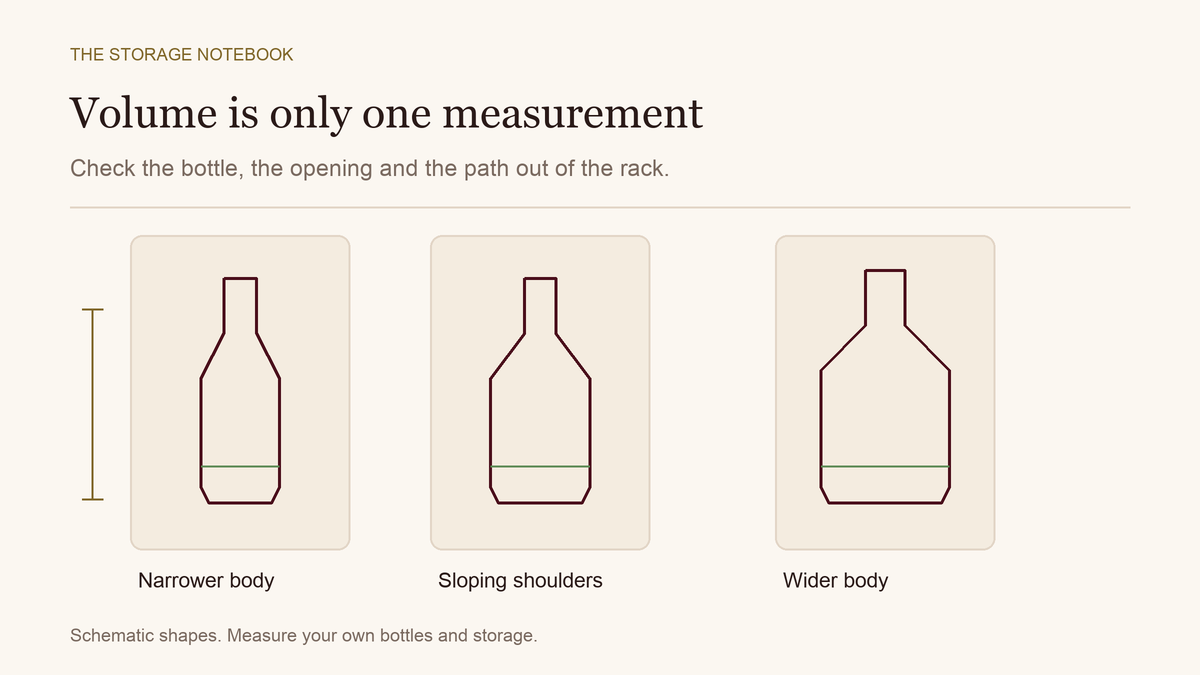
A 750 ml label tells you the capacity, not whether the bottle fits your rack. Measure the widest part of the actual bottle, its full length and the rack’s usable opening. Then check support, access and any clearance required by the manufacturer. Burgundy, Champagne and magnum bottles deserve their own fit check before you order storage.
A rack advertised for 100 bottles may hold fewer of your bottles if wide shapes occupy larger bays. That matters more than a neat catalogue capacity when half your collection is sparkling wine.
Measure the bottle you will store
Choose a representative bottle from each shape in your collection, including the widest and longest examples. Record the diameter at the widest point and the length from base to the top of the closure. Measure the shoulder as well if the rack has a narrow opening through which the bottle must pass. A large capsule or unusually broad base can change the result.
Vigilant’s rack guidance distinguishes straight Bordeaux shapes, broader Burgundy and Champagne shapes, and dedicated magnum racking. Its dimensions are examples of bottle variation, rather than a guarantee for every producer. Two bottles containing the same volume can have different glass shapes.
For named capacities, see our wine bottle size guide. For physical fit, write down millimetres measured from your bottles. Keep those two records separate.
Measure usable space, not the outside of the rack
An 85 mm gap between vertical rails is not necessarily an 85 mm usable opening. Crosspieces, curved supports, screw heads and the bottle’s angle may reduce it. Check the narrowest point along the insertion path, then the place where the bottle rests.
Length needs the same care. A bottle may sit on a shelf while projecting into a door, aisle or neighbouring bottle. With a wine fridge, include the manufacturer’s requirements for shelf arrangement and door closure. Do not remove supports or force bottles into an opening to reach an advertised capacity.
Use three decisions for each bottle shape:
| Check | What you need to establish |
|---|---|
| Entry | The widest part passes through the opening without force |
| Resting position | The intended supports hold the bottle as the rack manufacturer specifies |
| Access | You can insert and retrieve it without striking the closure, door or adjacent bottles |
A successful width check answers only the first question. It does not establish load capacity or safe support.
A worked fit worksheet
These are fictional measurements, included to show the method. They are not standard dimensions to use when shopping.
| Bottle measured | Widest diameter | Full length | Initial result for an 80 mm clear opening |
|---|---|---|---|
| Slim 750 ml bottle | 75 mm | 300 mm | Passes the width screen; check support and access |
| Broad 750 ml bottle | 90 mm | 310 mm | Does not pass; choose a wider bay |
| 1.5 litre magnum | 110 mm | 345 mm | Does not pass; assess a suitable magnum bay |
The slim bottle leaves 5 mm between its diameter and the stated opening. That calculation does not mean 5 mm is a recommended allowance. The required clearance depends on the rack design and its instructions. Ask the supplier about your measured bottle if the fit is close.
If you own 24 slim bottles, 12 broad bottles and four magnums, plan storage for those three groups. Do not treat them as 40 interchangeable slots and discover the exceptions after delivery.
Double depth adds a retrieval problem
For front and rear storage, check the manufacturer’s supported arrangement. Two 300 mm bottles have a combined length of 600 mm before any separation, stops or end clearances. A quoted 600 mm cabinet depth therefore does not establish that both will fit.
Also decide how you will retrieve a rear bottle. Putting two different wines in one lane may mean moving the front bottle whenever you want the rear one. Keep a location record that distinguishes front and back, and place frequently opened wines where they are accessible. A depth lane is useful only if you can find its contents without an unnecessary search.
Turn the measurements into a cellar plan
Keep a short list of exceptions beside your storage plan: wide sparkling bottles, magnums, long bottles and anything still untested. Our wine fridge buying guide helps with the broader buying decision.
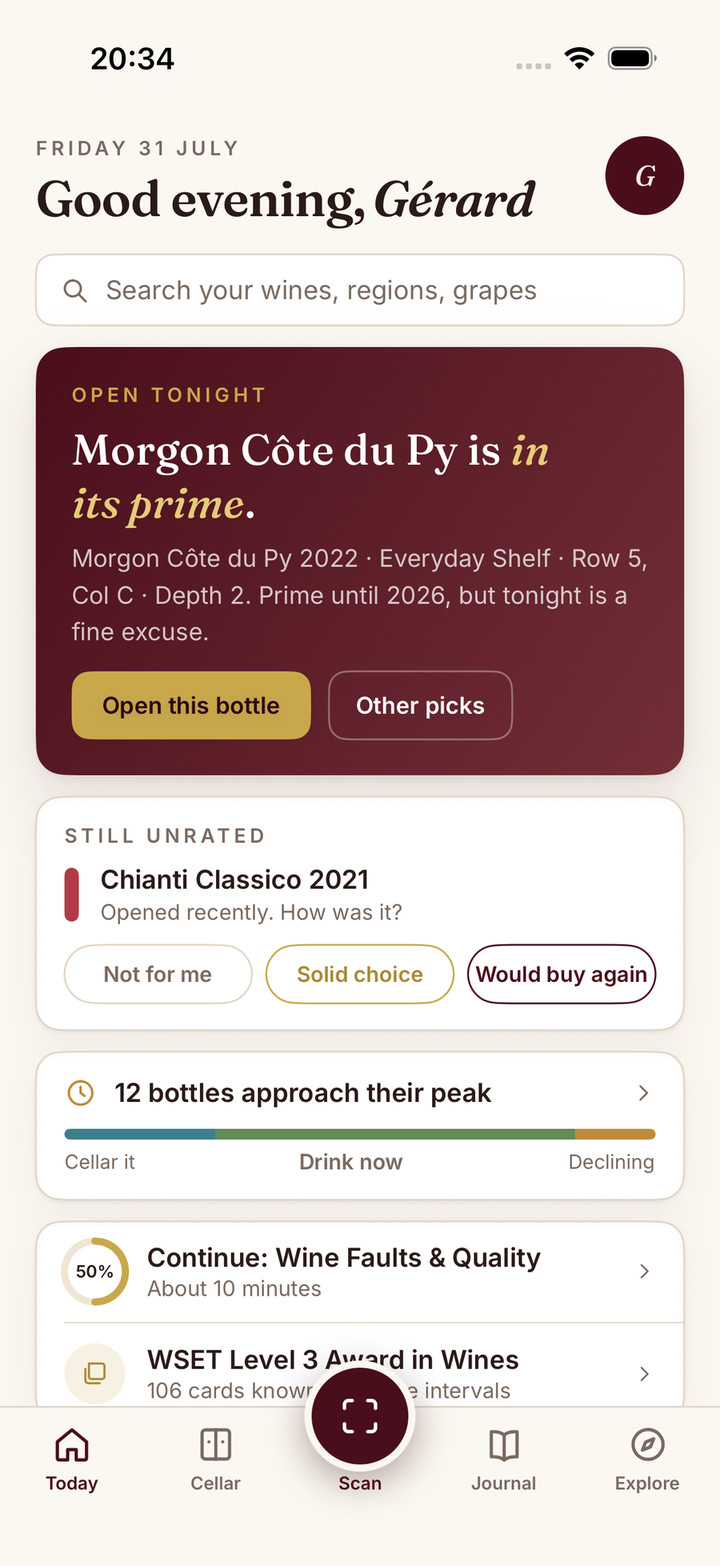
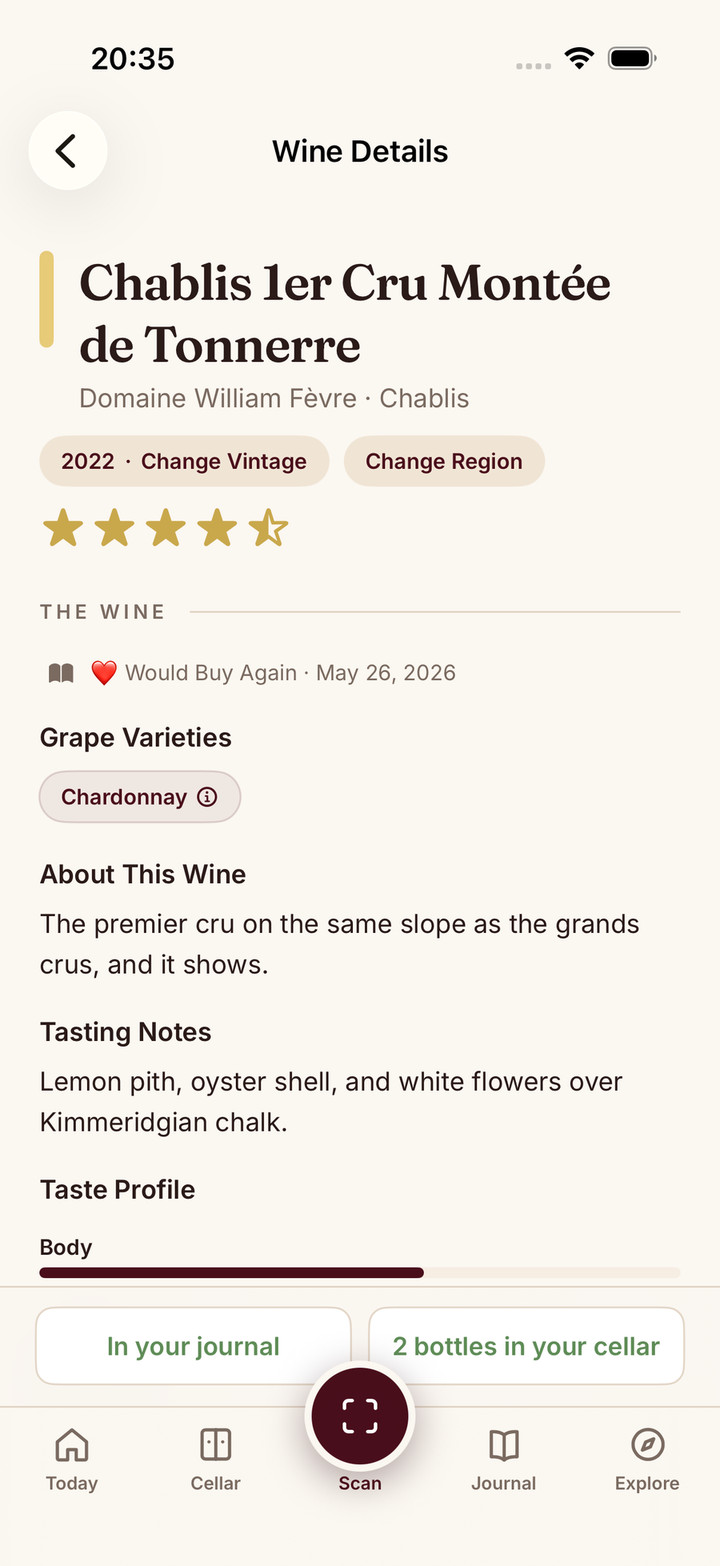
The free wine rack planner and measured clearance checker can organise a proposed grid and compare your measured bottle envelope with usable rack width, height and depth. Choose mm, cm or inches and set your required allowance per side. Save locally, print or export the result, then check support, access and the manufacturer’s instructions yourself. A dimensional result does not certify the rack’s construction. Once you have suitable storage, Sommo’s Premium cellar can record your bottles and rack positions.
Download Sommo to record where your bottles are stored. Keep printed or exported clearance notes as a separate reference: this browser checker does not upload or synchronise measurements with the app.