You recognise the smell immediately. Finding its name takes longer. That small gap is a useful reason to practise with aroma references, and it does not require an expensive box of vials.
Start with a few safe, familiar food ingredients if you want to connect smells with words you already know. Consider a purchased, labelled aroma kit if having the same organised reference set available matters enough to justify its delivered cost. Neither choice, by itself, establishes how well you will identify aromas in wine.
This guide focuses on recognition and recall. For the wider progression through structure, comparison and confidence, use our wine palate development guide.
Choose the job before the equipment
Write a small goal: “I want to distinguish lemon, orange and vanilla references, and try naming them without a list.” A goal like “learn all wine aromas” gives you no clear next step.
WSET’s palate-training article, published in March 2026, encourages attention to everyday food and drink as well as comparison between wines. Its tasting framework moves from broad aroma families towards more specific descriptors. That supports using familiar references as a vocabulary exercise; it does not demonstrate that a homemade set and a commercial kit produce equal results.
There are three different tasks to record:
- Family recognition: does this suggest citrus, spice or something floral?
- Recognition with options: can you select the reference from a supplied list?
- Unaided naming: can you produce a name before seeing any options?
Getting the second right after struggling with the third is useful information. Keep both results rather than converting them into one flattering score.
What changes when you buy a kit?
| Decision | Familiar food references | Purchased labelled kit |
|---|---|---|
| Initial cost | Ingredients, clean containers and preparation | Kit, delivery and any import charges |
| Upkeep | Replace perishable food; clean containers | Follow the kit’s storage and handling instructions |
| Repeatability | Ripeness, brand, amount and freshness can change | Reuse the identified vial; condition still matters |
| Vocabulary | Your chosen foods and familiar names | Manufacturer’s selection and accompanying explanations |
| Practical fit | Useful for a small starting set | Useful when an organised reusable collection is the priority |
The table compares logistics, not effectiveness. A vial labelled “blackcurrant” is the maker’s representation of that aroma. Fresh fruit is a variable biological reference. Neither is a certified duplicate of every blackcurrant impression in wine.
When costing a kit, divide its delivered price by the number of sessions you realistically expect to use it. A synthetic budget, not a current product quote, of £90 over 15 sessions is £6 per session. That calculation helps assess commitment; it cannot put a monetary value on learning.
Prepare a small, safe set
For food references, choose ingredients you already handle safely, such as a little fresh citrus peel or vanilla from a clearly labelled food product. Check allergies and sensitivities for everyone involved. Leave out any ingredient that creates uncertainty. Use separate, clean containers, label the contents, and discard perishable samples appropriately after the session.
This is a smelling exercise. Do not taste aroma-kit liquids, add them to wine, or substitute household chemicals, cleaning products or essential oils. Do not build fault references from suspect or mouldy food. Keep all reference materials away from children and pets, avoid contact with eyes and skin, and follow the supplied safety instructions. Stop if a sample causes irritation.
For a commercial example, we inspected the current Le Nez du Vin user’s guide on 16 October 2026. It describes smelling the vial or cap, trying an aroma family if the name will not come, then checking the vial number against its list. It also directs owners to their kit books. The maker’s storage advice says to keep vials upright and away from light and heat. Read the instructions supplied with the exact kit you buy.
We have not handled or compared these kits. The following is an original desk-designed worksheet, ready for you to use, rather than a report of a completed trial.
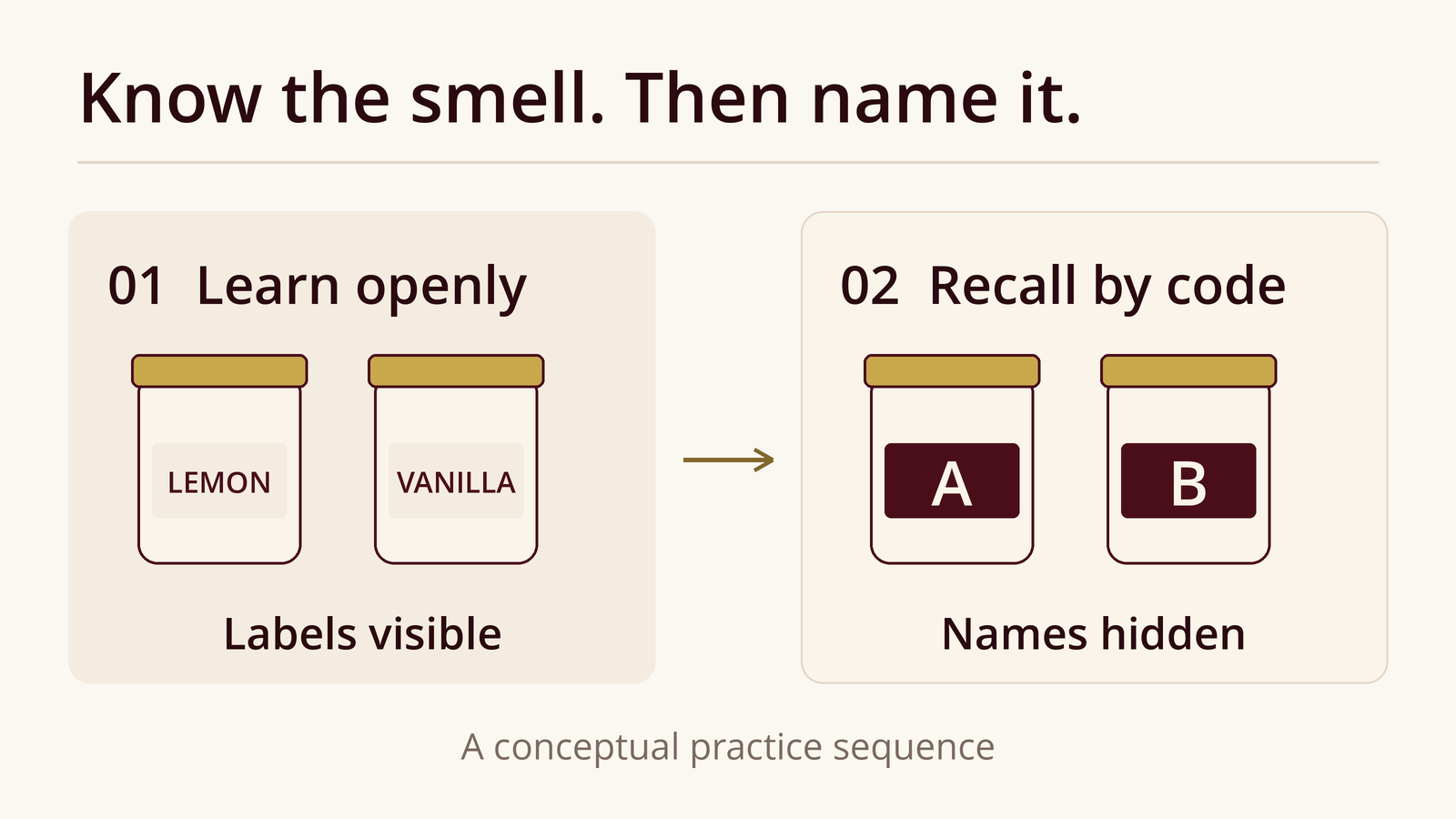
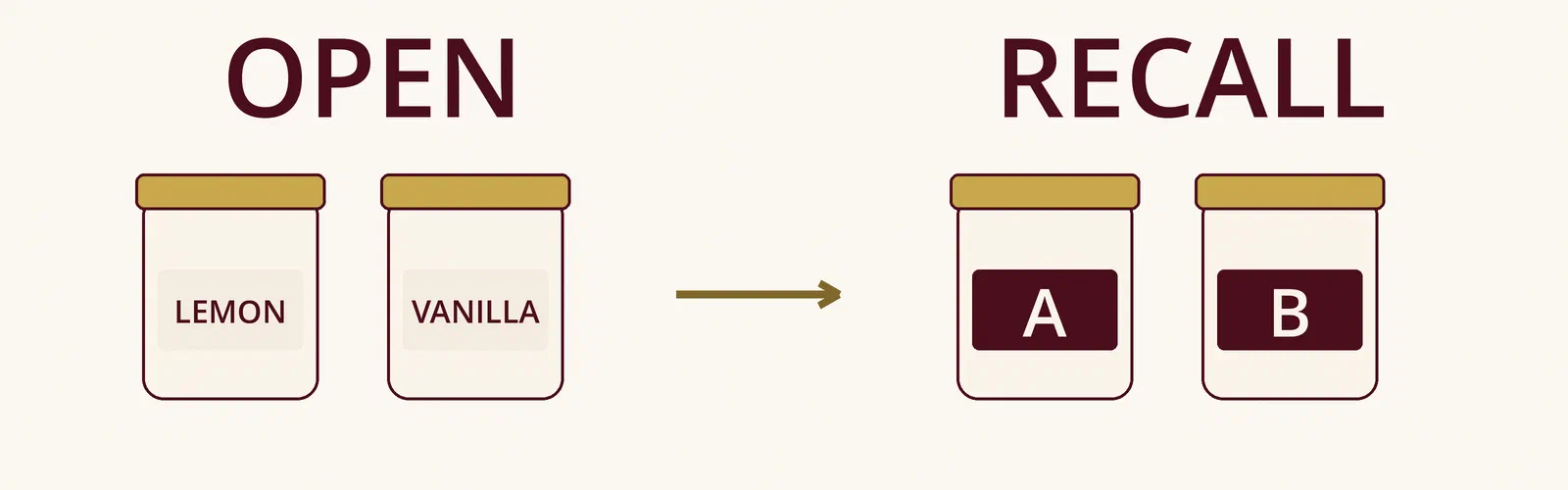
Session one: learn the labels openly
Choose three references. Keep their names visible, smell each gently, and write your own association before reading a detailed description. “Orange peel from breakfast” may be more memorable to you than an elaborate tasting phrase.
Record the exact preparation so another session is comparable: ingredient and brand, fresh or dried, approximate amount, container, preparation time and condition. With a kit, record its name, vial numbers and any handling limits. Work somewhere without competing cooking or perfume smells, and take breaks rather than repeatedly sniffing until everything blurs.
Session two: hide the names, then add options
On a later day, have a helper code and rearrange the same three references while keeping an answer key. If you prepare the codes yourself and remember them, mark the attempt as self-cued.
First write an unaided name or “unsure”. Only then look at the three possible names and record a separate choice. Reveal the key after all three. Here is a synthetic completed example, not observed performance:
| Code / true reference | Unaided answer | Choice from list |
|---|---|---|
| A / orange peel | Citrus, unsure which | Orange peel: correct |
| B / vanilla | Vanilla: correct | Vanilla: correct |
| C / lemon peel | Orange peel: incorrect | Lemon peel: correct |
That example is one exact unaided name out of three, versus three recognised with options. It is not “100% aroma mastery”.
Copy this blank record for each reference:
| Field | Your record |
|---|---|
| Session dates; reference and preparation | ______ |
| Session one: own association | ______ |
| Session two: code; unaided name | ______ |
| Options shown; chosen answer | ______ |
| Revealed identity; correct at each stage? | ______ |
| Changed condition or other cue | ______ |
Take the words back to wine carefully
On a separate occasion, smell a wine before reading its label notes. Record whatever you find, including a broad family or uncertainty. Wine combines many aromas, while temperature, glassware and context affect what you notice. Naming a reference vial does not prove you can identify it within that mixture, infer a grape, or judge quality.
The WSET Level 2 tasting-kit guide helps plan real-wine study separately. Save your actual wine observations in Sommo’s wine journal, with the date and whether descriptors were prompted. Keep the reference worksheet alongside those notes so a familiar word remains a useful clue rather than an answer you feel obliged to find.