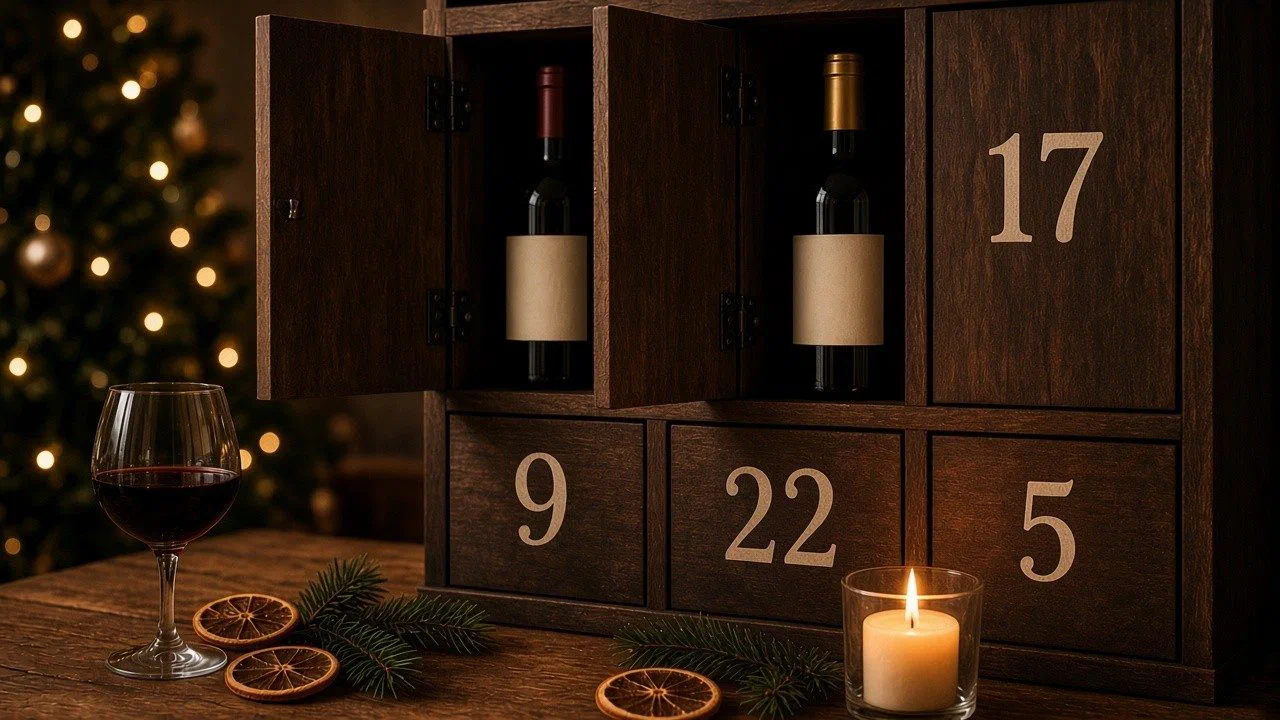
Twenty-four tiny bottles, twenty-four chances to find a wine you would never have picked off a shelf, and twenty-four chances to forget its name by Boxing Day.
That last part is the bit nobody puts on the box. I build Sommo, an app that helps people remember and understand what they drink, so every November I watch the same thing happen: a beautiful calendar arrives, December disappears in a blur of small pours, and by January the one bottle that genuinely surprised you is a vague memory of “the Portuguese one, maybe day nine”.
Wine advent calendar searches explode in November. So here is the honest version: whether one is worth your money, what to check before you buy, how to build your own, and how to make 24 small pours do something useful for your palate.
Is a wine advent calendar worth it?
Yes, if you are buying discovery. No, if you are buying volume. A calendar is a curated tasting flight spread over a month. You pay for selection, packaging and the fun of a door a day. You do not usually pay supermarket prices per litre.
Do the maths before you click. SquareMeal’s 2026 round-up of wine advent calendars lists a calendar of 23 miniature 187ml wines plus a full-size Prosecco at £89.99, usually £99.99. That is about 5 litres of wine, or roughly 6.7 standard 75cl bottles. So you are paying about £13.40 to £14.90 per bottle-equivalent.
That gives you a simple test:
- Worth it if you would happily spend £13 to £15 on a bottle, you like variety, and you want to try grapes and regions you would not buy blind.
- Not worth it if you drink one colour only, you mainly want lots of wine for parties, or you already know exactly what you like.
- Great as a gift for someone curious about wine but intimidated by a wine shop.
What is actually inside: sizes and formats
Not every calendar holds a glass a day. Read the listing for the bottle size before anything else.
- 187ml minis. The classic format. My wine bottle sizes guide explains the split, or piccolo, at 187.5ml: a single generous glass.
- 20cl bottles or cans. Slightly larger. SquareMeal also notes fizz calendars with 12 mini 20cl bottles rather than 24, so they will not cover every day of December.
- Tasting tubes. Some premium calendars use a few centilitres per wine. Brilliant for comparing, useless if you wanted a glass with dinner.
- A full bottle for the finale. Several calendars swap the 24th door for a standard bottle of fizz.
One responsible note. The NHS unit calculator gives the formula: ABV times millilitres, divided by 1,000. A 187ml mini at 12% is about 2.2 units. One every night for a week is around 15.7 units, above the NHS guidance of no more than 14 units a week, spread over three or more days. Nothing says you have to open a door every day. Skip a few nights, share a mini with someone or let the calendar run on into January, but don’t catch up by opening a week’s doors over one weekend. The NHS also suggests several drink-free days each week. Fewer, slower pours make the calendar last and taste better.
How to choose the best wine advent calendar for you
I would rather you bought one great calendar than three disappointing ones. Here is my checklist.
- Can you see the wine list before you pay? Good sellers publish the full line-up. If the listing only says “a mix of reds, whites and rosés”, you are buying blind.
- Does it go somewhere? Look for spread: different grapes, different countries, Old World against New World. Ten versions of the same easy red teach you nothing.
- Colour fit. Red-only, white-only, mixed and fizz calendars all exist. Buy for the person drinking it, not for the photo.
- Bottle size. Glass-a-day minis or tasting tubes? Decide what kind of December you want.
- Delivery timing. Order early in November so it arrives before 1 December. Calendars sell out, and searches peak this month.
- Storage. Minis need a cool, dark spot like any wine. A calendar propped next to a radiator for three weeks is a calendar of tired wine.
Build your own wine advent calendar (and make it better)
A DIY calendar is cheaper per glass, and it can be far more interesting than most boxed versions, because you design the journey.
What you need: 12 or 24 splits or half bottles, or standard bottles decanted into clean small bottles with good seals, numbered tags, and wrapping paper or a box with compartments.
Themes that teach you something:
- One grape, six countries. Sauvignon Blanc from the Loire, Marlborough, Chile, South Africa, Styria and Bordeaux. You will understand climate in a week.
- Old World against New World. Pair each European bottle with its New World cousin on consecutive days.
- A Christmas dinner rehearsal. Use December to test what will go with turkey, ham or a nut roast, then buy full bottles of the winner. My Christmas wine guide is a good shopping list for this.
- Blind week. Someone else wraps seven bottles. You taste, guess, then unwrap.
If you decant, fill the small bottle to the top to limit air, refrigerate it and drink it within a day or two. My guide to how long wine lasts after opening has the detail by style.
How to taste 24 small bottles like a pro
A small pour is a gift for learning. Small portions make you slow down, and 24 different wines in 24 days is the kind of range a wine course would give you.
- Serve it at the right temperature. Minis chill and warm fast. Fifteen minutes in the fridge for a light red and out of the fridge for ten minutes for a white usually beats the default. Check the exact numbers in my serving temperature tool.
- Use a proper glass. A tumbler hides the aroma you paid for.
- Look, smell, taste, decide. The WSET Systematic Approach to Tasting is what professionals use: appearance, nose, palate, conclusions. You do not need the full grid at home, but the order helps.
- Write one line, every day. Not a review. A reaction. “Too sharp alone, brilliant with cheese.” My guide to writing tasting notes shows how to make one line count.
Do this for 24 days and your palate moves. That is not a slogan; it is how building a wine palate works: repeated, deliberate comparison.
Turn your calendar into your taste profile with Sommo
This is where I will be direct, because this is exactly what I built Sommo for.
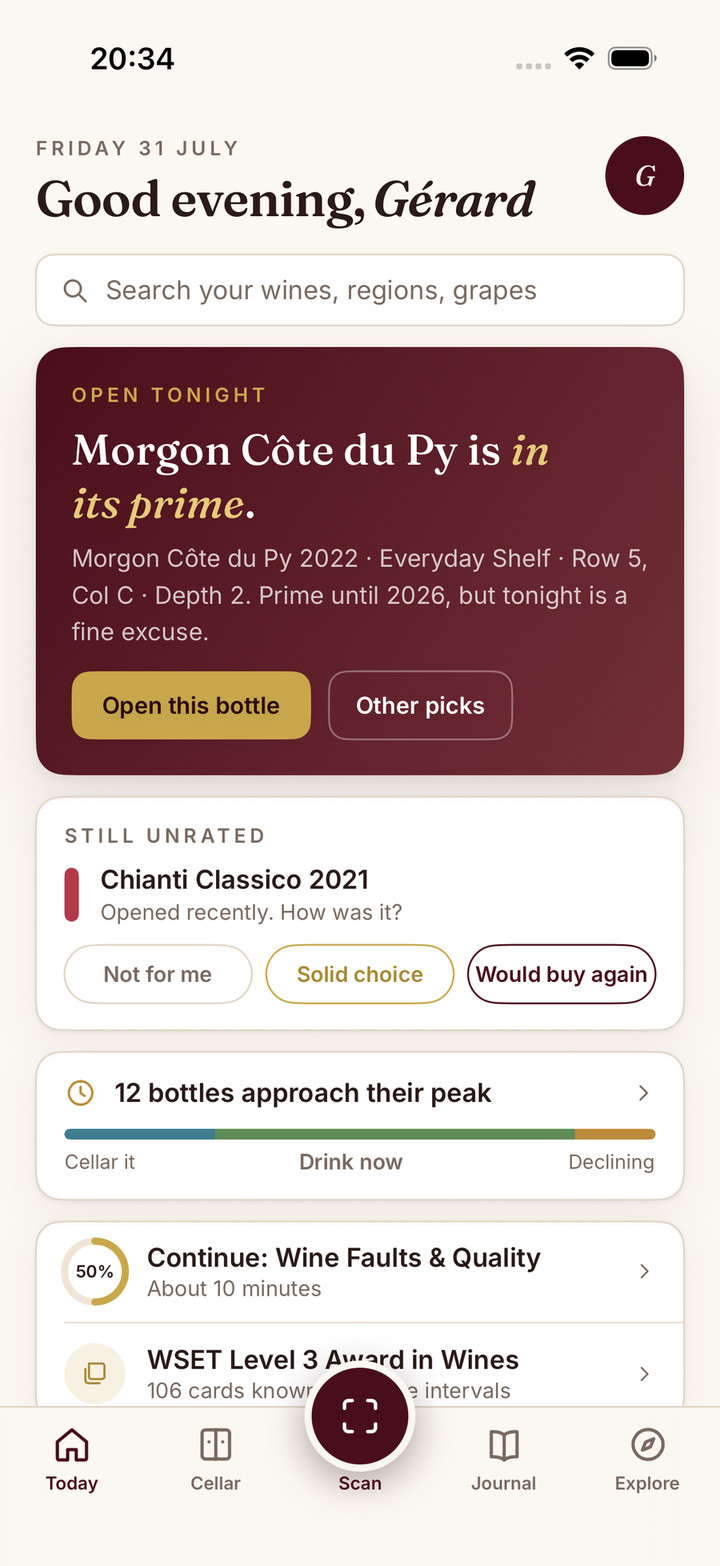
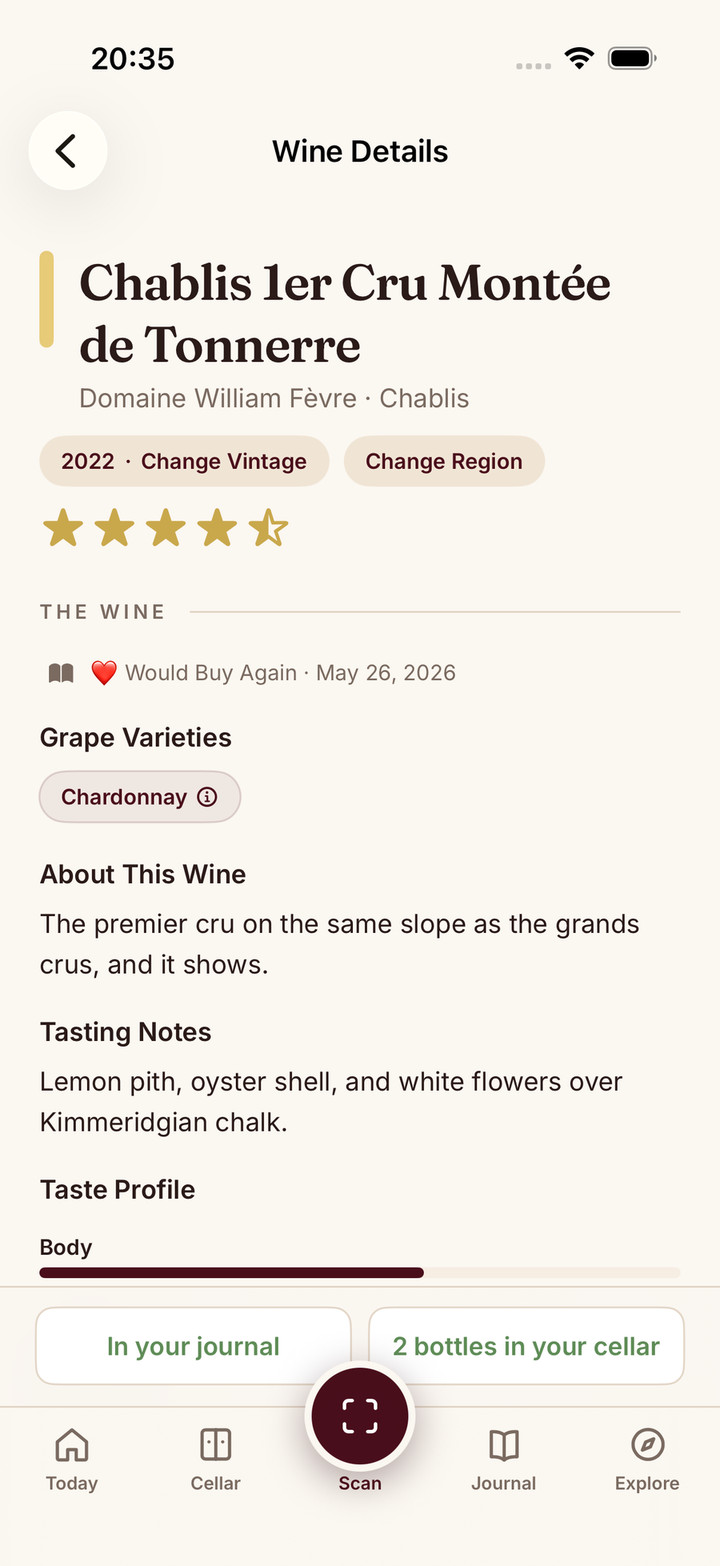
Scan each mini in seconds. Point your camera at the label and Sommo identifies the wine and builds its profile: grapes, region, tasting notes, food pairings and serving temperature. On iPhone, scan a wine you have tasted before and Sommo brings back your verdict and the date you had it, so day 17 never feels like a stranger.
Rate it honestly in one tap. Sommo’s wine journal uses three ratings, Not For Me, Solid Choice and Would Buy Again. A quick entry takes about 30 seconds. When a wine deserves more, the SAT Tasting Note Wizard walks you through appearance, nose, palate and conclusions, and with Premium it gives you AI feedback on how close you were to the wine’s known profile.
Watch Sommo learn you. After three rated wines, Sommo Premium draws your Taste DNA, a six-axis radar of body, sweetness, acidity, tannin, intensity and adventurousness, and writes a reading of your palate from your own history, not a quiz. By Christmas Eve, your Taste DNA is drawn from all 24 wines you’ve rated. Then it suggests a wine or region to try next. Twenty-four wines is a superb data set.
Hosting a tasting with friends? With Premium, Tasting Mode treats the calendar’s printed list like a flight card: photograph it and Sommo adds every wine to a session with producer, region, grape and vintage filled in. Rate each pour, save the session and every wine lands in your journal in one go. On ordinary nights, scan the day’s mini and rate it, and it goes into your journal on the day you drank it.
The free tier includes 5 lifetime AI scans per device, shared across labels, menus and shelves, plus the journal and 30 days of journal history. Premium unlocks unlimited scans, lifetime history, Taste DNA, AI tasting feedback and Tasting Mode, for $4.99 a month or $29.99 a year in the US; prices vary by country and store. Sommo runs on iPhone, iPad, Android, HarmonyOS and the web.
Your calendar gives you 24 wines. Sommo makes sure you keep every one of them. Download Sommo free and scan door number one.
The bottom line
A wine advent calendar is worth it when you treat it as a tasting course with a festive box, not a bulk wine purchase. Check the line-up, the bottle size and the cost per bottle. If the numbers do not work, build your own around a theme. Either way, record every door, because the point of tasting 24 wines is to come out of December knowing exactly what you want to buy in January.