These two apps get compared constantly, and they should not be. They answer completely different questions about the same bottle.
Vivino answers “is this any good?” Wine-Searcher answers “where can I get it and what should it cost?” You can hold both in your head at once, which is why so many people have both installed and no idea which to open first.
Here is how they actually differ in 2026, and the question neither one is built to answer.
The Short Answer
Vivino is a crowd verdict machine. Around 70 million users and 16 million wines as of mid-2026, plus the fastest label scanner in the category. It is free, ad-supported, and it will tell you within seconds whether strangers liked the bottle in your hand.
Wine-Searcher is the market’s price engine. Roughly 8 million offers from tens of thousands of merchants. It is what the trade uses. It will tell you whether the £42 on the shelf is a bargain or a mugging.
| Vivino | Wine-Searcher | |
|---|---|---|
| Core job | Is this wine good? | Where is it and what does it cost? |
| Scanning | Fastest in the category | Label search, secondary feature |
| Ratings | Crowd average from ~70m users | Aggregated critic scores plus 5-star user ratings |
| Price data | Community prices plus marketplace | ~8m offers across the merchant market |
| Free tier limits | Ads; wine-list scanning now Premium | Results show sponsoring merchants only |
| Cellar | Basic, Premium-gated | Valuation tool, 25 wines free / 500 on PRO |
| Price | Free with ads; Premium $4.99/mo or $47.90/yr | Free with sponsored results; PRO $8.25/mo billed annually |
All pricing as of mid-2026.
What Vivino Does Well
Scale, and speed. Vivino’s database is the largest consumer wine database anywhere, and the scanner reads almost anything you point it at. In a supermarket aisle with a trolley and a toddler, that is the whole game.
The social layer is underrated too. Seeing that a friend rated the same Rioja 4.3 last month is a more useful signal than a stranger’s average, and the marketplace means you can act on the verdict immediately.
Where it thins out: the ratings compress. Most Vivino scores land between roughly 3.5 and 4.2, so the difference between competent and outstanding is a couple of tenths. The average also cannot know you. If you dislike heavy oak, a 4.3 oak bomb is still a 4.3. And the free tier has been narrowing, with restaurant wine-list scanning moving behind Premium after years of being free.
What Wine-Searcher Does Well
Wine-Searcher is not really a consumer app. It is a market index that consumers are allowed to use, and that difference shows in everything about it.
If a wine exists in commerce, Wine-Searcher knows who is selling it and for how much. That makes it the only sane tool for three jobs: finding a scarce bottle, checking whether a restaurant markup is outrageous, and valuing what you already own. Since late 2025 it has also generated AI critic notes for wines with no human coverage, which fills a real gap in the long tail.
Where it thins out: the free tier shows sponsoring merchants only, which quietly undermines the one thing you came for. The full merchant list needs PRO at $8.25 a month billed annually as of mid-2026. The cellar valuation tool caps at 25 wines free and 500 on PRO, so it is a valuation calculator rather than a cellar. And the tasting side is thin: 5-star ratings with free-text notes, nothing structured.
Head to Head
In the Shop
Vivino. It is not close. Scan, score, decision, done. Wine-Searcher’s label search works but is a secondary feature, and the answer it returns is about price rather than quality.
At Auction or Hunting Something Rare
Wine-Searcher. Vivino’s marketplace shows you what Vivino’s partners stock. Wine-Searcher shows you the market. For allocated Burgundy, back vintages, or anything with limited distribution, it is the only real option.
In a Restaurant
Split, and both are compromised. Vivino’s wine-list scanning is genuinely handy but now requires Premium. Wine-Searcher gives you retail prices, which lets you calculate the markup but says nothing about which of the eight Riojas on the list suits your main course. Neither reads a list and ranks it for you on quality and value together.
Judging Whether a Price Is Fair
Wine-Searcher, comprehensively. This is its reason to exist.
Recording What You Thought
Both are weak. Vivino gives you stars and a text box. Wine-Searcher gives you stars and a text box. Neither offers a tasting framework, and neither turns your history into a picture of your own palate. After two years of use you have a list, not an education.
Learning Wine
Neither app tries. There is no structured learning, no exam preparation, no guided tasting. If you are studying for WSET or just want to understand why Left Bank and Right Bank Bordeaux taste different, you are going elsewhere.
Who Should Pick Vivino
You buy wine in shops and supermarkets, you want a quick second opinion, and you are not chasing rarities. Free Vivino covers you. Add Premium only if wine-list scanning in restaurants is something you would actually use.
Who Should Pick Wine-Searcher
You buy from merchants rather than shelves, you care about paying the right price, and you occasionally hunt something specific. PRO is worth it if you buy monthly. If you buy a couple of cases a year, the free tier plus a browser tab is enough.
What Both Leave on the Table
Notice what the two most-used wine tools in the world have in common: neither is interested in what happens after you swallow.
A crowd score describes the outside of the bottle. A market price describes the outside of the bottle. The thing you actually wanted, which is to understand what you are drinking and get better at recognising it, is nobody’s product in this comparison.
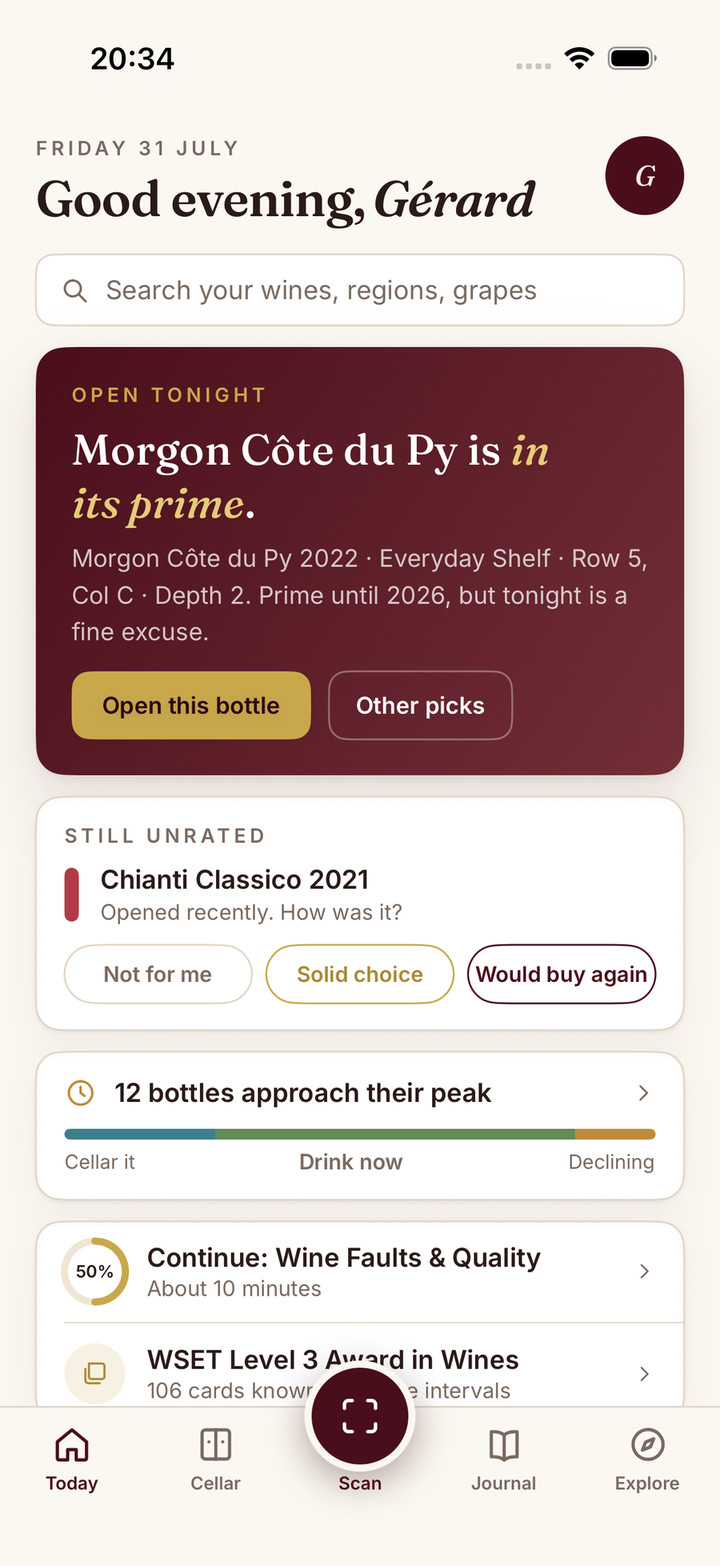
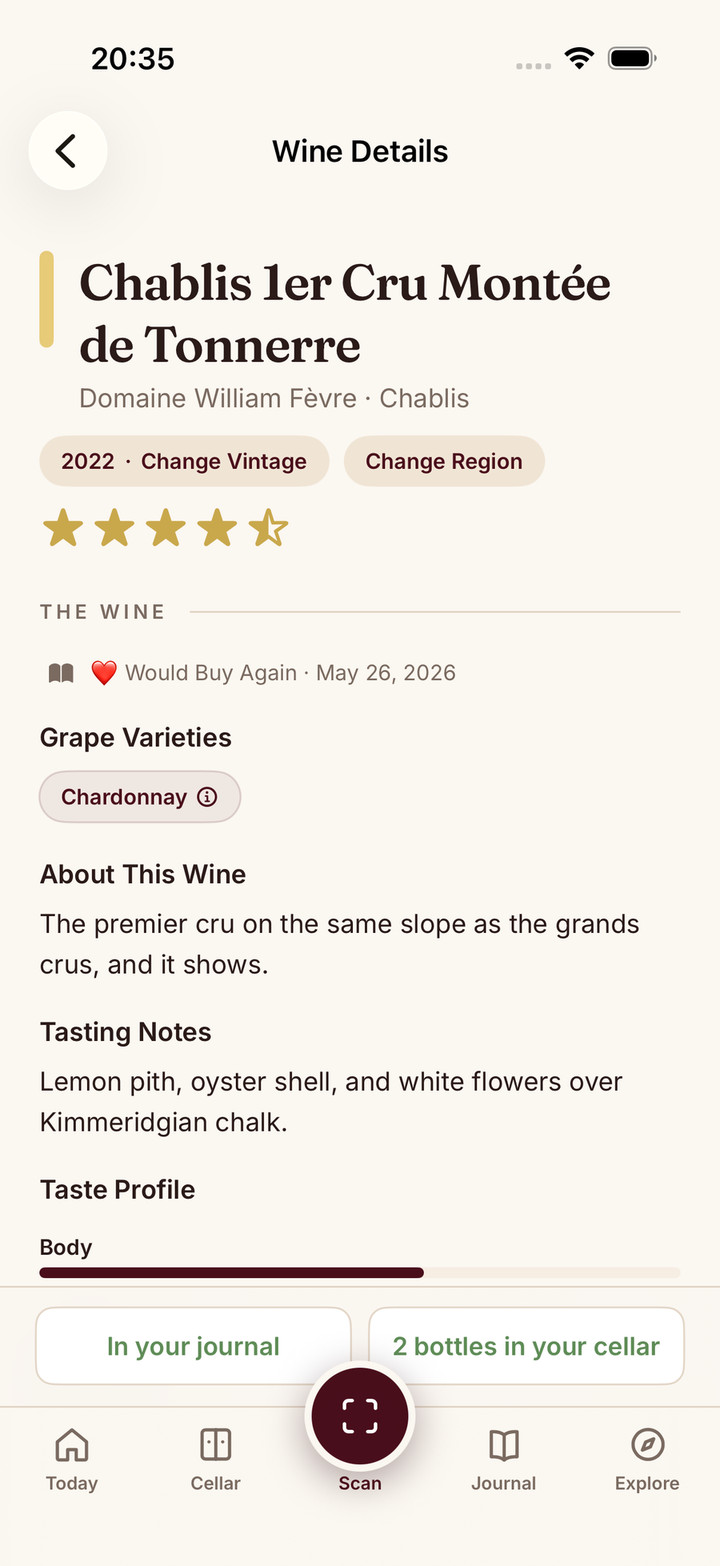
That is deliberately the gap Sommo fills. AI label scanning returns a briefing: the region’s terroir, the grape’s character, what to expect in the glass, and what to eat with it. Tasting notes follow the SAT structure and get AI feedback on what you caught and what you missed. The cellar suggests bottles for tonight’s dinner from what you actually own. WSET prep for Levels 1 to 4 sits in the same app.
And it is clear about what it is not: no marketplace, no price comparison, no crowd average. For those jobs, Vivino and Wine-Searcher remain the right answers, and Sommo does not pretend otherwise.
All Three, Side by Side
| Sommo | Vivino | Wine-Searcher | |
|---|---|---|---|
| Core job | Understanding wine | Judging wine | Pricing wine |
| Label scanning | AI briefing with context | Fastest, biggest database | Search-oriented |
| Crowd ratings | No, by design | Yes, the category standard | Aggregated critic scores |
| Price comparison | No | Community prices plus marketplace | Best in class |
| Structured tasting | SAT notes with AI feedback | Free text and stars | Free text and stars |
| Learns your palate | Yes | No | No |
| Cellar | Full cellar with AI pairing | Basic, Premium | Valuation, 25 or 500 wines |
| Menu scoring | Whole lists, Premium | Wine-list scan, Premium | No |
| WSET prep | Levels 1 to 4 | No | No |
| Price | Free tier; Premium $5/mo or $29.99/yr | Free with ads; $4.99/mo | Free limited; PRO $8.25/mo yearly |
The Bottom Line
Keep Vivino for the shop. Keep Wine-Searcher for the merchant. They are the best tools in the world at those two jobs and nothing here changes that.
But ratings and prices cover only the buying moment. The missing third tool keeps the bottle after that moment: scan, cellar, dinner pairing, journal, Taste DNA, friends and the knowledge you want around it, all in one record.
Try Sommo free, or read the detail: Sommo vs Vivino and Sommo vs Wine-Searcher.
Vivino or Wine-Searcher: which do you open first?