Most people’s first wine app is bought to solve one specific embarrassment: standing in front of 200 bottles with no idea which to pick.
Vivino and Hello Vino both solved it, from opposite directions. Vivino says: show me the bottle and I will tell you what people think. Hello Vino says: tell me what you are eating and I will pick for you.
Both are reasonable answers. Neither, it turns out, is a good long-term relationship.
The Short Answer
Vivino is bottle-first. Scan a label, get a crowd verdict from around 70 million users and 16 million wines as of mid-2026. Free and ad-supported, with a Premium tier at $4.99 a month or $47.90 a year in the US.
Hello Vino was meal-first. Tell it the dish or the occasion and it suggested a style and specific picks, aimed squarely at beginners rather than enthusiasts. It has historically been free, though its availability and feature set have shifted over time, so check the current store listing.
| Vivino | Hello Vino | |
|---|---|---|
| Starting point | The bottle in your hand | The meal or occasion |
| Scanning | Fastest in the category | Not the focus |
| Recommendations | Crowd average, same for everyone | Guided picks by food and occasion |
| Tasting notes | Free text and stars | Not offered historically |
| Journal | Basic history | Not offered historically |
| Education | None | Basic beginner guides |
| Price | Free with ads; Premium $4.99/mo or $47.90/yr | Historically free; check current listing |
What Vivino Does Well for a Beginner
It removes the fear of a bad bottle. That is not a small thing. When you do not yet know a Côtes du Rhône from a Chianti, a 4.2 average across thousands of ratings is a genuine safety net, and the scanner works on almost anything.
It also builds a rough history. Scan enough bottles and you can look back at what you rated well, which is the beginning of self-knowledge even if the app does little with it.
The ceiling arrives quickly, though. Ratings compress into a narrow band, so once you have learned to avoid the 3.4s, the difference between a 4.0 and a 4.2 stops meaning anything useful. The average is identical for every user, so it cannot account for the fact that you find heavy oak unpleasant. And reviews are unstructured free text, so nothing accumulates into an understanding of your own taste.
What Hello Vino Did Well for a Beginner
It asked a better question. “What are you eating?” is a far more useful prompt than “what bottle are you holding,” because the beginner’s real problem is not judging a specific wine. It is not knowing which category to look in at all.
Guided picks by food, occasion, and mood meant you could walk into a shop with nothing and leave with something sensible. For a nervous buyer, that is exactly the right shape of help.
The limits were structural. Scanning was never the focus. There were no tasting notes and no journal historically, so nothing you learned was retained. And beyond basic beginner guides, there was no education. It answered the question in front of you and then forgot you existed.
Head to Head
Standing in a Shop With a Bottle
Vivino, easily. This is the exact moment it was designed for.
Standing in a Shop With a Recipe
Hello Vino’s model, historically. Vivino can surface pairing information on a wine page and its Premium assistant will answer pairing questions, but the flow assumes you already have a candidate in hand.
Ordering in a Restaurant
Vivino, with a caveat: wine-list scanning is genuinely useful and now sits behind Premium after years of being free. Hello Vino’s occasion-based picks were not really built for reading a specific list in front of you.
Remembering What You Liked
Vivino, weakly. It keeps a history of your scans and ratings. Hello Vino historically kept nothing. Neither turns that history into a usable picture of your palate.
Learning Anything
Hello Vino offered basic beginner guides, which is more than Vivino’s none. But neither has structured learning, a tasting framework, or anything resembling a curriculum. Both are answer machines.
Still Being Developed
Vivino, clearly. It ships updates and its user base keeps growing. Hello Vino’s trajectory has been much quieter, which matters if you plan to rely on an app for years.
Who Should Pick Vivino
You want a safety net and you want it free. You buy bottles from shops and supermarkets, you are not chasing anything rare, and a quick sanity check before spending £20 is all you are after. Vivino is the right first wine app and probably the right free one indefinitely.
Who Would Have Picked Hello Vino
You want to be told what to buy rather than judge what you are holding. You cook, you entertain, and you think in meals rather than grapes. That framing is genuinely more beginner-friendly, and it is the thing worth carrying forward when choosing a replacement.
The Record Both Apps Leave Behind
Here is what can happen after a year with either app. You have scanned or been recommended a hundred wines and drunk them, but the rating or pairing answer never became a useful cellar, journal or personal taste record.
Both apps are strongest at the decision in front of you. The phone answers, the transaction closes, and the next bottle starts again. That can be enough. It is less useful when you want everything that happened after the answer to compound.
Sommo was built as the connected home for that whole loop.
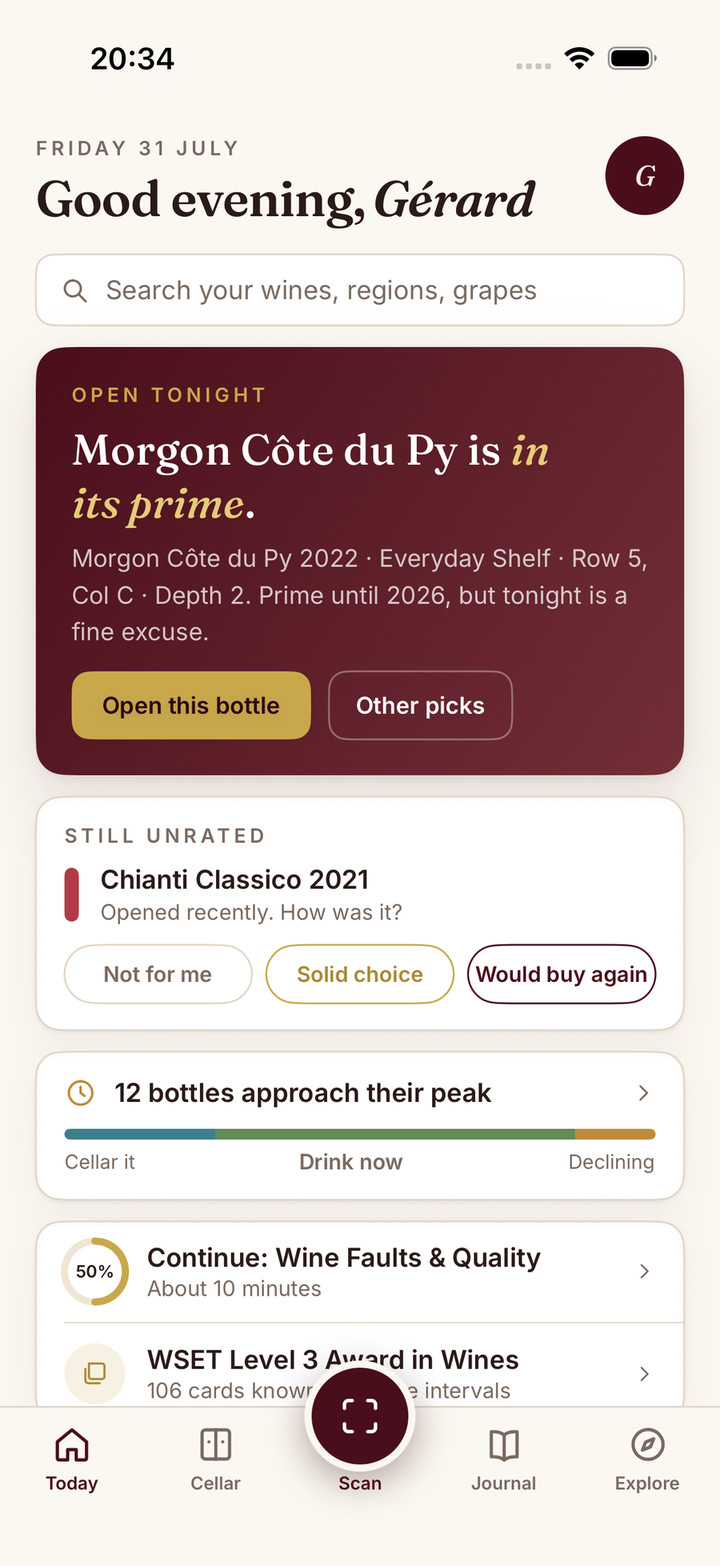
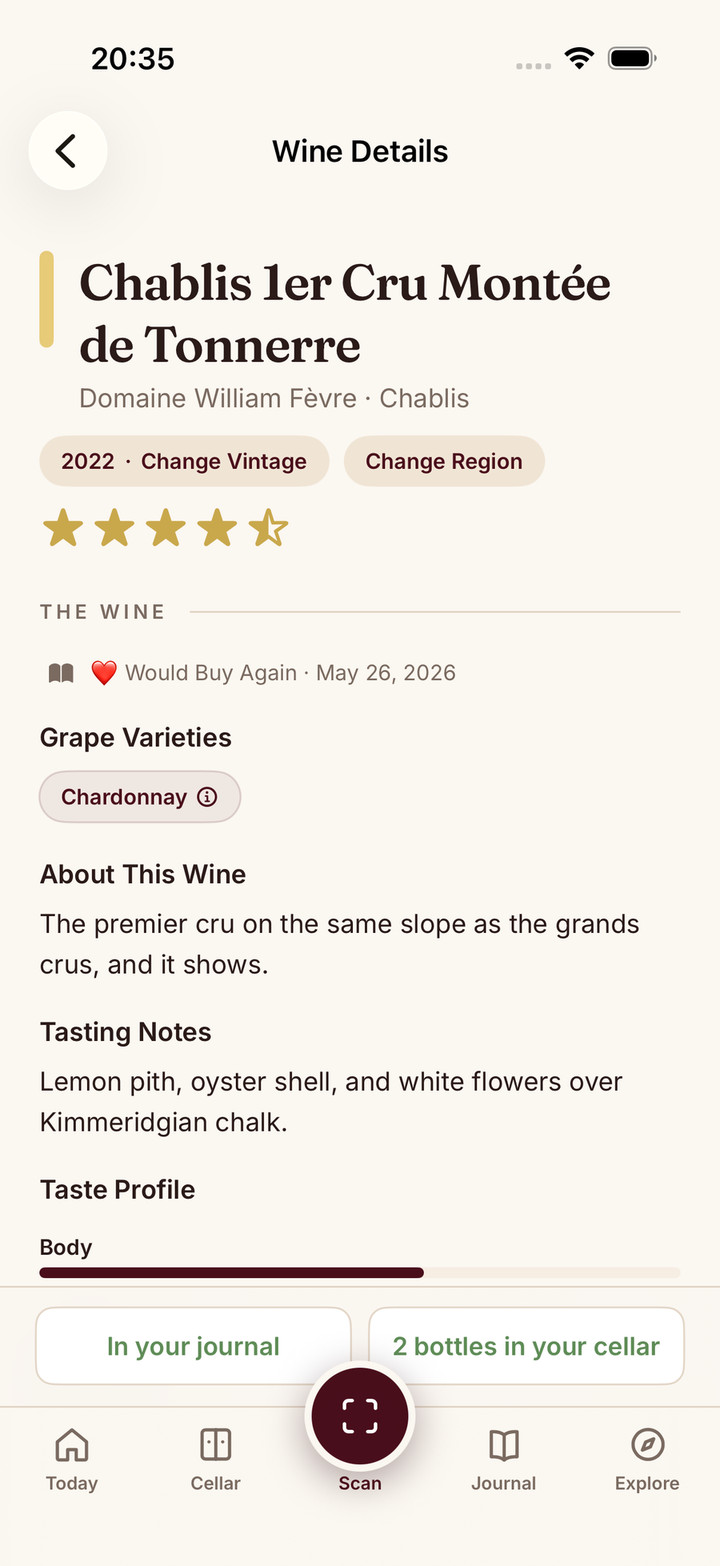
The entry point is the same low-effort promise: scan a label, get an answer. But the answer can also become a bottle in the cellar, a pairing, a journal entry, a Taste DNA signal or a shared tasting. Rating remains one tap on a three-tier scale, “not for me”, “solid choice”, or “would buy again”, so keeping the record does not become homework.
From there it opens up at your pace. SAT-style tasting notes are available when you want structure. Character analysis reads the journal back as a palate profile. Private Sharing Parties and Mix Palate groups bring friends in without turning every score into a public feed. Optional learning and WSET tools are there when you want them, but they are one part of the app rather than its category. And Hello Vino’s better question, start from the meal, is answered too: describe what you are cooking and the cellar picks from bottles you own, or use the wine pairing finder when you are shopping.
Where it does not compete: no crowd average, no marketplace, no price comparison. If your only question is “will strangers approve of this bottle,” Vivino answers that better and free.
All Three, Side by Side
| Sommo | Vivino | Hello Vino | |
|---|---|---|---|
| Starting point | Bottle or meal, both | The bottle | The meal |
| Scanning | AI briefing with context | Fastest, biggest database | Not the focus |
| Personalisation | Learns your palate from your journal | Same rating for everyone | Static guided picks |
| Tasting notes | SAT structure with AI feedback | Free text and stars | Not offered historically |
| Journal | Full journal with insights | Scan history | Not offered historically |
| Food pairing | AI pairing from your own cellar | Pairing info, Premium assistant | Core feature, historically |
| Education | Modules plus WSET 1 to 4 | None | Basic guides |
| Actively developed | Yes, iOS, Android and web | Yes | Check current listing |
| Price | Free tier; Premium $5/mo or $29.99/yr | Free with ads; $4.99/mo | Historically free |
The Bottom Line
If you are picking between these two today, pick Vivino. It is the living app, the database is unmatched, and the free tier does the job.
But both choices still end at the recommendation. The rating, meal and bottle do not automatically become a cellar record, journal entry, Taste DNA signal or shared tasting.
The alternative is one app that keeps the answer and everything after it connected. Try Sommo free, or see how Sommo combines pairing, the cellar and your journal.
Vivino or Hello Vino for picking a bottle?