Delectable was the wine app that people in the trade actually used. Clean, fast, and full of sommeliers whose notes were worth reading. Vivino was the one everyone else had.
For a few years that was a real choice: scale versus signal. In 2026 it is a different conversation, because one of these apps has stopped moving.
The Short Answer
Vivino is the living option. Around 70 million users, 16 million wines, the fastest scanner in the category, and active development. Free with ads, Premium at $4.99 a month or $47.90 a year in the US as of mid-2026.
Delectable was the better-tasting app and may still work fine on your phone, but its iOS app last updated in September 2021 and its Android app in April 2024. Premium has sat at $5.99 a month, unchanged since 2017.
If you are choosing today, that gap is the headline. Everything else is detail.
| Vivino | Delectable | |
|---|---|---|
| Last major updates | Actively developed | iOS Sept 2021; Android April 2024 |
| Community | Mass consumer, around 70m users | Trade and sommelier-leaning |
| Label scanning | Fastest in the category | Human-verified transcription |
| Notes | Free text and stars | Simple ratings and free text |
| Cellar | Basic, Premium-gated | None |
| Price data | Community prices plus marketplace | Limited |
| Education | None | None |
| Price | Free with ads; Premium $4.99/mo or $47.90/yr | Free; Premium $5.99/mo, unchanged since 2017 |
What Vivino Does Well
Coverage and speed. Vivino’s database is the biggest in consumer wine, and it shows most in the awkward cases: an obscure co-op bottling, a supermarket own-label, something from a region you cannot pronounce. Point the camera, get an answer.
The commerce layer is genuinely useful too. Community price data plus a built-in marketplace means the verdict and the purchase live in one place, which is exactly what you want standing in a shop.
Where it thins: the ratings compress into a narrow band, mostly between roughly 3.5 and 4.2, so they separate bad from fine but rarely fine from excellent. Reviews are unstructured. And the free tier has been narrowing, most notably with restaurant wine-list scanning moving behind Premium after years of being free.
What Delectable Did Well
Signal. Delectable’s community was disproportionately sommeliers, importers, and trade, and the feed read like it. A note from someone who tastes 300 wines a month is worth more than an average of 4,000 casual ratings, and Delectable made those notes easy to find.
The label transcription deserves a mention too. Rather than trusting automation alone, Delectable used human verification, which produced unusually accurate entries, especially on handwritten, foreign-language, and unusual labels where scanners typically fail.
And the logging flow was fast. Photograph the bottle, add a rating, move on. As a pure bottle diary it was one of the nicest things in the category.
Where it fell down, beyond maintenance: no cellar management, no structured tasting framework, no education, and no serious price data. It was a log and a feed, and it never tried to be more.
Head to Head
Scanning a Label
Vivino for speed and coverage. Delectable for accuracy on difficult labels, historically, thanks to human verification. On an unmaintained app, though, accuracy you cannot rely on going forward is a thin advantage.
Quality of What You Read
Delectable, when it was healthy. A trade-heavy community produces better notes than a mass-market one, and that was its entire reason for existing. Vivino’s feed is broader and noisier.
Managing a Collection
Vivino, by default. Its cellar is basic and Premium-gated, but Delectable has none at all. Neither is a serious answer if you have a real cellar. That job belongs to dedicated cellar apps.
Prices and Buying
Vivino, comfortably. This is not a category Delectable competed in.
Long-Term Safety of Your Notes
Vivino. This is the uncomfortable one. A wine journal is a long-term document: five years of notes are worth far more than five weeks. Trusting that document to an app with no iOS update since 2021 is a risk that grows with every OS release. Whatever you use, check that you can export your data.
Building Your Own Wine Record
Neither connects the full loop. Both give you a text box and a rating, but neither turns that entry into a cellar position, meal-aware pick, structured tasting, Taste DNA signal or private group session. You end up with a useful list of bottles rather than one record for what happens next.
Who Should Pick Vivino
Almost anyone choosing today. It is the living app, it covers the most wine, and the free tier does the core job. If you liked Delectable for its social feed, Vivino has a social feed, just with a broader and less expert population.
Who Should Stay on Delectable
If it is already on your phone, still working, and you only want a lightweight bottle diary, there is no urgency to move. But export your data, and know that every OS update is a roll of the dice.
The Connected Record Both Leave Open
Here is what is worth noticing about this comparison: both apps are strongest at showing what other people thought. Neither makes the bottle the centre of a connected cellar, journal, pairing and private tasting record.
That may be exactly what you want from a public ratings app. It becomes a gap when the wine you scanned should move into your rack, help choose dinner, become a structured note, inform your Taste DNA or join a tasting with friends.
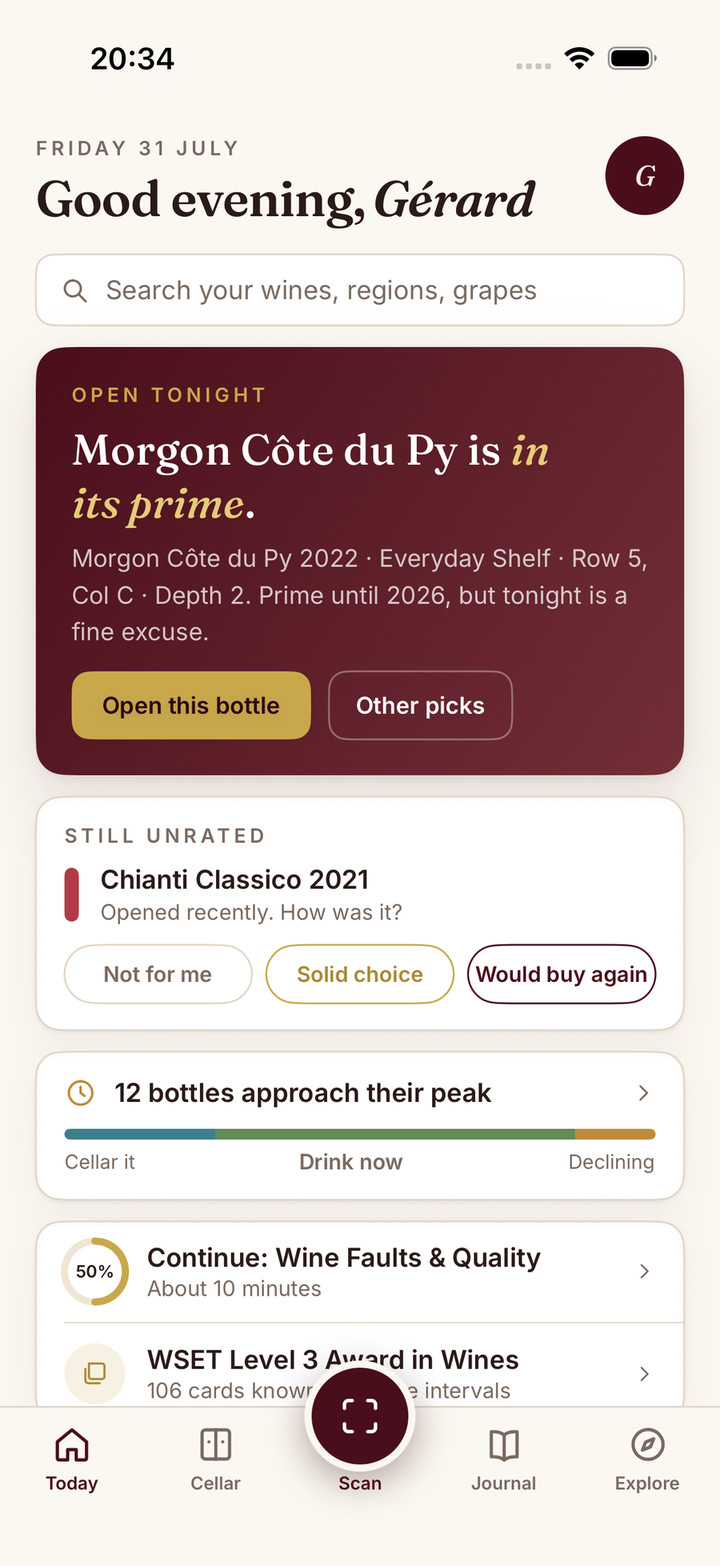
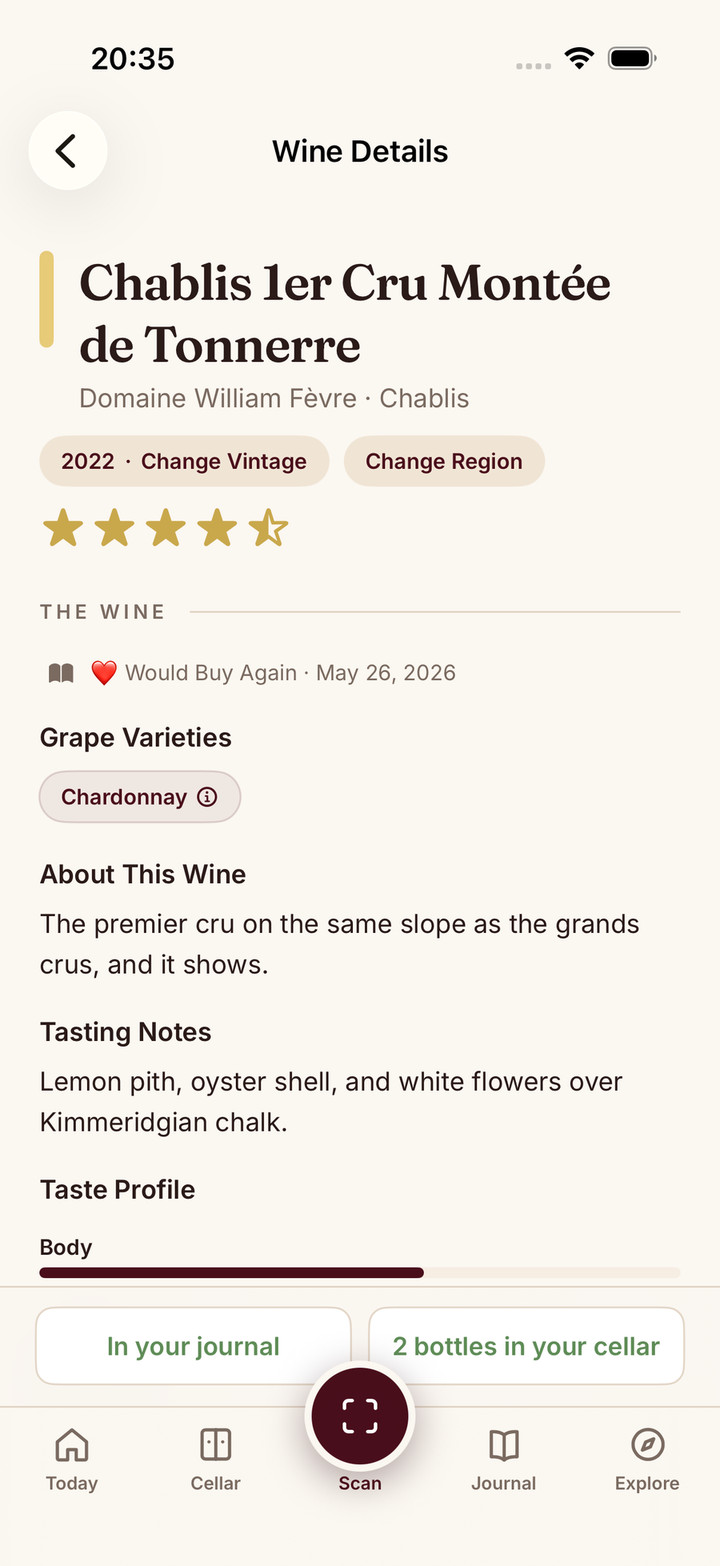
Sommo connects that loop. AI label scanning returns a briefing, then the same wine can move into a 3D cellar, dinner pairing, structured tasting note, Taste DNA signal or private Sharing Party. WSET exam prep for Levels 1 to 4 sits alongside it when you want to formalise the knowledge, but it is not the app’s whole identity.
For anyone specifically mourning Delectable, the practical parallels are these: the logging is fast, the journal is yours, CSV and Excel export are free and in the app, and it ships regularly on iOS, Android, and the browser rather than sitting still for five years.
Where it does not compete: no marketplace, no price comparison, no crowd average and no trade-heavy public feed. Sommo is the independent home for your own wine life, with invitation-led social tools when wine is better shared.
All Three, Side by Side
| Sommo | Vivino | Delectable | |
|---|---|---|---|
| Actively developed | Yes, iOS, Android and web | Yes | iOS last updated Sept 2021 |
| Label scanning | AI briefing with context | Fastest, biggest database | Human-verified, historically |
| Structured tasting | SAT notes with AI feedback | Free text and stars | Ratings and free text |
| Learns your palate | Yes, from your journal | No | No |
| Social feed | Opt-in sharing surfaces | Yes, mass consumer | Yes, trade-leaning |
| Cellar | Full cellar with AI pairing | Basic, Premium | None |
| Price data | No | Yes, plus marketplace | Limited |
| WSET prep | Levels 1 to 4 | No | No |
| Data export | CSV and Excel, free | Limited | Limited |
| Price | Free tier; Premium $5/mo or $29.99/yr | Free with ads; $4.99/mo | Free; Premium $5.99/mo |
The Bottom Line
Delectable was better than Vivino at the thing it cared about, and that is worth saying plainly. A community of serious tasters is hard to build and easy to lose.
But a wine app is a long-term relationship with your own notes, and the iOS release date settles this one. Vivino is the safe choice between these two in 2026.
If what you actually miss is wine with other people, a public feed is not the only model. Sommo keeps the journal personal, then opens opt-in Sharing Parties, Mix Palate groups, shared racks and share cards around real tables. Try Sommo free, or read Sommo vs Delectable and the Untappd for wine comparison.
Vivino or Delectable in 2026?