Two apps dominate wine on your phone, and they barely overlap.
Vivino is the one everybody has. You point the camera at a label, a number appears, and you decide whether to buy. CellarTracker is the one serious collectors have quietly run since 2003, a database that knows exactly which of your 214 bottles is drinking well this autumn and which needs another five years.
Ask which is better and the honest answer is that they are not really competing. They solve opposite halves of the same hobby. The interesting question is what happens in the middle, where most wine drinkers actually live.
The Short Answer
Choose Vivino if the question you ask most often is “should I buy this bottle?” It has the biggest database in the category and the fastest scanner, and it is free.
Choose CellarTracker if the question you ask most often is “what should I open from what I already own?” Unlimited free inventory and community drinking windows are unmatched.
Choose Sommo if the question is what happens across the whole bottle: scan it, decide, cellar it, pair it, open it, remember it and share the tasting without splitting that record across apps.
| Vivino | CellarTracker | |
|---|---|---|
| Built for | Buying decisions | Collection management |
| Scanning | Fastest in the category | Label photo search plus barcode tools |
| Ratings | Crowd average, 5-star | Community notes, 100-point |
| Inventory | Basic, Premium-gated | Unlimited, free |
| Drinking windows | Premium | Community, enhanced on paid tiers |
| Education | None | None |
| Price | Free with ads; Premium $4.99/mo or $47.90/yr | Free unlimited; $40 to $500/yr tiers |
Pricing checked as of mid-2026. Both change it periodically, so verify before subscribing.
What Vivino Is Actually For
Vivino is a purchase-decision engine wearing a wine app’s clothes. Its App Store listing counts around 70 million users and 16 million wines as of mid-2026, and that scale is the entire product. Scan almost any bottle on earth and someone has rated it.
That makes it genuinely excellent at one moment: standing in a shop with a bottle in your hand and 20 seconds to decide. You get a score, a price check across retailers, and a link to buy. For that specific moment, nothing beats it.
The limits show up everywhere else. A 4.1 average tells you the wine is competent and not much more, because most ratings compress into a narrow band between roughly 3.5 and 4.2. Reviews are free text and stars, with no structured tasting framework, so your own notes never accumulate into a picture of your palate. And the free app has been narrowing: scanning stays free but ad-supported, while restaurant wine-list scanning, which used to be free, now sits behind Vivino Premium. That change remains a sore point with long-time users.
What CellarTracker Is Actually For
CellarTracker is a database with a wine hobby attached, and that is meant as a compliment. It launched in 2003, and the thing it has that nobody else can buy is time: over 14 million community tasting notes, written largely by people who own the wines and have opened multiple bottles across multiple years.
For a collector tracking six vintages of the same Barolo producer, that archive is irreplaceable. You can see how the 2016 is showing now, from people who drank it last month.
The inventory side is equally serious, and free. Unlimited bottles, rack positions, purchase prices, valuations, and drinking windows drawn from community consensus rather than a single algorithm. Paid tiers add enhanced windows and the CellarChat AI assistant.
The mobile apps have been redesigned and cover the everyday collection flow, including label photo search, barcode tools and bottle management. Some deeper desktop functions are still not available on mobile, and the product retains a collector’s learning curve. There is no structured tasting framework or formal wine-learning system, but subscribers can use CellarChat for collection-aware answers and food pairings.
Head to Head
Adding a Wine
Vivino still wins for speed and recognition breadth. Camera up, bottle recognised, done. CellarTracker now offers label photo search and barcode tools in its mobile experience, but its inventory flow asks for more detail because location, purchase and vintage accuracy matter more to a collection.
Tasting Notes
CellarTracker wins on depth, Vivino on volume. CellarTracker notes are long, specific, and often come with a 100-point score from someone who has followed the wine for a decade. Vivino reviews are a sentence and a star rating from someone who drank it once.
Neither, though, gives you a framework. You write into an empty box. Nothing tells you that you described aroma and skipped structure entirely, or that you have now rated nine high-acid whites highly and might want to try Chablis.
Knowing When to Drink It
CellarTracker wins. Community drinking windows built from thousands of real bottle openings beat a single algorithm’s guess, and the enhanced windows on paid tiers are genuinely useful. Vivino gates drinking windows behind Premium and treats them as a secondary feature. If you buy wine to age, this alone decides it.
Deciding What to Open Tonight
CellarTracker is stronger here. Its ready-to-drink reports narrow the collection, and subscriber-only CellarChat can answer questions about bottles you own and pair them with food. Vivino’s Premium cellar includes drinking windows, but buying and crowd discovery remain the stronger parts of its experience. Sommo makes the meal-to-owned-bottle decision a dedicated everyday flow.
Learning Anything
Neither app teaches. Vivino gives you a number, CellarTracker gives you a row in a table. If you are working toward WSET Level 2 or Level 3, or simply want to understand why you keep reaching for Rhône reds, you will be doing that somewhere else.
Price
CellarTracker’s free tier is the most generous in the category, full stop: unlimited bottles, forever. Vivino’s free tier is fine but ad-supported and increasingly fenced. Vivino Premium runs $4.99 a month or $47.90 a year in the US as of mid-2026. CellarTracker’s paid tiers scale with collection size, roughly $40 to $500 a year, which is fair for a 2,000-bottle cellar and steep for a 300-bottle one.
Who Should Pick Vivino
You buy more wine than you cellar. You want a second opinion before spending £30 on something unfamiliar. You like seeing what friends drank. You mostly drink within a fortnight of buying. Vivino fits your life, and the free tier is probably all you need.
Who Should Pick CellarTracker
You own enough wine that you have lost track of some of it. You care about drinking windows and valuations. You have opinions about storage temperature. You are comfortable doing the serious work on a laptop. CellarTracker will outlast every app on your phone, and it will not cost you anything.
The Gap Both Leave Open
Here is what neither app connects end to end, and what many wine drinkers want once the bottle comes home.
You want the scan to become a bottle in the right rack, the rack to answer dinner, the opened bottle to move into a journal and the journal to shape future picks. Sometimes you want a structured note or wine knowledge; sometimes you want to compare the bottle with friends. The important part is that the record continues instead of restarting in another app.
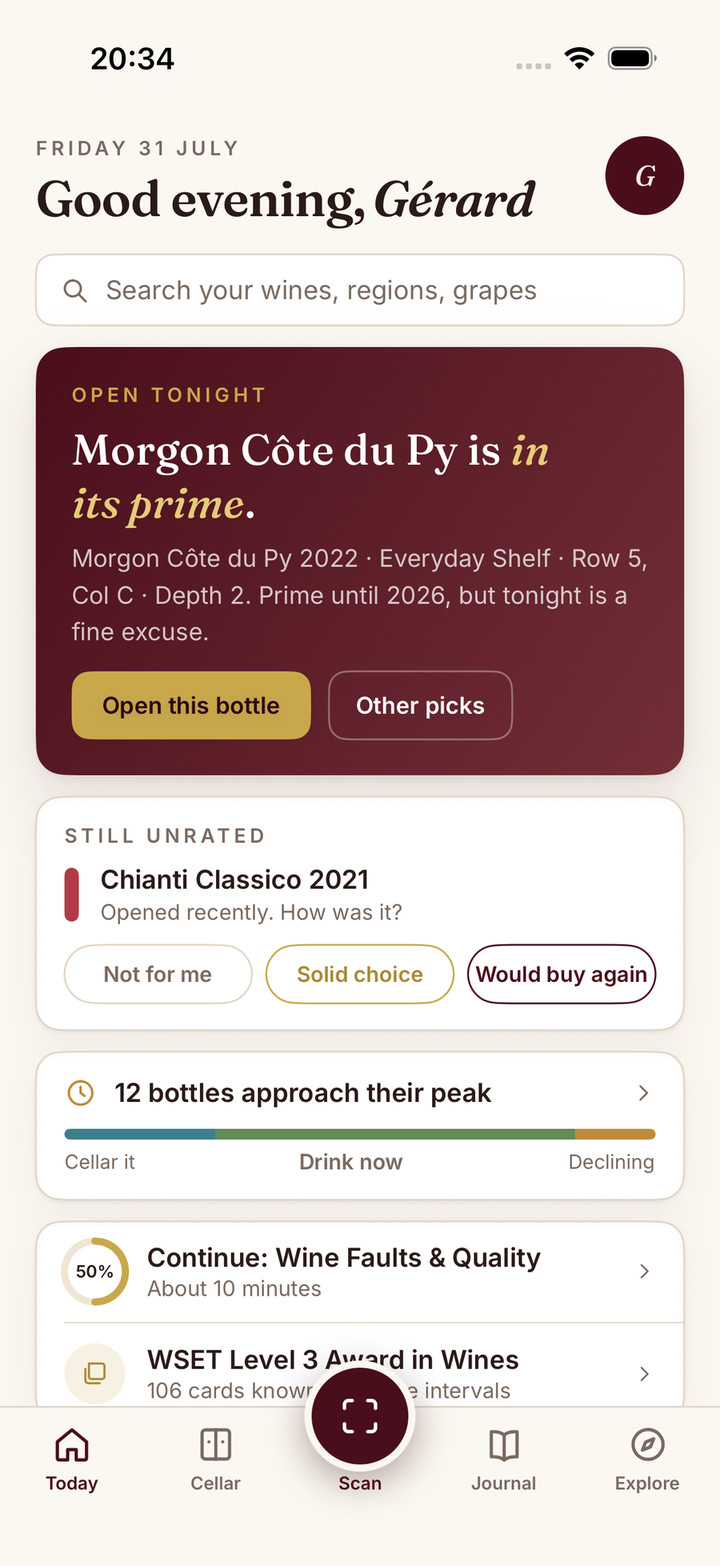
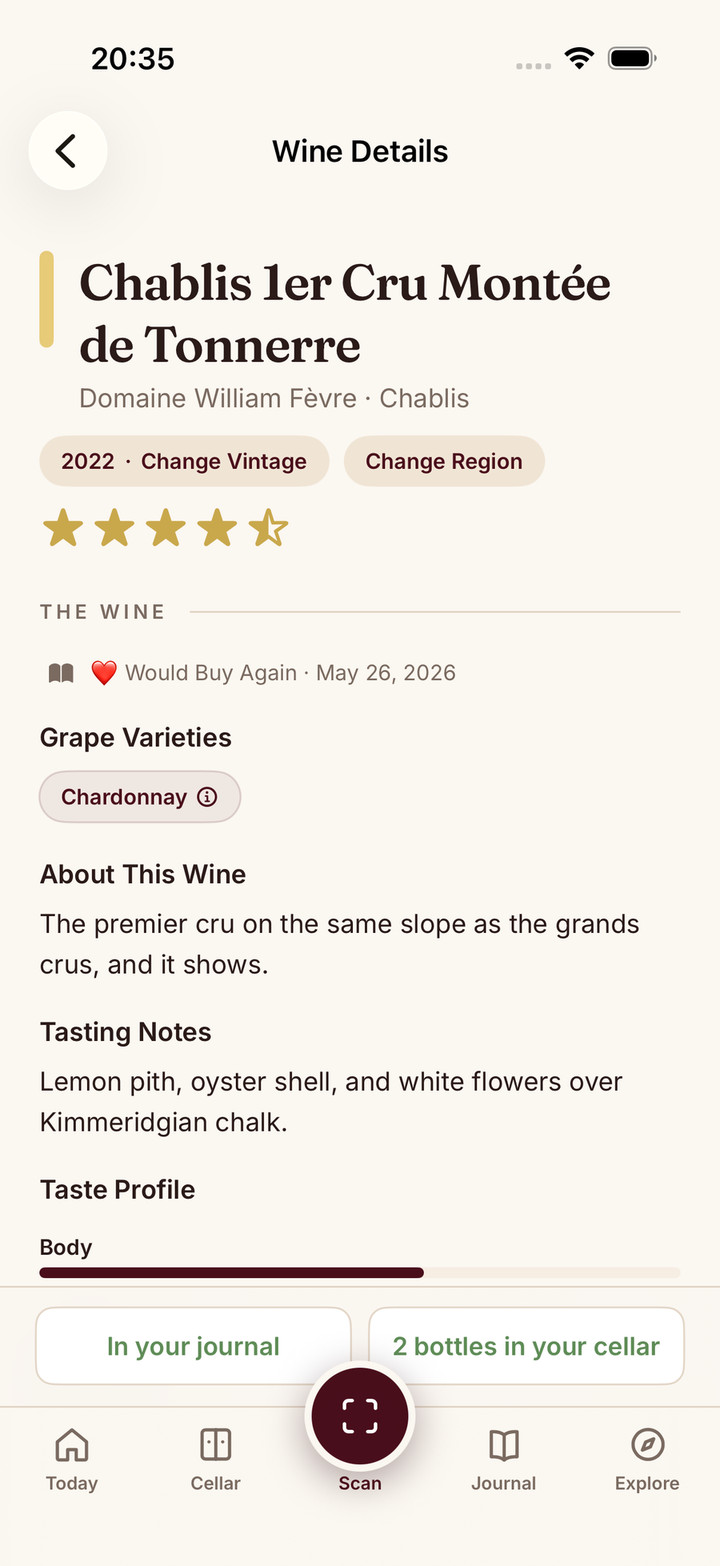
That is the job Sommo was built for. AI label scanning returns a briefing and can feed the cellar, where meal-aware pairing works from bottles you actually own. Opened bottles move into the journal and Taste DNA, while Sharing Parties, Mix Palate and shared racks bring in friends by invitation. WSET exam prep and structured tasting are available when you want depth, not imposed as the app’s category.
It runs on iPhone, iPad, Android, and in the browser at web.sommo.app on one account, so the cellar work does not get exiled to a desktop.
Where it does not compete: Sommo has no marketplace, no price comparison, and no crowd score. It will never match CellarTracker’s 14 million community notes or Vivino’s 16 million wines. If those are what you came for, the honest recommendation is to use those apps.
All Three, Side by Side
| Sommo | Vivino | CellarTracker | |
|---|---|---|---|
| Core job | Your connected wine life | Buying and crowd discovery | Collection management |
| Label scanning | AI briefing, not just a score | Fastest, biggest database | Label photo and barcode tools |
| Tasting notes | SAT structure with AI feedback | Free text and stars | Long-form community notes |
| Learns your palate | Yes, from your journal | No | No |
| Cellar | Yes, with AI food pairing | Basic, Premium | Unlimited, free, best in class |
| Drinking windows | Yes, with readiness alerts | Premium | Community, best in class |
| Menu scoring | Whole wine lists, Premium | Wine-list scan, Premium | No |
| WSET prep | Levels 1 to 4 | No | No |
| Crowd ratings | No | Yes, the category standard | Yes, 100-point |
| Price data | No | Yes, plus marketplace | Valuations |
| Platforms | iOS, Android, web | iOS, Android, web | iOS, Android, desktop web |
| Price | Free tier; Premium $5/mo or $29.99/yr | Free with ads; $4.99/mo | Free unlimited; $40 to $500/yr |
The Bottom Line
Vivino and CellarTracker are both very good at the thing they were built for, and neither is trying to be the other. If you are buying, use Vivino. If you are collecting at scale, use CellarTracker, and use the free tier without guilt.
But if you are tired of moving the same bottle between a shopping app and an inventory database, there is a third model. Sommo connects scanning, a visual cellar, dinner pairing, the journal, Taste DNA, insights and tasting with friends in one personal record.
Try Sommo free if that all-in-one approach fits, or read the full head to heads: Sommo vs Vivino and Sommo vs CellarTracker.
Vivino or CellarTracker: which one tonight?