There are now dozens of “AI wine apps” on the App Store. Most of them are not actually AI in any meaningful sense. Some are barcode scanners with a review database. Some are wine club marketing apps in disguise. A few are genuinely useful tools that change how you buy, drink, and learn wine. Telling them apart is harder than it should be, partly because every app claims AI in its marketing, and partly because the use cases vary so much that “best wine app” is almost a meaningless category.
This guide is the honest review most wine writing avoids. We will explain what AI in wine apps actually does, what to look for, what to ignore, and where each of the major apps in 2026 actually shines or falls short. We make our own app, Sommo, so we have skin in the game. We will be specific about where Sommo wins and where other apps do something better, because the goal of this guide is to help you pick the right tool, not to oversell ours.
What “AI” Actually Means in a Wine App
The phrase covers several distinct capabilities, only some of which most apps actually deliver.
Label recognition. Pointing your phone at a wine label and getting an identification. This is now genuinely automated for most known wines. The underlying technology is computer vision and pattern matching against large databases. Almost every app claims this. Quality varies dramatically.
Personalised recommendations. Suggesting wines based on your taste profile. Real personalisation requires the app to learn from your specific ratings and preferences. Most “AI recommendations” in wine apps are actually cohort-based (“people who liked X also liked Y”) rather than personal.
Tasting note generation or feedback. AI reading your tasting note and producing feedback or alignment scoring against known wine characteristics. This is rare and recent.
Cellar and drinking window management. Modelling each bottle’s optimal drinking window based on grape, region, vintage, and producer. This requires structured data plus modelling and is one of the genuinely useful AI capabilities now available.
Pairing recommendations. Suggesting wines for specific foods or suggesting foods for specific wines. The quality of these recommendations varies from useful to comically generic.
Menu and wine list scoring. Photographing a restaurant wine list and getting ranked recommendations. Genuinely AI-driven and now reasonably good.
When you read “AI wine app” in 2026, you are likely getting some combination of the above. The question is which features the app does well and which it does badly.
What to Look For
Before specific apps, the traits that distinguish a genuinely useful AI wine app from a hyped one.
A personal record. Does the app adapt to your preferences over time, or show every user the same recommendations? Real personalisation needs consistent ratings and journal history, while a useful product also lets you inspect, edit and export the record behind the answer.
Database depth. Can the app identify a wine from a small Portuguese producer, a single-vineyard Mosel Riesling, or an obscure Italian indigenous grape? Or does it only know the mass-market brands? A serious app should handle the long tail.
Cellar tracking. Can you log bottles, see what is ready to drink, get alerts for approaching drinking windows? Or is it just a scanning app?
Tasting note quality. Are the tasting notes thoughtful and aligned with how professionals actually describe wine, or are they generic marketing copy (“smooth, fruity, perfect for any occasion”)?
Pairing reasoning. When the app suggests a pairing, does it explain why? “Drink Pinot Noir with salmon” is unhelpful. “Drink Pinot Noir with grilled salmon because the wine’s bright acidity cuts the fat and its red fruit complements the char” is useful.
Honesty about limitations. A trustworthy app tells you what it does not know. An app that confidently answers every question is hallucinating most of them. Sommo publishes its edges openly on Under the Hood and what it cannot know.
The Major Apps in 2026
Vivino
The most widely used wine app in the world. Vivino’s strength is its enormous user community, which translates to broad label recognition and crowd-sourced average ratings on millions of wines. If you scan an obscure bottle, Vivino has the highest probability of any app of telling you what it is.
Strengths:
- Best-in-class label recognition for mainstream wines.
- Huge price comparison database for buying.
- Active social features for tracking what friends drink.
Weaknesses:
- The “AI” is largely cohort-based. Recommendations are not deeply personalised.
- Average ratings across millions of strangers tell you almost nothing about whether you specifically will like a wine.
- Tasting notes are crowd-sourced and inconsistent.
- The fuller cellar, drinking-window and wine-list features sit in Premium.
- Strong push toward Vivino’s own e-commerce, which can colour recommendations.
Best for: Casual drinkers who want to quickly identify wines they encounter and check the crowd consensus. Less useful for serious palate development.
For our detailed comparison, see the Vivino alternative guide.
Hello Vino
A simpler app focused on pairing recommendations. You tell it what you are eating, it suggests wines. The recommendations are generic but acceptable for a person without a wine background.
Strengths:
- Clean, simple interface.
- Decent pairing suggestions for common foods.
- Low barrier to entry.
Weaknesses:
- No real label recognition.
- No personal palate learning.
- Tasting notes are basic.
- No cellar tracking.
- Stale database for less common producers and regions.
Best for: Beginners who want a quick “what should I drink with this” answer and nothing more.
For more, see the Hello Vino comparison.
Delectable
A more social and tasting-focused app, popular with wine professionals and serious enthusiasts. Delectable focuses on the social act of sharing what you are drinking with a community of similarly serious drinkers.
Strengths:
- Strong community of serious wine drinkers.
- Higher-quality tasting notes than crowd-sourced apps.
- Decent label recognition for fine wines.
Weaknesses:
- The community is the main draw, and it is small relative to mass-market apps.
- Pairing and cellar features are basic.
- Personalisation is limited.
- Less focused on learning and palate development.
Best for: Wine enthusiasts who want to share notes with other enthusiasts and follow expert reviewers.
See our Delectable comparison for the full breakdown.
Wine-Searcher
Technically not an “AI wine app” in the social/tasting sense, but worth mentioning. Wine-Searcher is the global database for finding bottles at the best price across retailers worldwide. It does one thing extremely well.
Strengths:
- Unmatched depth for finding specific wines at retail across thousands of shops.
- Excellent for comparison shopping.
- Includes critic scores from major publications.
Weaknesses:
- Not a tasting note app or a cellar app.
- No personalisation.
- No food pairing.
- Most useful features are behind a subscription.
Best for: Anyone hunting a specific bottle. Less useful for daily wine decisions.
For more, see the Wine-Searcher alternative guide.
CellarTracker
The longest-running serious wine cellar management tool, founded in 2003. Beloved by collectors, it now has redesigned iOS and Android apps alongside the deeper desktop product, plus the collection-aware CellarChat assistant for subscribers.
Strengths:
- Best-in-class cellar database depth.
- High-quality tasting notes from a serious community.
- Excellent for managing a large collection over time.
- Granular search and filter.
Weaknesses:
- The deepest workflows still have a learning curve, and some desktop functions are not yet available on mobile.
- CellarChat is subscriber-only rather than part of the free inventory experience.
- It is centred on collection management and community data rather than one broader journal, tasting and learning system.
- Built for collectors, not casual drinkers.
Best for: Serious collectors with 200+ bottles who prioritise data depth over modern UX.
See our CellarTracker comparison for context.
Sommo
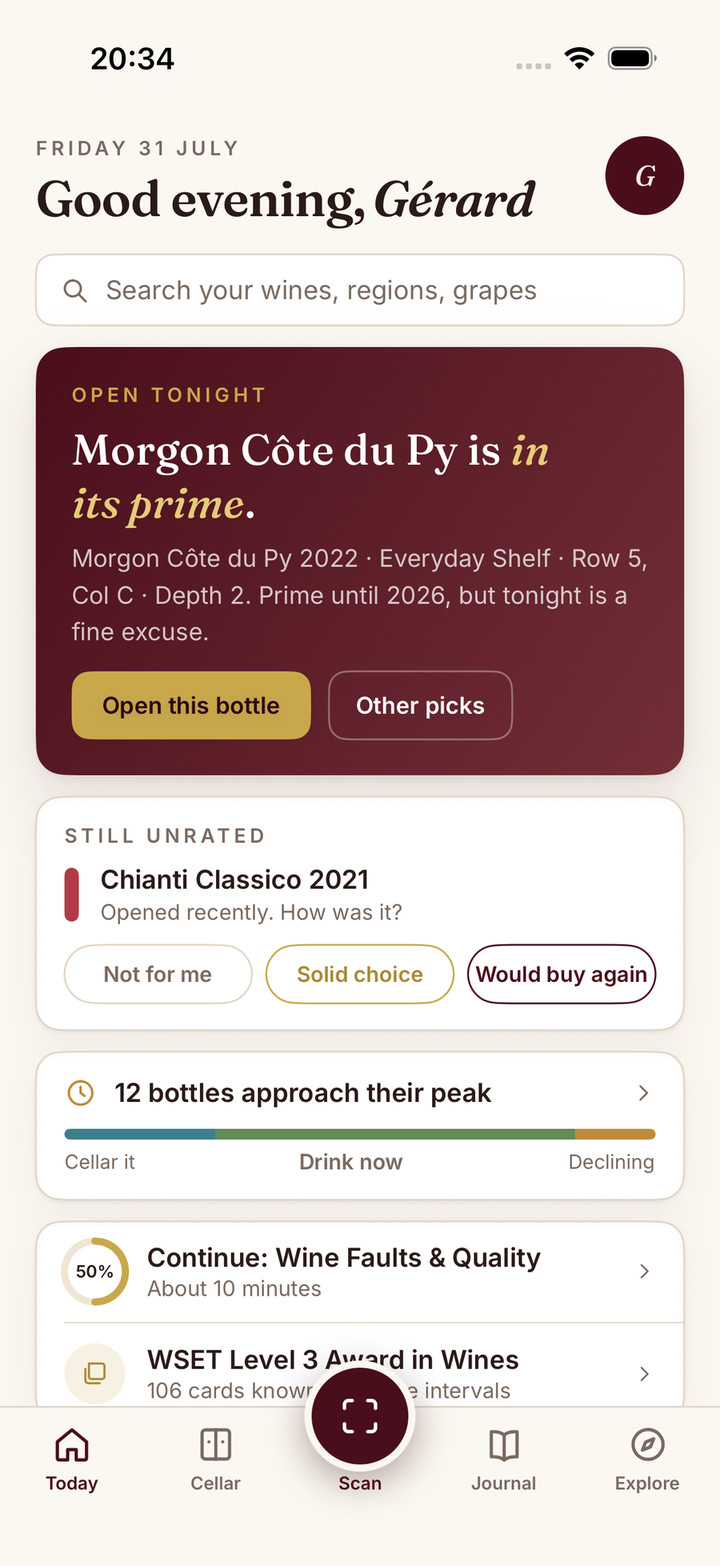
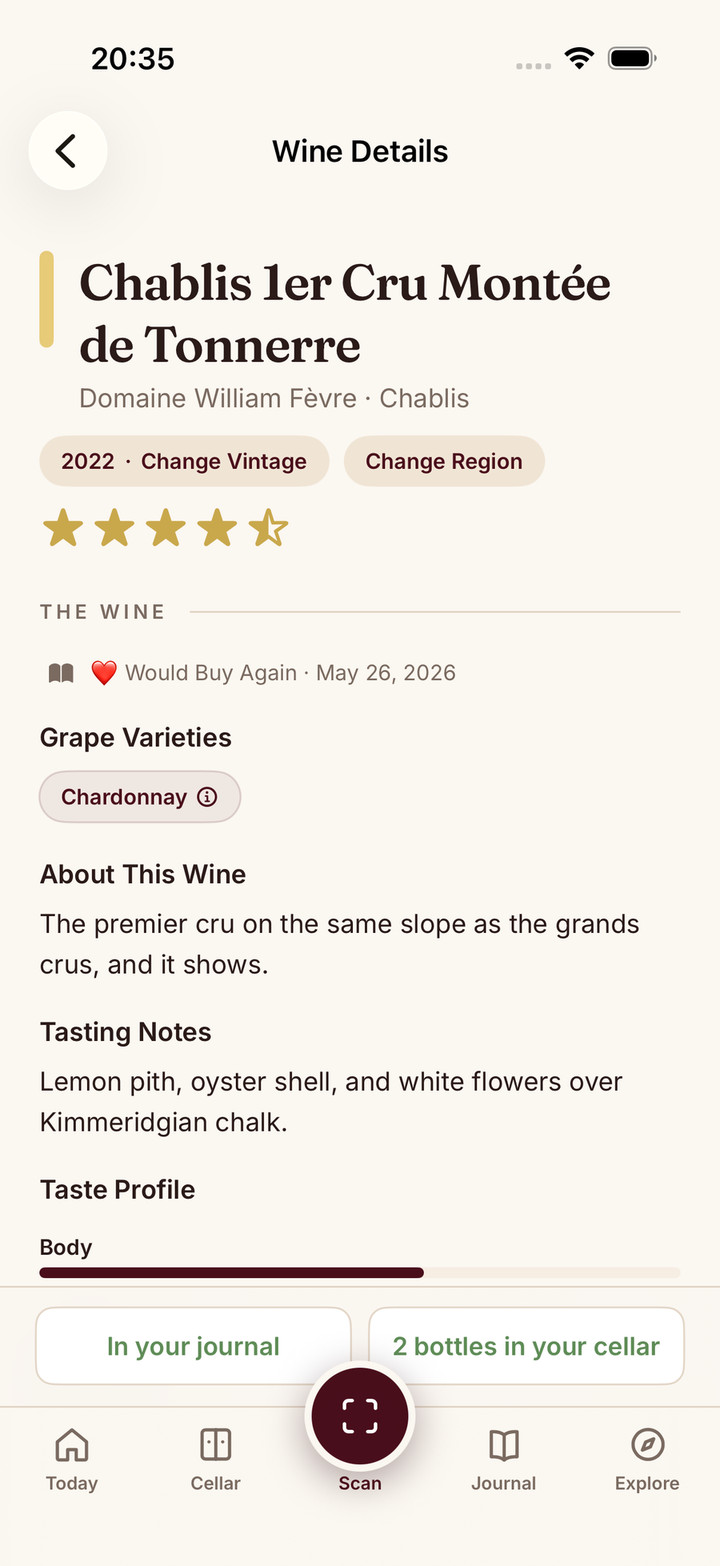
Our app, included for honest comparison. Sommo uses AI inside an independent, all-in-one wine app rather than making chat the destination. A scan can become a cellar bottle, pairing, journal entry, Taste DNA signal, shared tasting or optional WSET lesson without recreating the record. The genuinely AI-driven features include label and menu scanning, personal recommendations from your history, tasting feedback, cellar pairing and Wine Character Analysis. The full methodology is on Under the Hood.
Strengths:
- Label scanning works on obscure producers and indigenous grape wines.
- Personal palate learning is genuinely individual: recommendations are based on your specific rated wines, not cohort averages.
- AI-graded tasting feedback with WSET-aligned scoring.
- Cellar management with drinking window modelling and push notifications.
- AI restaurant menu scoring.
- WSET prep with adaptive spaced repetition for all four levels.
- Wine Character Analysis (the personality profile).
- Opt-in Sharing Parties, Mix Palate groups, live shared racks and designed share cards.
- Free tier covers most casual users and includes WSET Level 1 prep; Premium unlocks the cellar, menu scoring, tasting mode, and WSET Levels 2 to 4.
Weaknesses:
- A smaller, invitation-led community rather than a giant public rating feed.
- No marketplace or e-commerce integration.
- Younger app than CellarTracker or Vivino, which means less historical user data on some obscure wines.
- The full feature set requires Premium for serious collectors.
Best for: Drinkers who want one beautifully designed home for scanning, cellar, journal, pairing, knowledge and social tasting, with optional WSET depth rather than a learning-only product.
How to Choose
A practical decision framework.
If you are a casual drinker who wants to identify wines at the shop: Vivino is the most user-friendly starting point. Free, fast, large database.
If you want a quick pairing for what you are cooking: Hello Vino or Sommo. Sommo gives you reasoning, Hello Vino gives you faster answers. The free wine pairing finder on this site answers the same question in the browser, no install required.
If you want one app for the whole loop: Sommo connects the scan, cellar, journal, pairing, palate profile, tasting group and optional WSET study through one personal record.
If you are a serious collector with 200+ bottles: CellarTracker for the depth, or Sommo for the modern interface and AI assistance. Many serious collectors use both.
If you mostly want to share notes with other wine people: Delectable.
If you want to comparison shop specific wines: Wine-Searcher.
What All These Apps Do Badly
Worth being honest about the category as a whole. Three areas where every current AI wine app has limitations.
Subjective recommendations remain hard. AI is excellent at “wines like this one” recommendations. It is less reliable at “wines you should try because they will expand your palate.” The risk-taking part of recommendation is still a human strength.
Fault detection. No current app can tell you whether the wine you opened is corked, oxidised, or otherwise faulty. The bottle has to be opened, smelled, and tasted by a human.
Truly small producers. All apps struggle with the smallest producers: the family estate in Friuli or the natural wine producer who makes 2,000 bottles a year and ships to three restaurants. Database coverage is imperfect at the long tail.
Vintage variation. Apps generally know that a wine is good. They are less reliable about whether the specific vintage you have is good. A 2018 Bordeaux from a top château is great. A 2017 from the same château is mediocre. Apps are getting better at this but most still treat vintages as roughly equivalent.
Privacy and Data
A note worth making. When you log wines in any of these apps, you may be creating a detailed record of drinking patterns, preferences and spending. Business models and privacy choices differ, and they change over time.
Check the current privacy policy and store privacy label before you commit. Look for clear controls over public versus private notes, practical export and a plain explanation of how journal data is used.
The Workflow That Actually Works
Specialist tools still earn a place when you need their particular depth. For many wine drinkers, the cleanest workflow is one connected home with a specialist used only when the question calls for it:
- A primary wine-life app where scans, bottles, notes, pairings and people share one record. Sommo covers this breadth; CellarTracker is the deeper specialist for large collections.
- A search and price tool such as Wine-Searcher when you need to find a specific bottle or compare merchants.
- A public ratings network such as Vivino or Delectable when you specifically want the broader community’s view.
The practical test is continuity. If every scan ends as a dead-end answer, or every bottle needs to be entered into three apps, the workflow will eventually break. Pick the connected home that matches most of your wine life, then add a specialist only for the jobs it genuinely does better.
Explore with Sommo
If you choose Sommo as your primary, the value compounds with use. Every bottle you scan, rate and note becomes part of the same cellar, journal and palate record. Pairings can start from bottles you already own; Sharing Parties return each guest’s verdict to their own journal; Mix Palate compares only the people who opt in. The app is independently built, ad-free and shaped directly by its users rather than a marketplace. See Under the Hood for how the intelligence works and About Sommo for how the roadmap is shaped.
Download Sommo free and try the all-in-one wine app that keeps the answer and everything after it connected.