You enjoyed a supermarket wine, went back for the same-looking label and found something different in the glass. Perhaps the vintage changed. Perhaps you picked up another bottle in the same range. “The supermarket’s white with the cream label” was never quite enough information.
Choose an own-label wine by identifying the exact bottle, trying a sensible amount for your intended use and recording your own reaction. When buying again, check the current bottle against that record. A good experience with one wine is useful evidence about that wine, not an endorsement of the retailer’s whole range.
Write a More Precise Name
A retailer’s range name is only the start. Record the wine or cuvée, grape where stated, geographical designation, vintage and format. Two wines can share the same range branding without sharing origin, producer or style. A half bottle and a 75cl bottle also need to be distinguished when comparing cost.
Look at both front and back labels and the current official listing. Copy roles literally: “bottled by”, “produced by” and an importer address are different pieces of information. An address does not tell you every vineyard or production decision. Our wine-label guide covers the wider vocabulary.
Do not turn a disclosed producer into a hidden bargain theory. A business can make several wines to different specifications. Its name does not establish that the supermarket bottle is identical to another label it sells.
A Real Listing, Annotated at the Desk
On 16 October 2026, we checked the official Tesco Finest Torrontes 75Cl listing. This is a listing exercise: we did not handle its physical bottle or taste the wine. The example shows what to record and where to leave a gap.
| Listing field | What the retrieved page says | What to do with it |
|---|---|---|
| Retailer and range | Tesco Finest | Retain with the wine name |
| Wine and format | Torrontes; 75cl | Match both when repurchasing |
| Origin | Argentina; bottled in Argentina | Check the current bottle too |
| Producer field | Catena | Record as the listed producer |
| Bottler information | Bodegas y Viñedos Catena | Keep this role separate |
| Importer address field | Tesco Ireland Ltd; Tesco Stores Ltd | Listing identifies this role; check the physical label |
| Vintage | Not established from retrieved text | Leave blank until checked |
| Personal reaction | Not assessed | Do not turn listing copy into a tasting note |
A blank vintage here means unverified, not “non-vintage”. Although the page provides regional background, this desk exercise does not establish the exact physical label in a reader’s local shop. Check the bottle you are buying and save a clear front-and-back photograph if practical.
The listing includes short-lived price offers and location-dependent pricing, so we have not turned its displayed price into an ongoing recommendation. Your receipt is the useful record of what you actually paid.
Own-label also exists beyond supermarkets. The Wine Society’s own-label page distinguishes its Society and Exhibition ranges. That is a different merchant model; it does not supply evidence about Tesco’s sourcing or prove that all retailers’ own-label ranges work alike.
Try It for a Real Job
Decide what success would look like before buying: a dry white for a particular supper, a red you enjoy with pizza, or a bottle within a comfortable entertaining budget. Choose from the stated style and your preferences. For a quick broad shop-floor decision, use the grocery-store wine guide.
Start with one bottle where available and suitable, rather than buying a case merely to reach a promotion. Share or preserve the remainder as appropriate; tasting is not an obligation to finish it. A smaller format can be useful if offered, but compare the actual volume and price rather than assuming it is cheaper value.
Record the meal, serving context and what you liked or disliked in plain words. “Would buy for this dish again at this price” helps more than a score detached from the occasion. If you did not enjoy it, note why without declaring every bottle in the range poor.
Copy This Identity and Repurchase Card
The filled column below is a fictional purchase of an invented wine, entirely separate from the Tesco listing. It demonstrates the note format, not a tasting recommendation. Copy the blank column for your own bottle.
| Field | Synthetic example | Your bottle |
|---|---|---|
| Retailer / range | Example Grocer / Table Series | ___ |
| Wine / designation | Cuvée A white / origin as printed | ___ |
| Vintage / format | 2025 / 75cl | ___ |
| Literal producer/bottler roles | Copy from actual label; not yet checked | ___ |
| Purchase date / actual price | 20 October 2026 / £8.40, single bottle | ___ |
| Context | Vegetable supper; served chilled | ___ |
| Personal reaction | Enjoyed with food; less keen alone | ___ |
| Repeat decision | One bottle for the same meal if identity matches | ___ |
| Next-shop check | Vintage, origin, name, format, current price | ___ |
The fictional £8.40 bottle contains 0.75 litres, so the comparison price is £11.20 per litre. That calculation compares cost, not enjoyment. A discount on a larger purchase still costs more overall if you would otherwise buy only one bottle.
Check Again Before Repeating
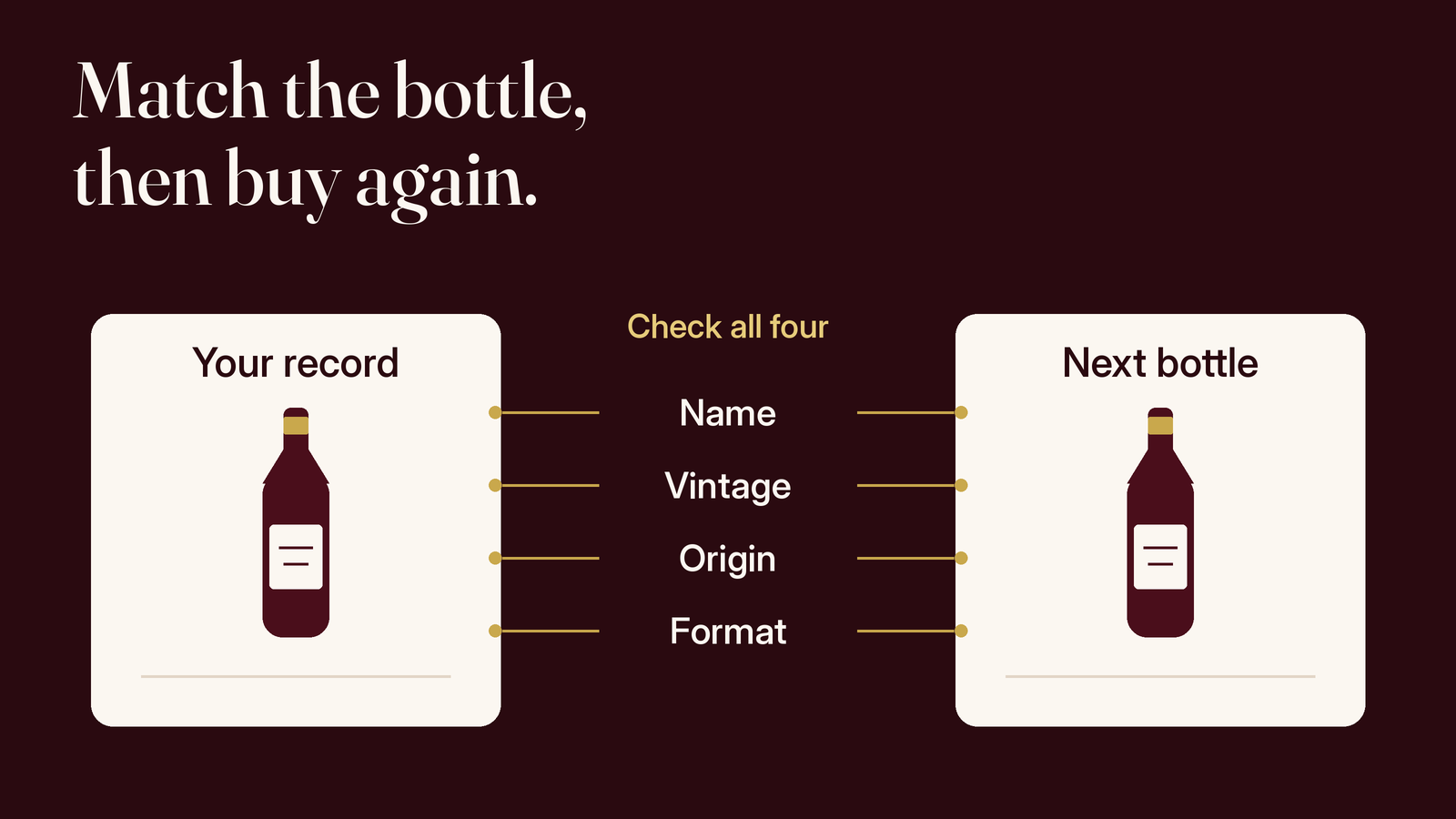
At the next shop, compare the wine name, range, vintage, origin and format with your card. Read any changed producer or bottler information rather than assuming a familiar front design means an unchanged wine. If the vintage or identity differs, treat the purchase as a new trial and preserve the earlier entry.
If the retailer listing and bottle disagree, record the discrepancy and ask the retailer before relying on the detail. Do not fill the gap with a scanner guess or an online claim about a secret supplier.
A personal tasting journal turns this into a small habit. Sommo’s journal can keep your reaction with the wine record; check recognised details against the bottle, especially vintage. Scanning does not guarantee an exact match or reveal an undisclosed supplier. Record the bottle you would actually buy again, and give your next shopping trip something firmer than a memory of the label colour.