Sommo 2.0 is out. It is the biggest release since the app first shipped, and unusually for a point-zero release, almost nothing about it is a gimmick. The app has been redesigned end to end, the cellar became a wall you can actually look at, your taste got a page of its own, and Sommo now runs in the browser at web.sommo.app, on the same account as your phone.
Here is what changed, and why.
The app now looks like the notebook
If you have spent any time on this site, you know the language: cream paper, wine ink, a serif that means it, chapter numbers where a hurried product would put another header. The site has spoken it for a while. The app, honestly, had not caught up.
2.0 closes that gap. The whole app has been re-set in the same editorial system, type, colour, and rhythm, so moving between a bottle in your hand, the app in your pocket, and this site in a tab feels like one object. I think of it as the Sommelier’s Notebook: less dashboard, more field journal.
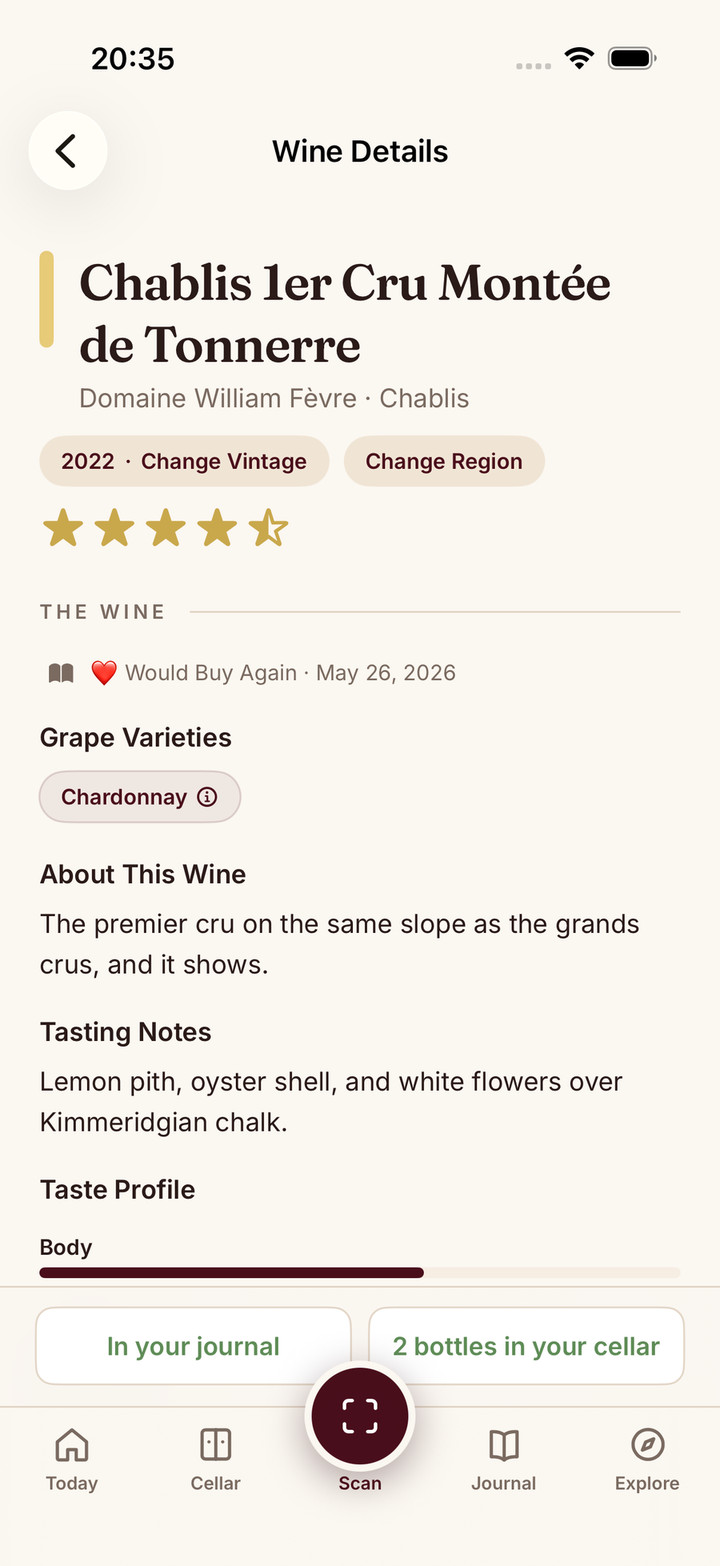
The structure changed with the clothes. Sommo now lives on five tabs: Today, Cellar, Scan, Journal, and Explore. Nothing you knew is gone; it is just findable now.
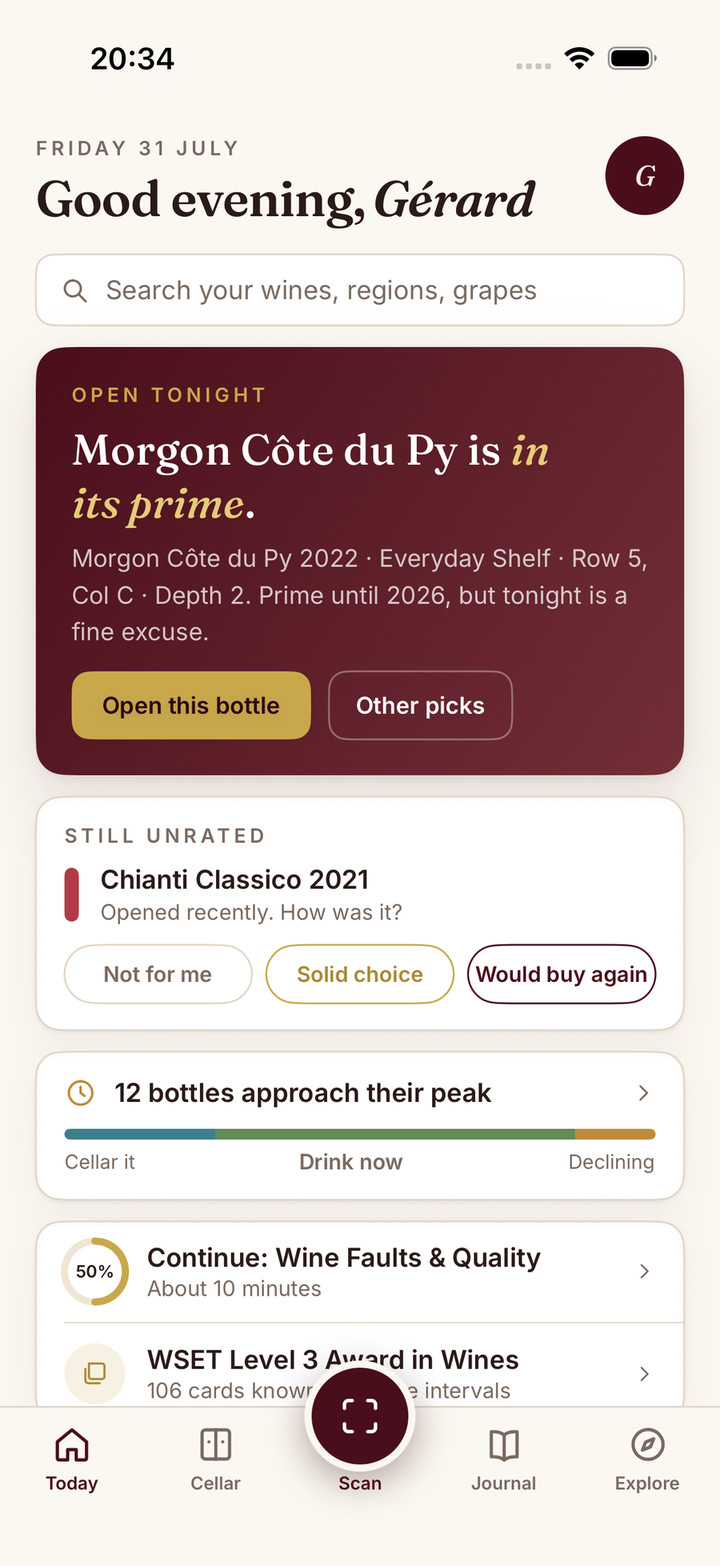
Today opens on a bottle, not a menu
The first screen used to be a hub of cards. Now it answers the question you actually open a wine app with: what should I open tonight?
Today greets you with a bottle you already own that is ready to drink now, backed by the drinking-window engine. Beneath it: the bottles approaching their peak, your study thread if you are working through WSET, and your insights. One glance, one decision, cork out.
The cellar is a wall now
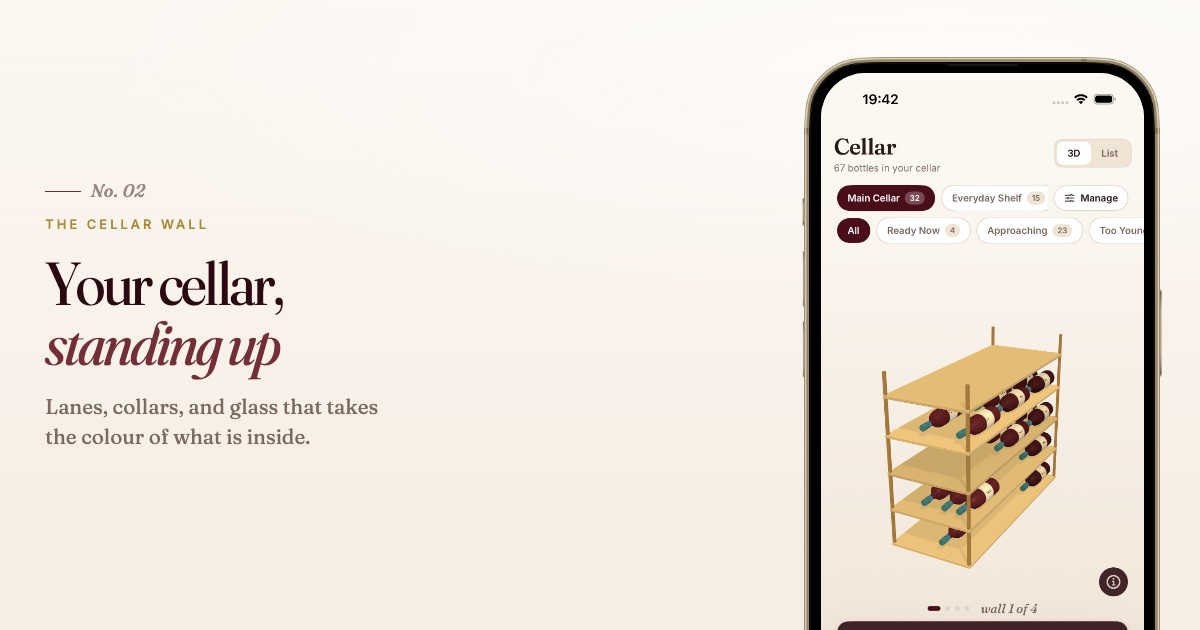
This is the one you will show people. Your racks render as a real three-dimensional wall: orbit it, pinch in until the name labels become readable, and long-press a bottle to pick it up and drag it to a new slot by hand.
The wall is informative, not just pretty. Each bottle’s glass takes the colour of the wine inside: red, white, rosé, orange, sparkling, fortified. The foil collar on every neck carries the drinking window, so a wall of green collars means relax, and a wall of amber means start pouring. Racks now have real depth too, up to twelve bottles nose to tail in a slot, the way an actual cellar stacks. A tappable legend explains every mark, with an illustrated guide behind it.
And because a rack is a thing you might give someone: share one by link, and the recipient gets it copied into their own cellar, bottles and positions intact.
One page that knows how you drink
Taste DNA and the Wine Character reading used to live in different corners. They were always two views of the same thing, so 2.0 merges them into one page: Your palate.
Up top, the six-axis radar: body, sweetness, acidity, tannin, intensity, adventurousness, each drawn from your journal rather than a quiz. An axis without enough data stays dim instead of guessing. Underneath, the reading: your archetype, your patterns, the recommendations that trace back to actual entries. Recent bottles weigh more than old ones, so the fingerprint moves when your taste does.
The whole app, in a browser tab
The one I am proudest of shipping as a team of one: Sommo now runs on the web, at web.sommo.app.
Sign in with the same Apple or Google account and it is all there: the cellar with the wall, the journal, your palate, tasting mode, menu scoring, the WSET suite, insights, the social features, data export. Label scanning works from a webcam or a photo you drop in. Nothing to install, nothing to sync, because there is nothing separate to sync.
A few things honestly stay on the phones: the guided first run, purchases, push delivery, and the pannable map (the web gets the atlas as a reading list instead). The full honest list lives on the web app page. But the day-to-day truth is simple: your wine life is now on whatever screen is in front of you.
And everything since you last read the notes
If you update rarely, 2.0 also folds in a busy run of releases: the Sharing Party and Mix Palate social suite, rack sharing, share cards that unfurl properly in chat, data export with the typeset cellar book PDF, the A to Z varietal index, region search on the atlas, cellar filters with live counts, per-bottle sizes, and typed WSET answers graded like an examiner.
The boring, important footnotes
Pricing has not moved: free tier as before, Premium at $5 a month or $29.99 a year, three-day trial, no card up front. One subscription covers iPhone, iPad, Android, and the web. Android ships 2.0 with full parity, because a second-class platform is not a platform.
Sommo 2.0 is on the App Store and Google Play now, and the browser needs nothing but the URL. Pour something worth writing down.