The bottle was in the shared rack, so you opened it. Your partner had been saving it for a birthday. Neither person thought they were being unreasonable, but the shelf never explained the plan.
A household cellar needs a short agreement about whose bottles they are, which may be opened, and who updates the record. Make those decisions before choosing software. A visible shelf card and a reliable habit will prevent more misunderstandings than an elaborate inventory nobody maintains.
Separate Three Things That Look Like Ownership
Physical ownership, custody and software access answer different questions. A birthday gift may belong to one person, live in another person’s wine fridge and appear in a rack managed through a third person’s account. None of those facts, alone, tells a housemate that they may open it.
Write your household’s understanding in ordinary language. This is an operating agreement for daily decisions, not a legal ownership document. If ownership is disputed, an inventory entry cannot settle it.
| Question | Useful household answer |
|---|---|
| Whose bottle is it? | Joint stock, or a named person’s private bottle |
| Who looks after it? | The person responsible for its physical storage |
| Who may change the record? | The people with the agreed software role |
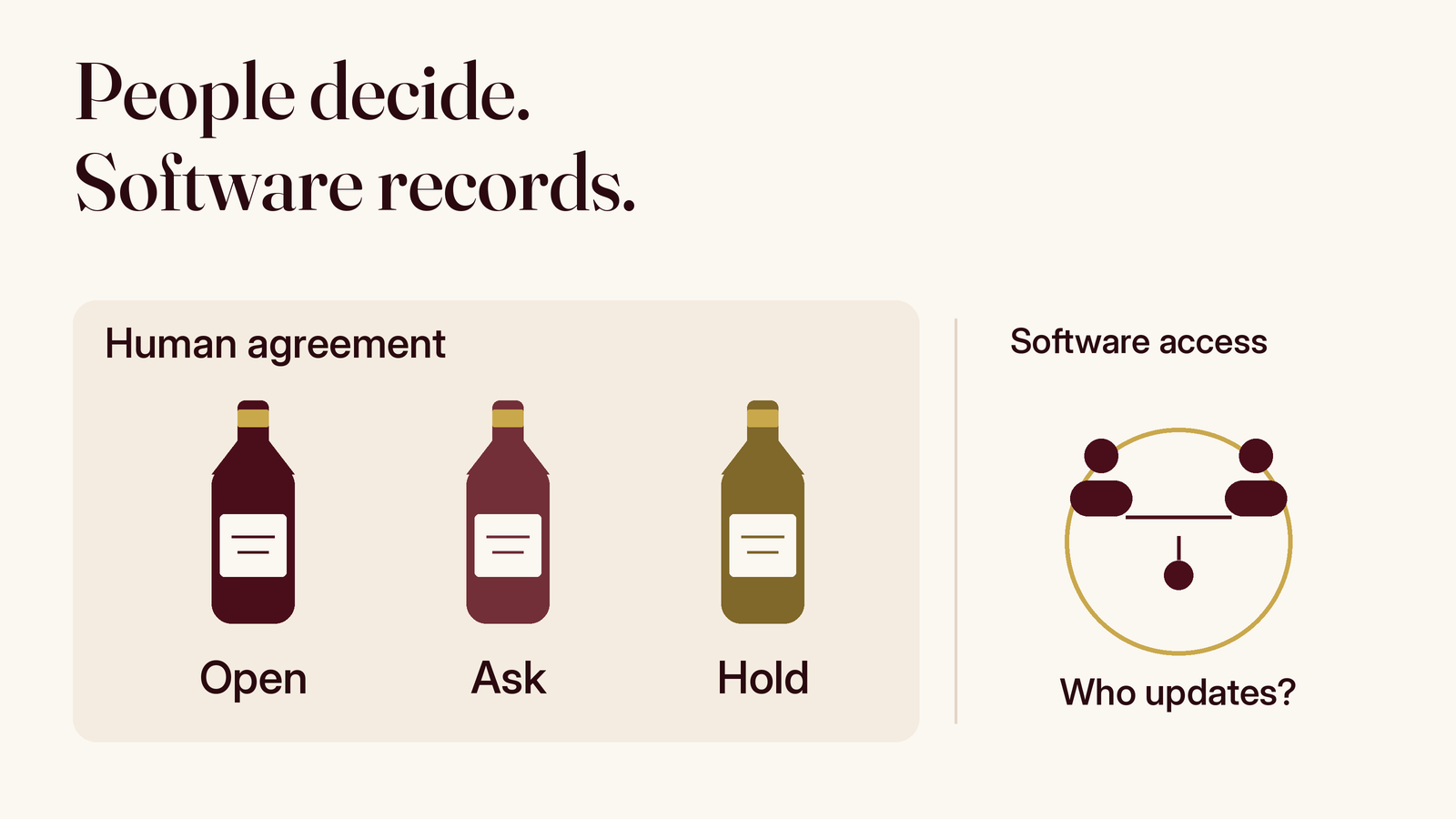
| May I open it? | Free to open, ask first, or held for a named occasion |
Keep opening status separate from ownership. Joint stock can be held for a dinner; a privately owned bottle can be offered freely. “Expensive” and “on the top shelf” are unreliable substitutes for an explicit answer.
Give Each Opening Status a Plain Meaning
Choose three phrases everyone understands:
- Free to open: within the household’s agreed everyday use. Say whether this includes serving guests or taking a bottle elsewhere.
- Ask first: contact the named person and wait for a clear answer. Silence leaves the bottle unopened.
- Held for an occasion: record the event, responsible person and date to review the hold.
A reservation can be a note or a paper tag: “Joint sparkling, held for anniversary dinner; Sam responsible; review 12 November.” It is a human instruction. It does not become an enforced lock because someone enters it in an app.
Avoid indefinite holds such as “special”. A review date creates a conversation if plans change without automatically releasing someone else’s wine. Keep identifying tags clear of labels and closures, and use a shelf card where attaching anything to a bottle would be awkward.
Copy This One-Page Agreement
This is an original template. The completed column is a fictional household example, not a tested household arrangement. Copy the blank column into a shared note, agree it together and keep it beside the rack or inventory.
| Agreement field | Example: Alex and Sam | Your household |
|---|---|---|
| Scope and date | Kitchen rack and hall fridge; 28 October 2026 | ___ |
| Joint stock | Bottles bought from our shared wine budget | ___ |
| Private stock | Named gifts and individually bought bottles; ask owner | ___ |
| Free to open | Joint everyday shelf, including dinner guests at home | ___ |
| Ask first | Anything private or with uncertain status | ___ |
| Occasion hold | Anniversary sparkling; Sam; review 12 November | ___ |
| Storage responsibility | Alex checks fridge; each person reports a move | ___ |
| Opening record | Opener updates quantity before clearing the table | ___ |
| Move record | Mover updates location when placing the bottle | ___ |
| Correction | Record known facts; flag uncertainty; reconcile together | ___ |
| Access review | Alex and Sam check members and roles monthly | ___ |
| Next agreement review | 28 November; Sam starts the conversation | ___ |
The agreement should fit the way you live. Housemates might exclude entertaining guests from free use. A couple might share everyday bottles but keep inherited wine private. A visiting friend should not have to infer the rules from everyone else’s habits.
Walk Through Three Situations Before Agreeing
These are synthetic examples to expose gaps in the wording.
Joint everyday wine. Alex chooses one of six bottles from the free-to-open shelf for dinner with friends. The agreement permits this. Alex records one opening, leaving five, before clearing up. No permission exchange was needed, and the count remains useful.
A private special bottle. Sam’s gift is in the same fridge, but it is marked private and held for a birthday. Alex asks Sam rather than treating shared storage as consent. If Sam agrees to open it early, they remove the old hold and record the opening. The account managing the rack has no authority to make that personal decision.
An opening nobody recorded. The list says five; there are four. Sam remembers opening one on Saturday. They correct the count to four and add that explanation. If nobody remembers, they record “one bottle missing at check, cause unknown”, then improve the opening habit. Inventing a tasting or blaming the software only makes the history less trustworthy.
For the physical count itself, use the holiday cellar audit. The agreement answers who decides; the audit checks what is actually there.
Keep the Smallest Reliable Habit
Use three verbs: open, move, correct. Whoever performs the physical action records it. If that person cannot update the app, they tell the agreed record keeper immediately through your normal household channel.
Review access when someone joins or leaves the household, or stops helping maintain the cellar. Check the actual members and roles rather than assuming an old invitation has expired.
Sommo’s Premium cellar supports live rack sharing. In the current web interface, viewers can see, rearrange and record openings; editors can also add, place, move and remove bottles. “Viewer” therefore does not mean a locked, read-only list. Check the permissions shown in your version before sharing. See the sharing feature guide for the available sharing tools.
Those roles do not transfer physical ownership, enforce your occasion holds or supply an approval workflow. Agree the rules first, then use Sommo to maintain the shared stock record. The useful result is a bottle everyone can enjoy without a surprise afterwards.