Every December someone asks me whether to buy ruby or tawny for the cheeseboard, and every December I give the same answer: it depends what you want the glass to do.
The short answer: ruby port is kept young and fruity, deep red in colour, tasting of fresh berries and plums. Tawny port is aged in wood until it turns amber, tasting of nuts, caramel and dried fruit. Ruby is bold and exuberant. Tawny is mellow and complex. Both are excellent at Christmas, and the best choice depends on the food and the people round your table.
The Port and Douro Wines Institute, the official body for port, divides port into two major categories by how it is aged: ruby style and tawny style. Everything else follows from that.
What is the difference between ruby and tawny port?
According to the Institute, ruby style ports are wines where the winemaker restrains the development of the deep red colour and keeps the fruit and strength of a young wine. Tawny style ports are blends of wines that have aged for different lengths of time in casks or vats, so their colour slowly fades to tawny and they develop a bouquet of dried fruit and wood. The older the wine, the stronger those aromas.
| Ruby port | Tawny port | |
|---|---|---|
| Colour | Deep red to purple | Amber, brick or golden brown |
| Flavour | Fresh red and black fruit, plum, cherry | Nuts, caramel, dried fig, toffee, orange peel |
| Ageing | Kept to preserve fruit and colour | Aged in wood, developing gradually |
| Categories | Ruby, Reserve, LBV, Vintage | Tawny, Tawny Reserve, 10, 20, 30 and 40 Years Old, Colheita |
| Best with | Blue cheese, dark chocolate, berry puddings | Nutty desserts, crème brûlée, hard cheese, mince pies |
Both styles are fortified. The Institute notes that port usually carries between 19% and 22% alcohol, which is why it is served in small measures.
What are the types of ruby port?
The Institute lists ruby style categories in ascending order of quality: Ruby, Reserve, Late Bottled Vintage and Vintage.
- Ruby. The simplest and most affordable. Young, bright and fruity. Our ruby port page has the profile.
- Reserve. A step up in concentration and depth.
- Late Bottled Vintage (LBV). Wine from a single year, aged in wood for four to six years before bottling, according to the Institute’s special categories rules. It is a great value way to get closer to Vintage character. See LBV port.
- Vintage. The flagship. The Institute describes it as produced from a single year, bottled two to three years after the vintage, and developing for 10 to 50 years in bottle before it is drunk.
What are the types of tawny port?
- Tawny. The entry level. Lighter, softer and nuttier than a basic ruby. Our tawny port page explains the style.
- Tawny Reserve. Under the current Port Wine regulations, a Tawny Reserve must spend at least six years in wood.
- 10, 20, 30 and 40 Years Old. Wood aged ports that, in the Institute’s words, bear the characteristics of that age. The number is a style indicator, not an exact age for every drop in the bottle. Ten year old is lively and nutty; forty year old is concentrated, silky and very complex.
- Colheita. A single vintage tawny, aged in cask for a minimum of seven years, according to the Institute.
The Institute groups tawnies as wood matured ports: the ageing has been done for you in cask, so they are ready to drink on release. Among the rubies, Vintage is the port built for long bottle ageing, and the Institute notes that some LBVs will also keep developing in bottle, so check the label.
Which port should you buy for Christmas?
This is how I choose:
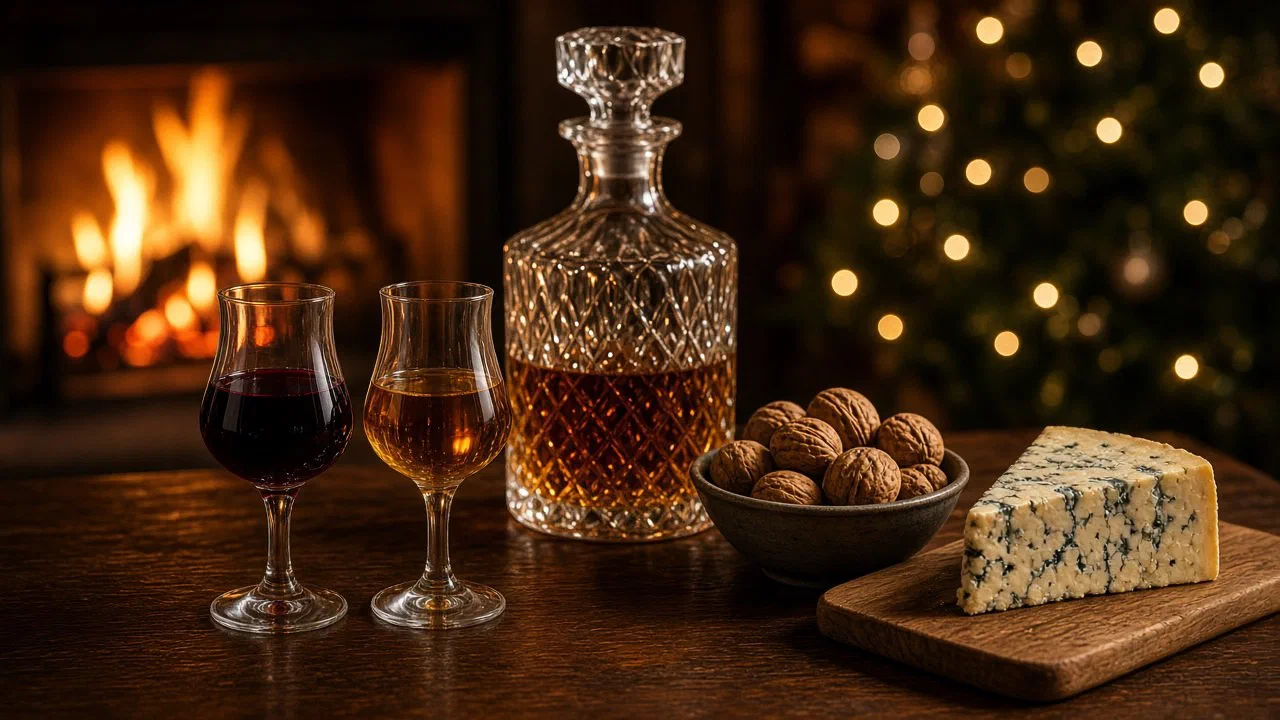
- For the cheeseboard with Stilton: a good Reserve or LBV ruby. The bright fruit and grip stand up to salty blue cheese. If your board leans towards hard cheese, walnuts and dried fruit, go tawny instead.
- For Christmas pudding, mince pies or anything with nuts and spice: a 10 year old tawny. Its caramel and dried fruit notes echo the pudding without fighting it.
- For chocolate desserts: a ruby or LBV. Dark fruit and dark chocolate are a natural pair.
- For a special gift: a 20 year old tawny or a Vintage Port. The tawny is ready to open on the day; the Vintage is a bottle to keep or to drink with someone who loves old wine.
- For a crowd with mixed tastes: buy one of each. A ruby and a 10 year old tawny side by side turn the end of a meal into a small tasting, and people love comparing them.
If you want a wider view of the cheese side, see my wine with cheese pairing guide.
How do you serve ruby and tawny port?
- Measure. Port is strong, so pour small. In the UK, fortified wine sold by the glass comes in 50ml or 70ml measures, and a 750ml bottle gives about fifteen 50ml pours.
- Glass. A small tulip shaped wine glass concentrates the aroma better than a tiny schooner.
- Temperature. Port is often served too warm. Check the right range for each style in my serving temperature tool.
- Decanting. Basic ruby, Reserve and tawny need no decanting. Vintage Port, and unfiltered LBVs, throw a sediment as they age, so stand the bottle upright and decant before serving.
Which keeps longer after opening, ruby or tawny?
In my experience, tawny is more forgiving once open, because it has already spent years slowly exposed to air in wood. Fresh, fruity ruby styles and especially old Vintage Port are best drunk sooner. Whatever you open, reseal it and keep it somewhere cool. If you are keeping bottles to age, my drinking window tool helps you judge when a wine is at its best.
How does Sommo help you choose port?
Port shelves are confusing: ruby, reserve, LBV, tawny, ages, years, single quintas. This is exactly the kind of decision I built Sommo to make easy.
Scan the bottle in the shop. Point your camera at the label and Sommo tells you the style, category, grapes and producer, plus food pairings and serving temperature. A label scan takes about 10 seconds, so you can compare a few bottles before the queue moves. Got a whole shelf in front of you? Sommo picks the best match from the bottles on the shelf, with two or three alternatives.
Get picks shaped by your taste. Sommo learns from the wines you’ve rated, so if you loved last year’s 10 year old tawny and found the ruby too sweet, its suggestions follow that.
Remember which one you loved. Save each port to your wine journal and rate it in a tap. Next December you will know exactly what to buy again.
It runs on proprietary wine-tuned AI grounded in a hand-maintained wine library. The free tier gives you 5 lifetime AI scans per device, shared across label, menu and shelf scans, plus the journal and 30 days of journal history. Premium unlocks unlimited scans, lifetime history, Taste DNA, AI tasting feedback and Tasting Mode for $4.99 a month or $29.99 a year in the US; prices vary by country and store. Sommo runs on iPhone, iPad, Android, HarmonyOS and the web.
For the bigger picture on every style, read my complete port wine guide or browse fortified wines.
Download Sommo and scan your Christmas port.
The bottom line
Ruby port is young, deep red and fruity; tawny port is aged in wood until it turns amber, nutty and mellow. Choose ruby or LBV for blue cheese and chocolate, a 10 year old tawny for puddings and nuts, and a 20 year old tawny or Vintage Port when the bottle is the present. Better still, open one of each and let the table decide.