How to Score a Restaurant Wine Menu Before You Order
Learn how to evaluate restaurant wine lists for quality and value. Plus, how AI-powered menu scoring takes the guesswork out of ordering wine at restaurants.
Restaurant wine lists exist in a strange space between opportunity and anxiety. They contain wines you might love, wines perfectly paired with the meal you’re about to eat, possibly at a once-in-a-lifetime moment. But they also carry intimidating prices, unfamiliar names, and the social pressure of choosing in front of others.
Here’s how to navigate them with confidence, whether you’re relying on your own knowledge or AI assistance.
Reading the Wine List Like a Pro
Structure Tells You a Lot
Well-curated wine lists share common organizational patterns:
- By style (sparkling, white, rosé, red, dessert), the most common format
- By region, signals a wine-focused restaurant with an educated team
- By body/weight (light to full), increasingly popular, very diner-friendly
- By price, straightforward but less informative
A list organized by region with detailed vintage and producer information suggests the restaurant has a knowledgeable wine program. That’s good news, it means someone cared about what’s on the list.
The Midlist Sweet Spot
Most wine lists follow a pricing pattern:
- Bottom third: High-margin, fast-moving wines. Familiar names, aggressive markups.
- Middle third: Where the best value usually hides. Less famous producers, more reasonable markups.
- Top third: Prestige selections. Sometimes worth it, sometimes vanity pricing.
The middle of the list is where wine-savvy diners shop. These wines are interesting enough that the restaurant chose them for quality, not just brand recognition, but they’re priced to actually sell.
Spot the Value Indicators
Regions that over-deliver on restaurant lists:
- Portugal, Outstanding quality at lower price points than France or Italy
- Southern France (Languedoc-Roussillon), Mediterranean character without Bordeaux pricing
- Spain, Aged wines at prices that would be impossible from Burgundy
- Greece, Unique indigenous varieties at accessible prices
- Argentina, Malbec and Torrontés at great value
Red flags for poor value:
- Only well-known commercial brands (the supermarket shelf with a 3x markup)
- Extremely limited selection by the glass (suggests low turnover)
- No vintage listed (the restaurant might not track inventory carefully)
- Only very young wines from regions that benefit from aging
The Manual Evaluation Method
If you understand wine fundamentals, you can evaluate a wine list without any technology:
Step 1: Match to Your Meal
What are you eating? This narrows the list immediately:
- Seafood → crisp whites, light rosés
- Red meat → medium to full-bodied reds
- Pasta with red sauce → medium-bodied Italian reds
- Cheese course → depends on the cheese, but often off-dry whites or medium reds
- Mixed table with varied dishes → versatile wines like Pinot Noir, Grüner Veltliner, or dry rosé
Step 2: Identify What You Know
Scan for grape varieties or regions you recognize. Even basic knowledge helps:
- Know you like Chardonnay? Look for one from a region you haven’t tried
- Enjoyed Rioja before? Try the one on the list
- Love Pinot Noir? See if there’s one from somewhere unexpected
Step 3: Ask the Server (But Smartly)
Don’t ask “what’s good?”, everything is supposedly good. Instead, ask:
- “Which of these whites pairs best with my dish?”
- “Is there a hidden gem on the list you’d recommend around $X?”
- “I usually enjoy Syrah, is there something similar here I should try?”
Specific questions get better answers and show the server you’re engaged, not lost.
AI-Powered Menu Scoring
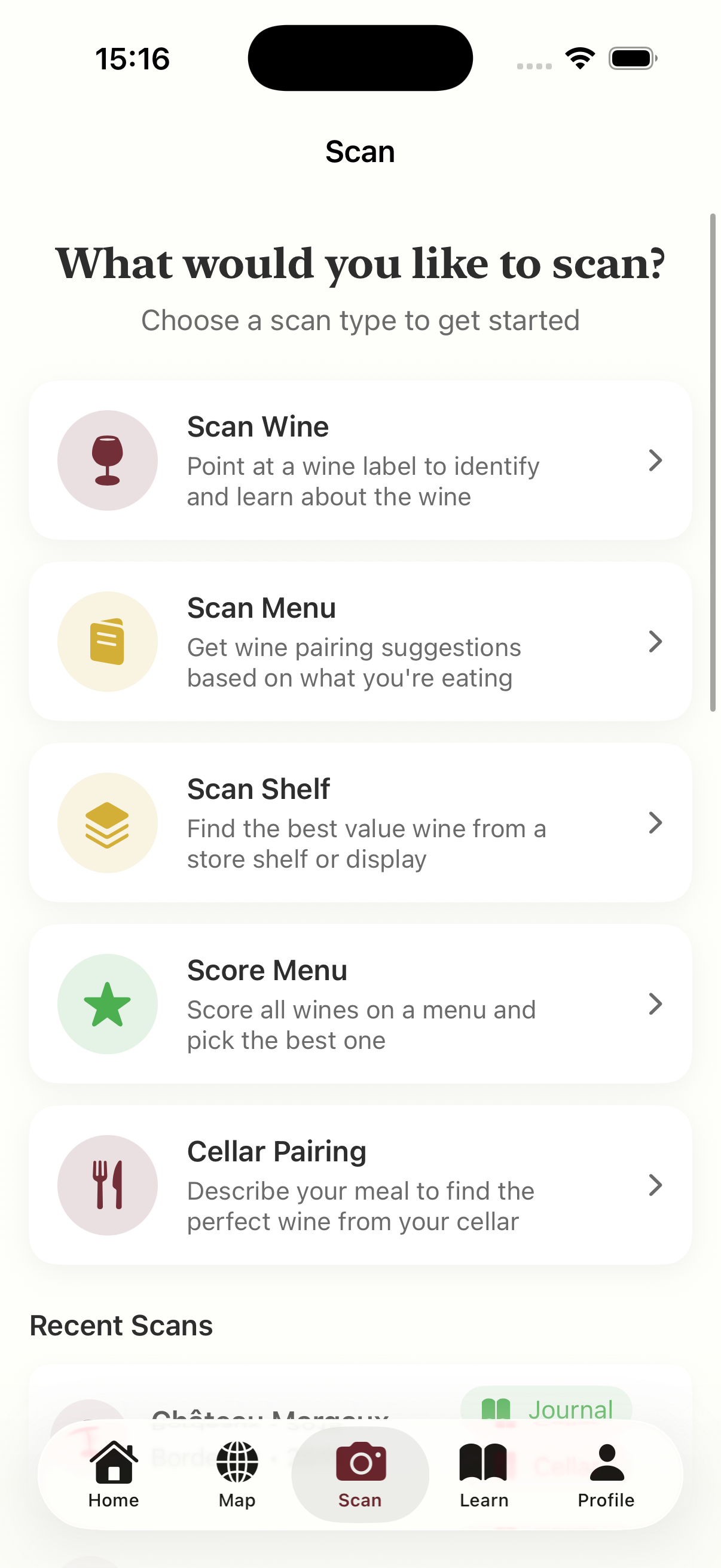
For those moments when you want data-driven confidence, Sommo Premium’s menu scoring feature provides instant analysis:
How It Works
- Open Sommo and select menu scoring
- Scan the wine list with your phone’s camera
- The AI identifies the wines and analyzes their quality and value
- You get a scored overview highlighting the best choices
What the AI Evaluates
- Quality-to-price ratio: Is this wine fairly priced for what it is?
- Wine style and characteristics: What to expect from each option
- Pairing suitability: Which wines complement common menu items
When to Use It
Menu scoring is most valuable at:
- Restaurants with extensive wine lists (50+ options)
- Unfamiliar restaurants where you can’t judge the wine program’s quality
- Business dinners where you want to choose confidently
- Special occasions where the wine choice matters
Building Wine List Confidence Over Time
Technology helps in the moment, but knowledge helps forever. Here’s how to build lasting wine list confidence:
Learn the major grape varieties: Knowing what Chenin Blanc, Tempranillo, and Nebbiolo taste like unlocks most wine lists.
Study wine regions: Understanding that Chablis is un-oaked Chardonnay from northern Burgundy, or that Barossa Valley Shiraz is bold and rich, transforms mysterious listings into known quantities.
Keep a journal: Record what you order at restaurants. Over time, you’ll build a personal database of restaurant experiences that informs future choices.
Explore by the glass: Wine-by-the-glass programs are your low-risk laboratory. Try something unfamiliar for the price of a single glass rather than committing to a full bottle.
The Confidence Equation
Restaurant wine ordering anxiety comes from one source: uncertainty. You’re uncertain about what the wine tastes like, whether the price is fair, and whether your dining companions will judge your choice.
Knowledge eliminates that uncertainty. Whether that knowledge comes from years of wine study, a quick AI analysis, or the combination of both, the result is the same, you order with confidence, enjoy the wine, and actually remember it next time.
Download Sommo and start building the wine knowledge that makes every restaurant visit a pleasure.
Liked this read? Try the app.
Scan any wine label with AI, build your tasting journal, and learn wine your way.