Your wine has arrived on the morning of a dinner. Should you open it tonight, stand it upright or put it away for a fortnight? The useful answer depends on the bottle and what you need it to do.
There is no well-supported universal seven-day or fourteen-day rest rule for delivered wine. Inspect it promptly, bring a sound bottle to a suitable serving temperature, and allow sediment to settle where relevant. Follow specific producer advice for a mature or recently bottled wine. Waiting is a practical choice with a purpose, not a treatment that repairs transport damage.
Inspect Before You Put the Box Away
Check that the bottles and vintages match the order. Look for broken glass, leakage, a displaced closure or damaged packaging before discarding anything. Photograph a problem, retain the order and delivery details, and contact the seller promptly through its stated process. Do not postpone reporting while you wait to see whether “rest” fixes it.
A warm parcel does not reveal the wine’s full temperature history. Our heat-damaged delivery guide explains how to document concerns without declaring a bottle ruined from one sign. Keep suspect bottles out of the dinner’s essential line-up and arrange a backup. Do not open or taste a bottle with broken glass to investigate it.
Once that check is done, put sound wine in suitable stable storage. Avoid leaving the parcel in sunlight or beside a heat source while deciding when to serve it.
Three Different Reasons People Say “Rest”
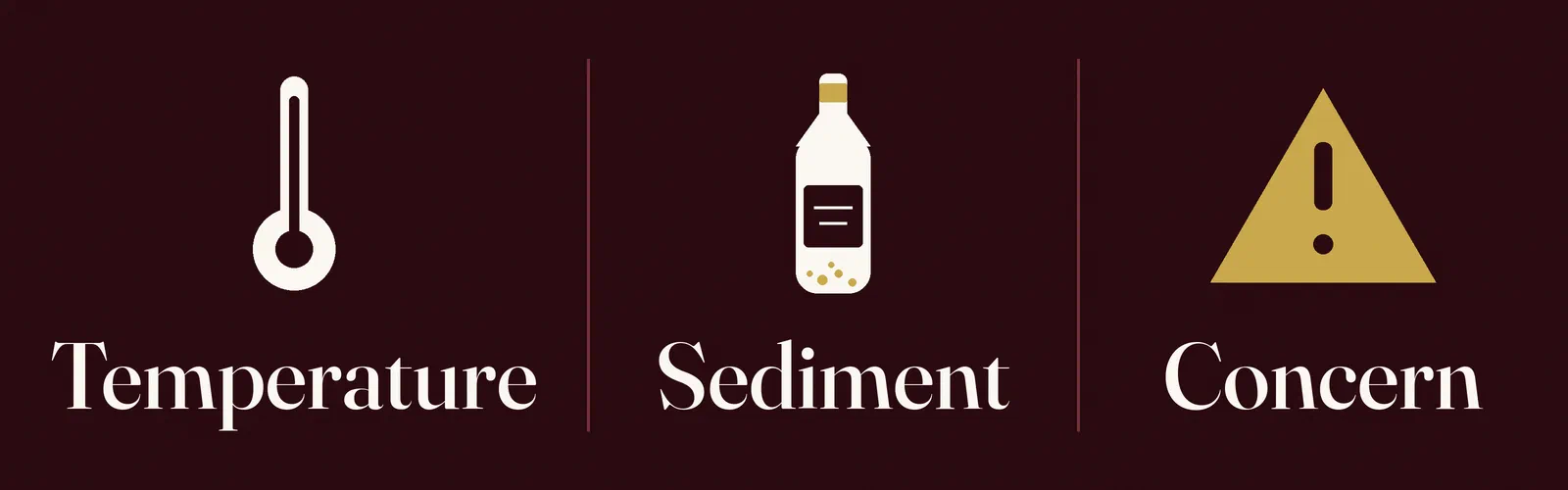
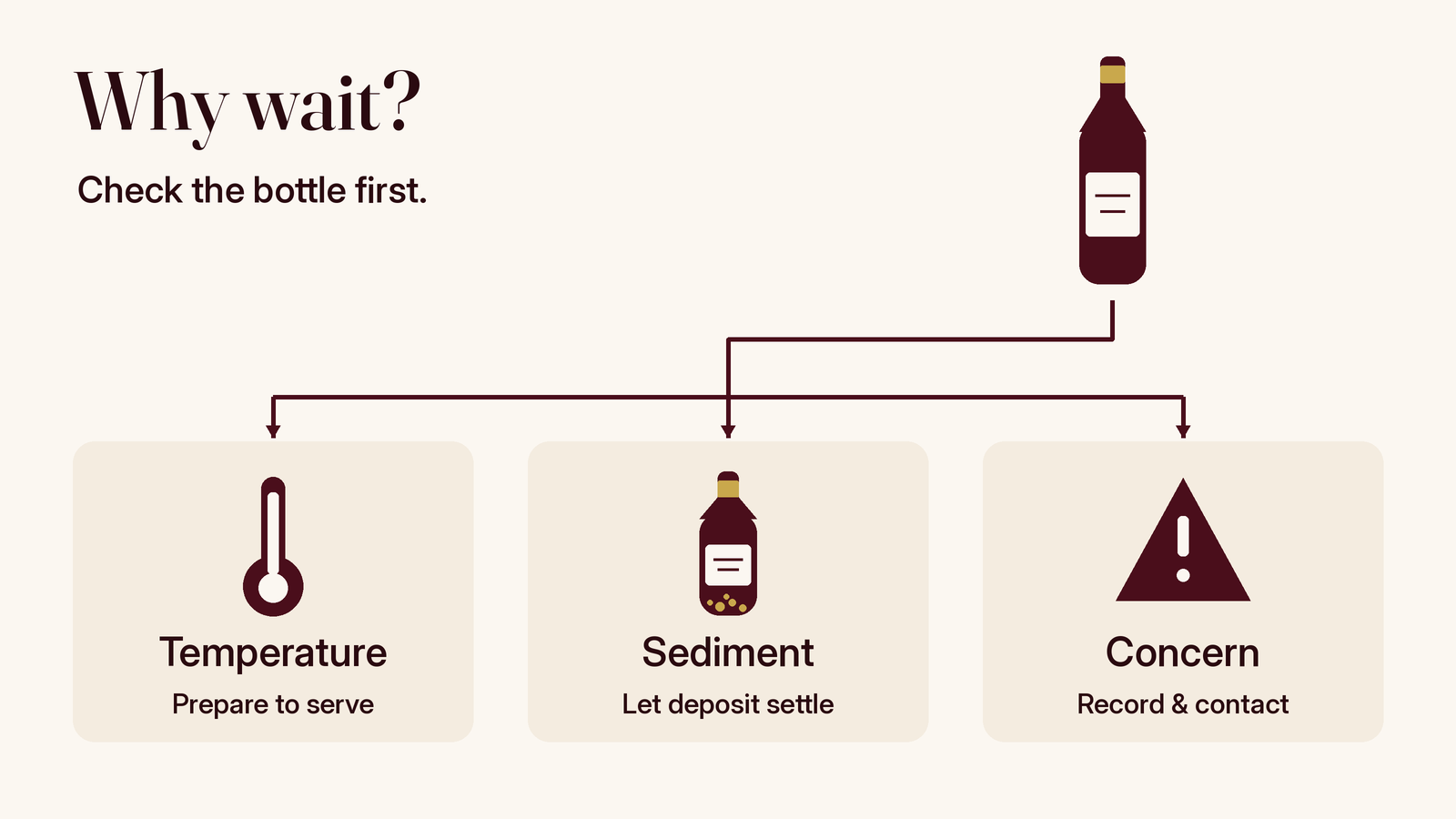
Temperature: wine delivered warmer or colder than you want to serve needs time to reach a suitable temperature. That is a service decision. Cooling a warm bottle does not reverse damage it may already have suffered.
Sediment: movement can redistribute a deposit in an older bottle. Standing it carefully before service can help separate the clear wine from the deposit. On its 1975 Vintage Port page, Taylor’s advises standing the bottle for a few hours before decanting so sediment can settle. This is producer guidance for mature Vintage Port, not a waiting period for every delivery. Use the decanting guide for the separate question of handling a deposit at service.
Recent bottling: “bottle shock” is also used for wine soon after bottling. It should not be treated as another name for having travelled in a van. If a producer has just bottled the wine and gives a specific opening recommendation, record that advice and ask what it means for your bottle.
Ageing until a wine is ready to drink is another decision again. A drinking-window estimate cannot tell you how long a parcel should recover from a journey.
What the Travel-Shock Evidence Can Tell Us
In a first-person Decanter account, Jonas Tofterup MW describes a controlled comparison using 48 consecutively filled bottles of one red wine. Air-freighted groups returned two days or two months before analysis; the road group travelled at the two-day point. A control remained at the winery. Autumn transport avoided heat extremes. The panel found no significant sensory differences at the tested intervals.
Same-day opening was not directly tested. He also reports chemical differences in flown samples and calls for replication with other wines. The result challenges confident claims that every travelled bottle tastes worse at the tested intervals, but it does not establish that transport never affects wine, especially under different temperatures, with fragile mature bottles or after repeated journeys.
We consulted the researcher’s published account, not the original research paper or raw data. We have not conducted a settling test or obtained an expert review for this guide. Those limits are why a precise universal recovery timetable would be misleading.
A Delivery-to-Service Decision Card
This is an original desk-based worksheet. The three completed cases are hypothetical, not bottles we transported or tasted.
| Case and intended opening | What is known | Practical decision |
|---|---|---|
| Clear young white for dinner tonight | Correct order; sound closure; no visible deposit; arrived warm | Bring to suitable service temperature; no automatic week-long delay |
| Mature red for Saturday | Sound bottle; visible sediment disturbed after travel | Store carefully; seek bottle-specific handling advice; allow deposit to settle and plan careful service |
| Questionable delivery for a gift | Leakage and damaged carton; transport history unknown | Photograph and contact seller promptly; choose another gift; waiting is not a repair |
| Your bottle ___; opening date ___ | Condition ___; sediment ___; producer advice/source ___ | Purpose of waiting ___; next action/person ___; review time ___ |
The card deliberately asks for an opening date. A sound young bottle intended for next month can simply go into storage; one needed tonight needs a temperature and service plan. A mature bottle expected tomorrow deserves questions before ordering, especially if it will be central to a special meal.
If you cannot establish its condition or prepare it confidently in time, choose another bottle. That is more dependable than assuming an extra day guarantees recovery.
Record the Reason for Waiting
Keep “arrived 30 October, intact, warm box, intended opening 2 November” separate from “tasted dull on 2 November”. The first is an observation at delivery; the second is a later reaction. Neither proves the cause of the other.
For wine brought home in luggage, our flying-with-wine guide covers packing and travel considerations. The same arrival questions still apply once it reaches your home.
A wine journal can preserve the bottle, opening date, context and your impressions. Use Sommo to remember what you actually observed, while retaining delivery photographs and seller correspondence separately. The record can inform your next purchase; the app cannot predict delivery recovery or certify that waiting has repaired a bottle.