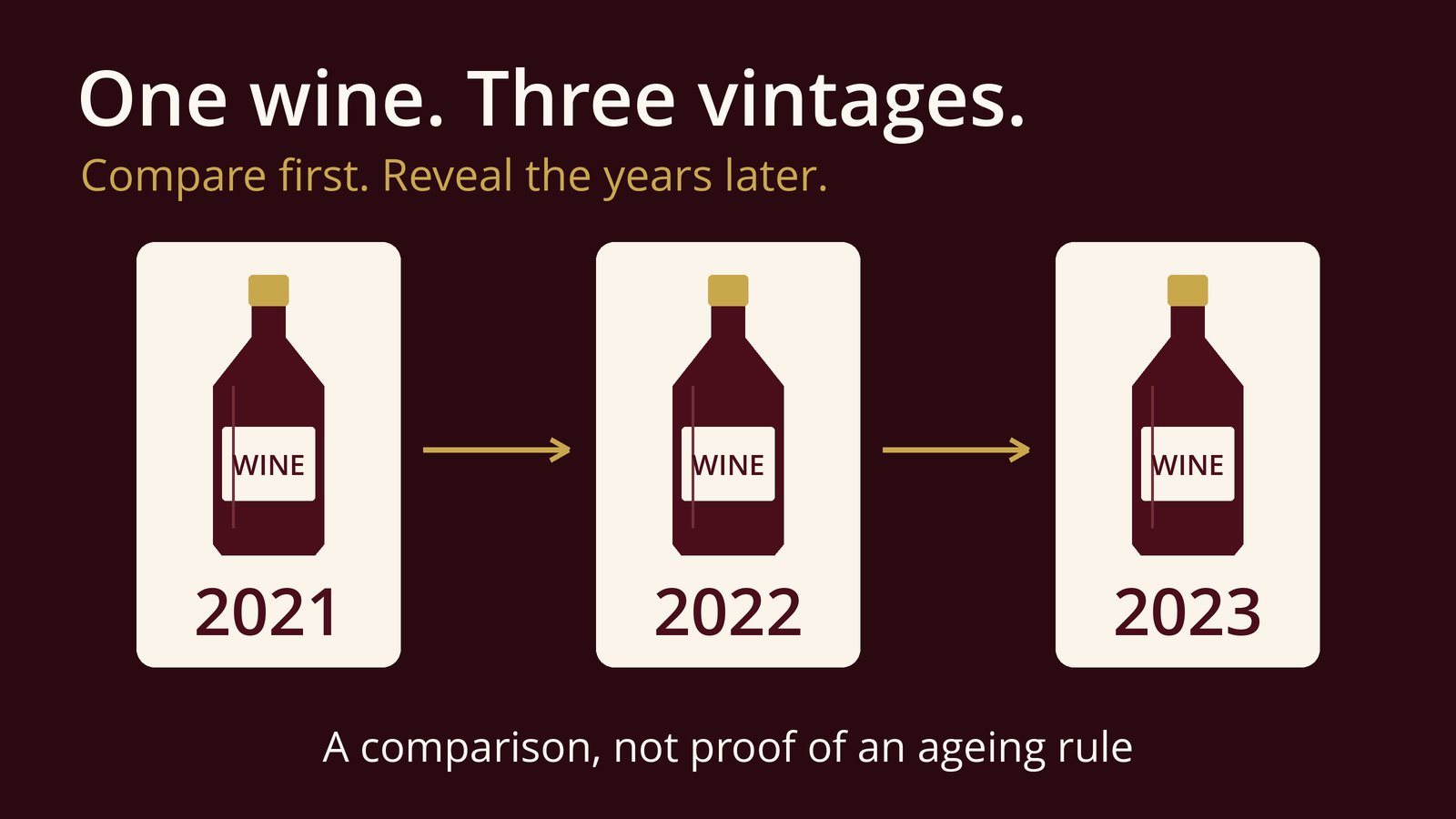
The hardest part of a vertical tasting usually happens before anyone lifts a glass: finding bottles that are comparable enough to make the evening worthwhile.
Choose one exact wine in three vintages, check each bottle’s identity and history, and decide how you will prepare and compare them. You can then ask what differs between those bottles. You cannot assume that every difference is caused by vintage weather or bottle age.
A vertical is the same wine across vintages, one of the formats described in Ridge’s home-tasting resources. If you are still choosing between themes, our wine flights guide covers the alternatives. This plan starts once you have chosen the vertical.
Give the evening one question
A useful question is “Which of these three bottles do we prefer tonight, and what differences do we notice?” A less useful promise is “We will discover exactly how this wine ages.”
The older vintage has also experienced different growing conditions, blending decisions, handling and storage. Even bottles of the same vintage can differ. A home vertical is a structured comparison, not a controlled ageing experiment.
Three vintages keep sourcing, glassware and note-taking manageable. They need not be consecutive, but a large age gap increases the importance of provenance and opening condition. Share the cost before buying and agree what happens if a bottle is faulty or unavailable.
A real three-vintage research example
Ridge Geyserville 2021, 2022 and 2023 provide a workable desk-planning example because producer technical information is available for each. We inspected these pages on 16 October 2026; we have not sourced or tasted the bottles.
| Exact wine | Published blend, in brief | Producer context to read later |
|---|---|---|
| Geyserville 2021 | 76% Zinfandel; 16% Carignane; 6% Petite Sirah; 2% Alicante Bouschet | Dry winter; 14.8% ABV |
| Geyserville 2022 | 67% Zinfandel; 20% Carignane; 10% Petite Sirah; 3% Mataro | Heat during harvest; 14.5% ABV |
| Geyserville 2023 | 70% Zinfandel; 18% Carignane; 9% Petite Sirah; 3% Alicante Bouschet | Cooler, later harvest; 14.6% ABV |
The label stays Geyserville, but the blend changes. That is a concrete reason to resist attributing everything you notice to age. The notes are producer context, not predictions of what your particular bottles will taste like. These pages also do not establish current merchant stock or delivered prices.
Buy by identity and condition
Match producer, cuvée, vineyard or appellation and bottle size. Avoid accidentally comparing a reserve bottling with the standard wine, a half-bottle with a magnum, or a similarly named wine from another site. Ask the merchant to confirm the vintage that will actually ship; a product title listing two years leaves the plan unresolved.
Request information about storage history and current condition. For older bottles, ask for photographs showing fill level, closure area, capsule and label, plus any known seepage or previous damage. Photographs cannot prove good storage, but missing history is worth recording. “Bought from a reputable merchant” and “known continuous storage” are different statements.
Prefer a consistent source where practical. If the older wine comes from a private cellar and the younger wines from recent retail stock, keep that difference in the worksheet. Ask about the seller’s process for an incorrect vintage, delivery damage or a suspected fault before you pay.
Complete the sourcing and preparation card
Use one card per bottle. This completed row is synthetic purchasing information using a real wine identity; it is not an actual offer or a claim about a bottle’s condition.
| Field | Synthetic example | Your bottle |
|---|---|---|
| Identity / size | Ridge Geyserville 2021 / 750ml | ______ |
| Source / storage history | Merchant A / history not supplied | ______ |
| Condition evidence | Photo requested; not received | ______ |
| Price / uncertainty | £55 + £5 delivery = £60; quote unconfirmed | ______ |
| Preparation plan | Stand upright before session; inspect on opening | ______ |
| Actual opening / treatment | To record on the day | ______ |
Three illustrative delivered costs of £60, £50 and £45 total £155. Split equally between five contributors, that is £31 each, before food or any replacement bottle. Work out your own total using confirmed offers; combining orders may change delivery charges.
Do not buy an unsuitable bottle just to complete a sequence. Two well-documented vintages are more useful than a third with doubtful identity or condition.
Decide preparation and order in advance
Allow delivery time before the event, especially for bottles with sediment. Read our decanting guide before choosing a treatment. Separating sediment and adding air are different aims. Blanket instructions to decant every vintage for the same long period may be a poor fit for fragile older wine.
Record serving temperature, opening time and any decanting separately for each bottle. Use matching clean glasses and comparable small samples. Small pours are for comparison, not a drinking target: provide water and spittoons, welcome smell-only participation, and arrange transport that does not depend on tasting participants driving. Plan what to do with open wine instead of expecting the group to finish it.
Oldest first gives a potentially delicate bottle attention before a more forceful young wine. Youngest first gives the sequence a clear chronological direction. Coded, varied order reduces the cue from seeing a year, while making the age story less immediate. None eliminates carry-over effects. Choose an approach, write it down, then revisit the glasses in a different order if their condition allows.
Keep first impressions independent
Cover the bottles or use codes if you want to hide years. Give everyone a quiet first pass before reading producer descriptions or hearing the most confident guest’s verdict.
For each code, note aroma families, perceived acidity and tannin, body, condition, preference and uncertainty. Add a second observation after time in the glass. Only then reveal identities and open the producer notes. Mark any new descriptor you adopt after the reveal as prompted.
Sommo’s Sharing Party supports independent guest ratings before the host reveals them, if your group wants a shared record. Keep the bottle-history and preparation cards too: ratings alone do not capture those differences.
End with a modest conclusion: which bottle you preferred, which observations the group shared, and what remains uncertain. That gives you a useful next purchase or future comparison without turning three bottles into proof of an ageing rule.