Keep an NV wine non-vintage, and record its edition, lot code and disgorgement information separately. A year printed somewhere on the bottle may describe a component harvest, bottling or release. It does not automatically become the wine’s vintage.
The point is to recognise the bottle you own and remember the one you drank. Two bottles can have almost identical front labels yet belong to different releases. A careful note is more useful than forcing both into a neat but false year field.
Five facts that should stay separate
| Detail | What it identifies | How to record it |
|---|---|---|
| Declared vintage | The wine’s labelled harvest vintage | Enter the declared year; do not infer one |
| NV or non-vintage | A wine sold without a declared vintage | Retain NV where supported; otherwise explain it in a note |
| Edition or lot | A producer’s release or production reference | Copy the complete wording or code literally |
| Disgorgement | Removal of the lees sediment in bottle-fermented sparkling wine | Retain the producer’s stated date and its precision |
| Purchase date | When you acquired that bottle | Keep it with the purchase, not the vintage |
A producer may also disclose the youngest or base harvest in a blend. That is informative, but it does not turn the whole blend into a vintage wine. Our Champagne guide explains the underlying distinction; this article is about keeping the resulting records usable.
A real example: read the producer’s terms literally
Krug’s official record for iD 424045, checked on 10 October 2026, identifies Grande Cuvée 173ème Édition. It describes a blend built around the 2017 harvest, including wines from 2001 to 2017, and says the cork was received in autumn 2024.
Those details answer different questions. Record the edition as 173ème Édition. Preserve the producer’s cork-season wording rather than converting autumn into an invented day. Do not rename the wine “Krug 2017” or “Krug 2024” on that basis.
Krug iD provides information about a release. It is not your unique inventory number for one physical bottle. If you own two bottles carrying the same iD, you still need another way to distinguish them when their location or history differs.
Give similar bottles a practical identity
Here is an invented example for a fictional producer, Maison Alder. The dates and codes demonstrate a record method, not a decoding rule.
| Your bottle reference | Labelled wine | Release detail copied from bottle | Purchase and location |
|---|---|---|---|
| A01 | Maison Alder Brut NV, 750 ml | Lot L2408; disgorged August 2024 | Bought May 2026; rack A, slot 1 |
| A02 | Maison Alder Brut NV, 750 ml | Lot L2502; disgorged February 2025 | Bought September 2026; rack A, slot 2 |
Keep a photograph of each back label and a link to any relevant producer page. If the date is absent or the code is unexplained, write “not stated” or “meaning unconfirmed”. The receipt date cannot fill that gap.
The personal references A01 and A02 identify your bottles. They are not producer lot numbers, and they should not be presented as such. A cellar inventory register can hold those references even when your app groups several bottles under one wine.
Check how your app groups additions
Before adding the second release, see whether the app creates a distinct record or increases the quantity on an existing wine. Check the notes afterwards. A release detail that silently replaces another is worse than a visibly incomplete field.
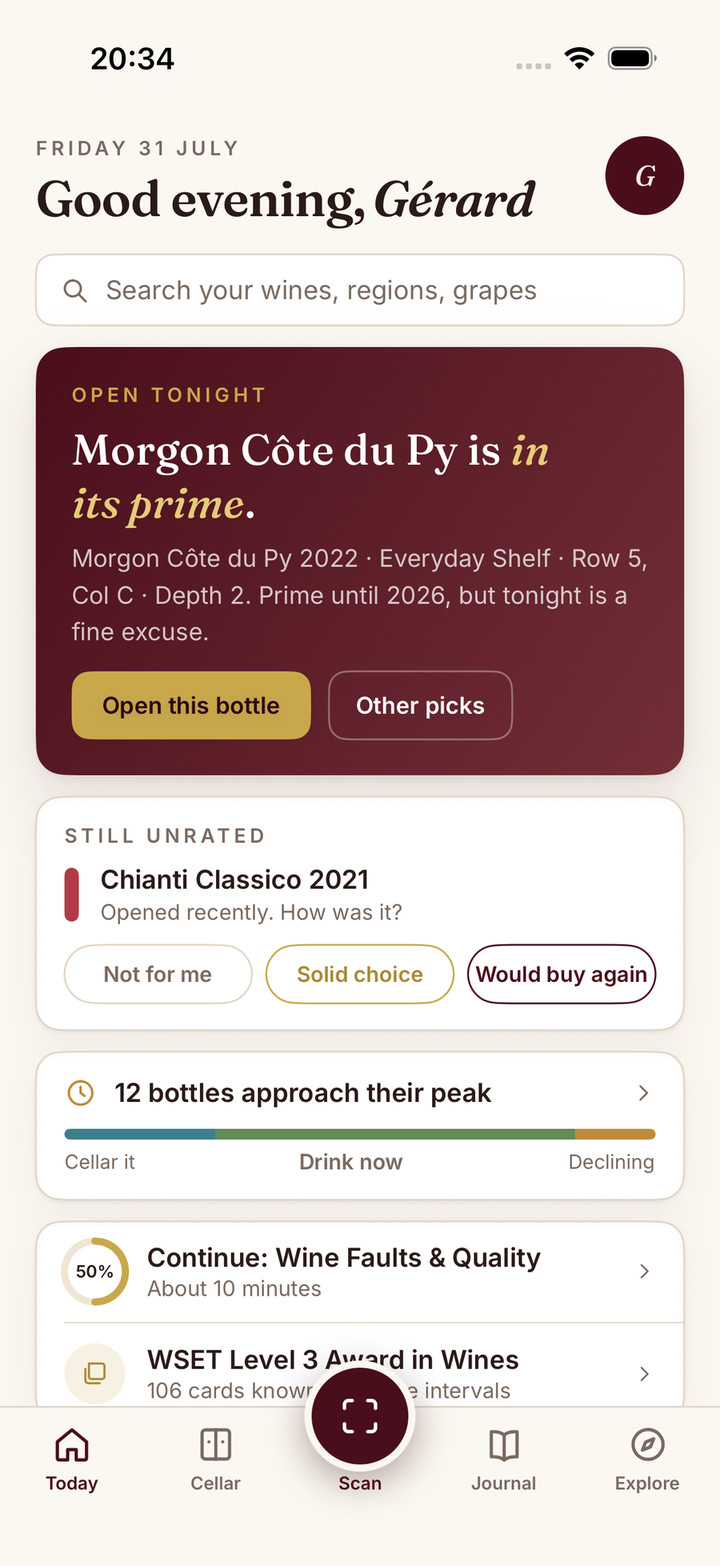
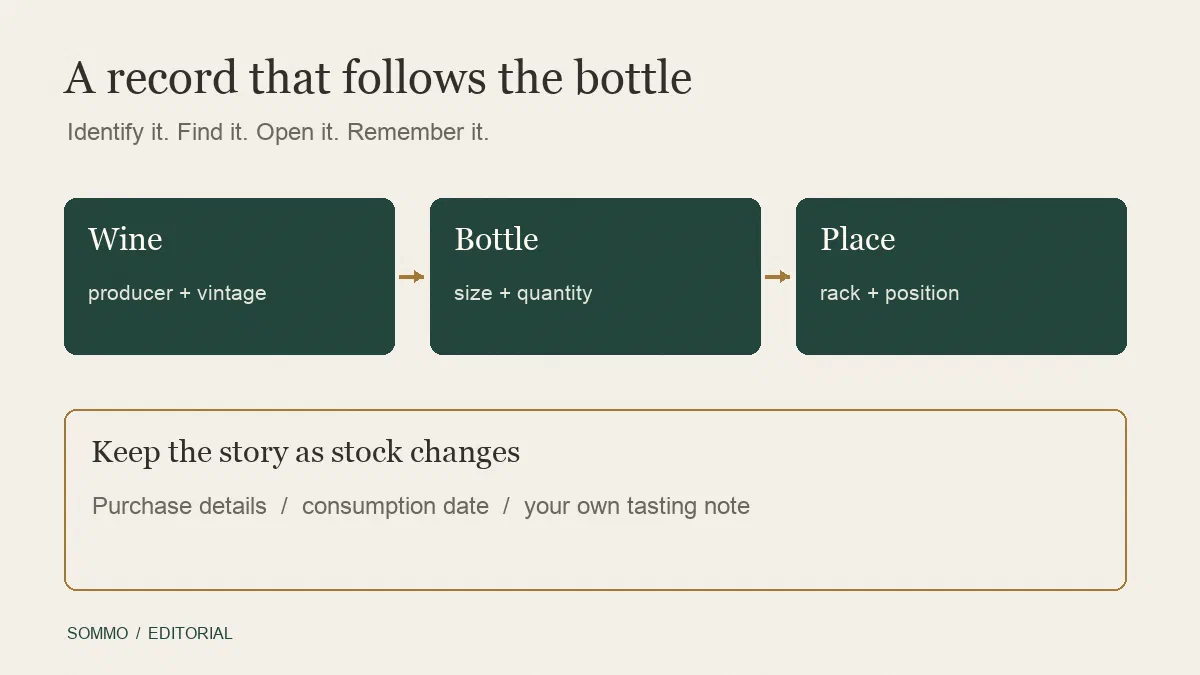
Sommo has personal notes, but no dedicated edition or disgorgement field. Repeated stock additions for the same wine ID consolidate into one cellar entry; they do not create independent batch lots. If you need separate bottle histories, keep the detailed register outside that grouped entry and use a clear reference in the note. Cellar management requires Premium.
Avoid changing the producer’s wine name just to make a second record appear. If identification is uncertain, follow the label-correction workflow and keep the uncertainty visible.
Make the record useful when you open it
Copy the release reference into the tasting note, then describe your actual experience. For example: “A02, lot L2502; tasted 12 October; fresh apple, light toast, would buy again.” This is an illustrative note, not a tasting result.
Do not combine observations from different releases into one confident claim about the whole cuvée. Serving temperature, storage and time open can also affect what you notice. A second edition is an interesting comparison, not a controlled experiment merely because both bottles were served at dinner.
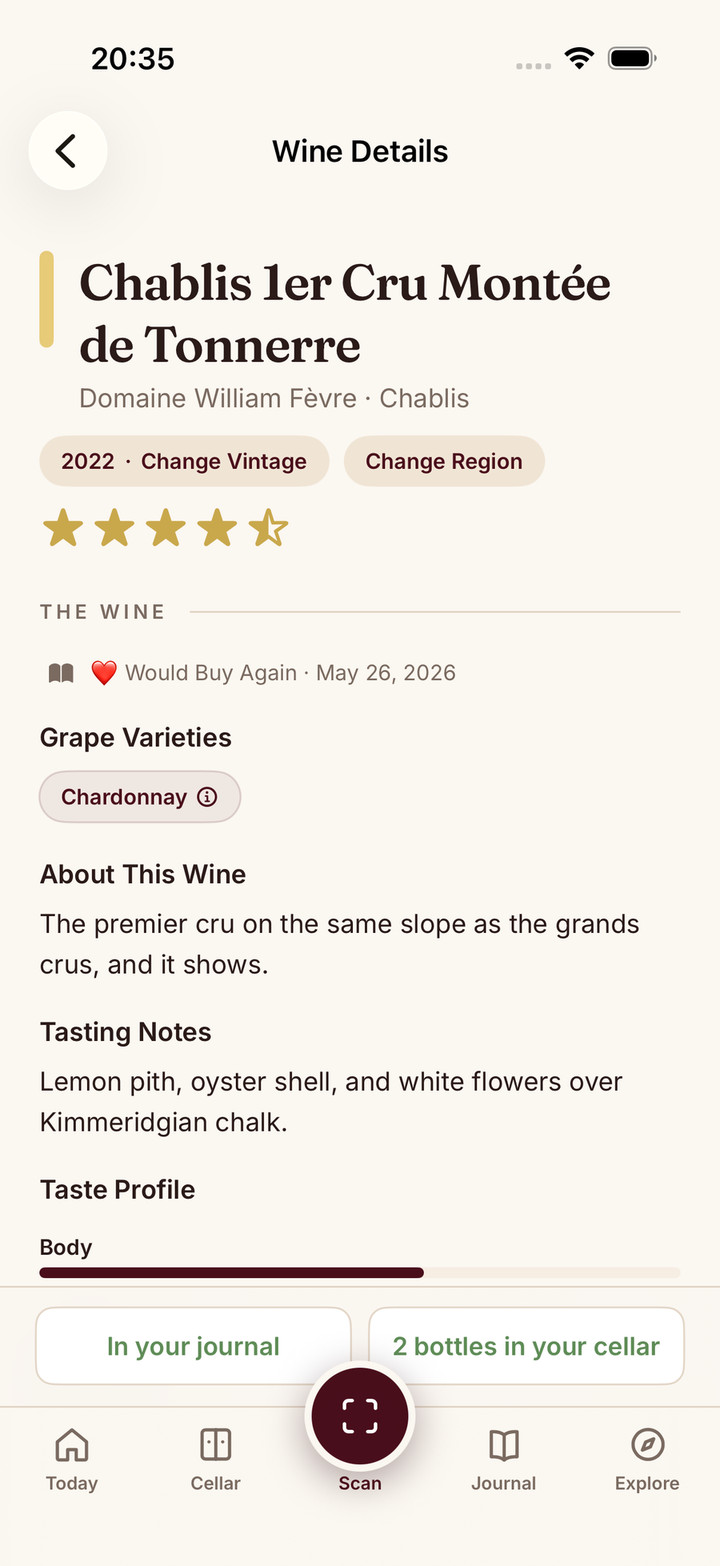
Record the wine you actually tasted in Sommo, including the literal release detail in the note. Free journal history covers the last 30 days; Premium gives access to the full history. Keep the bottle register and producer evidence separately if you need a lasting inventory trail.