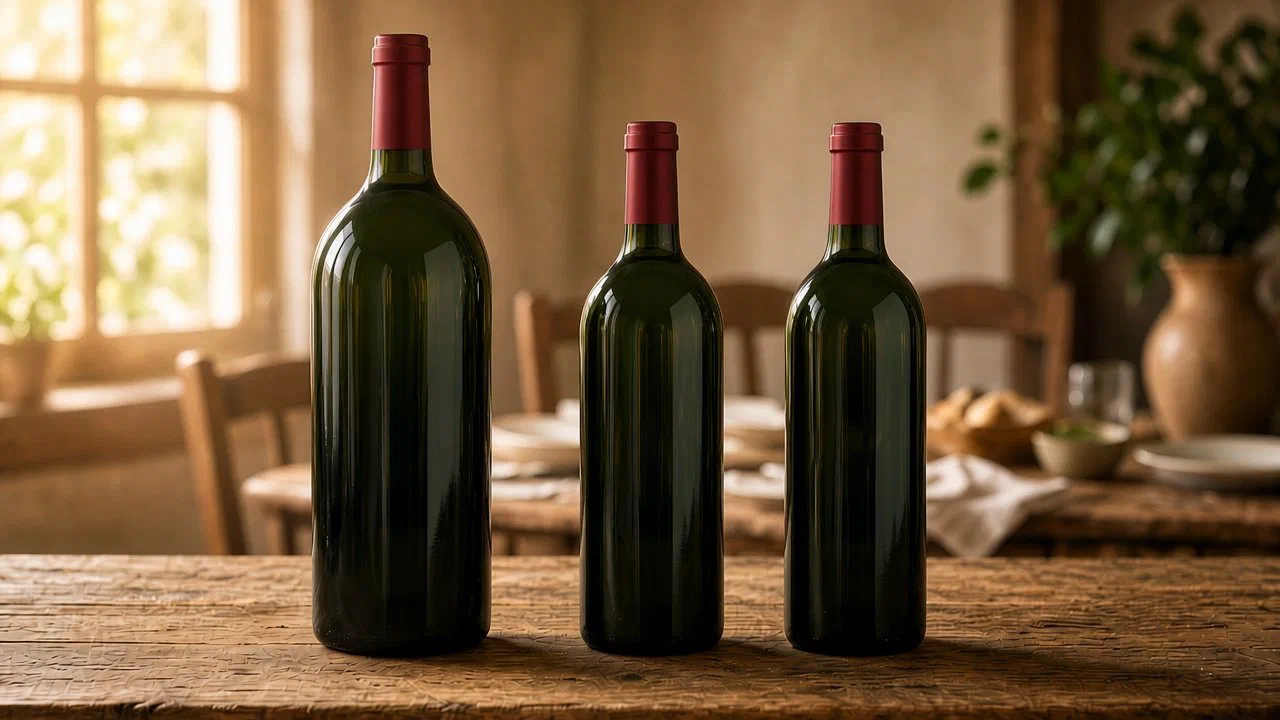
A magnum on the table changes the mood of a dinner. People notice it, they ask about it, and somehow the wine tastes more generous. But it holds exactly what two ordinary bottles hold, so is it worth the fuss and, often, the extra money?
The short answer: a magnum holds 1.5 litres, the same as two 75cl bottles, and it is worth it for a group of six or more, a wine you want to age or simply a sense of occasion. It is widely believed that wine ages more slowly in magnum, because there is less air relative to the wine; Berry Bros. & Rudd explains why, though Wine Spectator notes it is conventional wisdom rather than proven. For two people over two evenings, two bottles win.
Below I cover what a magnum is, whether wine really ages better in one, how many glasses you get, the price question, and practical tips for serving and storing.
What is a magnum of wine?
A magnum is a 1.5 litre bottle, double the standard 75cl. It is one of the standard sizes allowed for still and sparkling wine under the EU bottle size rules kept in UK law, alongside 75cl, 37.5cl and others. My guide to wine bottle sizes covers the whole family, from half bottles to the giants.
Does wine really age better in a magnum?
The case for it:
- Less air per glass. A magnum holds twice the wine of a standard bottle with a lower ratio of air to wine, both in the gap under the cork and in the air the cork itself holds. As Berry Bros. & Rudd puts it, less air means less reaction, which slows maturation.
- More thermal mass. A bigger volume of liquid warms and cools more slowly, so small swings in temperature have less effect.
- Champagne evidence. A study of Champagne aged for 25 to 47 years found magnums lost their dissolved carbon dioxide more slowly than standard bottles, so they kept their bubbles longer.
The caution: Wine Spectator points out that slower ageing in magnum is conventional wisdom and that drinking windows are written for standard bottles. In practice I treat a magnum as a little slower to mature, not a different wine.
For wines you are drinking this year, none of this matters much. It matters for bottles you plan to keep for a decade.
How many glasses are in a magnum?
| Pour size | Glasses from a magnum | Glasses from two 75cl bottles |
|---|---|---|
| 125ml (small) | 12 | 12 |
| 175ml (medium) | about 8 | about 8 |
| 250ml (large) | 6 | 6 |
The maths is identical; that is the point. What changes is that everyone drinks the same wine from the same bottle, which is lovely at a dinner and less flexible if half the table wants white. For bigger gatherings, my guide to how much wine for a party and the wine party calculator do the sums.
A magnum of 13% wine holds about 19.5 UK units of alcohol, so it is a bottle for sharing around a table, not for two people. The NHS advises no more than 14 units a week, spread over three or more days.
Is a magnum cheaper than two bottles?
Usually not. Magnums are made and bottled in smaller numbers, and they often cost the same as two bottles or a little more. Occasionally a merchant prices them generously, so it is always worth comparing the price per litre. If the cost matters more than the occasion, two bottles are the sensible choice.
When should I choose a magnum over two bottles?
Choose a magnum when:
- You are six or more around one table.
- You want to age a wine for many years.
- It is a celebration and the bottle is part of the fun.
- You are pouring one wine through a long lunch.
Choose two bottles when:
- You are two people drinking over two or three evenings. Open one, keep the other sealed. My post on how long wine lasts after opening explains why a sealed bottle beats half a magnum left open.
- You want to compare two wines, or serve a white and a red.
- Fridge or rack space is tight.
How do I serve and store a magnum?
- Chill early. Twice the liquid takes longer to cool. An ice bucket with water and ice works fastest.
- Pour with two hands. Support the base; it is heavy when full.
- Decant old reds. An older magnum may have sediment; my decanting guide covers how.
- Check your rack. Many racks and wine fridges do not fit a magnum. My guide to bottle dimensions and rack fit has the measurements to check.
- Store on its side in a cool, dark, steady place, like any bottle with a cork.
How does Sommo help with magnums?
Know what you are buying. Scan the label and Sommo tells you the producer, grape, region, style and drinking window in about 10 seconds. The scan saves the wine; rate it after the first glass and it goes into your journal.
Keep track of special bottles. With Premium, the Sommo cellar holds every bottle you own, big or small, with its drinking window. Ask Sommo picks the best bottle for tonight’s meal from the bottles you own, so the magnum gets opened for the right dinner. Export to CSV or XLSX is free.
Choose a wine the table will love. Sommo picks the best match from the bottles on the shelf, with two or three alternatives, using your 10 most recent ratings.
It all runs on proprietary wine-tuned AI grounded in a hand-maintained wine library. The free tier gives you 5 lifetime AI scans per device, shared across label, menu and shelf scans, plus the journal and 30 days of journal history. Premium unlocks unlimited scans, lifetime history, Taste DNA, AI tasting feedback and Tasting Mode for $4.99 a month or $29.99 a year. Sommo runs on iPhone, iPad, Android, HarmonyOS and the web.
Download Sommo and keep track of your best bottles.
The bottom line
A magnum holds the same 1.5 litres as two standard bottles. It is the better pick for a table of six or more, for wines you want to age (it is widely held to mature more slowly) and for a sense of occasion. Two bottles are cheaper more often, more flexible and better for two people over a few nights. Compare the price per litre and check your rack before you buy.