Every wine drinker has lived this moment: a bottle you loved a month ago, a shop shelf in front of you, and no memory of anything except that the label might have had a bird on it. The fix is not a better memory. It is a written note, taken in under a minute, in a format you will actually keep using.
I have kept wine notes for years, and the honest confession is that my early ones were useless. “Nice. Smooth. Would drink again.” Three months later those words described two hundred wines equally well. What follows is the method I wish someone had handed me at the start: a casual version for real life, and the professional version it grows into.
What to jot at a tasting (the ground floor)
At a busy tasting or a dinner, you have thirty seconds and one free hand. Capture four things, in this order of importance:
- The wine’s identity: producer, wine name, vintage. A photo of the label does this fastest.
- A verdict you will trust later: love it, like it, or leave it. Commit. “Interesting” is a dodge.
- One thing it smelled or tasted of, in your own words. “Cherry cola”, “cut grass”, “like a bonfire”.
- The context, if it matters: what you ate with it, who poured it, why it worked.
That is a complete, useful tasting note. Everything below is refinement, not requirement.
The 4-line method: look, smell, taste, conclude
When you have two minutes rather than thirty seconds, four short lines make a note you can compare against every other note you will ever write. This structure is not mine; it is how virtually all professional tasting works, stripped to its skeleton.
Line 1, Look. Colour and intensity, nothing more. “Pale lemon”, “deep ruby”, “fading garnet at the rim”. Ten seconds. Colour tells you about age, grape, and winemaking before you smell anything.
Line 2, Smell. Three aromas, named as specifically as you can manage. Push past “fruity”: which fruit? Fresh, ripe, cooked, or dried? Then anything that is not fruit: herbs, flowers, bread, smoke, vanilla, wet stones. The nose carries most of a wine’s information, so this is the line worth the most effort.
Line 3, Taste and structure. One line covering sweetness (bone dry to sweet), acidity (how much your mouth waters), tannin for reds (how much your gums dry), body (skimmed milk to full cream), and how long the flavour lasts after swallowing. If the sweetness scale feels abstract, the wine sweetness chart pins every major style to it.
Line 4, Conclude. Quality and verdict in plain words: was it balanced, was it interesting, would you pay that price again. This is the line future-you actually reads first.
A worked example: Marlborough Sauvignon Blanc
Here is the method applied to one of the most recognisable styles in the world, a Sauvignon Blanc from Marlborough, New Zealand:
Look: pale lemon, almost water-white at the rim, faint green tint. Smell: pungent and fresh. Passionfruit, cut grass, grapefruit pith, a whisper of green pepper. Taste: dry, searingly high acidity, light body, no tannin, flavours mirror the nose, medium finish that ends on citrus. Conclude: textbook and refreshing rather than complex. Exactly what it promises. Great with goat’s cheese; would rebuy under $18.
Four lines, one minute, and in a year that note will still tell you precisely what the wine was and whether to buy it again. Write twenty notes in this shape and something better happens: patterns emerge. You discover you consistently love high acidity, or that “vanilla and coconut” is your signal to walk away. That self-knowledge is the actual product; the notes are just the means. The five S method covers the physical tasting technique that feeds these lines, and how to taste wine like a sommelier goes deeper on training the nose.
How the WSET SAT formalises the same four lines
The Wine and Spirit Education Trust’s Systematic Approach to Tasting, the SAT, is this exact method with the vagueness surgically removed. Where the casual note says “smells of passionfruit, quite acidic”, the SAT demands positions on fixed scales: aroma intensity from light to pronounced, acidity from low to high, finish from short to long, quality from faulty to outstanding, every wine judged against the same rulers.
That standardisation is what makes professional notes comparable across tasters, countries, and years, and it is why exam candidates drill the grid until it is reflex. You can see the actual grids for each level: the Level 2 tasting sheet keeps things approachable, while the Level 3 tasting sheet adds the BLIC quality logic (Balance, Length, Intensity, Complexity) that turns “I liked it” into a defensible judgement. If the vocabulary on those sheets is unfamiliar, the WSET glossary decodes every term.
You do not need to be studying for anything to borrow the SAT’s discipline. Even adopting one habit, always rating acidity on a low to high scale, makes every note you write more comparable with the last one.
The five mistakes that kill tasting notes
Writing for an imaginary audience. Your note is not wine journalism. “Gooseberry and crushed shells” is worthless if you have never knowingly smelled either. Write words that mean something to you; translate to formal vocabulary later if you ever need to.
Recording everything except the verdict. A note that lists eight aromas but no opinion cannot answer the only question that matters at the shelf: buy it again or not?
Only noting special bottles. The Tuesday wines are where your palate actually lives. Noting only trophies gives you a diary of occasions, not a map of your taste.
Poetry over structure. “Sunset in a glass” is lovely and tells future-you nothing. Structure (dry, high acid, light body) is boring and tells future-you everything.
Trusting the label photo. A camera roll of five hundred labels is not a journal, it is a graveyard. Without a verdict attached, every photo asks the same unanswerable question: did I like this?
For the decoding direction, reading other people’s florid notes rather than writing your own, wine tasting notes explained translates the critic-speak.
How Sommo structures this automatically
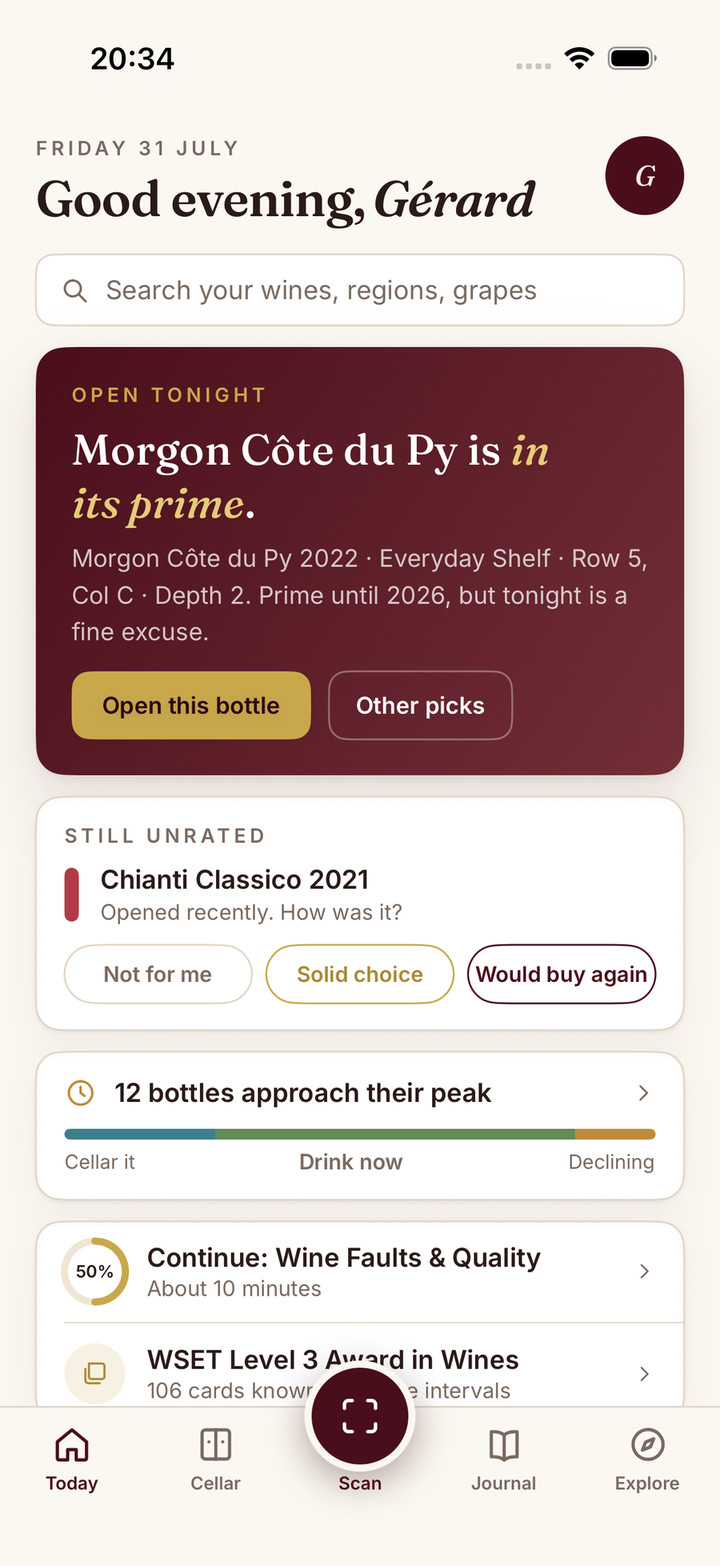
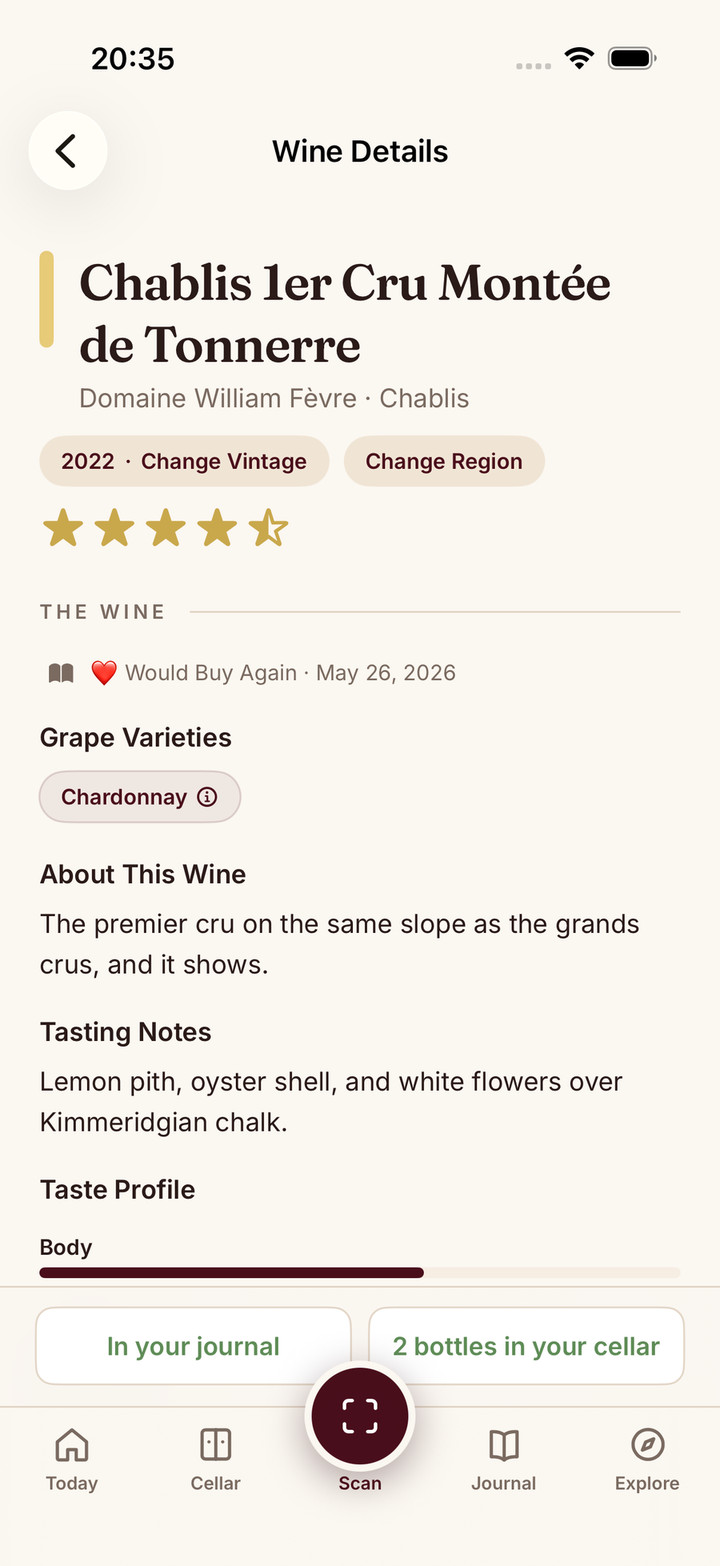
Everything above works with a pocket notebook. The reason I built structured tasting notes into Sommo is that the friction is what kills the habit: scan the label and the wine’s identity, region, and grape are logged before you have found a pen. The note screen then walks the same look-smell-taste-conclude arc, from a quick three-tier verdict on casual nights up to full SAT-style structured entries (appearance, nose, palate, conclusions) when you want to go deep, with AI feedback on how your note aligns with the wine’s known character.
Every note lands in your wine journal, which is where the compounding happens: patterns across regions, grapes, and price points that no shoebox of paper notes can surface. Start with the four lines tonight, on any bottle within reach. The method sticks because it is small, and what it builds is not a stack of notes but a palate you can finally read. Keeping a personal tasting journal is the single habit that separates drinkers who remember from drinkers who guess.