There is no wrong time to learn how to open a wine bottle properly. Whether you are hosting your first dinner party, trying to impress at a restaurant, or simply tired of mangling corks at home, this guide covers every tool and every tricky situation you will encounter.
The Waiter’s Friend (Sommelier Knife)
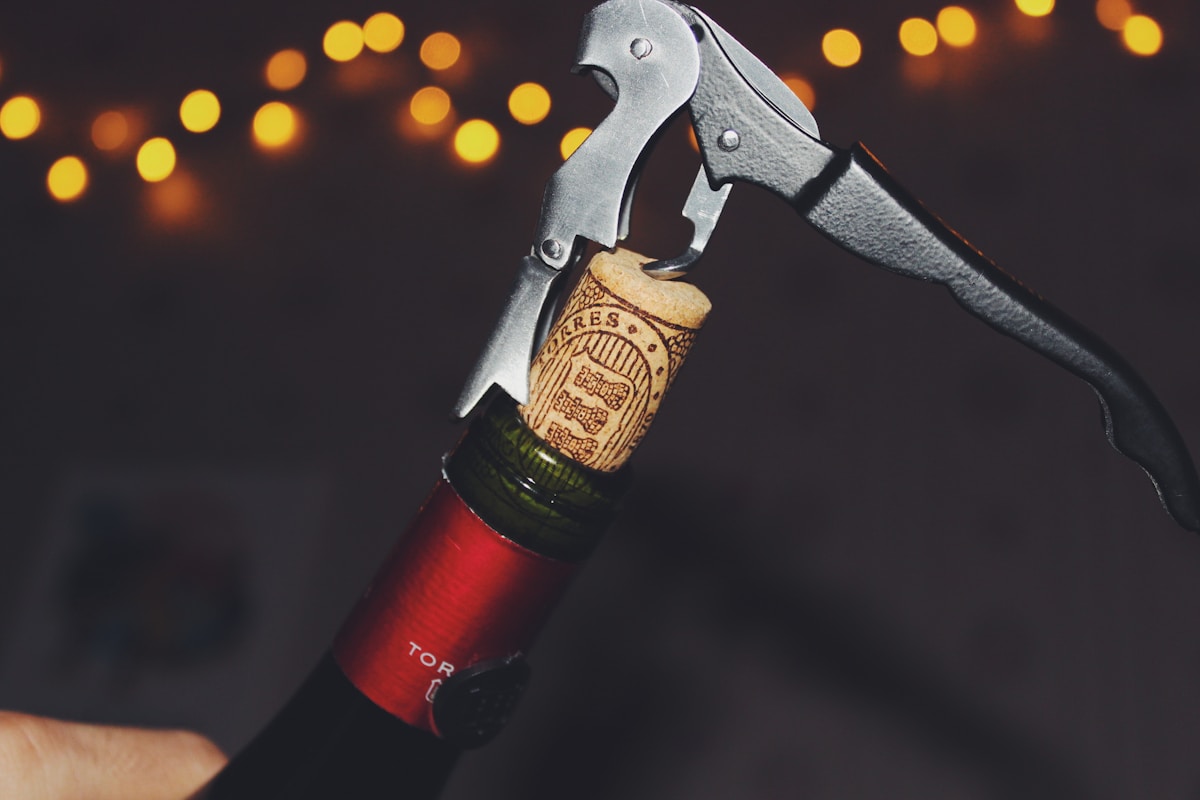
This is the tool professionals use, and for good reason. It is compact, reliable, and gives you the most control. A good waiter’s friend has three parts: a small blade for cutting the foil, a worm (the spiral), and a hinged lever that rests on the lip of the bottle.
Step by Step
Cut the foil. Open the small blade and cut around the foil capsule just below the lip of the bottle. Most people cut below the second ridge. Remove the foil cap cleanly; you do not want foil fragments falling into the wine later.
Wipe the top. If you see any residue or mould on the cork top, wipe it with a clean cloth. This is especially common with older bottles.
Insert the worm. Open the corkscrew spiral and place the tip slightly off centre on the cork. Twist the worm clockwise into the cork, keeping it as straight as possible. You want to go deep enough that only one spiral turn remains visible. Going too shallow is the most common cause of broken corks.
Engage the first notch. Place the first (shorter) step of the lever on the lip of the bottle. Hold the lever firmly against the lip with one hand and pull the handle upward with the other. The cork should rise about halfway.
Switch to the second notch. Move to the second (longer) step of the lever and repeat. The cork should now be almost entirely out.
Finish by hand. Once the cork is nearly free, grip it and twist it out gently by hand. This avoids the satisfying but slightly uncouth “pop” and reduces the chance of wine splashing.
Common Mistakes with the Waiter’s Friend
- Inserting the worm at an angle. This sends the screw through the side of the cork, which either breaks it or makes extraction impossible. Take a moment to centre the tip before twisting.
- Not going deep enough. If only half the worm is in the cork, you will pull the top off and leave the bottom half stuck in the bottle.
- Forgetting to use the lever. Brute force pulling without the lever is a recipe for a broken cork and a sore arm.
- Cutting the foil above the lip. Wine that drips over a ragged foil edge picks up a metallic taste. Always cut below.
The Wing Corkscrew
The wing corkscrew (also called a butterfly corkscrew) is the one most people have at home. It has two metal “wings” that rise as you twist the worm into the cork.
How to use it: Centre the worm on the cork and twist the handle clockwise. As the worm goes in, the wings rise. Once fully inserted, push both wings down simultaneously with even pressure. The cork lifts out.
The wing corkscrew is forgiving for beginners because the mechanism is intuitive. The downside is that the worm is often thicker and shorter than a waiter’s friend, which makes it more likely to damage fragile or old corks. It also lacks the finesse needed for a tableside opening.
The Ah-So (Butler’s Friend)
The Ah-So is the tool of choice for old bottles with fragile, crumbly corks. It has no screw at all: just two thin, flat metal prongs of different lengths connected to a handle.
How to use it:
- Insert the longer prong between the cork and the glass, gently rocking it in. Then insert the shorter prong on the opposite side.
- Work both prongs down by rocking the handle back and forth, applying gentle downward pressure. Do not force it.
- Once the prongs are fully inserted alongside the cork, twist the handle and pull upward simultaneously. The cork slides out intact.
The Ah-So is brilliant for corks that would crumble under a screw. It takes practice, but once you have the technique, it feels almost surgical. The risk is that you can accidentally push the cork into the bottle if you apply too much downward pressure without enough grip.
The Screwpull (Lever Corkscrew)
The screwpull, sometimes called a rabbit corkscrew, is the power tool of wine opening. It clamps onto the bottle neck, and a single lever motion drives the worm in and pulls the cork out in one smooth action.
How to use it: Clamp the device around the bottle neck. Push the lever down to insert the worm, then pull it back up. The cork comes out attached to the worm. To release the cork, simply push the lever down again.
Screwpulls are fast, effective, and require almost no strength or technique. They are excellent for anyone with limited hand mobility. The trade-off is size: they are bulky, expensive, and completely impractical for travel or tableside service.
Electric Openers
Battery or rechargeable electric openers work with a single button press. Place the opener on top of the bottle, press the button, and the motorised worm does the rest. Press again (or a second button) to release the cork.
Electric openers are the most accessible option and work well for casual, everyday use. They struggle with synthetic corks, which are denser and harder than natural cork, and they offer zero romance. But if ease is your priority, they are hard to beat.
How to Open Sparkling Wine Safely
Sparkling wine corks are under significant pressure, which means the technique is entirely different from still wine. The goal is control, not force.
Chill the bottle first. A warm bottle of sparkling wine has higher internal pressure and is more likely to shoot its cork across the room. Serve at around 6 to 8 degrees Celsius.
Remove the foil covering the cage (the wire muselet).
Loosen the cage by twisting the small wire tab six half-turns (this is standardised). Keep your thumb over the cork the entire time from this point forward. The cage is the only thing preventing an accidental launch.
Tilt the bottle at roughly 45 degrees, pointing away from people, pets, and anything breakable.
Hold the cork and cage together with one hand. With the other hand, twist the base of the bottle (not the cork). Twist slowly and steadily.
Ease the cork out with a gentle hiss, not a dramatic pop. Sommeliers call this “the sigh of a contented woman,” a phrase attributed to various sources. The quieter the opening, the more CO2 stays in the wine and the better it tastes.
Never use a corkscrew on sparkling wine. The pressure inside will turn the cork into a projectile the moment you compromise its seal.
How to Handle Foil Capsules
Most wine bottles have a foil or plastic capsule covering the cork. The standard approach is to cut it below the lip using the blade on your waiter’s friend. Some people prefer to remove the entire capsule, which is perfectly fine for home drinking.
If the foil is stubborn or the blade is dull, you can also use a sharp paring knife. Just be careful not to nick the glass or your fingers. Dedicated foil cutters (small devices that clamp around the bottle neck and cut as you squeeze and twist) make quick, clean work of this step.
How to Open Wax-Sealed Bottles
Wax seals look impressive but can be intimidating. There are two approaches:
Method 1: Go straight through. Ignore the wax entirely. Place your corkscrew worm on the top of the wax where the cork would be and twist it straight through. The wax will crack and split as you extract the cork. This is the approach most sommeliers use. It is fast and effective, though it leaves wax debris that you should brush away before pouring.
Method 2: Remove the wax first. Use a sharp knife to score around the wax below the lip, then peel or chip it away. This is cleaner but slower. Some wax is thick and brittle, which makes it crack off in satisfying chunks. Other wax is thin and pliable, which makes it frustratingly difficult to peel. Adjust your approach based on what you are dealing with.
Either way, wipe the bottle lip before pouring to remove any wax fragments.
Dealing with a Broken Cork
Corks break. It happens to everyone, and it is not a disaster. Here is what to do:
If the top half came off and the bottom is still in the neck: Reinsert the worm at a slight angle into the remaining cork. Go slowly and try to get the worm as centred as possible. Use the lever gently. If the cork is too crumbly for this, switch to an Ah-So if you have one.
If the cork has been pushed into the bottle: This is messy but salvageable. The wine is fine to drink; it will just have cork fragments floating in it. Pour the wine through a fine-mesh strainer or cheesecloth into a decanter or jug. Problem solved.
If small pieces of cork are floating in the wine: Same solution. Strain the wine. A coffee filter works in a pinch. The cork bits do not affect flavour; they are just visually unappealing.
Prevention: The best way to avoid broken corks is to insert the worm deeply and straight, use a quality corkscrew with a thin, Teflon-coated worm, and be patient with older bottles. If a bottle has been stored upright for years, the cork may be dry and fragile. Consider using an Ah-So for anything over fifteen years old.
Pouring Technique
Opening the bottle is only half the job. Proper pouring prevents drips and keeps the experience tidy.
Hold the bottle by the lower half of the body, not the neck. For heavier bottles, you can brace the base with your thumb in the punt (the indentation on the bottom).
Pour slowly into the centre of the glass, filling it to roughly one-third full for red wine, slightly more for white. This leaves room for swirling and allows the aromas to concentrate.
Twist and lift as you finish pouring. A small twist of the wrist at the end catches the drip that would otherwise run down the side of the bottle. This takes practice, but it becomes second nature quickly.
Wipe the lip of the bottle with a cloth or napkin after pouring. This prevents dried drips from affecting the next pour.
For sparkling wine, pour in two stages: fill the glass about one-third, wait for the foam to settle, then top up. This preserves the mousse and prevents overflow.
Opening Wine at a Restaurant
If you have ever felt unsure about the tableside ritual, here is what is actually happening and what is expected of you:
The sommelier or server presents the bottle so you can confirm it is the wine you ordered. Check the producer, vintage, and wine name. A quick glance is fine; you do not need to study it.
They open the bottle and may place the cork on the table. You can pick it up and give it a sniff if you like, but this is optional and mostly ceremonial. A cork that smells of wine is normal. A cork that smells of wet cardboard or mould might indicate the wine is corked, but the real test is in the glass.
They pour a small taste for the person who ordered. Swirl it, smell it, and take a sip. You are checking for faults (corked, oxidised, cooked), not whether you enjoy the style. If the wine smells clean and tastes sound, nod or say “that’s fine.”
They pour for the table. At this point, relax and enjoy.
If the wine is faulty, say so honestly. Any reputable restaurant will replace it without question. You are not being difficult; corked bottles are a known occurrence and restaurants account for them.
Common Mistakes (Quick Reference)
- Storing bottles upright for long periods. The cork dries out, shrinks, and crumbles when you try to open it. Store bottles on their side.
- Chilling sparkling wine in the freezer and forgetting about it. Frozen wine expands and can push the cork out or crack the bottle.
- Using the wrong tool for old wine. A standard corkscrew can destroy a fragile twenty-year-old cork. Use an Ah-So.
- Opening wine too early or too late before serving. Simply pulling the cork and leaving the bottle standing does very little to aerate the wine. The surface area exposed is tiny. If you want to aerate, use a decanter or pour into glasses.
- Fighting a screwcap. Some people feel that screwcap wines are inferior. They are not. Screwcaps are simply a different closure method, increasingly used for high-quality wines. Twist and pour.
Start Your Wine Journey with Sommo
Learning to open wine properly is the first step. Recording what you taste, building your palate, and discovering new regions is the adventure that follows. Sommo helps you track every bottle with tasting notes, explore wine regions on an interactive map, and learn through structured WSET exam prep modules.
Download Sommo free and start building your personal wine journal today.