There is a meaningful gap between a wine rack and a wine cellar. A rack holds the bottles you bought this month for the next two weeks. A cellar is a small, structured collection that gives you the right wine at the right age for the right meal, across years. Building one is not expensive, not particularly complicated, and not something most casual wine drinkers ever attempt, mostly because nobody explains how. This guide does.
We will cover what a 50 to 100 bottle cellar should actually contain, how to spend the budget across categories, what to buy first versus later, how to store it properly, and how to manage it so you do not lose track of what is in the rack. The target audience is the wine drinker who is ready to spend $1,500 to $5,000 building a serious working cellar over six to twelve months, not the collector planning a 500-bottle climate-controlled basement.
What a Real Cellar Is For
A cellar is not a savings account or a status object. It is a working tool with three specific purposes.
Right wine at the right age. Most great wine is sold before it is ready to drink. A serious cellar lets you buy wines at release prices and open them when they are mature, which is often five to ten years later.
Buffer against variability. A cellar means you always have the right bottle for the right meal, the right gift for the right occasion, and the right wine for the right mood. You stop buying reactively and start drinking from a curated set.
Economic efficiency. Wine bought by the case at release is dramatically cheaper than wine bought by the bottle from a wine shop at maturity. A serious Burgundy bought at release for $50 might cost $200 in a fine wine shop ten years later, when it is finally ready to drink. The cellar captures that delta.
These three purposes inform what to put in the cellar and how to allocate the budget.
The 50 to 100 Bottle Cellar Framework
A working starter cellar splits across four categories. The proportions matter.
| Category | Share | What it covers |
|---|---|---|
| Drink Now | 40 percent | Tonight-or-tomorrow bottles. Everyday whites, light reds, basic sparkling. |
| Drink Soon (1 to 3 years) | 30 percent | Bottles for next year’s dinners. Mid-tier reds and whites with a few years of evolution available. |
| Drink Eventually (5 to 15 years) | 25 percent | Age-worthy reds and serious whites for long-term holding. |
| Special Occasion | 5 percent | Vintage Champagne, top Bordeaux or Burgundy, Port, sweet wines for milestones. |
For a 100-bottle cellar, that splits to 40 / 30 / 25 / 5. For a 50-bottle starter, 20 / 15 / 12 / 3.
The “Drink Now” Tier (40 percent)
These are workhorses. The wines you reach for on a Tuesday evening, when friends come over, or when you need a bottle in the next 24 hours. The category should be cheap (under $20 per bottle), turn over fast, and require no thinking.
A typical drink-now case for a 40-bottle slot might include:
- 6 bottles of brut sparkling (Prosecco DOCG, Cava Reserva, basic Crémant)
- 8 bottles of crisp white (Albariño, Sauvignon Blanc, Picpoul de Pinet, Vinho Verde)
- 8 bottles of richer white (basic Mâcon-Villages, unoaked Chardonnay, Soave Classico)
- 6 bottles of light red (Beaujolais Cru, basic Pinot Noir, basic Côtes du Rhône)
- 8 bottles of medium-bodied red (Chianti Classico, Côtes du Rhône Villages, Spanish Garnacha)
- 4 bottles of rosé (Provence-style)
Total cost: roughly $400 to $700 depending on price point.
This tier should be replenished monthly. Buy by the half-case or full case at a shop that gives you a discount. Mix bottles for variety. Treat the drink-now tier as inventory, not as collection.
The “Drink Soon” Tier (30 percent)
These wines have one to three years of upside but will be drunk within the medium term. The category fills the gap between everyday and special occasion, and it is where most of the interesting evolution in your cellar will happen.
A typical drink-soon section for a 30-bottle slot might include:
- 4 bottles of serious Cru Beaujolais (Morgon, Moulin-à-Vent, Fleurie)
- 4 bottles of mid-tier Burgundy (Bourgogne Rouge, village Mercurey or Givry, basic Chablis)
- 4 bottles of mid-tier Bordeaux (Cru Bourgeois, basic Saint-Émilion, basic Pessac-Léognan)
- 3 bottles of single-vineyard or village Rioja Reserva
- 3 bottles of Chianti Classico Riserva
- 3 bottles of Brunello di Montalcino (drinks well at 5 to 8 years)
- 3 bottles of Northern Rhône (Crozes-Hermitage, Saint-Joseph)
- 3 bottles of serious Spanish or Portuguese reds (Ribera del Duero, Douro)
- 3 bottles of age-worthy white (Premier Cru Chablis, Mosel Kabinett, top Loire)
Total cost: roughly $750 to $1,200 depending on price point.
This is where the “buy at release, drink at maturity” logic kicks in. Wines you put away today will be ready in 18 to 36 months.
The “Drink Eventually” Tier (25 percent)
These bottles are why you have a cellar at all. They need patience, but they reward it more than any other category.
For a 25-bottle slot:
- 3 bottles of Premier or Grand Cru Burgundy (red or white)
- 4 bottles of classified-growth Bordeaux from good vintages
- 3 bottles of top-tier Barolo or Barbaresco
- 3 bottles of Brunello di Montalcino from top producers
- 3 bottles of top-tier Rioja Gran Reserva
- 3 bottles of Hermitage, Côte-Rôtie, or top Châteauneuf-du-Pape
- 3 bottles of dry Riesling (Grosses Gewächs Trocken or Wachau Smaragd)
- 3 bottles of vintage Champagne
Total cost: roughly $1,500 to $3,000 depending on producer and vintage. Buy these one or two at a time when good vintages are released. Resist the urge to buy in case quantity until you know the wine will reward it.
The “Special Occasion” Tier (5 percent)
The 5 percent reserve for milestones. Anniversaries, birthdays, the first dinner in a new house, a major promotion.
For a 5-bottle slot:
- 1 bottle of prestige cuvée Champagne (Krug, Bollinger La Grande Année, or grower equivalent)
- 1 bottle of First Growth Bordeaux from a recent excellent vintage (if budget allows)
- 1 bottle of Grand Cru Burgundy from a top producer
- 1 bottle of vintage Port from a declared year
- 1 bottle of Sauternes, Tokaji Aszú, or top dessert wine
Total cost: $800 to $3,000 depending on choices.
These are bottles you buy for events, not for daily drinking. Decide which one to open before you open the door.
What Order to Buy In
A practical sequence over six to twelve months.
Month 1-2: Build the drink-now tier. This is the workhorse and should be ready first. Focus on cases of value wines and a couple of mixed cases of variety.
Month 3-5: Add the drink-soon tier. Start watching wine shop releases and pick up wines as good vintages arrive.
Month 6-9: Begin the drink-eventually tier. This is when you start engaging with the real cellar work: tracking vintages, choosing producers, deciding how many of each wine to commit to.
Month 10-12: Add the special-occasion tier. By this point, you have enough familiarity with the rest of your cellar to know what milestone bottles complement it.
The order matters. Most new cellar builders make the mistake of starting with the most expensive bottles and ending up with no everyday drinkers. The rack fills up but the wine shelf at home stays bare. Build from the bottom up.
How to Store It
A cellar without proper storage is just an expensive collection of headaches. The four storage essentials:
Temperature: 12 to 14 degrees Celsius, stable. Avoid kitchens, garages, attics. A north-facing closet in a residential interior is often the cheapest viable space, but check temperatures across a full year before committing.
Light: Dark. UV light damages wine.
Humidity: 60 to 70 percent. Too low (under 50 percent) dries out corks; too high (over 80 percent) moulds labels.
Position: Cork-sealed bottles on their side. Screwcaps can be stored upright but most age-worthy wines have natural cork.
If you do not have a naturally cool space, three storage options at different budgets:
$400 to $1,000: A 30 to 50 bottle dual-zone thermoelectric wine fridge. Good for a starter cellar. Brands like NewAir, Wine Enthusiast, or Allavino sell models that handle this range well.
$1,500 to $4,000: A 100 to 200 bottle compressor-based wine cabinet. Quieter, more reliable temperature control, larger capacity. EuroCave, Liebherr, and Sub-Zero make serious options.
$5,000 and up: A custom climate-controlled wine room or basement installation. Worth it if you plan to grow past 200 bottles.
For more storage detail, see our guides on wine storage tips, how to build a wine cellar on a budget, and the wine fridge buying guide.
Cataloguing the Collection
A 50 to 100 bottle cellar is the inflection point where memory stops being enough. Beyond about 30 bottles, most people cannot reliably recall what they have, when they bought it, and what its drinking window is. The collection becomes opaque.
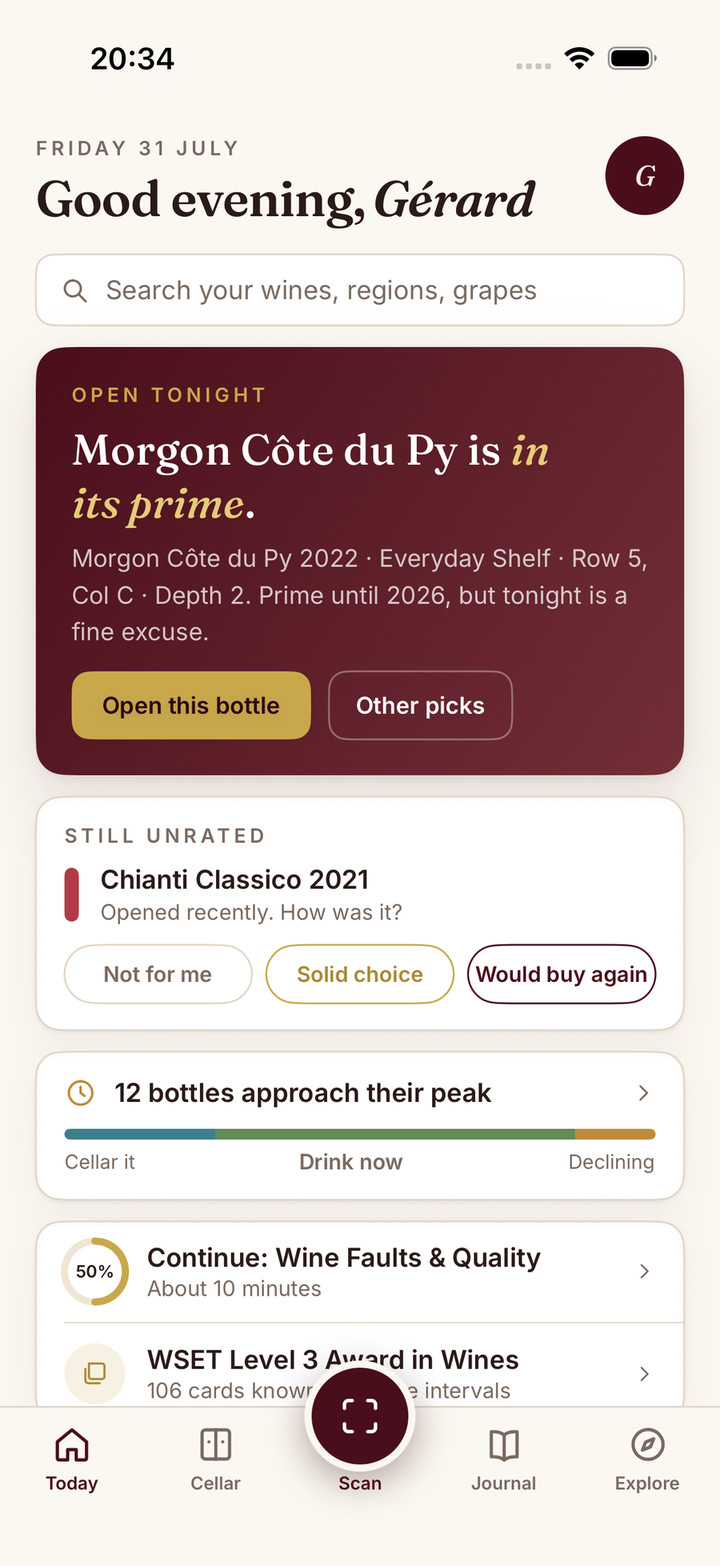
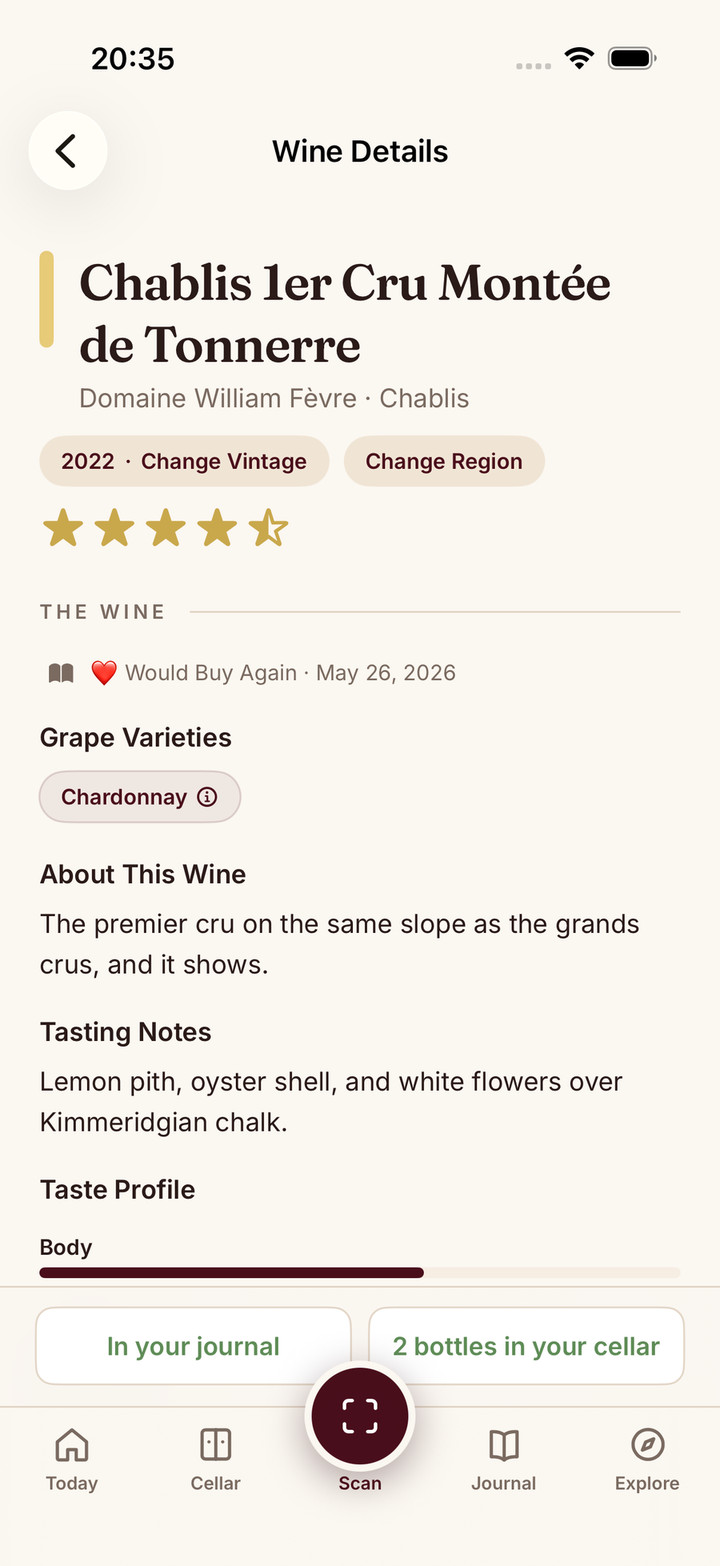
The traditional solution was a paper notebook or a spreadsheet. Both work, both require discipline. The modern solution is a cellar app. Sommo’s cellar feature lets you scan each bottle on arrival, automatically populate its grape, region, vintage, and producer details, and assign it to a rack position. The app tracks drinking windows for every bottle and pushes a notification when a wine is approaching its peak. If you want to see how those windows are worked out, layer by layer, read how Sommo estimates drinking windows.
The single most useful function for a cellar of this size is the search and filter capability. You can ask “what reds in my cellar are ready to drink this month and pair with grilled lamb?” and get an answer in five seconds. This is what makes the cellar a working tool rather than an archive.
What to Avoid
Three traps that show up in most first cellars.
Buying too much of any single wine. Six bottles of a wine you have never had is a gamble. Buy one, drink it, decide whether to commit. If you love the wine, then buy the case.
Cellaring wines that do not age. A $14 Côtes du Rhône is not improved by five years in your rack. Save the long-aging space for wines with the structural backbone to evolve.
Building only at the top end. A cellar with only Grand Cru and First Growth bottles becomes a museum. You will not open them, because every bottle feels too important. Keep the proportions and balance.
Forgetting the cellar exists. The most common cellar failure mode is wines that pass their peak because the owner never thought to open them. Build a review habit. Once a month, scan the rack, identify two or three bottles to open in the next 30 days, and put them somewhere you will see them. The free drinking window checker is a quick way to sanity-check any bottle you are unsure about.
The Twelve-Month Buy Plan: A Sample
For a person spending $3,000 total over 12 months, a working buy plan might look like:
- Month 1: $250 on the drink-now tier (12 bottles of sparkling, white, light red).
- Month 2: $250 on more drink-now (12 bottles, mixed case from a different shop).
- Month 3: $300 on drink-soon Italian and Spanish reds (10 to 12 bottles).
- Month 4: $300 on drink-soon Burgundy and Bordeaux (6 to 10 bottles).
- Month 5: $250 on drink-now replenishment.
- Month 6: $400 on drink-eventually Italian (Brunello, Barolo).
- Month 7: $250 on drink-now replenishment.
- Month 8: $400 on drink-eventually French (Burgundy Premier Cru, Cru Classé Bordeaux).
- Month 9: $250 on drink-now replenishment.
- Month 10: $250 on age-worthy whites (Mosel Riesling, Grand Cru Chablis).
- Month 11: $300 on Vintage Champagne or Port for the special-occasion tier.
- Month 12: $100 on Sauternes, Tokaji, or top dessert wine. Plus $50 review and gap-filling.
At the end of 12 months, you have a working 80 to 100 bottle cellar built across the four tiers, with predictable drinking windows and clear ownership of what works for your palate (for a head start on that palate map, the free wine quiz takes two minutes).
Explore with Sommo
A cellar of this size becomes manageable only with the right tools. Sommo is built to handle exactly this stage: scan each bottle on arrival, track inventory across drink-now, drink-soon, drink-eventually, and special-occasion tiers, see drinking windows at a glance, and get notifications when bottles are approaching peak. The AI also suggests pairings from your current cellar when you describe a meal, turning the cellar into something that helps with daily decisions rather than just an archive.
Download Sommo free and start building a cellar that actually works for you.