How to Build a Wine Palate: A Progression Guide from Beginner to Confident Taster
Build your wine palate with a clear progression from beginner to confident taster. Learn the habits, exercises, and strategies that accelerate palate development.
A good wine palate is not something you are born with. It is something you build, deliberately, through habits and practice. The difference between someone who drinks wine and someone who understands wine is not talent or genetics. It is attention.
This guide is not about tasting technique. If you want step-by-step instructions on how to assess a wine’s appearance, nose, and palate, read our guide to the five S’s of wine tasting. This post is about the journey itself: the habits, exercises, and progression stages that take you from casual drinker to someone who can pick up a glass and genuinely understand what is in it.
Stage 1: Beginner (The Awareness Phase)
At this stage, you know what you like and what you do not like, but you cannot always articulate why. Wine descriptions on labels or review sites feel like a foreign language. “Blackcurrant with cedar and graphite” reads as marketing copy rather than something you can actually detect in the glass.
This is completely normal. Everyone starts here.
What to Focus On
Taste intentionally, not casually. The single most important shift is paying attention while you drink. Before your next glass of wine, pause for ten seconds. Look at the colour. Smell it before you sip. Think about what you taste. This sounds obvious, but most people never do it. The gap between drinking wine and tasting wine is simply awareness.
Start with big contrasts. Do not begin by comparing two Burgundy Pinot Noirs. Start with comparisons that are impossible to miss:
- A dry white vs a sweet white
- A light-bodied red (Pinot Noir) vs a full-bodied red (Cabernet Sauvignon)
- An unoaked Chardonnay vs an oaked Chardonnay
These side-by-side tastings train your palate to detect broad categories before you worry about nuance.
Keep a journal from day one. You do not need formal tasting notes. Simply write down what you drank, whether you liked it, and one or two words about what you noticed. “Fruity and smooth” is a perfectly valid tasting note at this stage. The point is to create a record you can look back on. Over weeks and months, patterns emerge: you might notice you consistently enjoy wines described as “crisp” or that you prefer reds with softer tannins. A tasting journal turns scattered impressions into genuine self-knowledge.
Stage 2: Developing (The Vocabulary Phase)
After a few months of intentional tasting, something shifts. You start recognising flavours and textures you could not identify before. You might not have the right words yet, but you can tell that this Sauvignon Blanc tastes different from the last one you tried, and you can begin to say how.
What to Focus On
Taste in flights. A flight is simply two to three wines tasted side by side. This is the single most effective exercise for palate development because comparison sharpens perception. Your brain is much better at detecting differences between two things than evaluating one thing in isolation.
Try these flights:
- Same grape, different regions: Sauvignon Blanc from Marlborough, Loire, and Chile
- Same region, different grapes: A Bordeaux red (Cabernet-dominant) vs a Burgundy red (Pinot Noir)
- Same grape, different price points: An entry-level vs a premium version of the same variety
Each flight teaches you something specific about how grape variety, climate, and winemaking decisions shape what ends up in the glass.
Build your vocabulary gradually. Do not try to memorise a list of 200 tasting terms. Instead, focus on the structural elements first:
- Acidity: Does the wine make your mouth water? High acidity feels fresh and zesty. Low acidity feels soft and flat.
- Tannin (reds only): Does the wine dry your gums and cheeks? High tannin feels grippy. Low tannin feels smooth.
- Body: Does the wine feel light (like water), medium (like milk), or full (like cream) in your mouth?
- Sweetness: Is there residual sugar, or is it completely dry?
Once you can confidently assess these four structural elements, flavour descriptors (“cherry,” “vanilla,” “pepper”) start making sense because you have a framework to hang them on.
Explore systematically. Rather than randomly trying whatever is on the shelf, pick a grape variety or a region and spend a month exploring it. Try four or five different Pinot Noirs from different regions. Then move to Riesling. Then explore a region like Burgundy or the Rhone Valley. Systematic exploration builds a mental map of wine far faster than scattered sampling.
Stage 3: Confident Taster (The Integration Phase)
At this stage, you can pick up a glass of wine and make a reasonable assessment of what it is, where it might be from, and whether it is well made. You have tasted enough wines that you carry a mental library of reference points. When someone says “Chablis,” you do not just know it is Chardonnay from northern Burgundy. You can recall what that tastes like.
What to Focus On
Taste blind. Have someone pour you a wine without showing the label. Try to identify the grape, the climate (warm or cool), and the quality level before you look. You will get it wrong often, and that is the point. Blind tasting forces you to rely purely on what is in the glass, stripping away the bias that labels, prices, and reputations create. It is humbling and immensely educational.
Revisit wines you know. Go back to wines you tasted six months or a year ago. Your perception of them will have changed because your palate has developed. This is one of the most satisfying parts of the journey: realising that a wine you once found “just okay” now reveals layers you could not detect before.
Track your progress. Review your tasting notes from Stage 1 and compare them to what you write now. The difference is your proof that palate development works. If you have been using a tasting journal consistently, you will have a clear record of how your vocabulary, precision, and confidence have grown.
Connect tasting to knowledge. At this stage, theory and practice reinforce each other. Understanding that Nebbiolo produces high-tannin, high-acid wines with pale colour makes it easier to identify in a blind tasting. Knowing that cool climates produce higher acidity helps you distinguish a German Riesling from an Australian one. If you are drawn to formal wine education, this is an excellent time to explore WSET qualifications, which provide structured frameworks for the knowledge you are already building.
Habits That Accelerate Development
Regardless of which stage you are at, these habits make the biggest difference:
- Taste regularly: Once a week minimum. Two to three times a week is better. Short, focused sessions beat occasional marathons.
- Always take notes: Even brief ones. The act of writing forces you to think about what you taste rather than passively consuming it.
- Taste with others: Hearing how someone else describes the same wine expands your vocabulary and calibrates your perception.
- Be honest: If you cannot detect “violets and graphite,” do not write it because the back label says so. Record what you actually taste. Authenticity builds a genuine palate. Performance builds nothing.
- Stay curious: The moment you think you know enough about wine is the moment your palate stops developing. There is always another grape, another region, another style to explore.
Track Your Palate Journey with Sommo
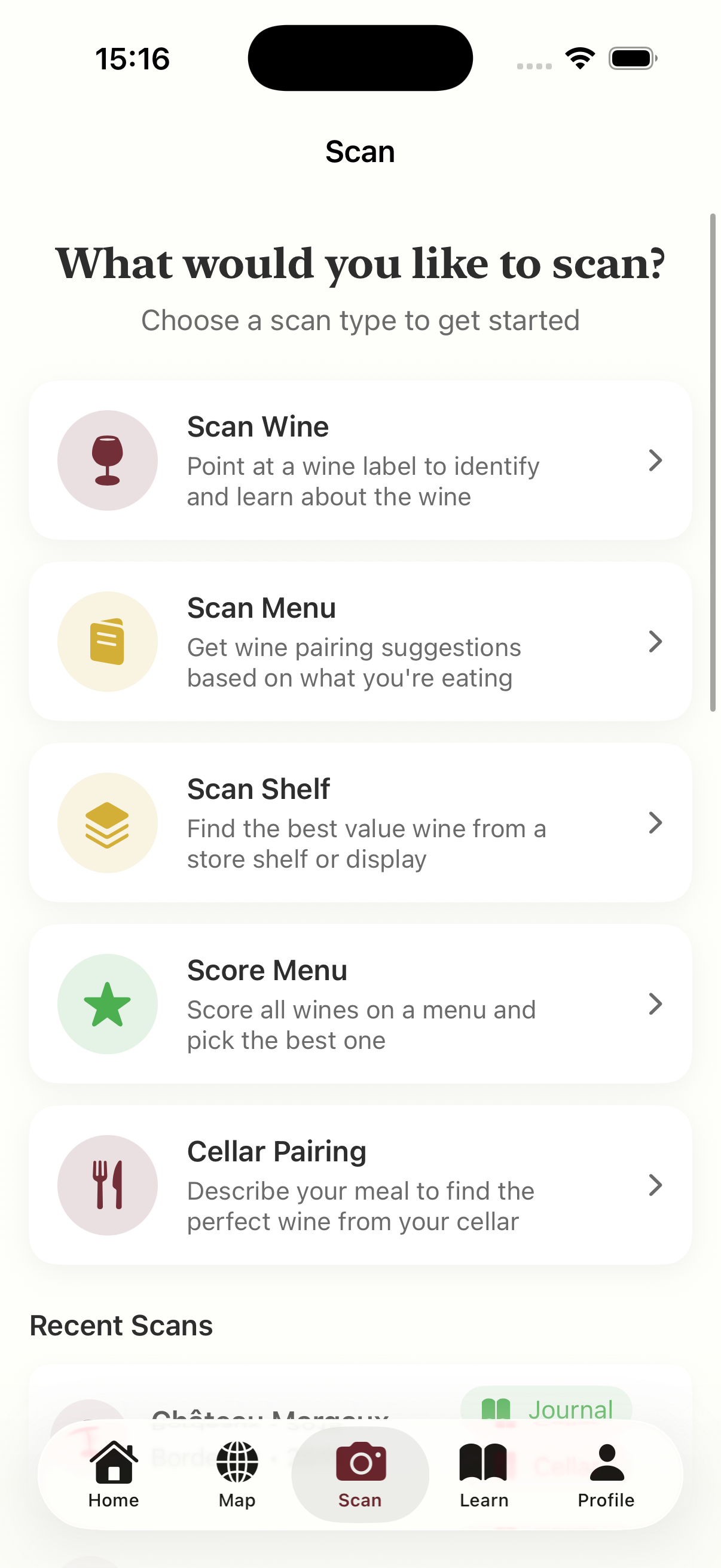
Building a wine palate is a long game, and the most powerful tool you can use is a record of your own journey. Sommo’s tasting journal captures every wine you taste with structured notes, building a palate profile that shows how your preferences evolve over time. Scan bottles to learn about them instantly, log your impressions, and watch your palate profile develop as you progress from curious beginner to confident taster.