Most wine apps tell you what a crowd of strangers thought of a bottle. That is useful for spotting a dud, but it is no help at all when you want to know whether you will like it. I built Sommo to answer the second question.
The short answer: Sommo learns your taste from your own ratings, not from crowd scores. You rate each wine you taste with one of three taps. Menu and shelf picks then use your 10 most recent ratings, and with Premium, Taste DNA reads every entry in your journal to map body, tannin, acidity, sweetness, intensity and how adventurous you are. The full mechanics are on the palate learning page.
Below I cover the three-tap rating, what happens after a scan, how picks use your ratings, what Taste DNA and Your palate show, and how to get better recommendations faster.
Why does Sommo use your ratings instead of crowd scores?
Because every palate is different. Someone who grew up on Sichuan food and someone raised on a Turkish table do not taste wine the same way. A crowd score averages all of that into the taste of nobody in particular.
Sommo starts from the other end. The only input it trusts for “will you like this?” is what you have told it about the wines you have actually tasted. There is no quiz to fill in on day one and nothing to game.
How do Sommo’s three ratings work?
After a glass, you pick one of three:
- Not for me.
- Solid choice.
- Would buy again.
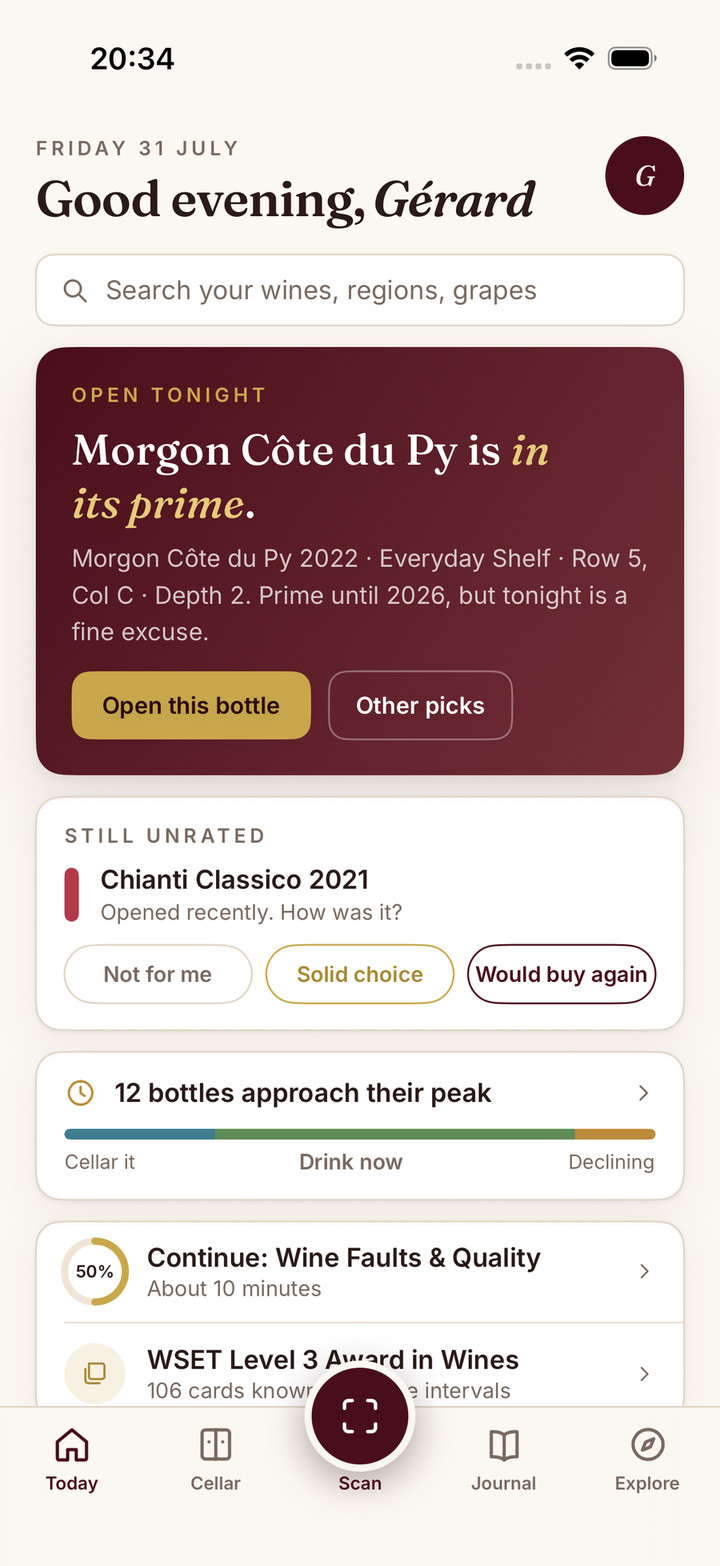
I chose three on purpose. At home, a 100-point scale is false precision; nobody can honestly tell an 89 from a 91 across a year of bottles. Three taps are fast enough that you actually do it every time, and that consistency is what makes the profile real. Your dislikes matter as much as your favourites.
If you want to go further, the structured tasting notes walk you through appearance, nose, palate and conclusions, the same path a WSET student learns. My guide to building a wine palate explains why that practice pays off.
What happens when I scan a wine?
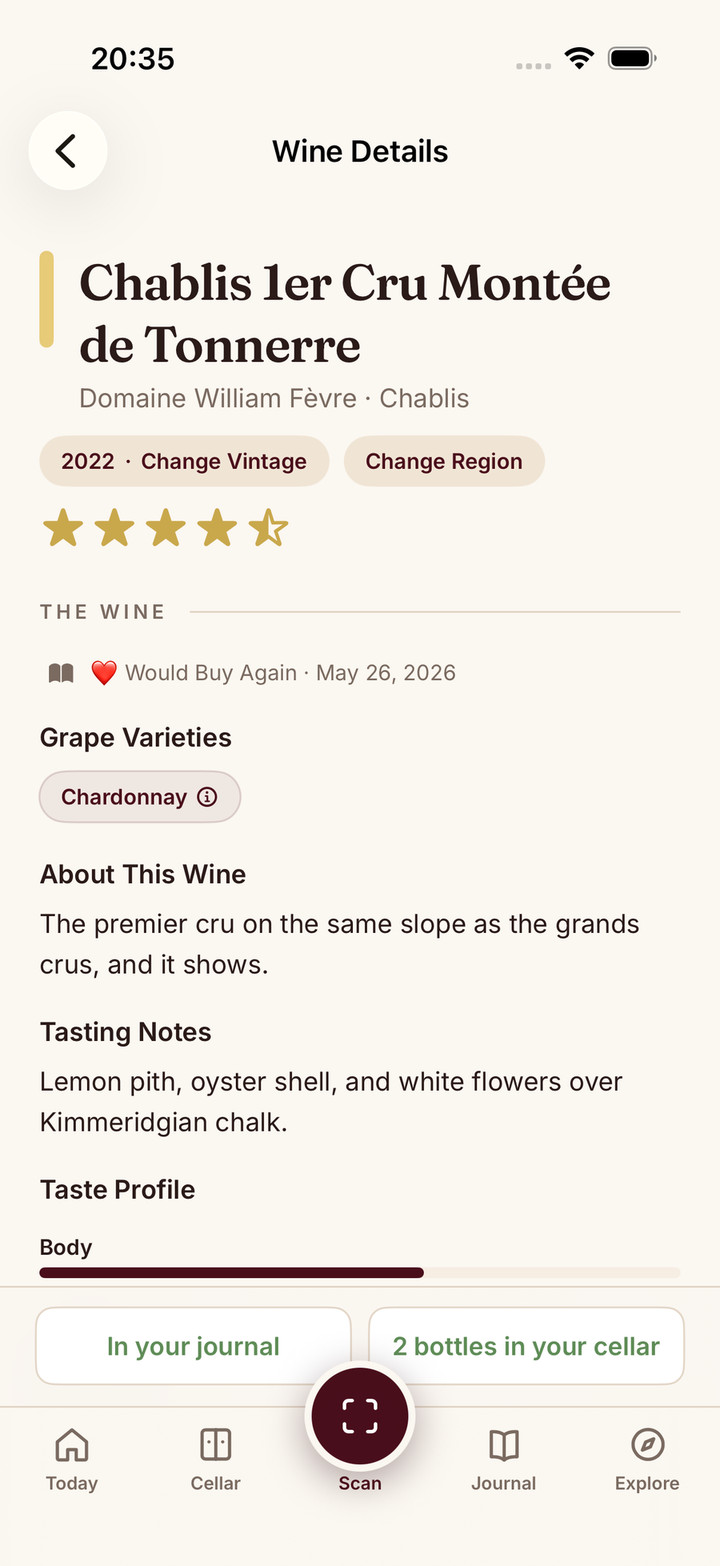
A label scan takes about 10 seconds and tells you the grape, region, producer, style and drinking window. The scan saves the wine; it does not create a journal entry. Rating it after you taste it is what logs the glass in your journal, and that rating is what Sommo learns from.
This matters because scanning a bottle in a shop is not the same as liking it. Sommo only learns from wines you have actually tasted.
How do menu and shelf picks use my ratings?
Menu and shelf picks use your 10 most recent ratings. That keeps them responsive: rate a run of crisp whites highly and your next shelf scan will lean that way.
- On a shop shelf, Sommo picks the best match from the bottles on the shelf, with two or three alternatives.
- On a restaurant list, with Premium, Score Menu gives every wine it reads on the list a quality score, alongside picks shaped by your recent ratings.
The menu scoring page explains how the list reading works.
What do Taste DNA and Your palate show?
Both sit on one Premium palate screen and both are built from your journal.
- Taste DNA uses every entry in your journal to build a fingerprint of your palate, showing body, tannin, acidity, sweetness, intensity and how adventurous you are.
- Your palate turns your entries into a written profile, names the patterns you might not have noticed and suggests a wine or region to try next. It starts once you have three journal entries and sharpens as you add more.
The wine character analysis page shows what Your palate looks like.
Does Sommo share my taste data?
Not for sale, and not with other users. Your journal powers your own picks, Your palate and Taste DNA. I never sell it, and there is no public feed or leaderboard. To run those features, wine details or a journal summary may be processed by AI service providers working for Sommo, as the privacy policy explains. The details are on the privacy and data page.
How do I get better recommendations faster?
- Rate every wine you taste, including the ones you did not like.
- Rate honestly, not aspirationally. If the famous bottle was a Solid choice, say so.
- Taste across styles. A spread of grapes and regions gives Taste DNA more to work with.
- Add a structured note when a wine puzzles you. That is where the learning is.
- Use Tasting Mode for flights. With Premium, you rate each wine as you go, and when you tap Complete Tasting every rated wine is saved to your journal with the session’s date.
How does Sommo help you find wine you will love?
That is the whole point of everything above. Sommo understands you because it learns from your own glass, it customises every pick to your recent ratings, and it is fast: about 10 seconds for a label and three taps for a rating.
It all runs on proprietary wine-tuned AI grounded in a hand-maintained wine library. The free tier gives you 5 lifetime AI scans per device, shared across label, menu and shelf scans, plus the journal and 30 days of journal history. Premium unlocks unlimited scans, lifetime history, Taste DNA, AI tasting feedback and Tasting Mode for $4.99 a month or $29.99 a year. Sommo runs on iPhone, iPad, Android, HarmonyOS and the web.
Download Sommo and start teaching it your taste.
The bottom line
Sommo learns from you, not the crowd. A scan saves a wine, a rating logs the glass, your 10 most recent ratings steer menu and shelf picks, and with Premium, Taste DNA reads your whole journal to show the shape of your palate and suggest what to try next. The more honestly you rate, the better it gets.