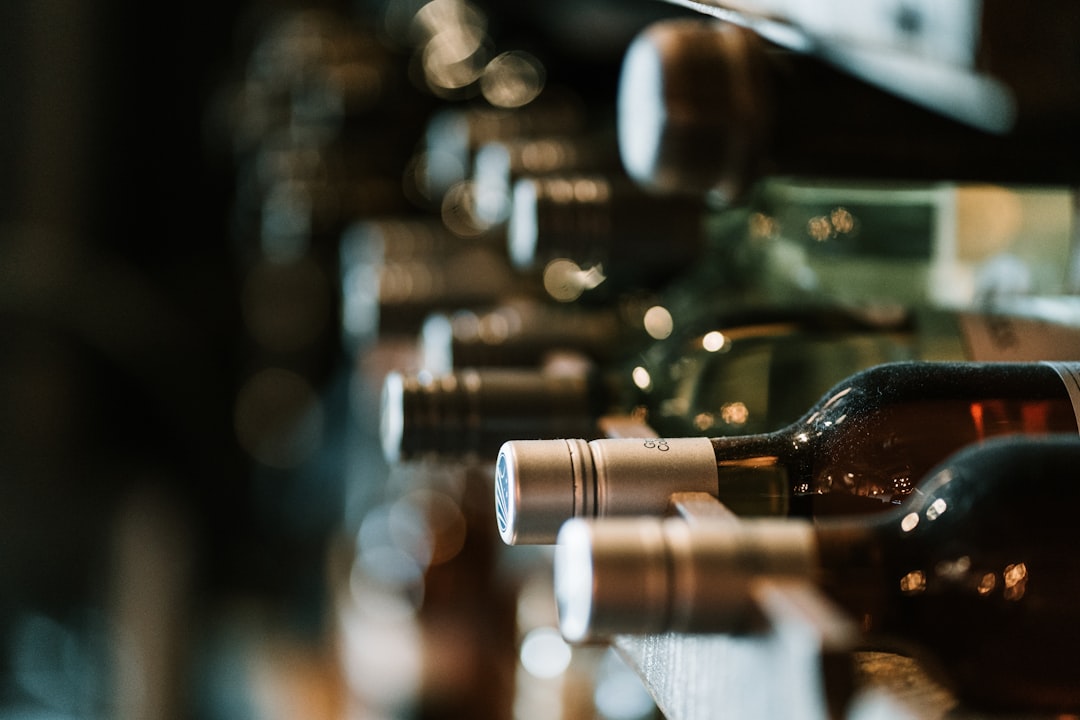
The single biggest myth in wine is that age improves every bottle. It does not. The overwhelming majority of wine sold in the world (estimates put it above 90 percent) is made to be drunk within two or three years of release, and gets worse, not better, with time. The remaining 10 percent contains some of the most rewarding bottles you will ever open, but only if you understand which wines to set aside, how to store them, and when to pull the cork.
This guide is the cheat sheet. It covers which wines age, which do not, what aging actually does to wine chemistry, and a region-by-region breakdown of typical drinking windows so you can look at your cellar (or the bottle in front of you at dinner) and make an informed call.
What Actually Happens When Wine Ages
To know which wines age well, it helps to understand what aging does. Three slow chemical processes are at work.
Tannins polymerise. The harsh, drying tannins in young red wine are short molecular chains. Over time, these chains link together into longer molecules. As they grow, they fall out of solution as sediment, and the remaining tannins in the wine become softer, rounder, and less bitter. This is why a 15-year-old Bordeaux feels silky compared to its harsh younger self.
Acids and esters reorganise. The fruit aromas that dominate young wine come from primary aromatic compounds. Over years in bottle, these compounds slowly transform into tertiary aromas: leather, tobacco, dried fruit, mushroom, forest floor, truffle, petrol (in Riesling), honey (in old whites). The wine moves from fruity to savoury.
Oxygen does its slow work. Wine bottles are not perfectly sealed. A microscopic amount of oxygen seeps in through the cork over years (less through screwcaps, which is partly why screwcap wines are not made for long aging). This slow oxidation rounds out the wine, integrates the components, and adds complexity. Too much oxygen, however, ruins it.
A wine that ages well needs the raw materials to survive these processes: enough acidity to stay fresh, enough tannin or sugar to act as a preservative, enough fruit concentration to evolve into something interesting, and enough structural balance that the components age in sync. Most cheap wine lacks these traits, which is why it does not improve in bottle.
The Aging Cheat Sheet by Wine Type
The estimates below assume proper storage (cool, dark, stable, ideally 12 to 14 degrees Celsius, away from light and vibration). Bad storage can collapse a wine’s aging window by years. We are talking about drinking windows from the vintage year, not from purchase.
Sparkling Wines
- Non-vintage Champagne, Prosecco, Cava: 1 to 3 years. Drink young.
- Vintage Champagne: 8 to 25 years. The best vintage Champagne ages remarkably well, developing toasty, nutty, brioche notes. Krug, Bollinger, Pol Roger, and similar producers make wines that drink beautifully at 15 to 20 years.
- Top single-vineyard Champagne (grower or prestige cuvée): 10 to 30 years. The most age-worthy sparkling wines in the world.
- English sparkling, Franciacorta, Cap Classique vintage: 5 to 15 years for the serious bottlings.
White Wines
- Most everyday whites (Pinot Grigio, Sauvignon Blanc, basic Chardonnay): 1 to 3 years. Fresh is best.
- Mineral whites (Sancerre, Pouilly-Fumé, basic Chablis): 3 to 8 years for top producers. Develop complexity.
- Premier and Grand Cru Chablis, white Burgundy (Meursault, Puligny-Montrachet, Chassagne-Montrachet): 8 to 20+ years. Some of the greatest white wines in the world.
- Dry Riesling (Alsace, Mosel Grosses Gewächs, Wachau Smaragd): 10 to 30+ years. Riesling is the most age-worthy white grape on earth.
- Off-dry and sweet Riesling (Spätlese, Auslese): 15 to 50+ years. The legendary German wines.
- Hunter Valley Semillon (Australia): 10 to 25 years. A unique style that age transforms completely.
- White Rioja (traditional style): 10 to 25 years for top producers like López de Heredia.
- Sauternes, Tokaji Aszú, German Beerenauslese / Trockenbeerenauslese: 20 to 100+ years. Botrytis dessert wines are among the longest-lived wines in the world.
Rosé Wines
- Most rosés: 1 to 2 years. Drink fresh.
- Top Provence rosé (Bandol, Tavel, serious single-vineyard rosé): 3 to 10 years for the best examples. Most rosé is not for aging.
Red Wines
- Beaujolais Nouveau: 6 months. Drink the spring after release at the latest.
- Basic Beaujolais and Beaujolais-Villages: 1 to 3 years.
- Beaujolais Cru (Morgon, Moulin-à-Vent, Fleurie): 5 to 15 years for top producers. The most underrated aging reds in France.
- Pinot Noir (Oregon, basic Burgundy, German Spätburgunder): 3 to 10 years for most. Top Burgundy ages 10 to 30+.
- Grand Cru Burgundy (DRC, Leroy, Rousseau, etc.): 15 to 50+ years.
- Bordeaux: Petit château 5 to 10 years. Crus Bourgeois 10 to 20. Classified growths (top châteaux) 20 to 50+ years from a good vintage.
- Right Bank Bordeaux (Saint-Émilion, Pomerol): Generally peaks slightly earlier than Left Bank: 10 to 30 years for top wines, 30 to 50 for Pétrus and Cheval Blanc.
- Rhône reds (Côtes du Rhône, Crozes-Hermitage): 5 to 10 years for basic. Hermitage and Côte-Rôtie 15 to 40+. Châteauneuf-du-Pape 10 to 30.
- Italian classics (Chianti Classico, Brunello di Montalcino, Barolo, Barbaresco): Brunello and Barolo 10 to 30+ years. Chianti Classico Riserva 8 to 20 years.
- Spanish reds (Rioja, Ribera del Duero, Priorat): Reserva 10 to 20 years. Gran Reserva 15 to 40 years. Top producers like López de Heredia and Vega Sicilia age 30 to 60+.
- Napa Cabernet: 8 to 25 years for serious wines. The best cult wines (Harlan, Screaming Eagle, Dominus) 20 to 40.
- Argentine Malbec: 5 to 15 years for top producers. Most everyday Malbec is for drinking within 5.
- Australian Shiraz (Barossa, McLaren Vale): 8 to 25 years for serious wines. Grange and similar top wines 25 to 50+.
Fortified Wines
- Vintage Port: 20 to 60+ years. Some of the longest-lived wines made.
- Tawny Port (10, 20, 30, 40 year): Ready when released. Will hold but not improve in bottle.
- LBV and Ruby Port: Drink within 5 to 10 years.
- Madeira (Bual, Sercial, Verdelho, Malmsey): 50 to 200+ years. Madeira is functionally immortal due to its production method.
- Sherry (Oloroso, Amontillado, Palo Cortado, Pedro Ximénez): Holds for decades once bottled but does not improve.
How to Tell If Your Wine Is Aging Well
If you have a bottle in your cellar and you want to know whether it is approaching peak, three signals help.
Look at the colour. Reds shift from purple to ruby to garnet to tawny as they age. A young Cabernet that has turned brick-red at the rim is starting to mature. A red that has gone completely tawny is either at peak or past it, depending on the wine.
Smell the cork. When you open a bottle, smell the cork. A faint vinous aroma is good. A musty, cardboard, or mouldy smell can suggest cork taint. A vinegar smell suggests advanced oxidation.
Taste a small pour. If you are unsure, decant a small amount, taste it, and decide whether to drink the bottle now or hold. A wine that is tight, closed, and overly tannic may need more time. A wine that is broad, soft, and starting to lose its fruit is at or past peak and should be drunk now.
When to Drink: The 80/20 Rule
A practical heuristic from professional cellars: try to drink wines in roughly the middle 60 percent of their aging window. If a wine has a 10 to 30 year window, drink it between years 14 and 24. Drinking too early sacrifices complexity. Drinking too late risks a wine that has lost its fruit.
For the wines worth aging, this means resisting the temptation to open the bottle on its release year, and not waiting so long that you push past peak. It also means having more than one bottle of each wine in your cellar so you can taste through the window and decide for yourself when it shows best.
Storage Matters More Than You Think
Even the most age-worthy wine will collapse if stored badly. The four rules.
Temperature. Ideally 12 to 14 degrees Celsius, stable. Avoid kitchens, garages, attics, and any space that swings more than a few degrees over a day. A wine kept at 22 degrees ages roughly twice as fast as one at 13, and not in a good way.
Light. Wine is photosensitive. UV light damages it. Store bottles in the dark.
Humidity. Around 60 to 70 percent. Too low and corks dry out; too high and labels mould. A residential basement is usually fine.
Position. Bottles with natural cork should be stored on their side so the cork stays moist. Screwcap wines can be stored upright.
If you have only a few age-worthy bottles, the cheapest acceptable storage is a small thermoelectric wine fridge (the dual-zone models around $400 to $800 work well). If you have more than 50 bottles you want to age, look at a serious cooled wine cabinet or a custom basement installation.
For more on this, see our guide on wine storage tips, how to build a wine cellar on a budget, and the wine fridge buying guide.
Common Aging Mistakes
A few traps to avoid.
Aging wine that was not made to age. A $12 supermarket red will not turn into a $50 wine in five years. It will turn into a tired, fruit-faded, slightly sad version of itself. Save the cellar space for wines that have the structural raw materials to evolve.
Forgetting what you have. A serious cellar problem that nobody mentions. Wines you cellar for ten years can easily be forgotten until you stumble across them while looking for something else, by which point they may be past peak. Keep a list and review it quarterly.
Buying just one bottle of a great wine. If you only have one bottle, you have to drink it at one specific point in time, and you cannot know if it was the right moment. The wine drinkers with the best aging experience buy by the case (or at least the six-pack) so they can pull a bottle every two or three years and watch the wine evolve.
Drinking too late. The most common mistake of cellaring enthusiasts. We hold wines too long because we are afraid to “waste” them on a casual evening. Most wines are better with a slight edge of youth than with a slight edge of decline. When in doubt, drink it.
The Drinking Window in Sommo
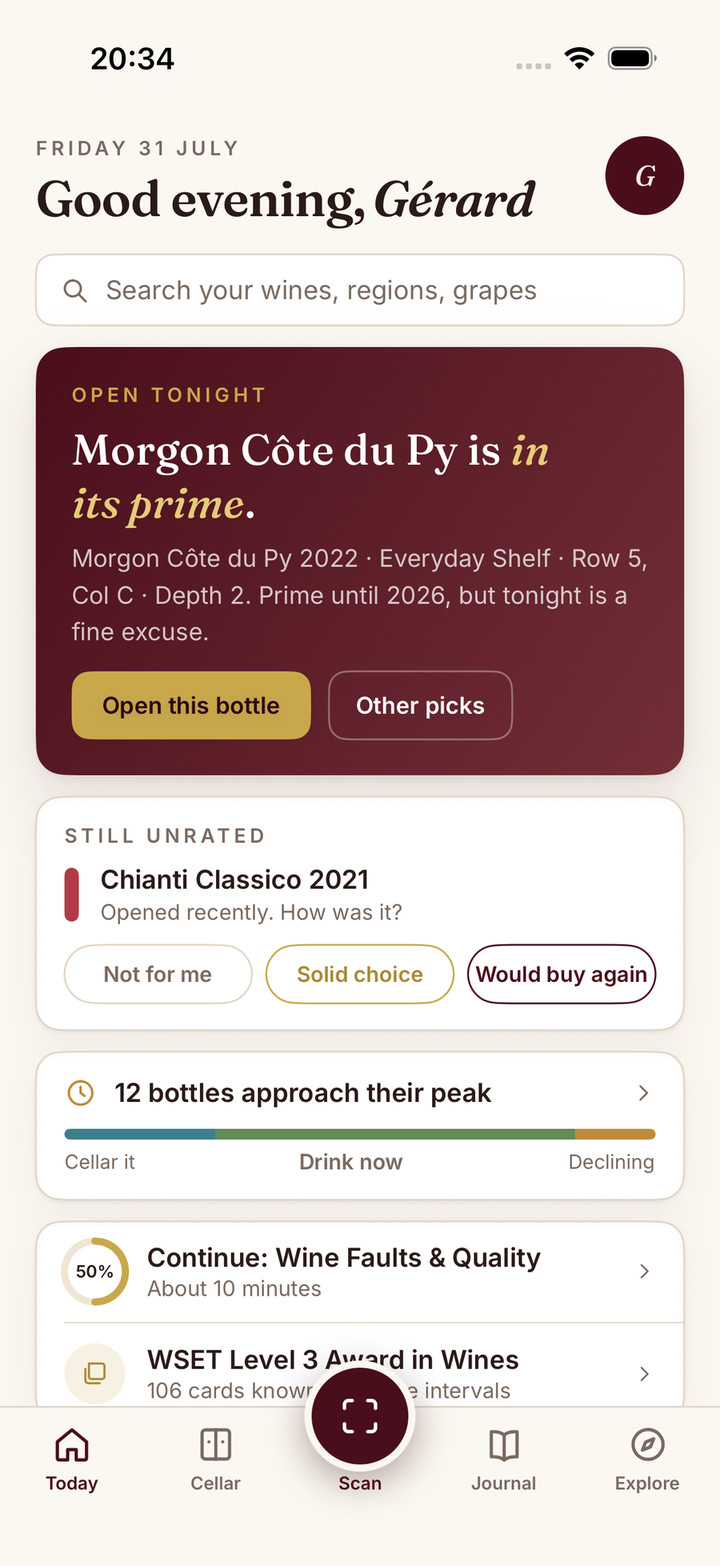
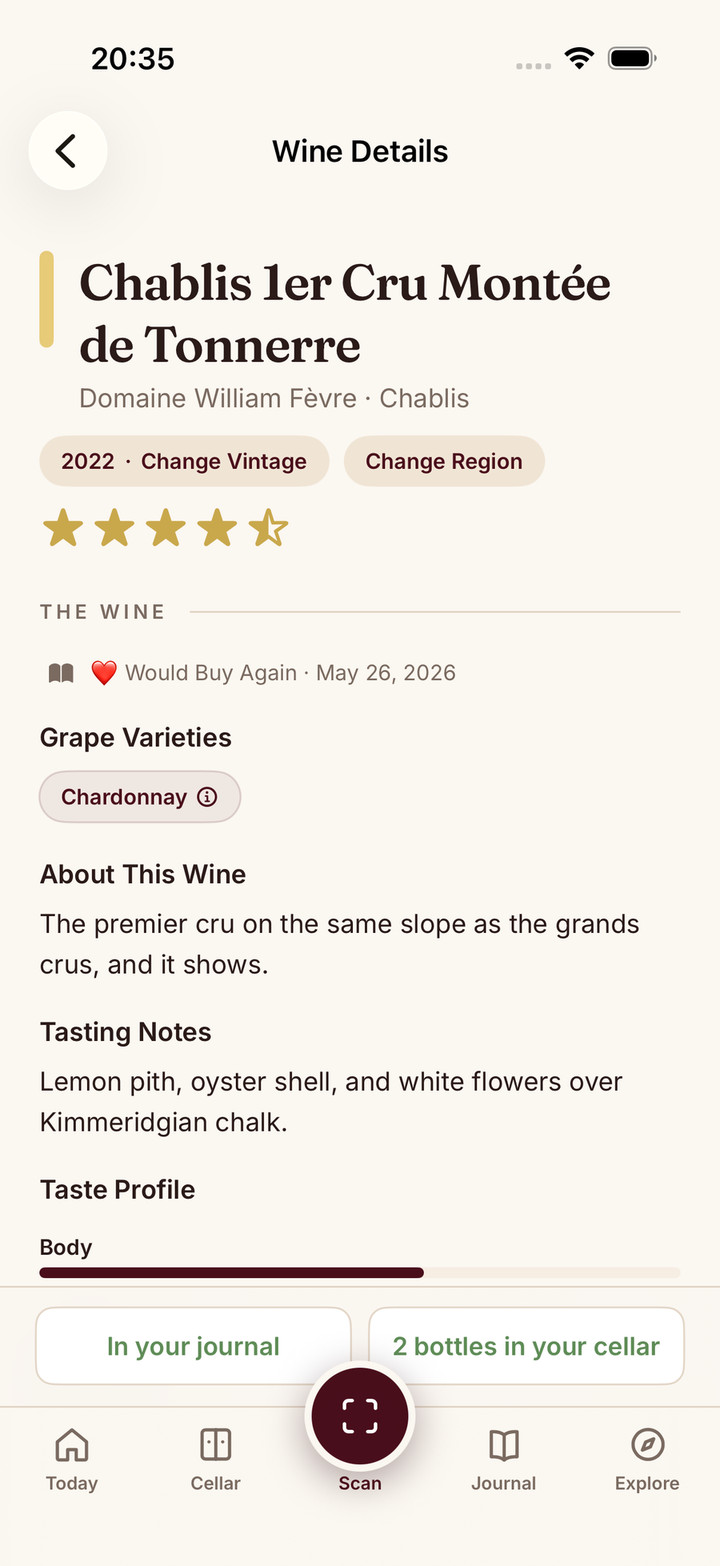
Sommo’s cellar feature tracks every bottle you own and models its drinking window based on grape, region, vintage, and producer. The app pushes you a notification when a bottle is entering its ready-to-drink window, so you do not have to remember every bottle in your collection on your own. Combined with the journal, you can also record how each bottle tasted on opening, which informs the timing of similar bottles still in your cellar.
This is one of the cases where AI cellar management genuinely outperforms what any human can do at scale. A serious wine cellar is more inventory than memory can hold.
Explore with Sommo
A good cellar is half about the wine and half about not losing track of it. Sommo makes the second half easy. Log every bottle you add to your collection, track drinking windows automatically, and receive reminders when each wine is approaching peak. Add tasting notes when you open each bottle, and over time you build a record that lets you make better aging decisions for everything still in the rack.
Download Sommo free and stop guessing when to pull the cork.