A friend once rang me in a panic. She had found a bottle her parents gave her as a wedding present, twelve years earlier, sitting in a kitchen cupboard above the kettle. Was it a treasure or a disaster? The honest answer: probably neither, but the cupboard did it no favours.
The short answer: most unopened wine is made to be drunk within a few years of the vintage, usually one to three years for everyday whites and rosés and two to five for everyday reds. Wines built to age, such as top Bordeaux, Barolo, vintage port, quality Riesling and Sauternes, can last decades. Storage decides how long any bottle actually keeps. WSET’s storage guidance recommends cool, constant conditions between 10 and 15°C.
Below I cover rough shelf lives by style, how storage changes them, whether to lie bottles down, and how to tell if an old bottle is past it.
Does unopened wine expire?
Wine does not carry a use-by date because it does not go off in the food safety sense. It changes. Young wine is all fresh fruit. Over time, fruit fades and savoury, nutty or earthy notes appear. For a few wines, that is the whole point. For most, the fruit fades before anything more interesting arrives.
A wine that has gone too far tastes flat, brown and tired, sometimes sherry-like or vinegary. Unpleasant, but not dangerous.
How long does each style of unopened wine last?
These are rough guides for bottles stored well. Individual wines vary, so treat them as a starting point.
| Style | Typical best within |
|---|---|
| Everyday rosé and light whites (Pinot Grigio, Sauvignon Blanc) | 1 to 3 years from vintage |
| Prosecco and most tank-method sparkling | 1 to 2 years from purchase |
| Everyday reds (Merlot, Malbec, Côtes du Rhône) | 2 to 5 years |
| Non-vintage Champagne | 2 to 4 years from purchase, often more |
| Quality white Burgundy, Chenin Blanc, Riesling | 5 to 15 years or more |
| Structured reds (Bordeaux, Barolo, Rioja Gran Reserva) | 10 to 30 years or more |
| Sauternes, Tokaji and other sweet wines | Decades |
| Vintage port | Decades |
| Ruby and tawny port | Ready on release, best within a few years |
For a specific bottle, try the free drinking window checker. My post on how Sommo estimates drinking windows explains the thinking behind the dates.
What shortens a wine’s life?
Three things do most of the damage:
- Heat. The biggest enemy. A warm kitchen, a car boot in summer or a loft can age wine years in a season.
- Temperature swings. Expanding and contracting wine can push the cork and let air in.
- Light. Sunlight and strong artificial light can create off flavours, especially in clear bottles.
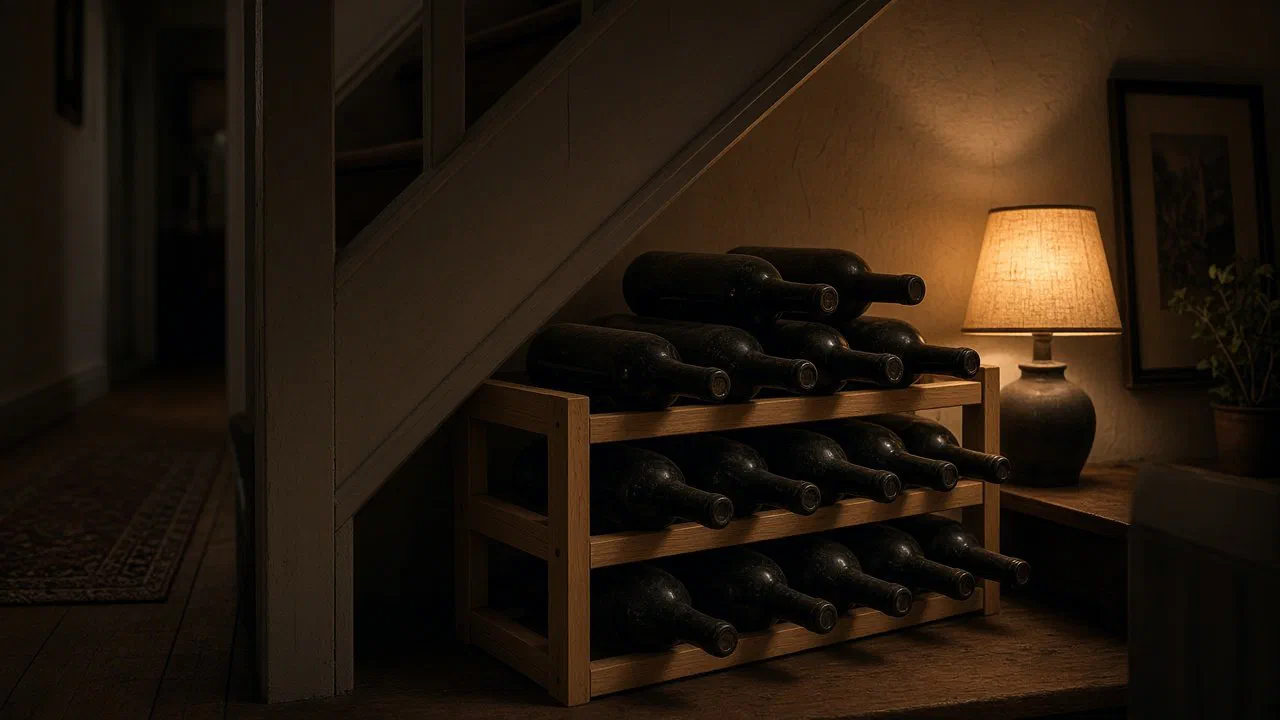
Vibration and humidity matter less for most people. A cool, dark cupboard away from appliances beats a stylish rack beside the oven every time. My wine storage tips cover where to keep bottles at home in detail, and if you have a garage, read wine fridge in a garage first.
Should wine be stored on its side?
For bottles with natural corks that you will keep for months or years, yes. Lying on its side keeps the cork in contact with the wine so it does not dry out and let air in.
For screwcap bottles, and for any bottle you will open within a few weeks, upright is fine. Sparkling wine is also fine upright for short periods, since the pressure in the bottle keeps the cork moist.
Does unopened wine last longer in the fridge?
A kitchen fridge is fine for a few weeks, especially for whites and sparkling you plan to drink soon. For long-term storage it is too cold and too dry, and the constant door opening means vibration and light. A dedicated wine fridge set to cellar temperature is a better choice; my wine fridge buying guide compares the options.
How can I tell if an old bottle has gone off?
Before opening:
- Check the fill level. A big gap between wine and cork in a young bottle can mean air got in.
- Look at the cork. A cork pushed up or wine seeping past it suggests heat damage.
- Hold it to the light. Whites turning deep gold or brown, and reds turning brick or orange, are signs of age, though not always faults.
After opening, smell it. Vinegar, nail polish, wet cardboard or a flat, stewed smell mean it is past saving for drinking. Some of those still work in a stew; my guide to how long wine lasts after opening covers the opened side of the story.
How does Sommo help you keep track of unopened wine?
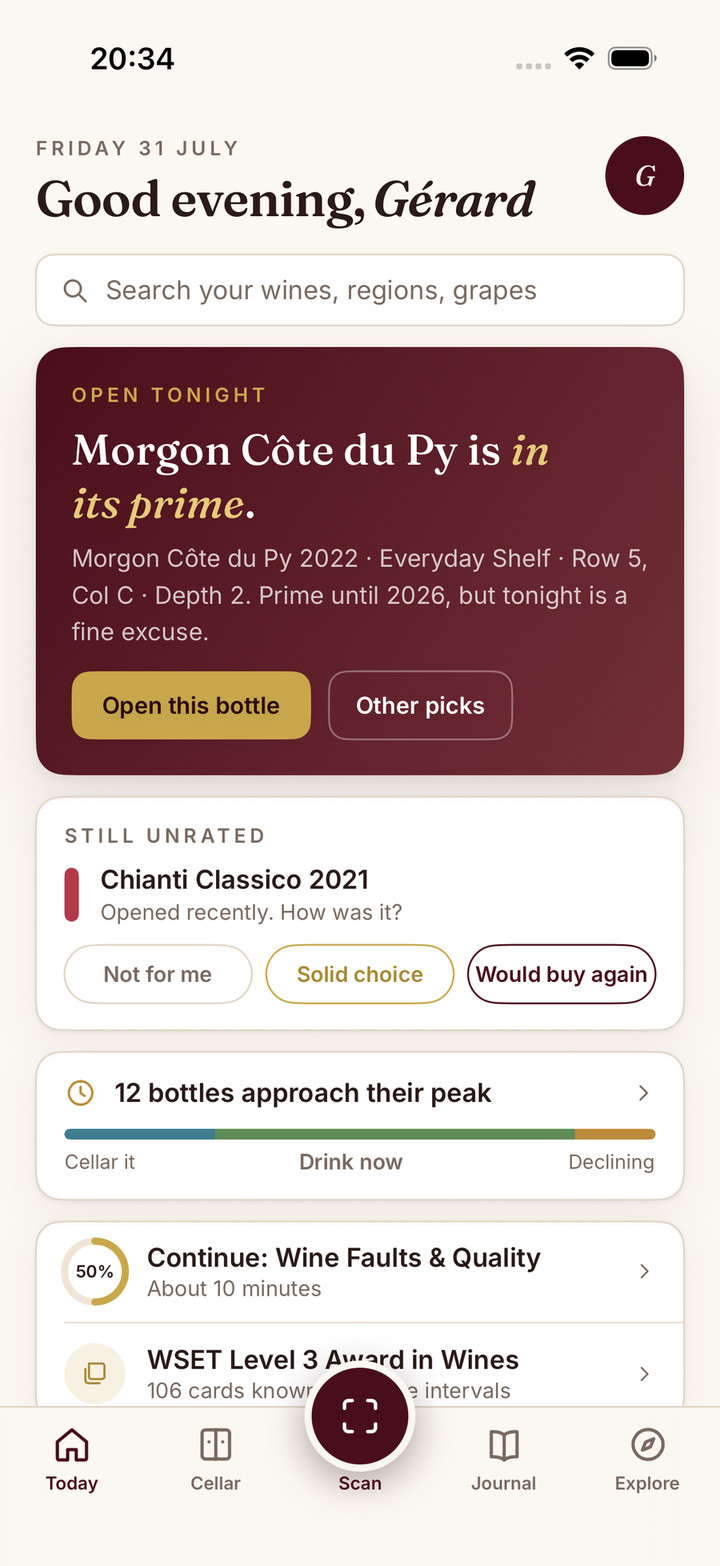
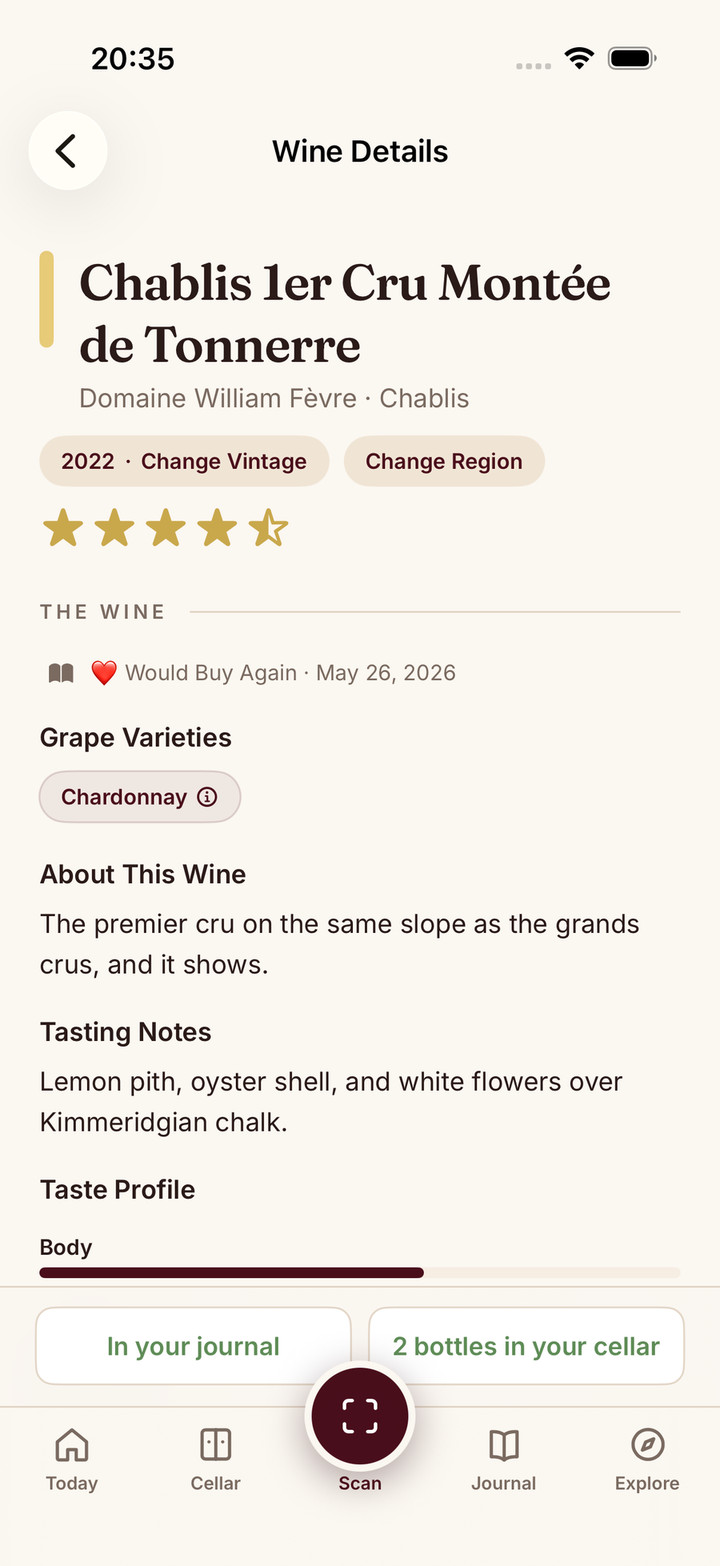
Know what you have, fast. Scan a label and Sommo identifies the wine in about 10 seconds, and its page has an Add to Cellar button so one tap puts a bottle in your cellar.
See what to drink first. The Sommo cellar is Premium. Every bottle gets a drinking window, and you can set a storage setting per bottle so a warm cupboard shifts the estimate. Statuses run from Too Young to Ready Now to Past Prime, and on iPhone, iPad, Android and HarmonyOS you get push alerts as bottles move through their windows. My how drinking windows work page explains the details.
Tailored to you. With Premium, Ask Sommo picks the best bottle for tonight’s meal from the bottles you own, so nothing sits in the cupboard past its best.
Your data stays yours. CSV and XLSX export are free.
It all runs on proprietary wine-tuned AI grounded in a hand-maintained wine library. The free tier gives you 5 lifetime AI scans per device, shared across label, menu and shelf scans, plus the journal and 30 days of journal history. Premium unlocks unlimited scans, lifetime history, Taste DNA, AI tasting feedback and Tasting Mode for $4.99 a month or $29.99 a year. Sommo runs on iPhone, iPad, Android, HarmonyOS and the web.
Download Sommo and see what to open first.
The bottom line
Most unopened wine wants drinking within a few years, so do not save that everyday bottle for a special occasion that never comes. Keep wine cool, dark and steady, lie corked bottles down for long stays, and save the long ageing for wines built for it. When in doubt, check the drinking window and open it while it still has fruit.