Wine education has not changed much in 50 years. The model is still the same: take a class with a knowledgeable teacher, drink through a curriculum of representative wines, memorise regions and grapes and vintages, write tasting notes that someone marks, and eventually sit an exam. The names change (WSET, Court of Master Sommeliers, the various regional academies), but the format is essentially the same one wine professionals learned in the 1980s.
That is now starting to shift, and the shift is real. AI is changing how serious wine students prepare, how casual drinkers build their palate, and how the gap between the dedicated enthusiast and the professional is closing. This is not hype. The specific tools are concrete, the learning gains are measurable, and the changes are accelerating. Here is an honest account of what is actually happening in 2026 and what it means for anyone trying to learn wine.
The Four Pillars of Wine Learning
To understand what AI is changing, it helps to think of wine education as four distinct pillars.
Knowledge. The factual base: regions, grapes, climates, classification systems, winemaking techniques, history. This is the textbook part.
Tasting. The sensory part: identifying aromas, calibrating acidity, recognising tannin levels, building reference points across grape varieties and regions. This is the part most people find hardest.
Memory. The retention part: remembering thousands of facts well enough to recall them quickly on an exam or in conversation. This is what separates students who pass from students who fail.
Pairing and recommendation. The applied part: knowing what to drink with which food, what to suggest for which occasion, how to read a wine list and make the right call.
AI is reshaping each of these pillars differently. The strongest impact is on memory and tasting. The weakest is on the experiential parts of pairing that still benefit from human practice.
Spaced Repetition: The Single Biggest Change
The most important shift in wine education over the last few years is the move toward spaced repetition. This is not new technology (it dates back to research by Hermann Ebbinghaus in the 1880s and was popularised by SuperMemo and Anki in the digital era), but its application to wine study is recent and the gains are substantial.
The idea is simple. Memory of any fact decays predictably over time. Without review, you forget. The optimal way to fight forgetting is to review just before you would have forgotten. Spaced repetition algorithms schedule each piece of information for review at increasing intervals: one day, three days, a week, two weeks, a month, three months. Each review resets the clock. After enough reviews, the fact moves into permanent memory.
The classical WSET student spends weeks rereading textbooks and memorising flashcards in cramming sessions before the exam. The spaced repetition student studies ten minutes a day for three months and remembers more on exam day, with less total time invested.
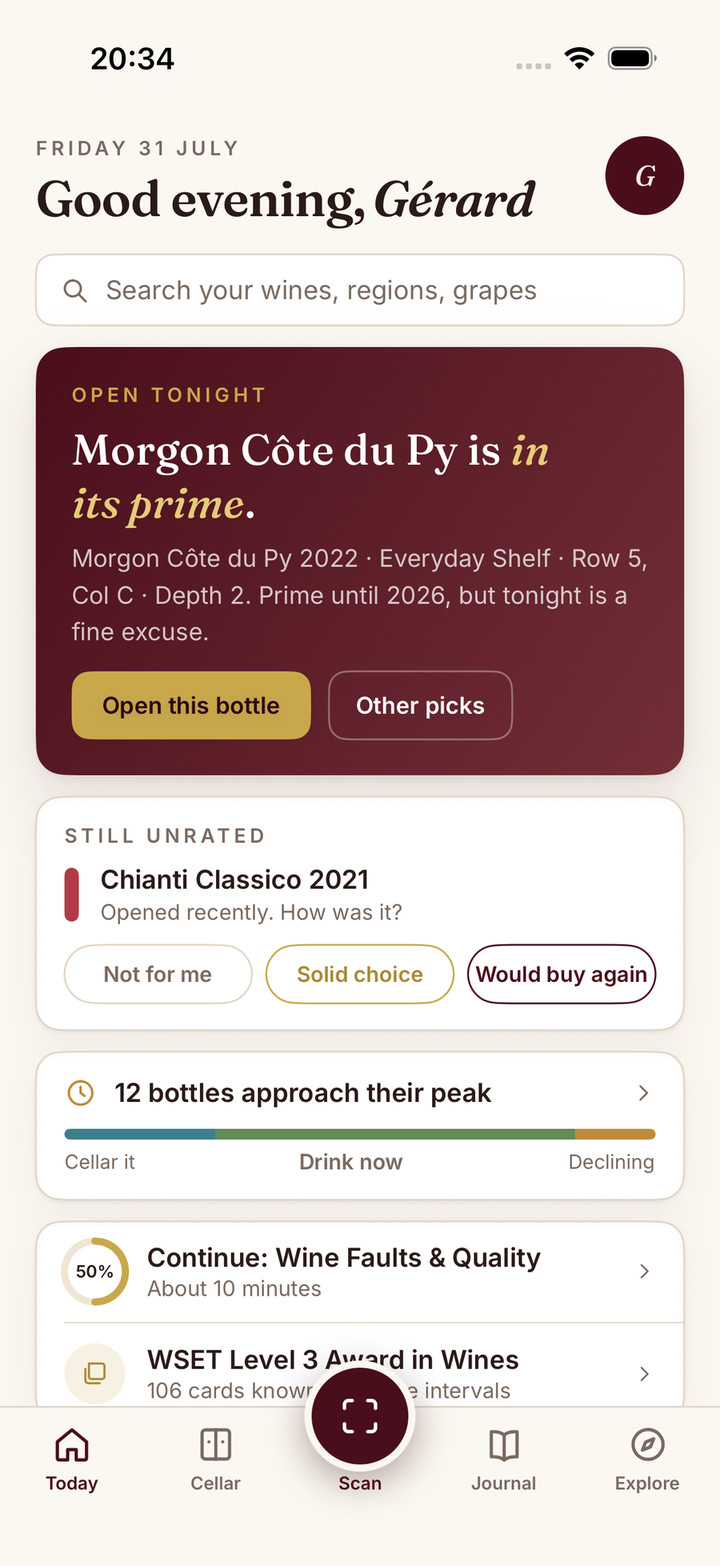
Sommo’s WSET prep is built around an SM-2 spaced repetition algorithm (the same algorithm that powers Anki) with a wine-specific flashcard library covering Level 1 through Level 4. Daily review takes ten to fifteen minutes. The algorithm tracks which facts you find easy, which you find hard, and adjusts intervals accordingly. After three months, students typically remember 85 percent of the material at a glance. Without spaced repetition, that number drops below 50 percent.
The detail behind this approach is in our spaced repetition study guide and how WSET adaptive study works on Under the Hood.
Adaptive Quizzing and AI-Graded Answers
The second major shift is in how practice tests are run.
A traditional WSET practice quiz is a fixed bank of multiple-choice questions. You answer them, you see the score, you move on. The bank does not know what you struggle with, and your study time is allocated uniformly across topics whether you need it or not.
An adaptive quiz changes this. The algorithm tracks your accuracy by topic in real time. If you get 90 percent of grape variety questions right but only 50 percent of region questions, the next quiz will weight regions more heavily. Over a month of practice, your weak areas get the bulk of the airtime, and your study efficiency rises dramatically.
The bigger change is in typed-answer grading. WSET Level 2 and Level 3 require written tasting notes and short essay responses on the exam. Until recently, the only way to practice this was to write notes and either send them to a tutor or guess at your own grade. Both approaches scaled badly.
Modern AI grading is now genuinely useful for these tasks. The system reads your tasting note, compares it against a model answer, scores it on the WSET criteria (correct identification of structural elements, appropriate descriptors, valid conclusions), and gives specific feedback on what was right and what was missing. The grading is not perfect. It is calibrated against thousands of human-marked papers and tends to be slightly more generous than a strict human marker, but the gap is small and shrinking.
For students who cannot afford a private tutor or who study outside formal classes, AI grading is a major democratisation. The cost difference between “review by an experienced WSET educator” and “AI-graded with structured feedback” is two orders of magnitude. For most students, the AI grading is good enough to identify gaps and prioritise revision. Sommo explains how typed grading works on Under the Hood.
Personalised Study Plans
A third shift is in study planning. Traditional WSET study plans are generic: “Spend two weeks on Old World whites, two weeks on Old World reds, one week on New World,” and so on. They do not know how much time you have, when your exam is, what you already know, or what you struggle with.
AI study plan generation produces a plan tailored to your specific situation. The system asks for your exam date, your current level, your weekly available study hours, and runs you through a baseline assessment. It then generates a daily schedule with specific topics, flashcard volumes, mock exam dates, and review intervals, and updates the plan in real time as your accuracy data comes in. The plan that worked for someone else does not become your plan. Your data shapes your own plan.
This is the part of AI wine education that feels least futuristic and matters most. Most students do not fail wine exams because the material is too hard. They fail because they ran out of time, studied the wrong things, or peaked too early. A good study plan solves this. AI makes good study plans available to everyone.
AI Tasting Feedback
The fourth and most controversial area is sensory training: helping students taste better.
Traditional tasting training requires a teacher. The teacher pours a wine, you smell and taste, you write a note, the teacher reads it and tells you what you got right and what you missed. This works, but it scales badly. A teacher can give five students proper attention. They cannot give 500.
AI cannot replace the calibrated palate of an experienced taster. But it can do something genuinely useful that scales: it can read your tasting note, compare your structural assessments (acidity, tannin, body) against the wine’s known profile, and tell you where you are calibrating well and where you are off. If you consistently rate Mosel Riesling as medium acidity when it is high, the system flags this and helps you recalibrate.
This is what Sommo’s Tasting Note Wizard does. You log a wine using the WSET SAT framework, the AI cross-references your descriptors against the wine’s official characteristics, and you get an alignment score with specific feedback. Over time, the alignment score climbs. Your taste perception calibrates against the wider consensus.
The system also handles a problem that classroom learning never solved: practising tasting on the wines you actually drink at home. The wines in a WSET class are chosen by the teacher and may not include the regions or grapes you most want to learn. Your home cellar is your home cellar. AI feedback lets you train on whatever you happen to be drinking, which is most students’ real learning opportunity. The free blind tasting trainer works the same muscle from the theory side, no bottle required.
Wine Character Analysis: The Personalised Map
A fifth and more recent development is the emergence of personal wine profiles.
After you have logged 20 or 30 wines, an AI system can analyse your tasting notes, ratings, and chosen wines to produce a personality profile that is meaningfully more useful than a generic preference test. The profile is not just “you like red wine more than white.” It is “you consistently rate cool-climate Pinot Noir higher than warm-climate Pinot, you prefer mineral whites over fruit-forward ones, you have a low tolerance for high alcohol, and you have been increasing your preference for natural-leaning wines over the last six months.”
This kind of profile is what unlocks better recommendations. The standard recommendation engine (“people who liked X also liked Y”) relies on cohort behaviour and tells you almost nothing about whether you specifically will enjoy a wine. A profile built from your own data, with reasoning you can read, is fundamentally more useful. For more on this, see our piece on what your wine preferences say about you.
The Implications for WSET and the Established Schools
The big question is what all of this means for WSET, the Court of Master Sommeliers, and the other established educational institutions. The honest answer is that AI is not replacing them. It is complementing them.
The credential itself still matters. A WSET Level 3 or a CMS Certified Sommelier pin is a signal that someone has been examined by qualified humans and met a standard. AI tools do not award credentials, and they will not for the foreseeable future. The institutions retain the credentialing power, which is where their economic moat sits.
What is changing is how students prepare for those exams. The traditional model (classroom course, textbook study, paper flashcards, practice tasting at home) is being augmented by AI tools that make the study time more efficient. Most serious WSET students in 2026 use a hybrid approach: enrol in the official course for the structured curriculum and the credential, but supplement with AI flashcards, AI grading, AI study plans, and AI tasting feedback to fill the gaps the classroom cannot cover.
The institutions are responding. WSET has been quietly experimenting with adaptive learning features in its online courses. CMS has acknowledged that digital tools are changing how candidates prepare, even if the exam itself remains analogue. The pace of institutional change is slower than the pace of tool development, which is normal in any educational field.
What This Means for Casual Wine Drinkers
The shifts above are most visible in formal wine education, but the casual wine drinker benefits as much or more.
A few years ago, learning wine outside a structured course was hard. You bought a textbook, you tried to make sense of it, you drank some wines, you forgot most of what you read. There was no feedback loop.
Today, a casual drinker can log every bottle they drink, get AI feedback on their tasting notes, see their preference profile evolve over months, and learn at the same pace as a paid student, for the cost of a few dollars a month. The democratisation here is significant. The wine knowledge that used to require expensive classes and access to a wide range of wines is now available, in a structured form, to anyone with a phone and curiosity.
The biggest beneficiaries are people who would never have signed up for a WSET course but who want to learn wine seriously over time. The tools meet them where they are.
What AI Cannot Do (Yet)
Three areas where AI wine education still falls short and probably will for some time.
Calibrating a palate without reference wines. You can read about Burgundy for ten years and still not know what good Burgundy tastes like until you have drunk it. AI helps you process and remember what you drink. It cannot pour the wine for you.
Reading the room in service. The interpersonal skills of a great sommelier (which we covered in our AI vs sommelier piece) are not what AI is built for. Formal training in those skills still happens face to face.
Producing the credential. AI does not award certifications. Until that changes (and there are no serious signs that it will soon), the institutional path remains the path for anyone wanting professional recognition.
The Future Direction
A few predictions worth making.
The line between studying and drinking will continue to blur. The future serious wine student does not separate “study mode” from “drink mode.” Every bottle is a logged data point. Every tasting is a calibration exercise. The learning happens continuously, in tiny daily increments, rather than in concentrated exam-prep sessions.
Personalisation will accelerate. The wine learning experience of 2030 will look different for each student, with AI generating custom curricula, flashcard sets, and tasting prompts based on each person’s history. Generic courses will continue to exist but will increasingly serve as the credentialing layer rather than the learning layer.
The cost of expertise will fall. Wine knowledge that used to require expensive courses and tutors is becoming accessible to anyone with a phone. The gap between the dedicated enthusiast and the professional will continue to narrow at the knowledge level, even if the professional craft (service, sensory verification, hospitality) remains a higher bar.
The role of the human teacher will shift. The best wine educators will move toward what AI cannot do: leading group tastings, telling stories from the field, drawing connections that require lived experience. The textbook-and-flashcard part of teaching will become AI’s job.
Explore with Sommo
Sommo is built around the principles in this article. WSET prep with adaptive spaced repetition for all four levels. AI-graded typed answers for WSET Level 2 and beyond. Personalised study plans that update with your data. Tasting Note Wizard with alignment scoring. Wine Character Analysis that builds a personal profile over time. Whether you are studying for a credential or simply trying to learn wine more seriously, the tools are designed to compound across months of use.
Download Sommo free and start a study habit that actually compounds.